
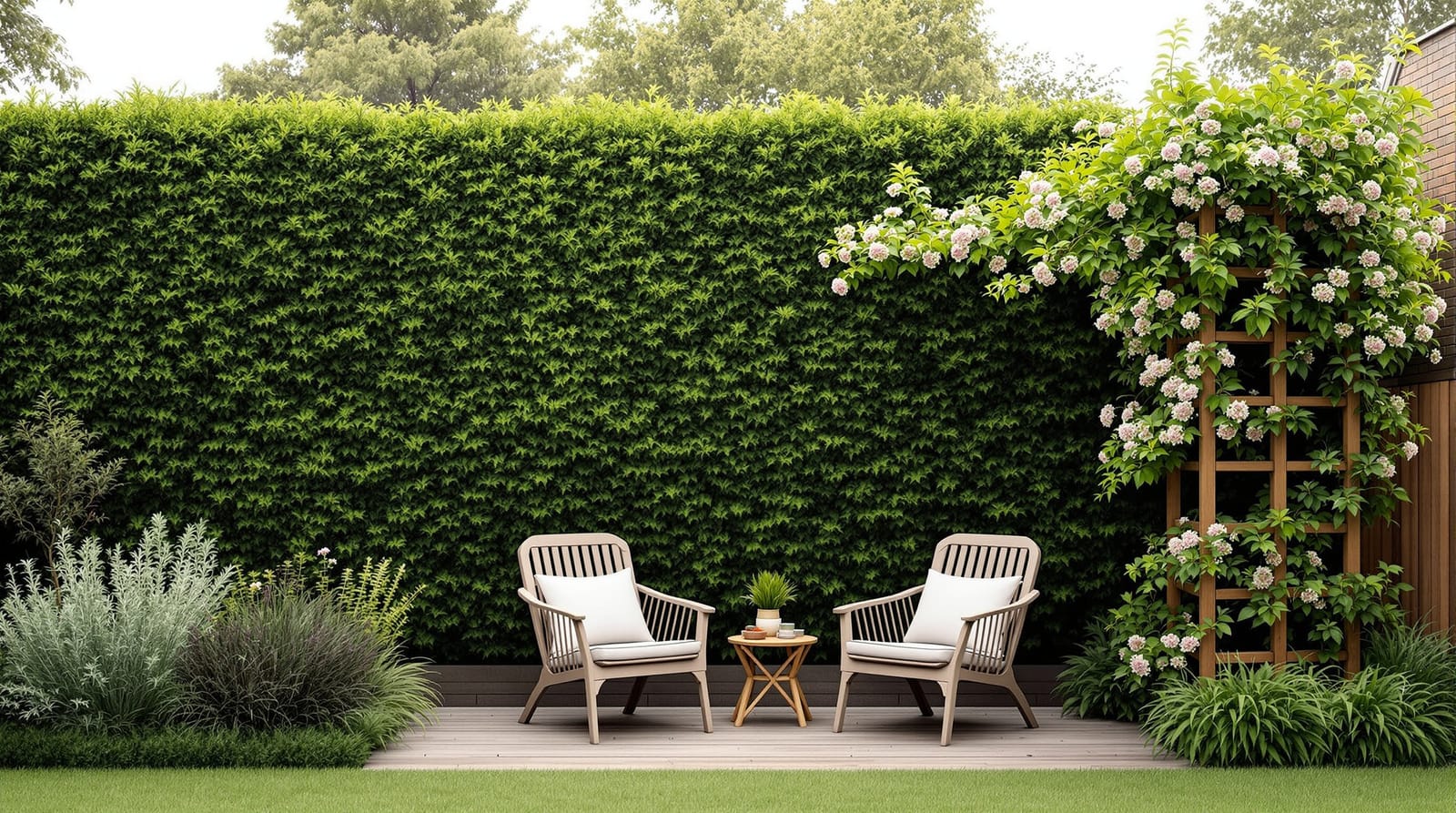
Landscape Privacy Design — Screening the Outdoor Room
Outdoor privacy as a design problem — sight-line analysis, layered green screens, living vs built screens, and privacy without darkness, including balconies
Outdoor privacy is a spatial design problem, not a boundary-wall problem — and in dense Indian plotting, the homes that feel truly private are the ones where someone analysed the sight-lines first and then placed greenery, level changes and screens to break them, rather than simply building the tallest wall the bye-laws allow.
In most Indian neighbourhoods, houses sit close. Setbacks are tight, plots are stacked, and your neighbour's first-floor bedroom window very often looks straight down into your back courtyard or onto your terrace garden. The instinct is to raise the compound wall and be done with it — but a tall blank wall blocks the breeze, traps summer heat, kills your evening light and announces to the street that you are hiding. Real outdoor privacy is gentler and smarter than that. It works by understanding exactly who can see what, from where, and then interrupting those specific lines of sight with the lightest possible touch.
This guide is strictly about your outdoor spaces — courtyards, sit-outs, terraces, balconies, the patch of garden where you actually relax — and the overlooked windows and balconies that compromise them. (If you are planning private interior rooms, that is a separate subject covered in our retreat-and-rest guides; here we stay outdoors.) It sits alongside our Landscape Zoning for Family Activities guide and complements Residential Site Planning.
Privacy is about sight-lines, not boundaries
A boundary marks where your land ends. A sight-line marks where someone's view enters your space — and the two are rarely the same. A neighbour standing at their upper window can see over a 6-foot wall and into your garden from 20 feet away. Conversely, a single well-placed shrub three feet from where you sit can block that same view completely, because it intercepts the line close to your eye.
This is the core insight: you do not need to screen the whole boundary. You need to screen the specific lines of sight that matter, at the specific points where they matter. Screening close to the viewer (or close to you) is far more efficient than screening at the property edge, because a small object near the eye blocks a wide cone of view.
A simple method: map your own sight-lines
Before you buy a single plant or quote a single louvre, do this survey. It takes twenty minutes and saves lakhs.
1. Sit where you will actually sit. Place a chair on the sit-out, the courtyard, the terrace corner — wherever the private zone will be. Sit at eye level, because that is the line that counts.
2. Look slowly all the way around. Note every window, balcony, terrace, staircase landing and stretch of street from which someone could see you. Pay special attention to upper-floor windows next door — these are the views people forget, and the ones that matter most in dense plotting.
3. Photograph each offending view from your seated position. The camera shows you the cone of exposure honestly.
4. Mark them on a quick plan of your plot — an arrow from each overlooking point to your seating spot.
5. Repeat in the evening, when interior lights are on. After dark, an unlit garden is invisible, but a lit sit-out is a stage; and after dark you can see into lit neighbouring rooms too.
Now you have a map of the handful of lines that actually compromise you — usually three or four, not a continuous ring. You screen those.
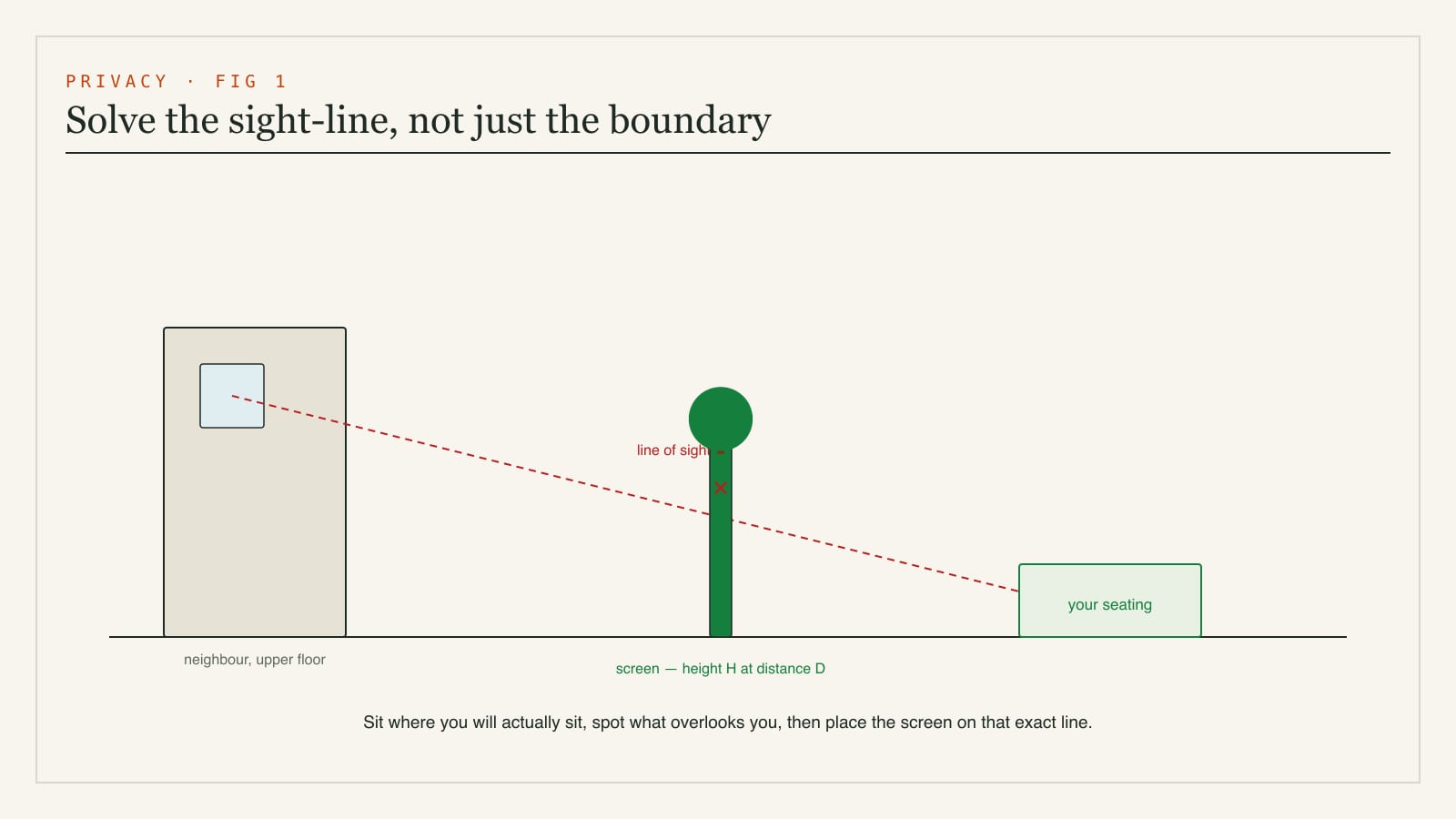
The section diagram above shows why upper windows are the hard case. A view that comes from above needs screening that is both tall and positioned correctly between the window and your chair. A 2-metre hedge at the boundary will not stop a downward view from a first-floor window 6 metres up — the line of sight passes clean over it. To block a downward line, you either raise the screen height where it can be raised, push the screen closer to your seating (so a modest height covers the angle), or use an overhead element — a pergola, a tree canopy, a trellis roof — to cap the view from above.
The layered green screen
The most natural, breathable and beautiful screen is not one thing — it is several heights of planting working together. A single row of one species reads as a green wall and behaves like one too: dense, flat, and prone to dying in patches that you can never fill. Layering is both prettier and more forgiving.
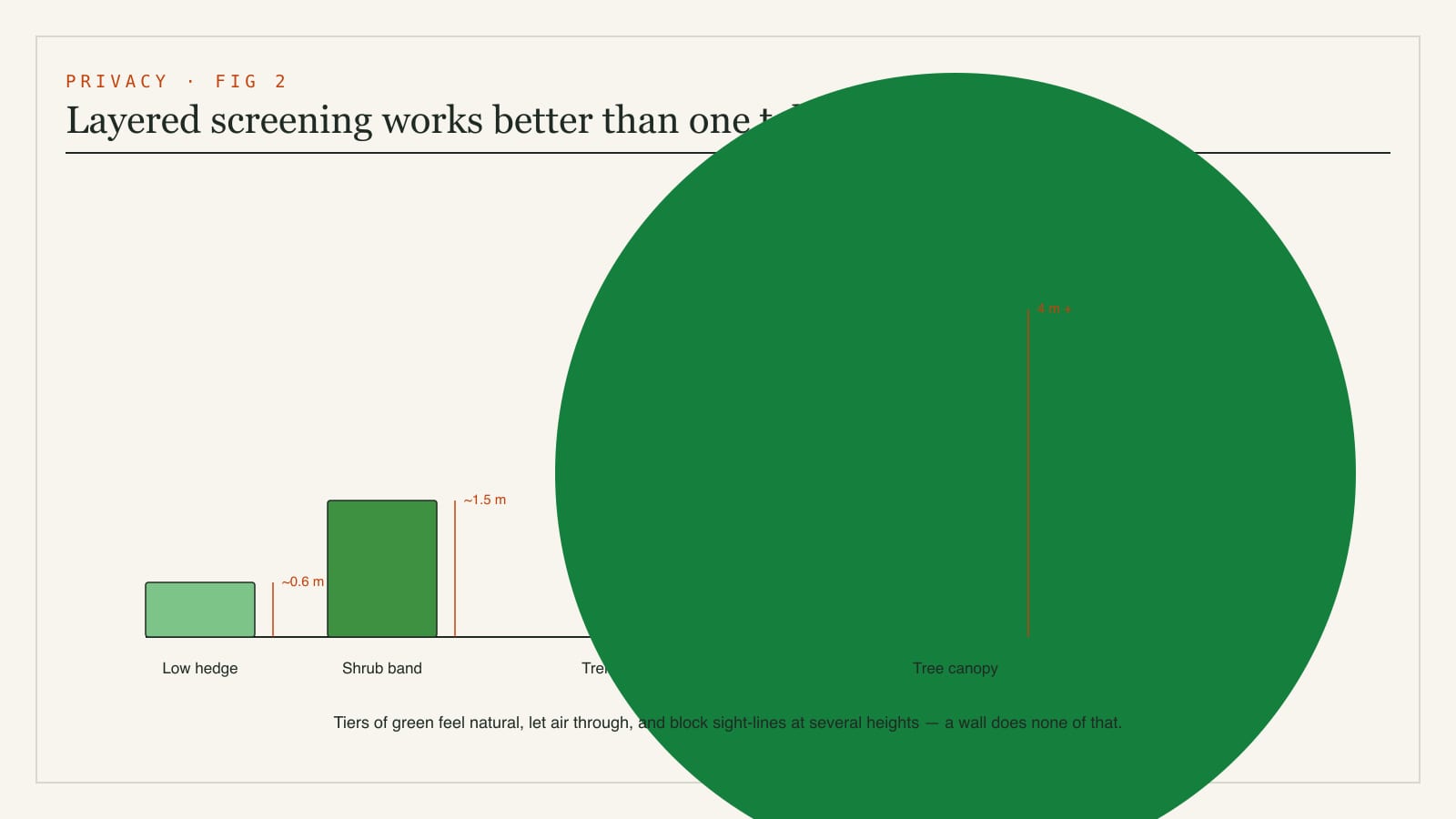
Think in four tiers, front to back:
- Low edge / hedge (knee to chest, 0.5–1.2 m): Defines the line and stops ground-level views and small children straying. Duranta (golden dewdrop), Murraya (kamini / orange jasmine, also fragrant), Clerodendrum or a clipped Ixora.
- Mid shrub band (1.5–2.5 m): The workhorse layer that blocks standing eye-level views. Tabernaemontana (chandni / crepe jasmine), bamboo clumps, Thuja, tall Murraya, or Nerium (kaner) for hot dry sites.
- Tall canopy / tree (4 m and up): Blocks upper-window views and provides shade and the breeze-cooling that a wall destroys. Choose by space — for tight plots use slim, well-behaved species (see Best Trees for Indian Homes). A high canopy with a clear trunk lets air move beneath while the leaves cap the downward view.
- Vertical / overhead (trellis, pergola, creeper): Fills the awkward angles and caps views from directly above. A timber or MS trellis with Bougainvillea, Thunbergia, jasmine or Passiflora gives quick height in a narrow footprint.
The point of layering is that the tiers cover each other's gaps. The tree blocks the high view but is bare at the trunk; the shrub band fills the middle; the hedge closes the bottom. Together they read as a deep, living edge — and depth is what makes a screen feel like a garden rather than a fence.
Living screens vs built screens
Green screens breathe, cool and soften, but they take time and need water and care. Built screens — louvred walls, bamboo screens, planters with integral trellis — are instant and certain but can feel hard and can block air if solid. The right answer is almost always a combination: a built element for the line you must block now and certainly, softened and supplemented by planting that matures around it.
The table below compares the common options for an Indian home.
| Screen type | Speed to effective | Mature height | Indicative cost | Light / air impact | Best for |
|---|---|---|---|---|---|
| Clipped hedge (Duranta, Murraya) | 1.5–3 years | 1–2.5 m | ₹150–400 per running ft to establish | Filters light, lets breeze through | Defining edges, mid screening |
| Shrub band (Tabernaemontana, Nerium) | 1–2 years | 1.5–3 m | ₹200–500 per running ft | Filters light, breathable | Eye-level screening, soft mass |
| Screening tree (slim canopy) | 4–8 years | 4–10 m+ | ₹500–3,000 per tree | Shade below, breeze beneath, caps high views | Blocking upper windows, cooling |
| Trellis + creeper (Bougainvillea, jasmine) | 1–2 seasons | 2–4 m | ₹400–1,200 per running ft incl. frame | Semi-open, good airflow | Quick height in narrow space, overhead angles |
| Bamboo (clumping, e.g. Bambusa) | 1–2 years | 3–6 m | ₹300–800 per running ft | Light, airy, rustling, breathable | Tall fast screen, contemporary look |
| Built louvre wall (timber/MS/concrete) | Instant | As built | ₹800–2,500 per sq ft | Angled louvres pass air and filtered light | Certain, immediate screening of a fixed line |
| Solid masonry wall | Instant | As built | ₹250–600 per sq ft | Blocks light and breeze; traps heat | Last resort; security boundary only |
Costs are broad indicative ranges for guidance — they vary widely by city, species size at planting, and finish. Treat them as planning figures, not quotes.
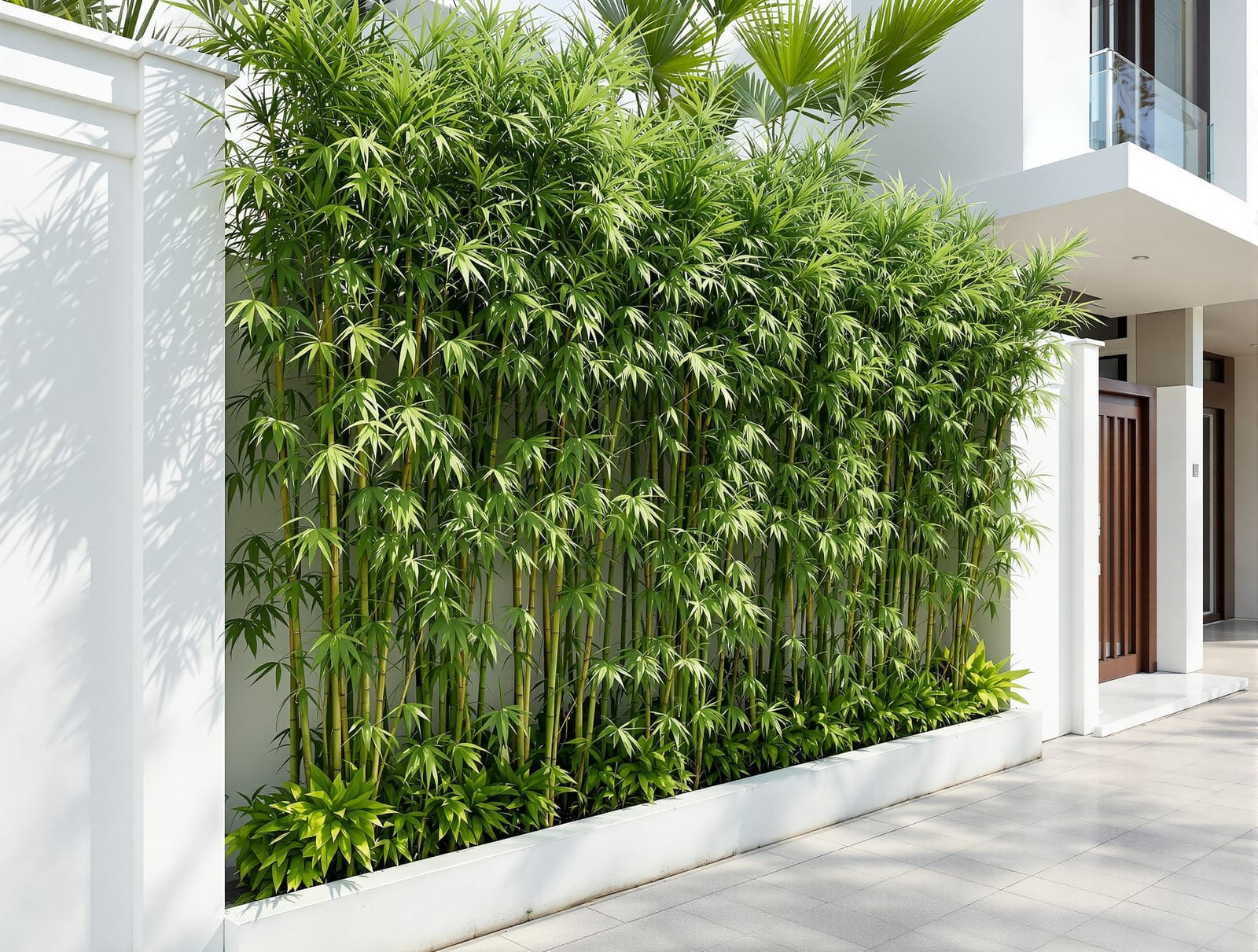
A note on fast vs slow screening, conceptually. Fast screeners (bamboo, creepers on a trellis, large shrubs) give you cover within a season or two but can be greedy — bamboo runs if you choose the wrong type (always pick clumping species, never running), and vigorous creepers need regular cutting back. Slow screeners (trees, dense hedges) take years but become the permanent, low-fuss backbone. The intelligent approach is to plant the slow backbone and the fast filler together: the trellis or bamboo gives you privacy this year while the tree and hedge mature behind it, and in five years the slow layer carries the screen while you remove or relax the fast one.
Screening overlooked windows and balconies
Some of your own windows and balconies are themselves the problem — overlooked by a neighbour, or opening onto an unattractive gap between buildings. You cannot move the window, so you screen the view through it without losing its light and air.
- Tree placed for the window, not the wall. A single tree with its canopy at the height of the overlooking window — positioned on the line between the two windows — breaks the view while leaving your room bright. This is far better than frosting the glass and losing the outlook entirely.
- Window-box trellis or jaali screen. A light MS or timber jaali set a foot outside the window, with a slim creeper, gives a filtered, dappled view out while denying a clear view in. Traditional jaali (perforated screen) is the original Indian privacy device — it passes air and soft light while breaking sight-lines, and it suits the climate far better than glass.
- Stagger, don't block. If a balcony is overlooked from the side, a single well-placed tall planter or a partial fin screen at the overlooked end works better than enclosing the whole balcony, which would make it a box.
The discipline here is the same as the whole guide: screen the line, at the point where it does most work, not the whole opening.
Privacy without a dark fortress
The commonest mistake is over-screening. Block everything and you get a damp, dim, airless courtyard that no one wants to sit in — exactly the opposite of the relaxed outdoor room you were after. In the Indian climate this matters doubly: you need the breeze for comfort through long hot months, and you need light so the space stays dry and healthy through the monsoon.
Keep these balances in mind:
- Screen at eye level, stay open above and below. A canopy tree with a clear trunk, or a hedge with a gap to a high planter, screens the view while air still moves through. Solid floor-to-sky barriers are what create the fortress.
- Favour louvres and jaali over solid panels wherever you need a built screen. Angled louvres can block the specific downward or sideways line while still passing air and filtered light.
- Protect the breeze path. Note your prevailing wind (in much of India the cooling breeze comes off a particular direction in the evening) and keep that line as open as your privacy allows — screen the other directions harder. Our Climate-Responsive Landscape Design guide goes deeper on working with, not against, the climate.
- Use the western edge to fight the sun, not just the view. A tall green screen on the west does double duty: privacy and a buffer against the brutal afternoon sun that overheats west-facing sit-outs.
Privacy and openness are not opposites here — a layered green edge gives you both, where a wall gives you neither comfort nor delight.
Privacy for apartment balconies
Apartment dwellers face the same sight-line problem in miniature, plus a rulebook. Balconies are typically overlooked from the flat above, the flat beside, and the building opposite — three different lines, each needing a different move.
- Side overlooking (next balcony): A run of tall, narrow planters with bamboo, Areca palm or a trellis screen along the shared edge. A 1.5–1.8 m planted screen at the divider blocks the casual sideways glance.
- From above: Hardest in a flat, because you cannot easily cap the view. A pergola or stretched shade-cloth / bamboo chic (roll-up blind) over the seating corner does it, and also tames the sun.
- From opposite (building across): Distance is your friend — usually you only need to screen the near edge of the balcony where you sit. A planter-and-trellis combination at the railing, plus a parasol or canopy over the seat, is enough.
Two practical constraints for apartments: weight and water. Use lightweight containers and a soil-less or coco-peat mix, and never block the balcony drain — RWAs are strict about leakage onto the flat below, and rightly so. And before you fix anything to the structure, check your society / RWA rules — many prohibit external grilles, fixed screens or anything that alters the building's elevation. A free-standing planted screen almost always passes; a bolted-on wall may not.
Boundaries, neighbours and Vastu
Outdoor privacy is partly a legal and social matter, so settle these before you build.
- Setbacks and wall height. Municipal bye-laws cap compound-wall height (commonly around 1.5–1.8 m on the front, sometimes more at the rear — it varies by city and zone). Planting is usually unrestricted in height, which is another reason a green screen often beats a wall: you can go taller, legally, with leaves.
- Plant on your own side of the line. Roots and overhanging branches that cross the boundary are a classic neighbour dispute. Set hedges and trees far enough inside your line that their mature spread stays on your land, and choose species whose roots will not lift a neighbour's paving or undermine a shared wall.
- Talk to the neighbour first. A privacy screen affects two gardens. A quick conversation — "we're planting a hedge along here" — prevents the resentment (and the retaliatory wall) that a surprise barrier provokes. Often a shared screen on the line, jointly paid, serves both homes better than two competing ones.
- Vastu notes, where you find them relevant. Vastu generally favours keeping the north and east lighter and more open (for morning light and air) and placing heavier mass — taller trees, denser screens — to the south and west. This dovetails neatly with sound climate sense, since the west is also where you most want a sun-and-view buffer. Heavy planting or a tall wall directly on the north-east is the combination Vastu most often cautions against; if you follow the tradition, screen those quarters with lighter, lower greenery and put your tall screens south and west.
For a fuller treatment of laying out the whole plot — zones, circulation and where the private garden belongs in the first place — see our Villa Landscape Design guide.
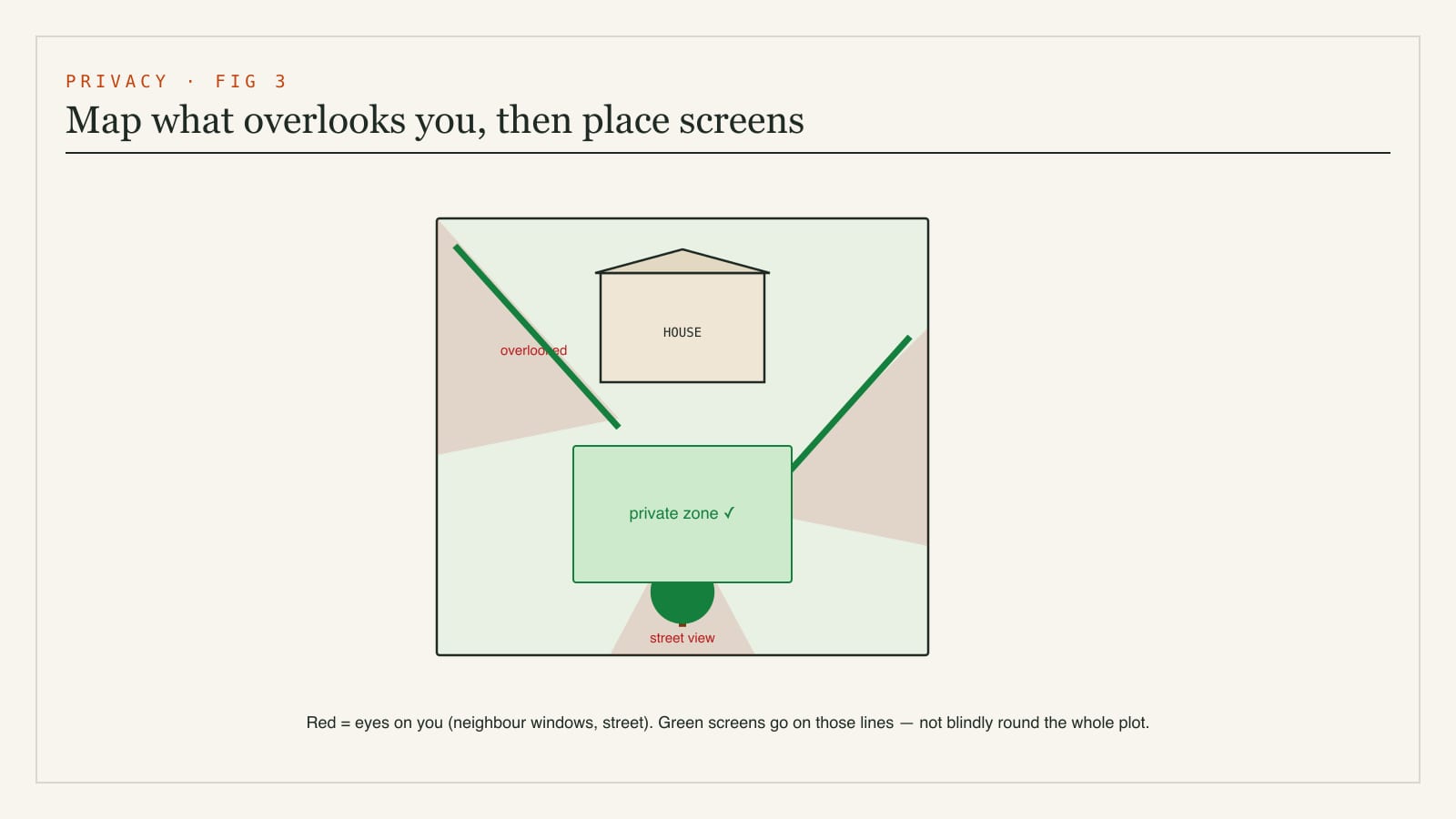
The plan above shows the principle in one picture: the overlooked lines are identified, and screens, hedges and a single well-placed tree are positioned on those lines — not wrapped uniformly around the boundary. The result is a plot with genuinely private outdoor rooms and plenty of light and air everywhere else.
Maintenance — keeping a living screen working
A green screen is a living thing, and an unkept one fails as privacy: hedges go leggy and see-through at the base, creepers smother and then die back in patches, bamboo invades.
- Hedges: Trim two to three times a year, and clip slightly wider at the base than the top so light reaches the bottom and it stays dense to the ground. A bare-bottomed hedge is a failed screen.
- Creepers and trellis: Cut back hard at least annually so the frame is not overloaded and the growth stays leafy rather than woody and gappy. Check the frame for rust or rot.
- Bamboo: Choose clumping species; thin old culms yearly and root-prune or contain if it spreads. Never plant running bamboo near a boundary.
- Trees: Water well for the first two to three years to establish; thereafter most well-chosen Indian species need little. Prune to keep the canopy at the screening height and clear of neighbours' airspace.
- Watch for gaps. Inspect your screen from the seated position once a season — the same survey you started with — and fill any new lines of sight before they become a habit of being watched.
A screen that is checked from the chair and clipped on schedule will, within a few years, do its work so quietly that you stop thinking about the neighbours at all — which is the whole point.
References & further reading
- Indian Society of Landscape Architects (ISOLA) — professional resources and member work on residential and screening planting in Indian conditions.
- ICAR – Indian Institute of Horticultural Research (IIHR), Bengaluru — guidance on ornamental shrubs, hedges and suitable species for Indian gardens.
- Royal Horticultural Society (RHS) — "Hedges: selection, planting and maintenance" and "Screening and boundaries" advisory articles.
- Ian H. Thompson, Landscape Architecture: A Very Short Introduction (Oxford University Press) — on landscape as the shaping of space and view.
- John Brookes, The Book of Garden Design — practical principles of enclosure, screening and the layered planted edge.
- Your local municipal building bye-laws — for compound-wall height limits and setback rules specific to your city and plot zone.
Export this guide
Related Guides — Deep-dive reading
Designing for Views and Privacy
The site-level craft of capturing the good view while screening the neighbour's window three metres away — tuned for dense Indian plots.
Site PlanningOrientation, Light & Views: Designing With Your Space, Not Against It
How reading your plot's sun, breeze and views — and placing each room on the right face — gives an Indian home that is cooler, brighter and quietly right, instead of one that fights its site forever.
Design PrinciplesThe Best Trees for Indian Homes
A research-grade guide to choosing and placing trees around an Indian home — the real cooling and clean-air numbers, the right species for shade, flowers, fragrance and fruit, and the placement science that keeps roots out of your walls and drains.
LandscapeRelated Tools — Try Free
Cross-Ventilation Analyzer
Estimate airflow and air changes per hour (ACH) from room size, window areas, layout, and local wind — with NBC 2016 Part 8 compliance check.
Ventilation CalculatorMonsoon-Readiness Checklist
Pre-rain home audit across 9 categories — terrace, drains, waterproofing, electrical, HVAC, pest, vehicles, documents.
Seasonal AuditWindow Grill Design Selector
Pick a window grille style and material by priority — security, looks, budget, view — and estimate cost.
Window Tool