

Environmental Clearance for STPs & Projects: When Your Build Needs EC (and How the STP Fits In)
When a building or township project must obtain prior Environmental Clearance under India's EIA Notification 2006, how it differs from SPCB consent, and why the sewage treatment plant is written into the clearance as a binding condition — explained honestly, with the contested discharge standards laid out.
Most developers meet the term "Environmental Clearance" late — usually when a lender, a buyer's due-diligence team, or a notice from the pollution board asks for the EC letter and it does not exist. By then the building may already be rising. Environmental Clearance, or EC, is a prior permission: for projects above a certain size it must be obtained before the first spade goes into the ground, and the sewage treatment plant your project will run for the next thirty years is written into that clearance as a legally binding condition.
This guide explains when a building or township triggers the EC requirement under India's EIA Notification, 2006, how EC is different from the SPCB consents everyone confuses it with, and exactly how the STP shows up as a condition inside the clearance. Regulation in this area has shifted repeatedly — through 2016, 2017 and again in 2025 court rulings — so treat the specifics below as a map, not a substitute for confirming the current position with your SEIAA and State Pollution Control Board.
Environmental Clearance is the project-level permission that says a development may exist on that land at all. The STP is one of the promises you make to get it — and one the authority can revoke your clearance for breaking.
EC, CTE and CTO are three different permissions
The single most expensive misunderstanding in this space is treating "green clearance" as one document. It is not. A large project in India typically needs three separate approvals, from two different laws:
- Environmental Clearance (EC) — granted under the EIA Notification, 2006, which draws its authority from the Environment (Protection) Act, 1986. It is a project-level sign-off from the State Environment Impact Assessment Authority (SEIAA) or, for the largest projects, the Ministry of Environment, Forest and Climate Change (MoEFCC).
- Consent to Establish (CTE) — the "NOC to build," granted by your State Pollution Control Board under the Water Act, 1974 and Air Act, 1981. Covered in the Consent to Establish guide.
- Consent to Operate (CTO) — the permission to actually switch the building (and its STP) on, renewed periodically, covered in the Consent to Operate guide.
EC comes first and sits above the consents. The STP appears in all three — but it is the EC that fixes the obligation to build one of adequate capacity, and the CTO that later polices the quality of what it discharges. For the wider framework, see STP regulations in India and MoEF rules for STPs.
When does a project need Environmental Clearance?

The EIA Notification, 2006 lists the activities that require prior EC in its Schedule. For our purposes two entries matter, and — importantly — both are Category B, meaning they are appraised by the state SEIAA, not the central Ministry (EIA Notification, 2006, MoEFCC).
| Schedule item | Project type | Threshold that triggers EC | Appraised by |
|---|---|---|---|
| 8(a) | Building & construction projects | Built-up area ≥ 20,000 m² and < 150,000 m² | SEIAA (State) |
| 8(b) | Townships & area-development projects | Built-up area ≥ 150,000 m², or total plot area ≥ 50 hectares | SEIAA (State) |
A few practical reads on that table:
- "Built-up area" is defined broadly in the notification — it generally means the covered/constructed area including basements and services, not just the FSI-counted area. Confirm how your SEIAA computes it, because it decides whether you clear the 20,000 m² line.
- Below 20,000 m² built-up area, a standalone building generally does not need EC — but it still needs SPCB consents and must still meet building bye-law STP requirements and local water/sewage norms.
- Larger sectoral projects (industrial estates, certain infrastructure) fall under other Schedule items and can be Category A, cleared centrally by MoEFCC. Building/township work is the state's remit.
A regulatory history you must not skip
The thresholds above look settled; the rules around them have not been. A 2016 amendment tried to fold EC for 20,000–150,000 m² buildings into the local building-permission process (a self-certification route) — the National Green Tribunal set that amendment aside in 2017. More recently, a January 2025 amendment exempted schools, colleges, hostels and industrial sheds up to 150,000 m² from EC; in Vanashakti v. Union of India (2025) the Supreme Court struck that exemption down and reaffirmed that projects over 20,000 m² require prior clearance (Supreme Court Observer). The same line of rulings has closed the door on post-facto (retrospective) EC — you cannot regularise a project that started construction without clearance by applying afterwards. The message for developers is blunt: get the EC before you build, and do not rely on a recent exemption without checking it survived the courts.
The STP as a condition inside your EC
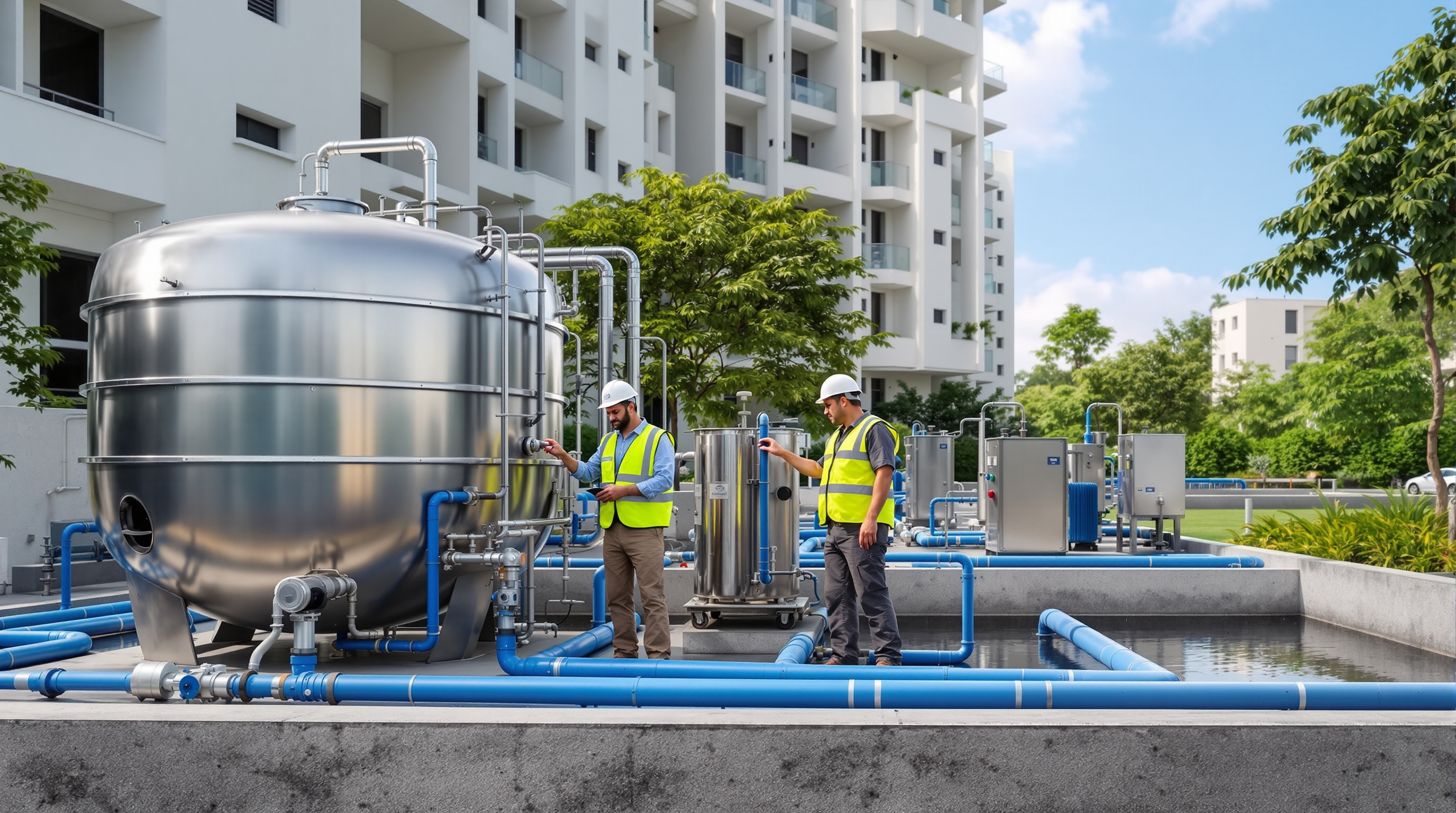
Here is the editorial heart of it. Building and construction projects (item 8) are usually appraised as Category B2 — meaning the SEIAA typically waives a full EIA study and public hearing and instead grants the clearance against Form 1 / Form 1A and a standard set of environmental conditions. The sewage treatment plant is one of the most consistent of those conditions.
A typical building EC letter will require, in substance:
- An STP of adequate capacity sized to the projected sewage load, provided within the project — decentralised, on your own land.
- Tertiary treatment so the effluent is fit for reuse (often specified as sand + activated-carbon filtration plus disinfection, sometimes ultrafiltration to meet the standard the order names).
- Maximised on-site reuse of treated water — flushing, landscaping, cooling, toilet flushing via a dual line — moving toward zero liquid discharge where feasible (see ZLD).
- Third-party certification that the STP is installed and functioning before the project is commissioned/occupied.
- Rainwater harvesting, waste segregation, solar provision and pervious open space as companion conditions.
Break any of these and you are not merely out of consent — you are in breach of the EC itself, which the authority can revoke, and which the NGT can act on with compensation orders against the developer or the RWA that inherited the plant. This is why the STP compliance checklist matters from day one, and why capacity must be right at design stage — start with the STP capacity calculator and the how-to-size-an-STP guide.
What standard must the STP meet? (an honest answer)
This is where India's rulebook is genuinely unsettled, and you should be wary of any source that hands you one tidy number. The discharge/reuse standard your STP is held to has been fought over for a decade:
- 2015 — CPCB draft norms: stringent values (BOD around 10 mg/L, tight TSS and nutrient limits).
- 2017 — MoEFCC notification: diluted the draft, and introduced a two-tier structure (a stricter band for metro cities and state capitals, a looser one elsewhere).
- 2019 — NGT order (30 April 2019): on an expert committee's advice (IIT Kanpur, IIT Roorkee, NEERI, CPCB), the Tribunal scrapped the 2017 note and restored the stringent 2015-style norms, applicable to all STPs — new and existing — nationwide (Down To Earth).
The values below are the commonly cited reference points. Do not treat them as absolute: exact enforceable limits come from the conditions written into your SPCB's Consent to Operate and your EC letter, and states differ in which regime they apply.
| Parameter | 2017 notification (as diluted) | 2019 NGT / 2015-style (stringent) |
|---|---|---|
| pH | 6.5 – 9.0 | 6.5 – 9.0 |
| BOD (mg/L) | 20 (metro/capitals) · 30 (elsewhere) | 10 |
| COD (mg/L) | not separately fixed | 50 |
| TSS (mg/L) | ~50 – 100 | < 20 |
| Ammonical-N (mg/L) | not fixed | 5 |
| Total-N (mg/L) | not fixed | 10 |
| Faecal coliform (MPN/100 mL) | not fixed | < 100 (desirable) / < 1000 |
Reporting indicates the Supreme Court upheld the NGT's stricter position in 2021, but on-ground enforcement remains uneven, and some SPCBs still frame consent conditions on the older two-tier values. The safe engineering conclusion most consultants now reach: design the STP to the stringent target (BOD ≤ 10, tertiary treatment, near-total reuse) so it satisfies whichever regime your state currently enforces. For the full breakdown see treated-water quality standards and treated-water reuse standards, and confirm the current enforceable figures with CPCB (CPCB general standards) and your SPCB — norms change, and this is exactly the kind of figure that changes.
The EC process, step by step
For a Category B building/township project the sequence runs roughly as follows. Timelines and fees vary by state — confirm the current ones on your SEIAA portal rather than budgeting from any figure quoted online.
| Step | What happens | Who |
|---|---|---|
| 1. Screening | Project classified B1 (needs EIA study) or B2 (study/hearing waived) | SEAC / SEIAA |
| 2. Application | Submit Form 1 + Form 1A with a conceptual plan, water balance and STP details on the PARIVESH portal | Proponent |
| 3. Scoping (if B1) | Terms of Reference issued for the EIA study | SEAC |
| 4. Public consultation (if applicable) | Public hearing — commonly waived for standalone building projects, required for larger developments | SPCB / SEIAA |
| 5. Appraisal | Expert committee reviews the application and environmental-management commitments | SEAC → SEIAA |
| 6. Grant of EC | Clearance issued with conditions — the STP, reuse, RWH, monitoring | SEIAA |
| 7. Compliance & monitoring | Six-monthly compliance reports; STP performance and reuse tracked for the life of the project | Proponent |
The clearance does not end at grant — condition 7 runs forever. That is why STP environmental monitoring, performance testing and periodic STP audits are not optional extras but the evidence that keeps your EC and CTO alive. For an RWA that has taken handover from a builder, this is the machinery of ongoing apartment-association STP compliance.
The bottom line
If your building's built-up area crosses 20,000 m², assume you need prior Environmental Clearance from the SEIAA — obtained before construction, on top of (not instead of) your SPCB Consent to Establish and Consent to Operate. Inside that clearance, the STP is a binding condition: adequate capacity, tertiary treatment, maximised reuse, third-party certification and lifelong monitoring. The discharge standard it must meet has a contested history — the honest planning answer is to build to the stringent 2019/NGT target and confirm the enforceable numbers with your CPCB/SPCB, because this is a rulebook that keeps moving.
From here: understand the plant itself in What is a Sewage Treatment Plant, work through the wider STP regulations in India, or browse the full Sewage Treatment Plants guide library. And before you commit any of it to a drawing, size the plant honestly with the STP capacity calculator — the litres-per-day figure is the number your EC condition, and everything downstream of it, is built on.
Export this guide
Related Guides — Deep-dive reading
CPCB Guidelines for STPs Explained: Discharge Standards & the 2017/2019 History
What the Central Pollution Control Board actually prescribes for sewage treatment plants — the effluent parameters, the contested 2015–2017–2019 notification history, the NGT interventions, and which numbers your plant is really held to today.
Sewage Treatment PlantsMoEFCC Rules Affecting STPs: How the EIA Notification 2006 Brings Sewage Treatment Into the Approval Net
The Ministry of Environment's EIA Notification 2006 is the law that decides whether your building needs environmental clearance at all — and it makes a working STP a condition of getting it. Here is how the thresholds, the clearance process and the contested discharge standards actually fit together.
Sewage Treatment PlantsSPCB Approvals for STPs: The State Pollution Control Board Consent Regime Explained
How State Pollution Control Boards actually administer STP approvals in India — their role versus the CPCB, the Consent to Establish and Consent to Operate regime, inspections and monitoring, and why the rules differ from one state to the next.
Sewage Treatment PlantsRelated Tools — Try Free
Rainwater Tank Sizer
How big should your rainwater tank be? Computes annual harvest, recommended tank capacity in litres, water-bill savings, and payback — for 10 Indian cities.
RWH CalculatorSTP Compliance Checklist Tool
Interactive self-audit that ticks off STP consents, discharge norms, reuse metering, online monitoring and O&M records to give a live compliance readiness score.
ChecklistCPCB Compliance Checklist for STPs
Tick off CPCB/SPCB outlet standards, monitoring duties and record-keeping to score your sewage treatment plant's compliance readiness.
Checklist