
Energy Efficient Windows Explained: The Whole-System Guide for Indian Homes
Treat the window as an energy device — frame, glass, seals, shading, install and rating — and learn why low SHGC and shading beat chasing a cold-climate U-value in hot India.
A window is the weakest link in your home's thermal envelope. A wall might resist heat ten times better than the glass beside it, so the few square metres of glazing in a room often decide whether your air conditioner runs for four hours or eight. Yet most Indian homes still treat the window as a hole to be filled with the cheapest aluminium frame and a single sheet of clear glass — the worst possible energy choice in a country where the problem is keeping heat OUT.
This pillar is the system-level view. It treats a window not as glass, but as an energy device built from six parts: frame + glass + seals + shading + install + rating. Get the system right and a modest home stays cooler and quieter on a smaller electricity bill. This guide pulls the whole picture together and points you to the deep-dive spokes for each piece.
A window is not a pane of glass. It is an assembly, and it performs at the level of its weakest part — usually the seals or the bare aluminium frame, not the glass everyone argues about.
The three numbers that matter
Every energy claim about a window reduces to three measured coefficients. Learn these and you can read any spec sheet.
| Metric | What it measures | Direction in hot India | Typical range |
|---|---|---|---|
| U-value (W/m2K) | Non-solar heat CONDUCTED through the whole window (glass plus frame plus spacer) | Lower is better insulation | Single ~5.0 to 5.8; DGU ~2.7; Low-E plus argon ~1.6 |
| SHGC (0 to 1) | Fraction of SOLAR heat let through | Lower is better — this is the one that matters most here | Clear ~0.82; clear DGU ~0.70; solar-control ~0.25 |
| VLT (0 to 1) | Visible DAYLIGHT let through | Higher is better (you want light without heat) | Clear ~0.80; tinted ~0.40; good Low-E ~0.60 to 0.70 |
A fourth derived number ties two of them together: LSG (Light-to-Solar-Gain) = VLT divided by SHGC. A high LSG means the glass lets daylight in while blocking heat — the spectrally-selective ideal. A good Low-E unit hits LSG greater than or equal to 1.25. Two more NFRC numbers appear on imported labels: Air Leakage (AL) — lower is tighter — and Condensation Resistance (CR) — higher is better.
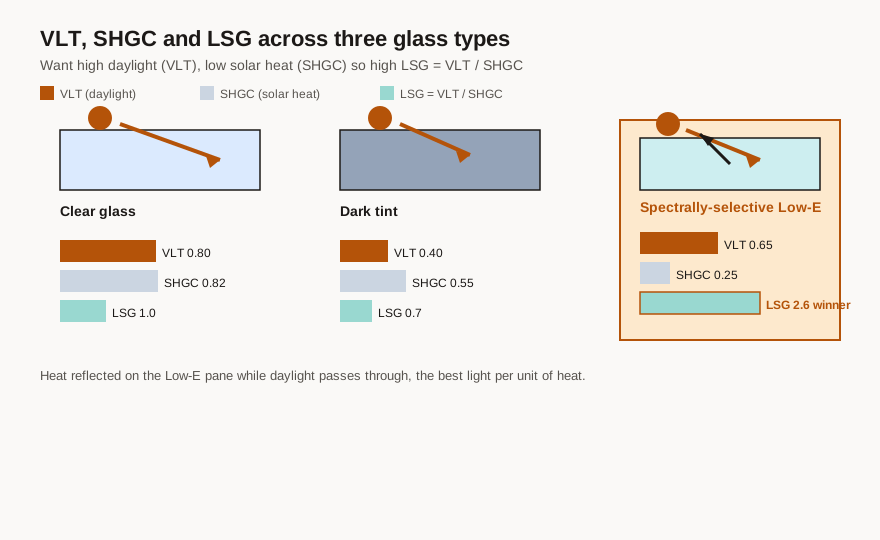
The ladder above is the whole trick of modern glazing. Plain clear glass lets in lots of daylight (high VLT) but also lots of heat (high SHGC), so its LSG sits near one — light and heat come in together. A dark tint cuts the heat but kills the daylight too, dropping VLT, so its LSG barely improves and rooms go gloomy. Spectrally-selective Low-E is the breakthrough: a microscopically thin metal-oxide coating that passes visible light but reflects near-infrared heat, so VLT stays high (0.60 to 0.70) while SHGC collapses to 0.25 or lower — pushing LSG past 1.25. That high LSG is exactly what a hot, sunlit Indian room wants: bright without the burn.
The full metrics deep-dive (LSG, thermal bridging, how the spec sheet is built) lives in the spoke on thermal performance of windows. For the certification side — who tests these numbers and how to read the label — see window energy ratings explained.
The honest hot-India reframe
Cold-climate advice obsesses over U-value, because in Delhi's January or in Europe heat ESCAPES by conduction. Most of India has the opposite problem: heat POURS IN as sunlight. The dominant flow is solar radiation, governed by SHGC and by what shades the glass — not conduction through the pane.
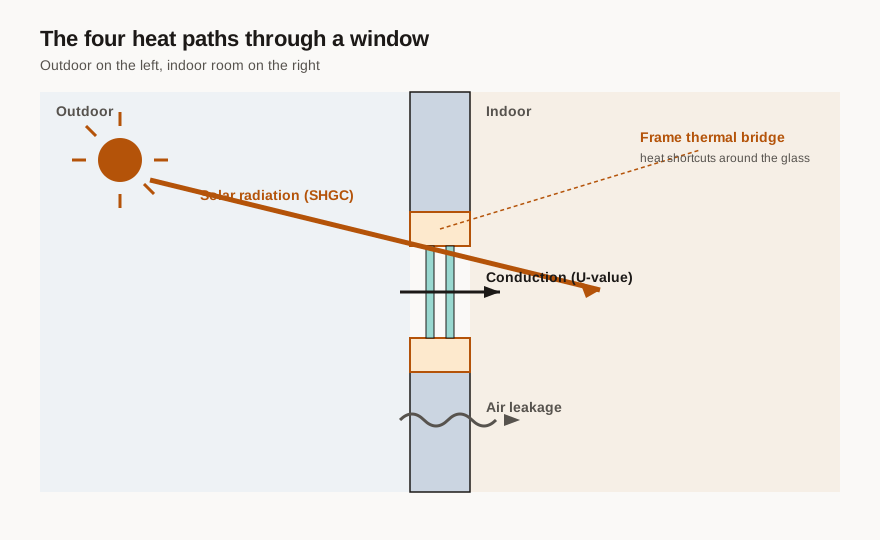
Heat crosses a window four ways: conduction through glass and frame (U-value), solar radiation straight through the glass (SHGC), air leakage through bad seals (convection), and the frame acting as a thermal bridge — a bare aluminium frame is a metal highway dumping outdoor heat into your room. In a sunlit Chennai or Ahmedabad window, the solar component usually dwarfs the rest.
In hot India, chasing a passive-house sub-1.0 U-value is the wrong fight. The wins are low SHGC, external shading, and airtightness — in that order. Spend your rupees there first.
This is why full passive-house triple glazing is usually overkill and poor value in most of India: the third pane buys insulation you do not need while adding cost and weight. The honest verdict is detailed in triple glazed windows. The exceptions are cold hill stations — Shimla, Manali, Leh — where insulation and high-SHGC south glazing genuinely pay.
The window as a six-part system
| Part | What it does | The lever | Spoke |
|---|---|---|---|
| Frame | Holds glass; can be a thermal bridge | uPVC or thermally-broken aluminium, not bare metal | Frame materials comparison |
| Glass | Sets SHGC, VLT, base U-value | Low-E, low-SHGC, DGU | Energy efficient glass |
| Seals | Stop air leakage | EPDM or silicone gaskets, double weatherstripping | Window insulation guide |
| Shading | Blocks sun before it hits glass | Chajja, fins, overhangs by orientation | Window shading strategies |
| Install | Seals the gap between frame and wall | Tape, foam, flashing; airtight perimeter | Window placement guide |
| Rating | Verifies the numbers | NFRC or EN test report from the maker | Window energy ratings explained |
Note the split with our glass cluster: energy efficient glass is the umbrella for the GLASS layer alone — coatings, fills, panes. This pillar is the whole-window-system view that surrounds the glass with frame, seals, shading, install and rating. Use the glass guide to pick the pane; use this one to make the entire assembly perform.
Assembly tiers: what you actually get
The single most useful thing a homeowner can see is how a window performs as a complete assembly, not part by part. Frame prices are indicative — confirm with fabricator quotes — and exclude eighteen per cent GST.
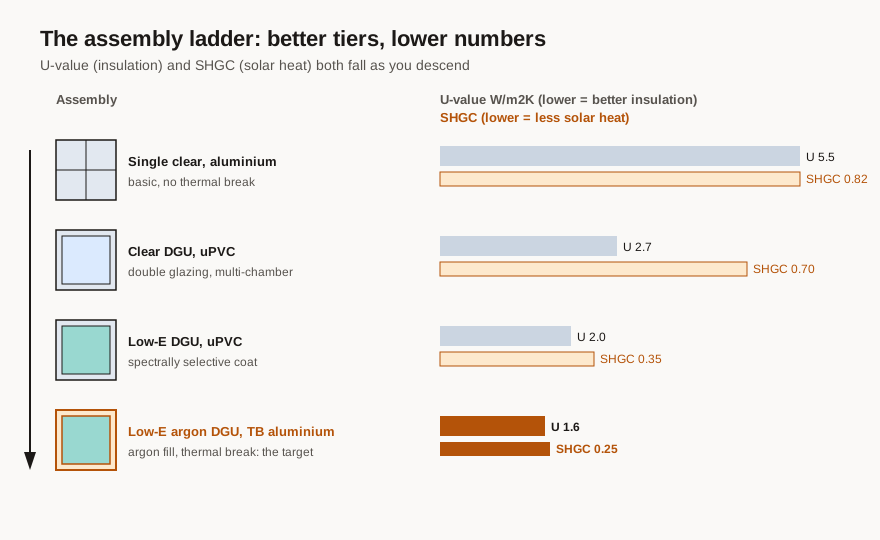
| Tier | Assembly | U-value (W/m2K) | SHGC | VLT | Indicative cost (₹/sqft) |
|---|---|---|---|---|---|
| Basic (avoid for sun-facing) | Single clear glass, bare aluminium | ~5.5 | ~0.82 | ~0.80 | 350 to 550 |
| Good (the value default) | Clear DGU, uPVC multi-chamber frame | ~2.7 | ~0.70 | ~0.75 | 600 to 1,100 |
| Better | Low-E DGU, uPVC frame | ~2.0 | ~0.30 to 0.40 | ~0.65 | 900 to 1,500 |
| Best (hot-India sweet spot) | Low-E plus argon DGU, thermally-broken aluminium | ~1.6 | ~0.25 | ~0.60 to 0.65 | 1,400 to 3,000 |
The jump from Basic to Good roughly halves conduction; the jump to Better collapses SHGC — and in hot India that second jump matters more. Argon fill cuts U-value a further ten to fifteen per cent and a warm-edge spacer kills the cold perimeter. For most homes the Better tier — Low-E DGU in a uPVC frame plus external shading — is the smart stop: it captures the SHGC win without the premium of system aluminium. The detail of cavity widths, gaskets and spacers is in the window insulation guide, and the practical, rupee-ranked playbook for cutting heat gain is in reducing heat gain through windows.
Climate-zone cheat sheet
India spans five envelope-relevant climates. Eco-Niwas Samhita 2018, the residential code, caps the Residual Envelope Transmittance (RETV) at fifteen W/m2 and sets a minimum VLT that falls as the window-to-wall ratio rises (0.27, 0.20, 0.16, 0.13, 0.11 across WWR bands).
| Zone | Cities | Priority | Glass and frame call | Shading |
|---|---|---|---|---|
| Hot-dry | Jaipur, Ahmedabad, Nagpur | Cut SHGC, block sun | Low-E low-SHGC DGU; uPVC or TB aluminium | Deep external — chajja, fins |
| Warm-humid | Chennai, Mumbai, Kochi | Low SHGC plus ventilation, corrosion-proof | Low-E DGU; uPVC (coastal) | Shade plus large openable area |
| Composite | Delhi, Lucknow, Bhopal | Low SHGC in summer, some insulation for winter | Low-E DGU, argon worth it | Movable or seasonal shading |
| Temperate | Bengaluru, Pune | Mild — moderate SHGC, daylight | Clear or light Low-E DGU | Light shading, glare control |
| Cold | Shimla, Manali, Leh | INSULATE; want winter sun | Triple or argon DGU, higher SHGC south | Minimal on south |
West and east windows take low evening and morning sun at a flat angle that overhangs cannot catch. Treat them with vertical fins or movable shading and the lowest-SHGC glass in the house.
A decision framework
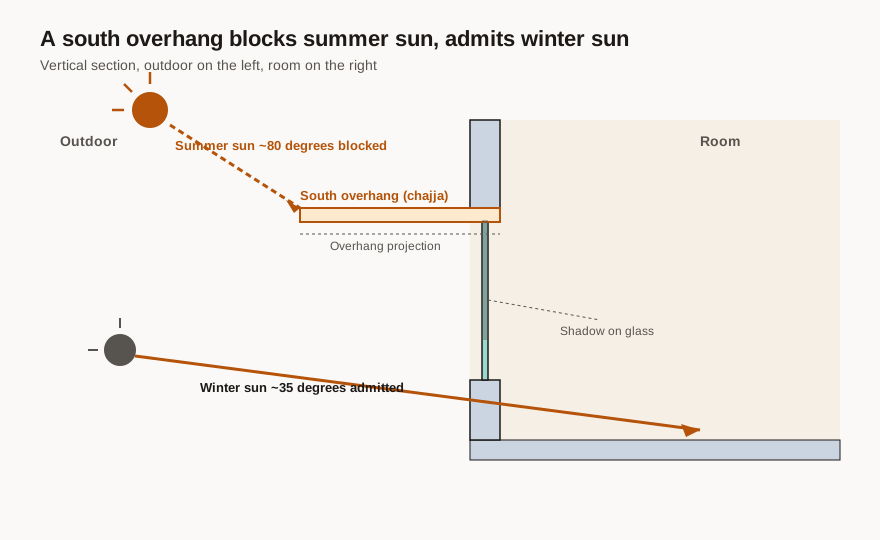
A correctly sized horizontal overhang is geometry, not guesswork. The summer sun climbs high — near 80 degrees at noon in much of India — so a modest projection casts a shadow right down the glass and blocks the worst heat. The winter sun stays low, slipping under the same overhang to warm and light the room when you want it. This self-adjusting behaviour only works on the south face; west and east windows take low, flat sun that no horizontal chajja can catch, which is why they need vertical fins or movable shading instead.
1. Start with orientation and shading, not glass. External shading stops heat before the glass and is the cheapest control — a one-time concrete chajja has near-zero running cost. Size overhangs by orientation per window shading strategies.
2. Pick SHGC for your sun exposure. Sun-facing and west glass needs SHGC at or below 0.27; shaded north glass can relax.
3. Pick the glazing layers. DGU is the energy default; add Low-E for the SHGC collapse; add argon if budget allows.
4. Pick a frame that is not a thermal bridge. uPVC for value and insulation; thermally-broken aluminium for large spans; never bare aluminium on a sunlit wall.
5. Demand airtight seals and a sealed install. A poorly sealed premium window underperforms a well-sealed mid one — sealing is the cheapest fix and the most ignored.
6. Ask for the test report. There is no consumer star sticker on Indian windows yet, so read the manufacturer's NFRC or EN-tested U and SHGC, per window energy ratings explained.
Do this and your window stops being the weak link and starts paying you back — quieter rooms, steadier temperatures, and an air conditioner that rests.
References
- Eco-Niwas Samhita 2018, residential envelope code (BEE/ECBC): https://ecbc.in/econiwas.html
- Low-E glass rating: U-factor, SHGC, VT explained: https://www.mannleecw.com/what-is-low-e-glass-rating/
- Low-E glass and energy efficiency (Guardian Glass): https://www.guardianglass.com/eu/en/our-glass/glass-types/low-e-glass
- Best glass for windows in India 2026 (IndiFrame): https://indiframe.com/blog/best-glass-for-windows-in-india
- uPVC windows price per sq ft 2026 (Building and Interiors): https://buildingandinteriors.com/upvc-windows-price-per-sq-ft-india-2026-cost-guide/
- IS 1948, aluminium doors and windows (BIS): https://law.resource.org/pub/in/bis/S03/is.1948.1961.pdf
Export this guide
Related Guides — Deep-dive reading
Floor-to-Ceiling Windows (India): Maximum Light, and the Heat Trade-Off
Full-height glazing for Indian homes — how to win the daylight and view without losing the energy code, comfort or safety.
Windows & GlazingEnergy-Efficient Facades in India: How the Building Skin Cuts Your Cooling, Heating & Lighting Bills
How a building facade drives cooling, heating and lighting energy in India, the three levers of solar-heat-gain control, insulation and daylighting, U-value, SHGC, VLT and WWR in plain terms, ECBC and Eco-Niwas expectations, and real Indian green buildings.
Building FacadesWindow Insulation Guide for Indian Homes
How a window keeps heat out and conditioned air in — the glazing cavity, frame thermal break and air-sealing deep-dive
Windows & GlazingRelated Tools — Try Free
Brise-Soleil Visualizer
Interactive horizontal-louvre cut-off angle calculator — sun altitude, louvre depth, and spacing inputs with a live shadow preview. Computes θ = arctan(spacing/depth) for façade shading, ECBC envelope compliance, hospital daylight design, and tropical sun-control detailing.
Sun Shading ToolCross-Ventilation Analyzer
Estimate airflow and air changes per hour (ACH) from room size, window areas, layout, and local wind — with NBC 2016 Part 8 compliance check.
Ventilation CalculatorWindow Orientation Planner
Pick the best window type, glass and shading by wall direction — north, east, south and west.
Window Tool