
Window Shading Strategies for Indian Homes
The external shading device catalogue and overhang geometry, by orientation
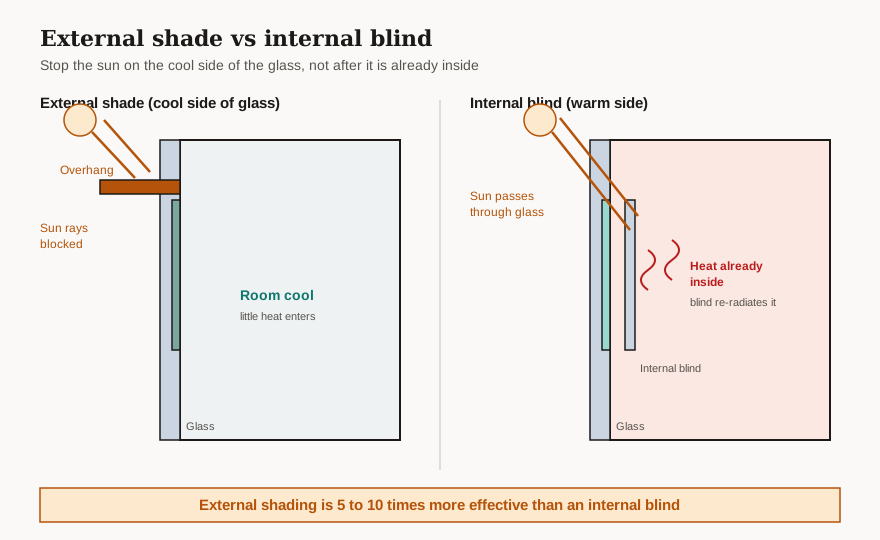
The single most cost-effective thing you can do to a window in hot India costs nothing to run and lasts the life of the building: shade it from the outside. A shading device that intercepts sunlight before it touches the glass stops that heat from ever entering the room. By the time light has crossed the glass and you reach for an internal blind, the energy is already inside — the blind only decides whether it lands on the floor or on the curtain. This is why external shading is routinely 5 to 10 times more effective than internal blinds or curtains for the same window.
This guide is the device catalogue and the geometry — what each shading element is, which orientation it suits, and how deep to make it. It is the companion to three cousins, and it deliberately does not repeat them:
- Reducing Heat Gain Through Windows is the rupee-ranked playbook — orientation, glass, film, timing, all costed. Read it to decide what to spend first.
- Passive Cooling Through Windows is the planning strategy — where to put openings and how to move air.
- Solar Heat Gain and Windows is the science — what SHGC means and why west is the worst orientation.
This one is the hardware: pick the device, get the depth right.
Internal blinds manage glare and privacy. External shading manages heat. They are not substitutes — if you only buy one for a hot-side window, buy the external one.
Why "before the glass" beats "after the glass"
Sunlight that hits glass splits into a fraction admitted (the SHGC, Solar Heat Gain Coefficient) and a fraction reflected or absorbed. A clear single pane has an SHGC near 0.82 — it lets in roughly four-fifths of the sun's heat. An internal blind sits on the warm side of that glass, so the heat is already in the cavity; much of what the blind absorbs re-radiates into the room. An external device works on the cool side: it casts a shadow, so the glass stays in shade and the SHGC barely matters for that window during shaded hours.
Low-SHGC solar-control glass and external shading are a both-and, not an either-or: the glass protects against diffuse sky radiation and reflected glare that no overhang can block, while the overhang kills the direct beam. Together they are how good Indian homes stay cool without running the AC at noon.
The geometry that decides everything: sun path by orientation
The reason there is no single "best" shading device is that the sun arrives at a different angle on each face, and each season.
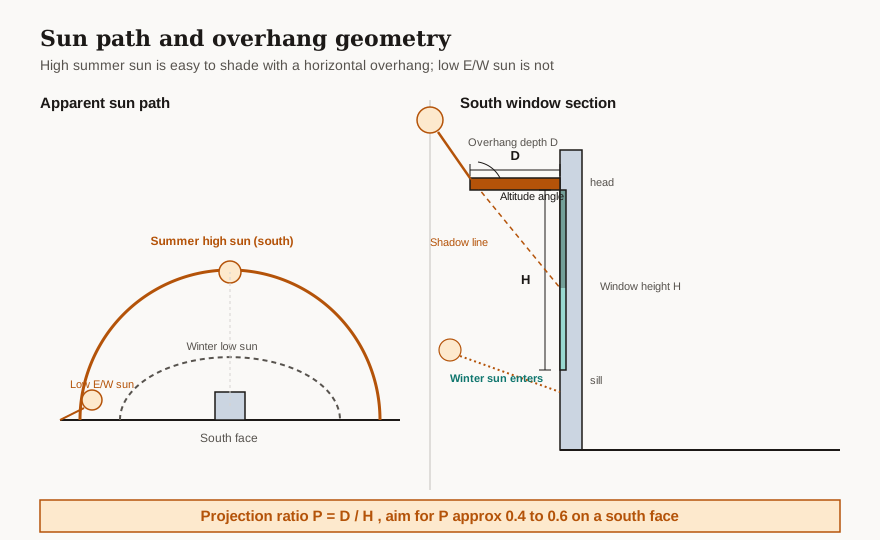
- The south face (in the northern hemisphere, which is all of India) sees the sun high in the sky — steep altitude, especially near noon and in summer. High sun is easy to block with a horizontal element above the window: a shallow overhang casts a long shadow.
- The east and west faces see the sun low — morning sun rakes in from the east, evening sun from the west, both at shallow altitude. A horizontal overhang is nearly useless here because the sun comes in under it. Low sun needs vertical elements, or movable/operable devices.
- The north face gets little direct sun in most of India and needs only light shading for sky glare.
Overhang projection: a rule of thumb
For a horizontal overhang (chajja) over a south window, the depth you need depends on how high the summer sun climbs at your latitude. A workable starting rule across most of peninsular and central India (roughly 8 to 28 degrees N):
- Projection ratio P = overhang depth / window height ≈ 0.4 to 0.6 fully shades a south window through the hottest summer hours while still letting low winter sun reach the glass.
- Further north (Delhi, Chandigarh, latitude 28 to 32 degrees N) the summer sun is slightly lower, so lean to 0.5 to 0.7.
- Deep south (Chennai, Kochi, latitude 8 to 13 degrees N) the sun is nearly overhead in summer, so even a shallow 0.3 to 0.4 chajja performs well.
So a 1.5 m tall south window in Bengaluru wants roughly a 0.6 to 0.9 m projecting chajja. Crucially, this same overhang does almost nothing on the east or west face — there, switch to vertical fins or movable shutters.
The device catalogue
| Device | Best orientation | How it shades | Pros and cons |
|---|---|---|---|
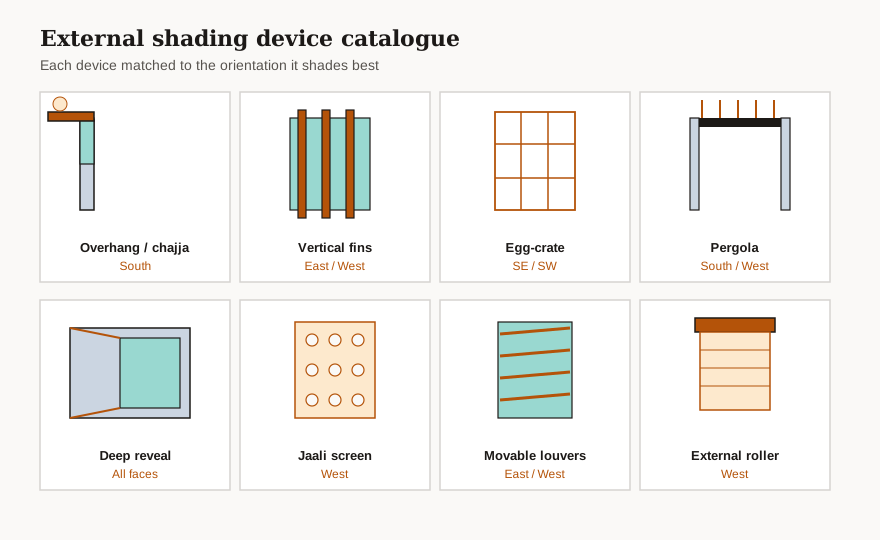
| Horizontal overhang / chajja | South (also flat-roof parapets) | Blocks high-angle sun from above; casts a downward shadow on the glass | Cheapest, zero running cost, permanent; near-useless for low E/W sun |
| Vertical fins / louvers | East and West | Block low, side-raking morning/evening sun | Essential for E/W; can obstruct the view to one side; fixed fins shade only part of the day |
| Egg-crate (horizontal + vertical grid) | South-east, south-west, harsh composite climates | Combines overhang and fins for sun that is both high and angled | Best all-round shading; heaviest, most material and cost, can darken interior |
| Pergola / louvered canopy | South and west terraces, balconies, sit-outs | Slatted top filters direct sun while keeping openness | Softens light, good for outdoor rooms; needs maintenance; partial shade only |
| Deep window reveal | All, modest effect | Recessing the window into a thick wall self-shades the edges | Free if the wall is already thick (stone, AAC, cavity); limited depth of shade |
| Jaali / perforated screen | West and harsh exposures; balconies | Perforated screen diffuses and cuts the beam while allowing air and filtered light | Beautiful, ventilating, cuts glare; reduces view and daylight; dust collects |
| Movable external louvers / shutters | East and West (and any tunable face) | Operable slats adjust through the day and seasons | Most effective for low sun; best performance; highest cost, mechanism upkeep |
| External roller shade / awning | West, balconies | Drops over the glass outside to block the beam | Retractable, cheap-ish; fabric ages in UV and monsoon |
| Internal roller blind / curtain | Any (last line, glare/privacy) | Absorbs/reflects heat already inside the glass | Cheap and easy but 5 to 10x less effective; manages glare, not heat |
| Solar-control film | Existing single glazing you cannot reshade | Reflects/absorbs at the glass surface | Cheapest retrofit (~₹50 to 150/sqft); check adhesion and warranty; not a substitute for external shade |
The ranking above is roughly the order of heat-stopping power: external, fixed-to-movable, comes first; internal options and films are the fallback when you cannot build outside.
A jaali does at window scale what a perforated facade does at building scale — both trade a slice of view and daylight for diffuse, cooled, ventilated light. On a hot west window it is often the most elegant fix.
Putting it together by orientation
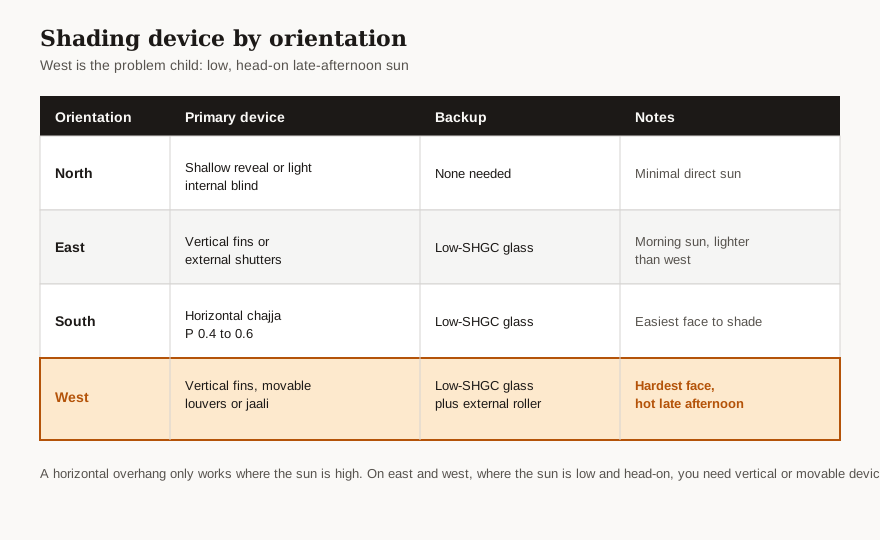
- South: horizontal chajja at P ≈ 0.4 to 0.6. This is the easy face — one well-sized overhang and you are largely done.
- West (the problem child): the sun is low, intense and in the late afternoon when the building is already hot. Overhangs fail here. Use vertical fins, movable louvers, a jaali, or an external roller — and back it with low-SHGC glass. See Solar Heat Gain and Windows for why west punishes you most.
- East: like west but in the cooler morning, so it is more forgiving — vertical fins or operable shutters, lighter than west.
- North: minimal shading; a shallow reveal or light internal blind for occasional sky glare is enough.
For new construction, lock these in at the planning stage — see Window Placement Guide for choosing which rooms get which face, and the Energy Efficient Windows pillar for how shading sits alongside frame, glass and seals in the whole window-as-energy-device.
What the codes expect
India's residential envelope code, the Eco-Niwas Samhita (ENS) 2018, regulates the glazed envelope through a Residential Envelope Transmittance Value (RETV less than or equal to 15 W/m2) and a daylight requirement that scales with window-to-wall ratio. External shading is one of the levers a designer pulls to meet RETV, because it cuts the effective solar gain of each opening. NBC 2016 separately asks for openable area of roughly 10 per cent of floor area for ventilation — so your shading must not seal the window shut; movable and louvered devices keep both heat control and airflow. ECBC 2017 governs commercial buildings and also credits shading via projection factors.
Do and avoid
- Do size the south overhang to your latitude — deeper up north, shallower deep south.
- Do use vertical or movable devices on east and west; never rely on a flat overhang there.
- Do combine external shading with low-SHGC solar-control glass for diffuse and reflected sky load the shade cannot block.
- Do keep shading operable enough to preserve NBC ventilation openings.
- Avoid buying premium glass for a hot window while leaving it fully exposed — shade it first.
- Avoid treating internal blinds as heat control; they are glare and privacy tools.
- Avoid dark, dense jaali on a window that is your only daylight source — balance VLT against shade.
References
- Bureau of Energy Efficiency, Eco-Niwas Samhita 2018 (Energy Conservation Building Code for Residential Buildings): https://beeindia.gov.in/en/programmes/eco-niwas-samhita
- Bureau of Energy Efficiency, Energy Conservation Building Code (ECBC) 2017: https://beeindia.gov.in/en/programmes/ecbc
- National Building Code of India 2016, Bureau of Indian Standards: https://www.bis.gov.in/standards/technical-department/national-building-code/
- Indian Green Building Council, IGBC Green Homes: https://igbc.in/igbc/
Export this guide
Related Guides — Deep-dive reading
Energy-Efficient Facades in India: How the Building Skin Cuts Your Cooling, Heating & Lighting Bills
How a building facade drives cooling, heating and lighting energy in India, the three levers of solar-heat-gain control, insulation and daylighting, U-value, SHGC, VLT and WWR in plain terms, ECBC and Eco-Niwas expectations, and real Indian green buildings.
Building FacadesDesigning a Naturally Energy-Efficient Indian Home
Comfort first, gadgets last — passive design, orientation, insulation, ventilation and the climate wisdom that cuts Indian energy bills
SustainabilityFloor-to-Ceiling Windows (India): Maximum Light, and the Heat Trade-Off
Full-height glazing for Indian homes — how to win the daylight and view without losing the energy code, comfort or safety.
Windows & GlazingRelated Tools — Try Free
Brise-Soleil Visualizer
Interactive horizontal-louvre cut-off angle calculator — sun altitude, louvre depth, and spacing inputs with a live shadow preview. Computes θ = arctan(spacing/depth) for façade shading, ECBC envelope compliance, hospital daylight design, and tropical sun-control detailing.
Sun Shading ToolCross-Ventilation Analyzer
Estimate airflow and air changes per hour (ACH) from room size, window areas, layout, and local wind — with NBC 2016 Part 8 compliance check.
Ventilation CalculatorWindow Shade Depth Calculator
Size the overhang or chajja that shades a window in summer — by orientation, latitude and height.
Window Tool