

Window Energy Ratings Explained for Indian Homes
How to read a window's energy rating — NFRC label anatomy, ENERGY STAR climate zones, and the honest truth that India has no consumer window star-label yet
You can pick a window blind to the salesman's adjectives if you can read three numbers — and know who measured them. This guide is the LABELS-and-CERTIFICATION walk-through: how to read a window's energy rating, what each line on an NFRC sticker means, how ENERGY STAR's climate zones work, and the honest truth about ratings in India — where there is no mandatory consumer star-label on residential windows yet, so you read the manufacturer's tested numbers and demand the test report behind them.
This guide is about WHO RATES a window and HOW TO READ the label. What the numbers physically MEAN — the heat-flow behind U-value and SHGC — lives in our thermal performance of windows guide. Read that for the physics; read this to decode the sticker.
The five numbers on an NFRC label
On imported, premium and most international-spec windows you will see an NFRC label — issued under the US National Fenestration Rating Council, the global benchmark for whole-window performance testing. It rates the WHOLE assembly (glass plus frame plus spacer), not just the glass, which is exactly what you want. The label carries five numbers.
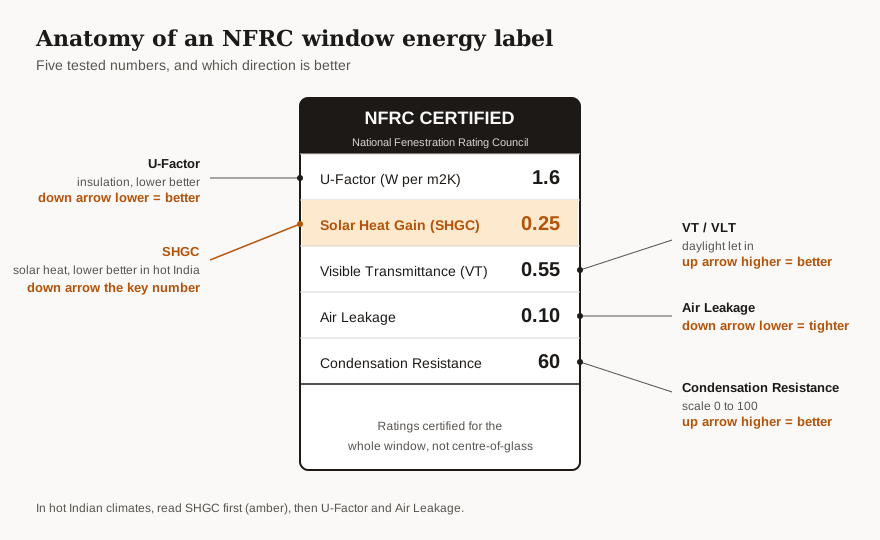
- U-factor (W/m2K, or Btu in US units): rate of non-solar heat flow through the whole window. Lower is better. NFRC range roughly 0.20 to 1.20 (US units); in metric, single glazing sits near 5.x, a good Low-E DGU near 1.6.
- SHGC (Solar Heat Gain Coefficient, 0 to 1): fraction of solar heat admitted. In hot India, lower is better, and this is the number that matters most. Clear single is about 0.82; aggressive solar-control DGU reaches 0.18 to 0.27.
- VT / VLT (Visible Transmittance, 0 to 1): daylight let through. Higher is better — you want bright rooms without the heat. A good spectrally-selective Low-E keeps VT high while SHGC stays low (the light-to-solar-gain ratio).
- Air Leakage (AL, cfm/ft2): air slipping through the seals. Lower is tighter. Often 0.3 or below on a well-made unit. The cheapest performance to lose and the easiest to overlook.
- Condensation Resistance (CR, 0 to 100): how well the window resists fogging and sweating. Higher is better — relevant in humid coastal India and air-conditioned rooms.
Read them as a set. A window can have a beautiful U-factor and a terrible SHGC — disastrous for Chennai, fine for Leh. The metric cheat-sheet below, and the table that follows it, are the two to screenshot.
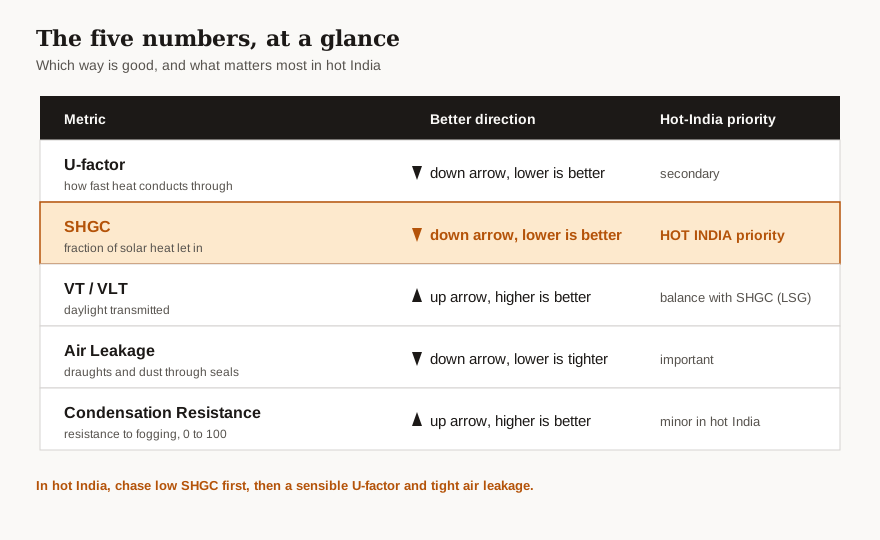
| Number | Unit | Better direction | Hot-India priority |
|---|---|---|---|
| U-factor | W/m2K | Lower | Moderate — insulation |
| SHGC | 0 to 1 | Lower | Highest — blocks the sun |
| VT / VLT | 0 to 1 | Higher | High — daylight |
| Air Leakage | cfm/ft2 | Lower | High — cheap to fix |
| Condensation Resistance | 0 to 100 | Higher | Coastal / AC rooms |
ENERGY STAR climate zones — and why India needs the opposite
The US ENERGY STAR window programme divides the country into climate zones (Northern, North-Central, South-Central, Southern) and sets different U-factor and SHGC thresholds for each. The logic is simple: cold zones reward a low U-factor (keep heat in) and tolerate a higher SHGC (free winter sun); hot southern zones demand a low SHGC (keep the sun out) and relax the U-factor.
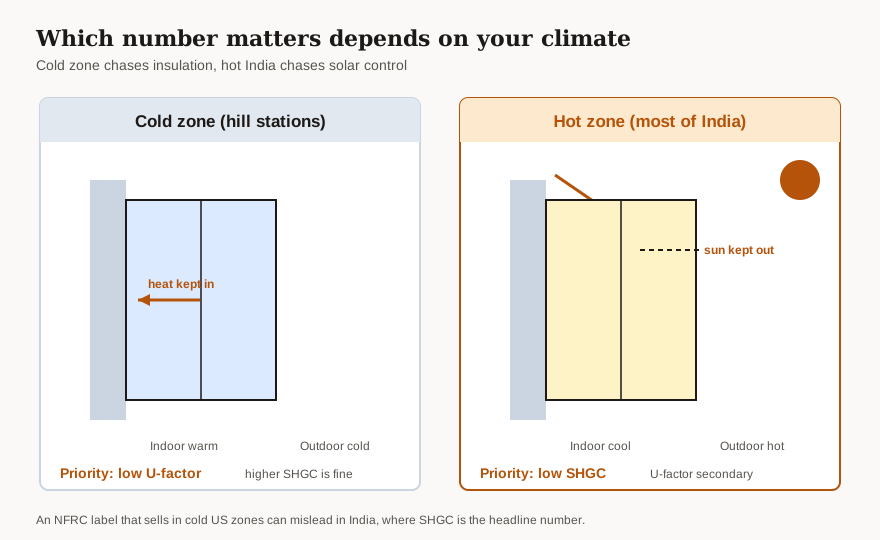
Pivot that to India and the lesson is sharper than any imported threshold. Most of the country — hot-dry, warm-humid and composite — behaves like the US "Southern" zone on steroids: SHGC is king, U-factor is secondary. Only the cold hill stations (Shimla, Manali, Leh) flip to the cold-zone logic where a low U-factor and a higher south-facing SHGC pay off. So when you see an ENERGY STAR "qualified" sticker on an imported window, check WHICH zone it qualified for — a Northern-zone window optimised for insulation can be exactly wrong for Hyderabad.
| Climate (India) | Priority metric | Target SHGC | U-factor stance |
|---|---|---|---|
| Hot-dry (Jaipur, Ahmedabad) | Low SHGC | 0.25 or below | Secondary |
| Warm-humid (Chennai, Mumbai) | Low SHGC + airtight | 0.25 or below | Secondary |
| Composite (Delhi, Nagpur) | Low SHGC, some U | 0.25 to 0.40 | Moderate |
| Temperate (Bengaluru, Pune) | Balanced | 0.30 to 0.45 | Moderate |
| Cold (Shimla, Leh) | Low U-factor | 0.50 plus (south) | Highest |
The honest India reality: there is no window star-label yet
Here is the part the brochures will not tell you. India has no mandatory consumer star-label on residential windows. The BEE (Bureau of Energy Efficiency) Standards and Labelling (S and L) programme — the familiar star sticker — covers appliances and air-conditioners, not windows. A building star-label scheme exists but is under revision and was paused in September 2025, so there is no sticker on a window the way there is on a refrigerator.
What India does have is codes, not consumer labels — a landscape worth mapping before you shop.
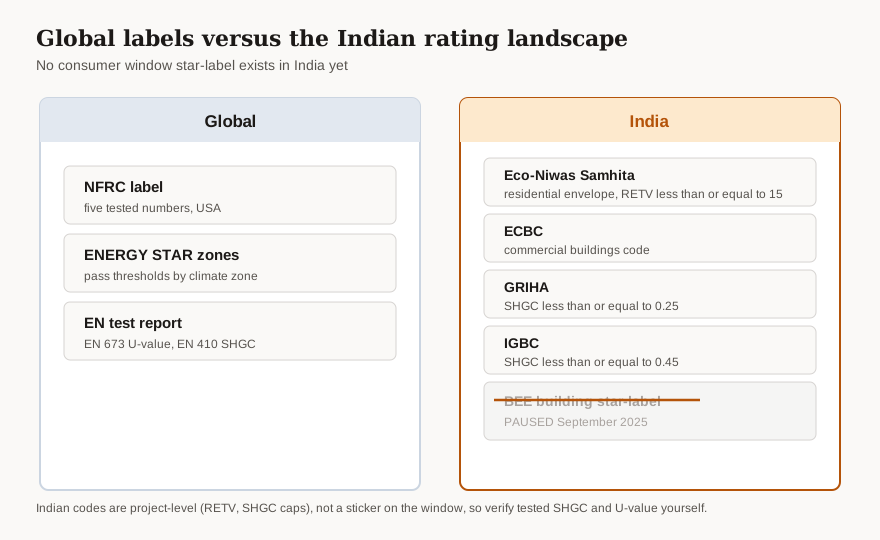
- Eco-Niwas Samhita 2018 (ENS) — the residential envelope code. It caps RETV (Residential Envelope Transmittance Value) at less than or equal to 15 W/m2 and sets a minimum VLT that rises with window-to-wall ratio (the VLT-by-WWR ladder). It governs the envelope as a system, not a single window's sticker — see window-to-wall ratio for how WWR drives this.
- ECBC 2017 — the Energy Conservation Building Code for COMMERCIAL buildings, with its own SHGC and U-factor limits by climate.
- Green rating systems set fenestration thresholds: GRIHA requires SHGC less than or equal to 0.25; IGBC Green Homes v3 requires SHGC less than or equal to 0.45. These are credits, not labels you buy off a shelf.
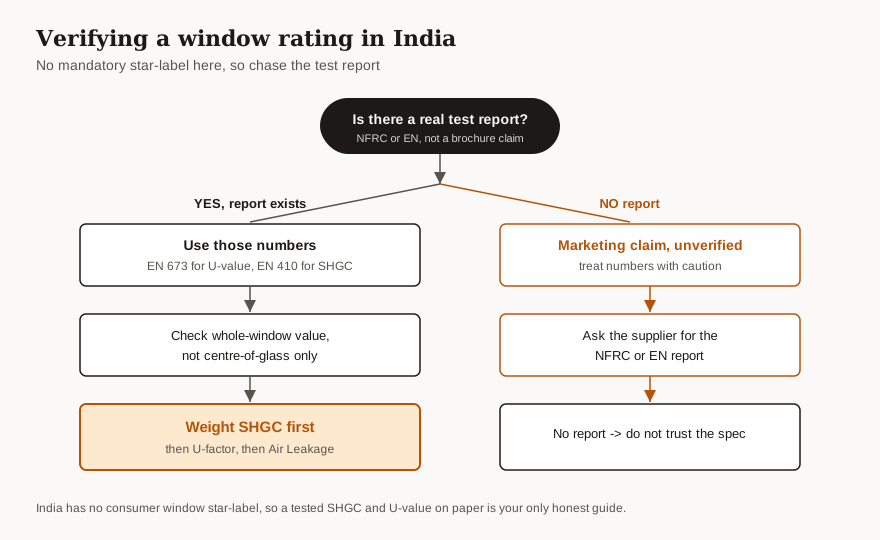
So in practice you read the manufacturer's tested U-value and SHGC — and your job is to verify they were actually tested. The decision flow below is the one to follow at the showroom.
How to actually verify a claim
- Ask for the test report, not the brochure. Acceptable proof is an NFRC certificate or a European EN test report (EN 673 for U-value, EN 410 for SHGC and light transmittance). A glass-only test (centre-of-glass) is weaker than a whole-window number — ask which it is.
- Whole-window beats centre-of-glass. A datasheet quoting only the centre-of-glass U-value hides the frame and edge losses. The honest number includes the frame.
- Beware untested marketing. "Heat-resistant", "energy glass" and "high-performance" mean nothing without a tested SHGC and U-value. If no report exists, treat the claim as unverified — it is not the same as a rated window.
- Match the report to YOUR climate. A low U-factor headline is a cold-climate boast. For most of India, ask first: what is the SHGC?
In India there is no star sticker on your window. The rating you trust is the one on a real NFRC or EN test report — and the one number to check first, almost everywhere in this country, is the SHGC.
Putting it together
A window energy rating is only as good as the lab behind it. Internationally that lab is NFRC (or EN in Europe); in India it is whichever test house the manufacturer used — so insist on seeing the certificate. Read the five numbers as a set, weight SHGC highest for hot India, and ignore any adjective that is not backed by a tested figure. For the system-level view of how rating, glass, frame, seals and shading combine into one energy device, start at the pillar, energy-efficient windows explained. To choose the glass that produces a good SHGC in the first place, see energy-efficient glass. And for the physics that makes these numbers mean what they mean, read thermal performance of windows.
Related guides
- Energy-efficient windows explained — the pillar: frame, glass, seals, shading and rating as one system.
- Thermal performance of windows — what U-value, SHGC and VLT physically mean; this guide is about reading the label that reports them.
- Window-to-wall ratio — the WWR that drives the Eco-Niwas Samhita VLT and RETV limits.
- Energy-efficient glass — choosing the glass that delivers a low SHGC and high VLT.
References
- Eco-Niwas Samhita 2018 (BEE / ECBC): https://ecbc.in/econiwas.html
- NFRC — understanding the energy performance label: https://www.nfrc.org/energy-performance-label/
- ENERGY STAR residential windows climate zone criteria: https://www.energystar.gov/products/residential_windows_doors_skylights/key_product_criteria
- Bureau of Energy Efficiency — Standards and Labelling programme: https://beestarlabel.com/
- GRIHA rating — fenestration and SHGC criteria: https://www.grihaindia.org/griha-rating
- IGBC Green Homes rating system: https://igbc.in/igbc/redirectHtml.htm?redVal=showGreenHomesnosign
Export this guide
Related Guides — Deep-dive reading
Energy Efficient Windows Explained: The Whole-System Guide for Indian Homes
Treat the window as an energy device — frame, glass, seals, shading, install and rating — and learn why low SHGC and shading beat chasing a cold-climate U-value in hot India.
Windows & GlazingThermal Performance of Windows: Reading the Spec Sheet
U-value, SHGC, VLT, LSG, Air Leakage and Condensation Resistance — what every number on a window's spec sheet physically means, with Indian figures
Windows & GlazingEnergy-Efficient Facades in India: How the Building Skin Cuts Your Cooling, Heating & Lighting Bills
How a building facade drives cooling, heating and lighting energy in India, the three levers of solar-heat-gain control, insulation and daylighting, U-value, SHGC, VLT and WWR in plain terms, ECBC and Eco-Niwas expectations, and real Indian green buildings.
Building FacadesRelated Tools — Try Free
Brise-Soleil Visualizer
Interactive horizontal-louvre cut-off angle calculator — sun altitude, louvre depth, and spacing inputs with a live shadow preview. Computes θ = arctan(spacing/depth) for façade shading, ECBC envelope compliance, hospital daylight design, and tropical sun-control detailing.
Sun Shading ToolCross-Ventilation Analyzer
Estimate airflow and air changes per hour (ACH) from room size, window areas, layout, and local wind — with NBC 2016 Part 8 compliance check.
Ventilation CalculatorWindow-to-Wall Ratio Calculator
Compute WWR percent and check it against Eco-Niwas Samhita VLT and RETV limits and climate.
Window Tool