
Electrical Standards, Codes & Regulations in India: NEC, IS Codes & CEA Rules
The rulebook behind a safe installation — the National Electrical Code (SP 30), the key IS standards for wiring, earthing and cables, and the CEA Safety Regulations that carry the force of law, explained so a homeowner knows what governs their home and what to hold an electrician to.
Behind every safe electrical installation is a rulebook — a set of standards, codes and regulations that define how it must be built. Most homeowners never see it, but knowing what governs your home is powerful: it tells you what to expect, what to insist on, and what to hold your electrician and contractor to. This guide maps India's electrical standards landscape in plain language — the codes, the key IS standards, and the regulations that carry the force of law — without pretending you need to read them cover to cover.
It is the standards reference of the Electrical Knowledge Hub, and underpins every other guide in it.
The safety line. Standards define what good looks like; a licensed electrician applies them. This guide helps you understand and reference the rules and verify compliance — not to design or execute the installation yourself.
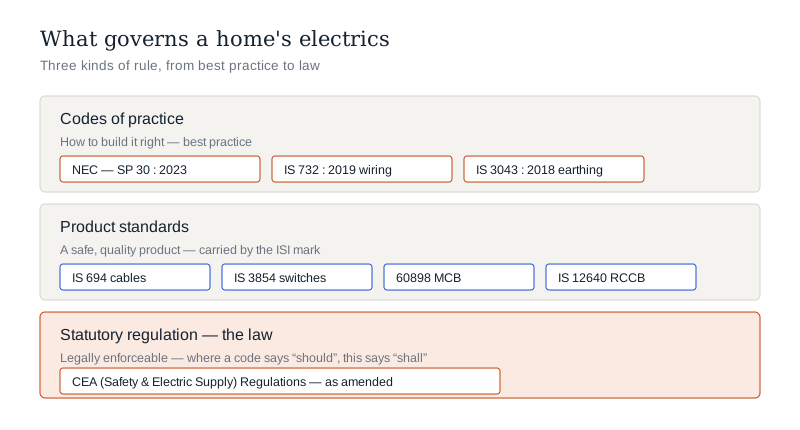
The three kinds of rules
It helps to separate three things that often get lumped together:
| Type | Example | Force |
|---|---|---|
| Code of practice | National Electrical Code (SP 30), IS 732 | Best-practice "how to build it right" |
| Product standard | IS 694 (cables), IS 3854 (switches) | Defines a safe, quality product (the ISI mark) |
| Statutory regulation | CEA Safety Regulations | Law — legally enforceable |
Codes tell you the right way; product standards define good materials; regulations make certain things legally mandatory. A safe home respects all three.
The National Electrical Code (SP 30)
The National Electrical Code of India (SP 30 : 2023) is the overarching, consolidated code for electrical installations — the single reference that pulls together design, safety and installation practice for buildings. Think of it as the master "how to do electrical work properly in India" document. Its most recent edition is SP 30 : 2023.
The key IS standards for a home
A handful of Indian Standards govern most of what's in a home's electrics. Your electrician works to these; you can reference them:
- IS 732 : 2019 — Code of Practice for Electrical Wiring Installations. The core wiring code — circuits, cable sizing, protection, the whole installation.
- IS 3043 : 2018 — Code of Practice for Earthing. Governs the earthing that keeps you safe from shock.
- IS 694 : 2010 — PVC insulated cables up to 1100 V. The common house-wiring cable standard.
- IS 3854 — Switches for domestic and similar purposes (and the modular-accessory standards) — see switches & sockets.
- IS/IEC 60898 — MCBs; IS 12640 — RCCBs/RCDs — the protection devices.
- IS/IEC 62305 : 2010 — Lightning protection; and product standards like IS 302 : Part 1 : 2024 for appliance safety.
You don't memorise these — you reference them when specifying, and expect a professional to comply.
The CEA Safety Regulations — the legal layer
Above the codes sits the law. The Central Electricity Authority (Measures relating to Safety and Electric Supply) Regulations are statutory — legally enforceable rules covering electrical safety, supply and installation across India. Where a code says "should", these regulations say "shall". They are the reason certain safety provisions (proper earthing, protection, safe clearances, competent workmanship) aren't optional. The regulations are periodically amended, so the current version should be verified rather than assumed.
The ISI mark: standards you can see
The most visible standard for a homeowner is the ISI mark — the BIS certification stamp on products that conform to the relevant IS standard. For safety-critical items (cables, switches, MCBs, RCCBs), buying ISI-marked products is the simplest way to apply standards without reading them. It's covered fully in the buying electrical materials guide.
Beyond electrical: the building rules
A home's electrics also sit within broader building rules:
- The National Building Code (NBC) framework for building services (note SP 7 : 2016 was withdrawn; the current edition is SP 7 : 2026 — verify status).
- Local body / municipal electrical approvals and inspections where applicable.
- DISCOM connection and metering rules for your supply and any rooftop solar net metering.
How to use standards as a homeowner
You don't need to be an expert; you need to be informed enough to expect compliance:
- Specify ISI-marked cables, switches and protective devices.
- Insist the installation follows IS 732 and IS 3043 — a competent electrician does this by default; asking signals you care.
- Reference the code when something looks wrong (no earthing, no RCCB, undersized cables) — see the safety guide.
- Verify current status — standards are revised; check the BIS catalogue rather than trusting an old number.
The one-line answer
India's electrical rules come in three layers: codes of practice (the National Electrical Code SP 30 : 2023 and IS 732 : 2019 for wiring, IS 3043 : 2018 for earthing) that define good installation; product standards (IS 694 cables, IS 3854 switches, IS/IEC 60898 MCBs, IS 12640 RCCBs) marked by the ISI mark; and the statutory CEA Safety Regulations that make core safety legally mandatory — all sitting within the broader NBC/building-approval framework. As a homeowner you don't design to them, but knowing them lets you specify ISI-marked materials, expect IS-compliant work from a licensed electrician, and recognise when something falls short. Always verify a standard's current edition via the BIS catalogue.
Where to go next
- Apply it safely: Home Electrical Safety Guide.
- Buy to standard: Buying Electrical Materials Guide.
- The protection devices the codes require: Electrical Protection Guide.
- The complete pillar: Residential Electrical Systems Guide.
References
- National Electrical Code of India, SP 30 : 2023, Bureau of Indian Standards.
- IS 732 : 2019 (Wiring Installations); IS 3043 : 2018 (Earthing); IS 694 : 2010 (PVC Cables); IS 302 : Part 1 : 2024 (Appliance Safety), BIS: https://www.bis.gov.in/
- Central Electricity Authority (Measures relating to Safety and Electric Supply) Regulations, 2010 (as amended) — verify current version: https://cea.nic.in/
Standards and regulations are periodically revised; codes, IS numbers and CEA regulation versions change. Verify the current edition via the BIS catalogue and CEA before relying on any citation, and leave design and execution to a licensed electrician.
Export this guide
Related Guides — Deep-dive reading
Residential Electrical Systems: The Complete Guide for Indian Homes
How the electricity in an Indian home actually works — from the utility supply and meter through the distribution board, circuits, wiring, earthing and protection, to lighting, safety, energy efficiency, smart controls, solar and backup — written so a homeowner can understand, plan and judge it, and know exactly where a licensed electrician must take over.
Electrical & WiringSecurity and Fire Regulations Guide for India (2026): Know the Rules and How to Navigate Them
There is no single national rulebook you can read off. This is the map of the whole regulatory landscape for home, housing-society and commercial security and fire systems in India, and a calm way to navigate it: who sets the rules, who approves what, and how to stay on the right side of them.
SecurityElectrical Safety for Security Systems in India (2026): Powering It Without Peril
A homeowner's guide to the power side of home and RWA security systems, CCTV, alarms, gates, access control and NVRs, done so it protects you instead of quietly becoming a shock or fire hazard. What makes a supply safe, what to insist on, and why the mains work belongs to a licensed electrician.
SecurityRelated Tools — Try Free
Electrical Safety & Load Audit
Home electrical audit — 10 categories, 65+ checkpoints across earthing, RCCB, MCB, wiring, switchboards, appliance circuits, DG/inverter backup.
Safety AuditSolar Sizing Calculator
Size a rooftop solar system from your monthly electricity use — the kW system, number of panels, roof area and yearly generation.
SolarEarth Conductor Size Calculator
Find the minimum protective (earth) conductor size for a circuit from its phase conductor size, using the standard IS 732 / IEC 60364 rule.
Electrical