
How Your Home Is Protected: The Layers of Electrical Protection
The complete picture of electrical safety — the layers that guard a home, from the MCB that protects cables and the RCCB that protects people, to earthing, surge protection and lightning protection. What each layer does, what it does not, and why you need all of them.
Electrical safety in a home is not one device — it is a set of layers, each guarding against a different danger. The mistake most people make is assuming one of them covers everything: that MCBs make a home safe, or that "it has earthing, so it's fine". In reality, each layer protects against a specific threat and is blind to the others, so a genuinely safe installation needs all of them, working together. This guide is the map of those layers — what each does, what it cannot do, and how they add up to a home that is safe against fire and shock.
It is the anchor of the protection cluster and ties together the deeper guides: the MCB & MCCB guide, the RCCB, RCBO & ELCB guide, the home earthing guide, surge protection and lightning protection.
The safety line. This guide helps you understand and audit the protection in your home so you can ask an electrician the right questions. Assessing, installing and testing protective devices is a licensed electrician's job. If you find a layer missing — especially earthing or an RCCB — treat it as a priority to have addressed professionally.
The five layers, at a glance
Each layer answers a different danger. Read this table as a checklist for your own home.
| Layer | Guards against | Device | Protects |
|---|---|---|---|
| Overcurrent | Overload & short circuit | MCB / MCCB / fuse | The cable from overheating (fire) |
| Earth leakage | Current leaking to earth | RCCB / RCBO | The person from shock |
| Earthing | A live fault on metal parts | Earthing system | Gives fault current a safe path; enables the above to trip |
| Surge | Voltage spikes (grid, lightning) | SPD (surge protective device) | Electronics & appliances |
| Lightning | A direct or nearby strike | Lightning protection system | The structure & occupants |
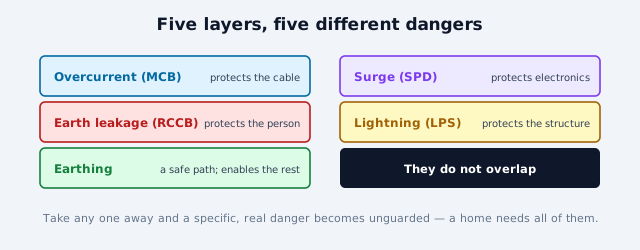
The crucial insight: these do not overlap. An MCB will not save you from a shock; an RCCB will not stop a cable overheating on overload; neither does anything about a voltage surge frying your electronics; and none of them protects the building from a lightning strike. Take any one away and a specific, real danger becomes unguarded.
Layer 1 — Overcurrent (MCB): protecting the cable
The MCB (or MCCB in larger installations) trips when a circuit draws too much current — either a sustained overload or a sudden short circuit — before the cable overheats and starts a fire. It protects the wiring, not people. Every circuit has one, sized to its cable. The full story, including trip curves and the vital rule never to oversize a breaker, is in the MCB & MCCB guide.
Layer 2 — Earth leakage (RCCB): protecting the person
The RCCB (or RCBO) trips when current leaks to earth — for example, through a person touching a faulty appliance — cutting power in milliseconds. This is the layer that prevents electrocution, and the one most often missing in older homes. For life safety it must be 30 mA sensitivity. This is arguably the single most important protective device in a home; it is covered in depth in the RCCB, RCBO & ELCB guide.
Layer 3 — Earthing: the foundation the others stand on
Earthing connects the metal parts of the installation and appliances to the earth through a low-resistance path. It does two things: it carries a fault current safely away instead of leaving a metal casing live, and it enables the protective devices to work — many faults only trip an MCB or RCCB because earthing gives the fault current somewhere to go. Without proper earthing, the other layers are undermined. Earthing is governed by IS 3043 : 2018 and covered in the home earthing guide.
Layer 4 — Surge protection: guarding the electronics
A surge protective device (SPD) clamps sudden voltage spikes — from grid switching, faults, or a nearby lightning strike — that would otherwise destroy sensitive electronics (TVs, computers, inverters, LED drivers). MCBs and RCCBs do nothing about surges; they react to current, not a brief voltage spike. As homes fill with electronics, this layer matters more. See surge protection & SPDs.
Layer 5 — Lightning protection: guarding the building
For exposed or tall structures, a lightning protection system intercepts a strike and carries its enormous energy safely to earth, protecting the structure and the people inside. It is a structural safety system, separate from the electrical protection inside — a tall or isolated building needs it, an ordinary flat in a large building usually relies on the building's own system. Covered in lightning protection.
How the layers work together
Good protection is not just having the devices — it is coordination: the right device trips for the right fault, the nearest one trips first (so a fault in one room does not black out the house), and earthing underpins them all. This coordination is a design task for a competent electrician; your job as an owner is to make sure no layer is missing. The most common, dangerous gaps in Indian homes are: no RCCB (no shock protection), poor or absent earthing (undermining everything), and no surge protection (electronics exposed).
Audit your home layer by layer: Is there an RCCB (with a working test button)? Is the earthing real and tested? Are cables protected by correctly-sized MCBs? Is there surge protection? Each "no" is a specific danger left unguarded — and a specific thing to ask an electrician to fix.
The one-line answer
A safe home is protected in layers, each guarding a different danger: the MCB protects the cable from overload and short circuit (fire), the RCCB protects the person from earth leakage (shock), earthing gives faults a safe path and lets the others work, surge protection guards the electronics, and lightning protection guards the structure. They do not overlap, so you need all of them — and the common, dangerous gaps in Indian homes are a missing RCCB, poor earthing, and no surge protection. Audit yours layer by layer, and have a licensed electrician close any gap.
Where to go next
- Overload protection: MCB & MCCB Guide.
- Shock protection: RCCB, RCBO & ELCB Guide.
- The foundation: Home Earthing Guide.
- Electronics: Surge Protection & SPDs.
- The structure: Lightning Protection Guide.
References
- IS 3043 : 2018, Code of Practice for Earthing (Second Revision), Bureau of Indian Standards.
- IS/IEC 60898-1 : 2015 (MCBs); IS 12640 (RCCBs/RCBOs) — BIS.
- IS/IEC 62305 : 2010 (Parts 1–4), Protection Against Lightning, BIS.
- IEC 61643 series — international standard for low-voltage surge protective devices (confirm current BIS designation).
- IS 732 : 2019, Code of Practice for Electrical Wiring Installations; National Electrical Code SP 30 : 2023 — BIS: https://www.bis.gov.in/
Protection layers and devices are indicative for typical Indian homes. Assessment, installation and testing must be done by a licensed electrician. If a protection layer is missing, treat it as a priority safety issue. Verify any standard's status via the BIS catalogue before relying on it.
Export this guide
Related Guides — Deep-dive reading
RCCB, RCBO & ELCB: The Devices That Protect You From Shock
The single most important safety device in a home distribution board — the residual current device that detects electricity leaking to earth and cuts power in milliseconds. What RCCB, RCBO and ELCB mean, why 30 mA matters, the difference from an MCB, and why every home must have one.
Electrical & WiringSurge Protection & SPDs: Guarding Your Home's Electronics
The device your MCB and RCCB cannot replace — a surge protective device clamps the sudden voltage spikes from grid switching and lightning that quietly kill TVs, computers, inverters and LED drivers. What SPDs are, the Type 1/2/3 system, where they go, and whether your home needs one.
Electrical & WiringElectrical Safety for Security Systems in India (2026): Powering It Without Peril
A homeowner's guide to the power side of home and RWA security systems, CCTV, alarms, gates, access control and NVRs, done so it protects you instead of quietly becoming a shock or fire hazard. What makes a supply safe, what to insist on, and why the mains work belongs to a licensed electrician.
SecurityRelated Tools — Try Free
Electrical Safety & Load Audit
Home electrical audit — 10 categories, 65+ checkpoints across earthing, RCCB, MCB, wiring, switchboards, appliance circuits, DG/inverter backup.
Safety AuditLift Safety Audit Checklist
Interactive checklist that scores your home lift on safety devices, compliance and upkeep.
ChecklistMCB & RCCB Selector
Suggests an MCB current rating and trip curve for a home circuit, the minimum matching cable, and the RCCB sensitivity for shock protection.
Electrical