
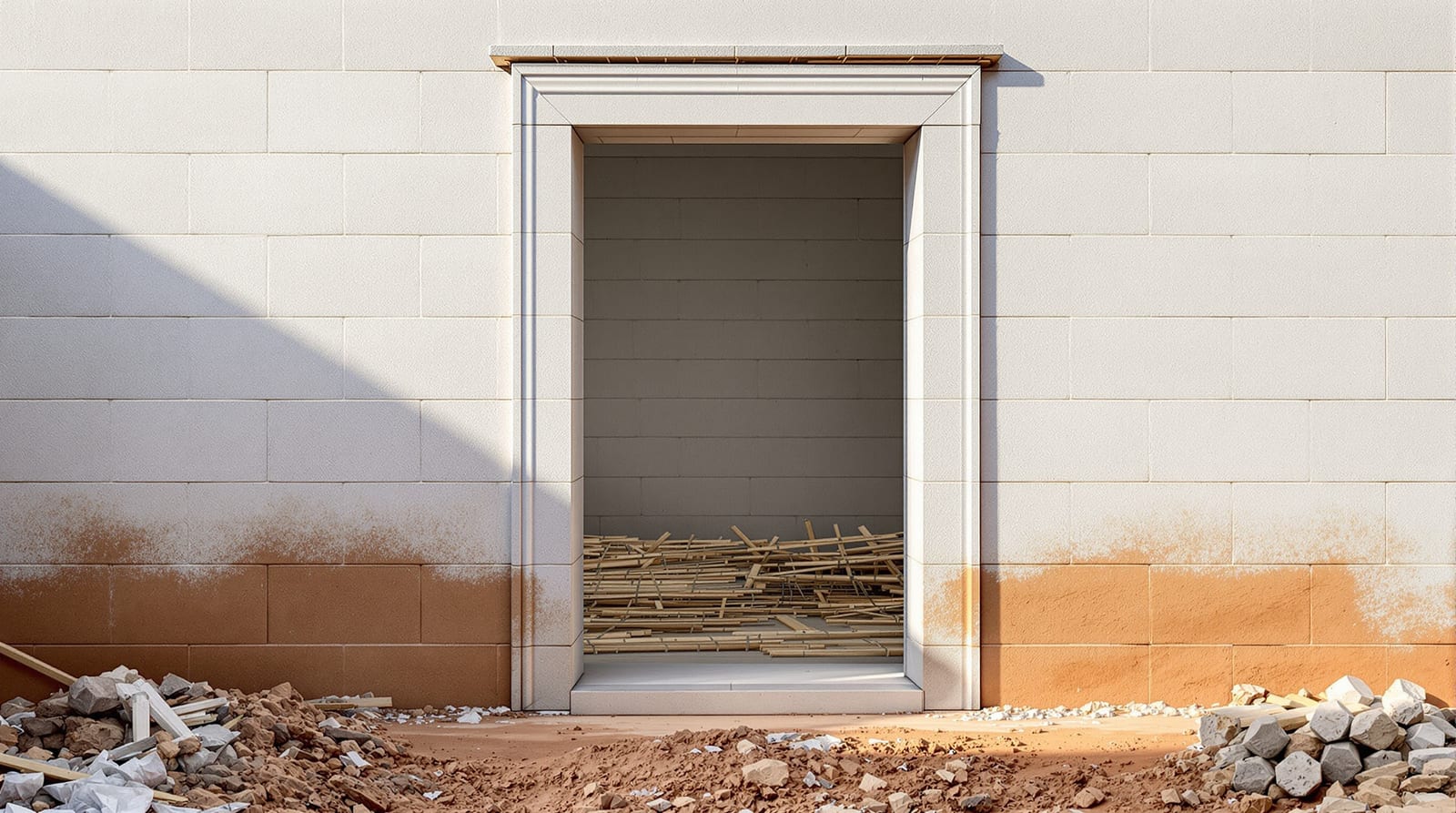
Door Opening Preparation Before Fitting (India 2026)
How to prep a door opening before the chowkhat goes in — checking size, plumb and square, confirming the lintel, laying DPC and marking holdfasts.
A door that latches cleanly, swings true and never rots starts long before the carpenter lifts the chowkhat into place. Most fitting faults — a frame that won't go plumb, a leaf that catches, a jamb foot that rots in two monsoons — are baked in at the door opening preparation stage, when the masonry is still raw. This guide is the site engineer's and fitter's pre-fit checklist for an Indian build: how to measure and verify the opening, confirm the lintel is doing its job, lay a damp-proof course at the base, clean out the pocket and mark holdfast positions, so that when the frame finally goes in it sits true the first time. Getting this right is the cheapest quality you will ever buy on a job; getting it wrong means cutting, packing and apologising later. The relevant standards are IS 4021 (timber frames), IS 4351 (steel frames) and NBC 2016 for minimum clear widths and egress.
Why door opening preparation decides the fit
The opening is the negative shape the frame has to live inside. If it is out of square, out of plumb, too tight, too wide, missing a lintel or wet at the base, no amount of skilled carpentry fully recovers it. The frame can be packed and twisted to suit a bad opening, but a twisted frame holds a twisted leaf — and the door self-swings, rubs or won't latch. So door opening preparation is really about handing the fitter an opening that is correctly sized, true on all three checks (level, plumb, square), structurally headed by a lintel, and dry at the base. Do those four things and the frame practically sets itself.
Step 1 — Measure the opening properly
Never trust a single tape measurement. Masonry openings bulge, lean and taper. Measure the width at the top, middle and bottom, and the height at both jambs and the centre, and work to the smallest figure — the frame has to pass the tightest point. Then check the opening is square by comparing the two diagonals: equal diagonals mean square; a difference flags a racked opening that will leave an uneven reveal.
| Check | How to measure | What you want |
|---|---|---|
| Width | Top, middle, bottom of the opening | All three within ~5mm; use the smallest |
| Height | Both jambs and the centre | Consistent; use the smallest |
| Square | Compare the two diagonals corner-to-corner | Diagonals equal (within ~5mm) |
| Plumb | Spirit level / plumb bob on each jamb face | Each jamb vertical within ~1-2mm over height |
| Level | Level across the sill / floor at the threshold | Floor level, or note the fall to plan the undercut |
The opening should be the frame outer size plus a packing gap of roughly 10-12mm each side — enough to wedge, plumb and grout/foam the frame, not so much that you are filling a chasm. Too tight and the frame won't go in without forcing (which racks it); too loose and you waste grout and lose fixing bite. Feed your finished frame size and wall type into the door rough opening calculator and cross-check against door rough opening for the full sizing logic. For the underlying measuring discipline — diagonals, smallest dimension, plumb and level — see measuring for a door.
Step 2 — Confirm the lintel
No door opening is ready until it is properly headed. The lintel (or RCC band/header) carries the masonry above the opening so that load never bears on the frame head — a chowkhat is joinery, not a beam. Before you prep anything else, confirm:
- A lintel or RCC header actually spans the opening, with a minimum bearing of about 150-200mm onto solid masonry each side so it cannot shear or sag at the ends.
- The underside of the lintel is level and at the correct height to give the frame head its packing gap plus the finished-floor-to-head dimension you need.
- The lintel is cured and load-bearing before you load it — a green RCC band is not a lintel yet.
If the opening was left without a lintel (a depressingly common site shortcut), stop: a missing lintel will crack the wall and crush the frame head over time. It must be put right before fitting. The full requirements are in door lintel requirements.
Step 3 — Lay the DPC and base block
The single most-skipped step on Indian sites, and the one that quietly destroys door frames: damp at the base. A jamb foot standing on a wet floor wicks moisture, and timber rots while steel anchors corrode. Before the frame goes in, the opening base must be protected:
- Lay a damp-proof course (DPC) — bitumen layer, DPC membrane or a dense cement course — across the base of the opening, continuous with the wall's plinth DPC, so ground moisture cannot rise into the frame foot.
- At ground-floor and external openings, sit the jamb feet on a stone or RCC base block / saddle, not directly on a screed that will stay damp. This keeps ground-contact timber clear of standing water.
- Anti-termite treat the timber foot and the surrounding masonry — ground-contact timber is the first thing white ants find in India.
- In bathrooms and wet zones, integrate the door base with the waterproofing membrane and raise a small kerb / granite saddle; better still, specify a non-timber frame (WPC, PVC, RCC or aluminium) that cannot rot.
This is the detail that separates a frame lasting decades from one that needs frame repair after a couple of monsoons. See door frame damp proofing for the full base-protection detail.
Step 4 — Clean out the pocket and mark holdfasts
With size, lintel and DPC confirmed, the last job is to clean and mark:
- Clean out the pocket. Knock off mortar snots, projecting brick edges and droppings from the jamb faces and head so the frame seats flat against true masonry. Sweep the base clear. A lump of set mortar in the wrong place will hold a whole jamb out of plumb.
- Mark the holdfast / fixing positions. For a standard 2.1m frame, plan three fixings per jamb — roughly 200mm from the top, 200mm from the bottom and one near mid-height — landed as close as practical to the hinge and lock points where load concentrates. Where holdfasts are cast into the masonry, cut or rake out the pockets at those marks ready for the cement-concrete fill; where you will fix after, mark the drill points clear of mortar joints.
- Plan the packing zones behind the eventual hinge and lock points so the fitter packs solid and the jamb cannot bow.
The fixing logic in full — holdfasts, anchors, substrate choices and edge distances — is covered in door frame fixing methods and door frame anchoring to masonry.
The pre-fit checklist
Run this before any frame is offered up. Every line should be a yes.
| # | Check | Pass criterion |
|---|---|---|
| 1 | Opening width (top/mid/bottom) | Within ~5mm; frame size + ~10-12mm packing each side |
| 2 | Opening height (both jambs + centre) | Consistent; smallest figure clears the frame |
| 3 | Square | Diagonals equal within ~5mm |
| 4 | Jambs plumb | Each jamb vertical within ~1-2mm |
| 5 | Floor level / fall | Level, or fall noted to plan the undercut |
| 6 | Lintel | Present, cured, ~150-200mm bearing each side, level soffit |
| 7 | DPC / base block | DPC laid; stone/RCC base at ground/external & wet zones |
| 8 | Anti-termite | Timber foot and surround treated |
| 9 | Pocket clean | No mortar snots, projections or debris |
| 10 | Holdfasts marked | 3 per jamb marked / pockets cut at hinge & lock heights |
India realities to design around
The lintel shortcut. Openings get left un-headed to "save time"; never accept it — the wall cracks and the frame crushes. Damp first, always. Ground-floor and external frame feet rot because the DPC and base block were skipped; it is the cheapest insurance on the job. Tile-step undercut. Note the finished-floor level now — tile or marble laid after fitting raises the floor and a leaf with no undercut allowance starts rubbing; plan the door undercut clearance before the floor goes down. Skilled hands. Reading an opening for square and plumb, and cutting holdfast pockets true, is a mason-and-carpenter job — a rushed opening is the root of most sticking doors. And remember NBC free-egress and accessibility: keep the clear opening width to standard and plan an accessible (≤12mm / flush) threshold where required.
Once the opening passes every line above, you are ready to set the frame — continue to door frame installation, confirm the door frame plumb and level as you wedge it, and see the phase pillar door frames and the cluster pillar complete door guide.
Frequently asked questions
How big should a door opening be before fitting the frame?
As a rule of thumb, make the opening the frame outer size plus about 10-12mm packing each side — enough room to wedge, plumb and grout or foam the frame, but not so much that you lose fixing bite. Always work to the smallest measured width and height, since masonry openings taper. Run your finished frame size through the door rough opening calculator.
How do I check a door opening is square?
Compare the two diagonals corner to corner. If they are equal (within about 5mm) the opening is square; a difference means it is racked and will give an uneven reveal once the frame is in. Also check each jamb is plumb with a level or plumb bob and that the floor is level at the threshold.
Do I really need a lintel over every door opening?
Yes. The lintel or RCC header carries the masonry above so that load never bears on the frame head — a chowkhat is joinery, not a beam. Confirm it spans the opening with about 150-200mm bearing each side, is cured and has a level soffit. A missing lintel cracks the wall and crushes the frame; it must be put right before fitting. See door lintel requirements.
Why lay a DPC at the door base?
Ground moisture wicks up into a jamb foot standing on a damp floor, rotting timber and corroding steel anchors — one of the most common reasons frames fail in India. A damp-proof course and a stone/RCC base block at the opening foot keep the frame clear of standing water; in wet zones integrate it with the waterproofing and prefer a non-timber frame. See door frame damp proofing.
How many holdfast positions should I mark per jamb?
Plan three per jamb for a standard 2.1m frame — about 200mm from the top, 200mm from the bottom and one near mid-height, landed close to the hinge and lock points where load concentrates. Where holdfasts cast into the masonry, cut the pockets at those marks ready for the concrete fill. Full detail in door frame fixing methods.
What is the most common door opening preparation mistake?
Skipping the DPC and base block, leaving the frame foot to rot, and accepting an opening with no lintel or one that is out of square. Each of these is invisible once the architrave is on but causes sticking, rotting or cracking doors later. Run the full pre-fit checklist above before offering up any frame.
Export this guide
Related Guides — Deep-dive reading
Measuring for a Door: Opening Sizes & Checks (India 2026)
How to measure a door opening in India — three width and height points, diagonals, plumb and level — so the carpenter cuts it right the first time.
Home Doors & EntrancesDoor Frame Anchoring to Masonry: Holdfasts (India 2026)
How to anchor timber, steel and WPC door frames into brick, concrete block, AAC and RCC walls — fixings, edge distance, loads and India site realities.
Home Doors & EntrancesDoor Frame Fixing Methods: Holdfasts & Anchors (India 2026)
How to fix a chowkhat to masonry with M.S. holdfasts, lugs, screws and frame anchors — numbers, spacing and packing that keep the frame true.
Home Doors & EntrancesRelated Tools — Try Free
Door Size Calculator
Get the standard door and frame size by room, with swing clearance and the accessible clear-width check.
Door ToolAccessible Door Checker
Check a door against wheelchair-accessibility guidance — clear width, threshold, handle and closer force per RPwD 2021.
Compliance ToolAI Measurement Tool
Measure your room using voice, photos, or video sweep — no tape measure needed.
DesignAI