
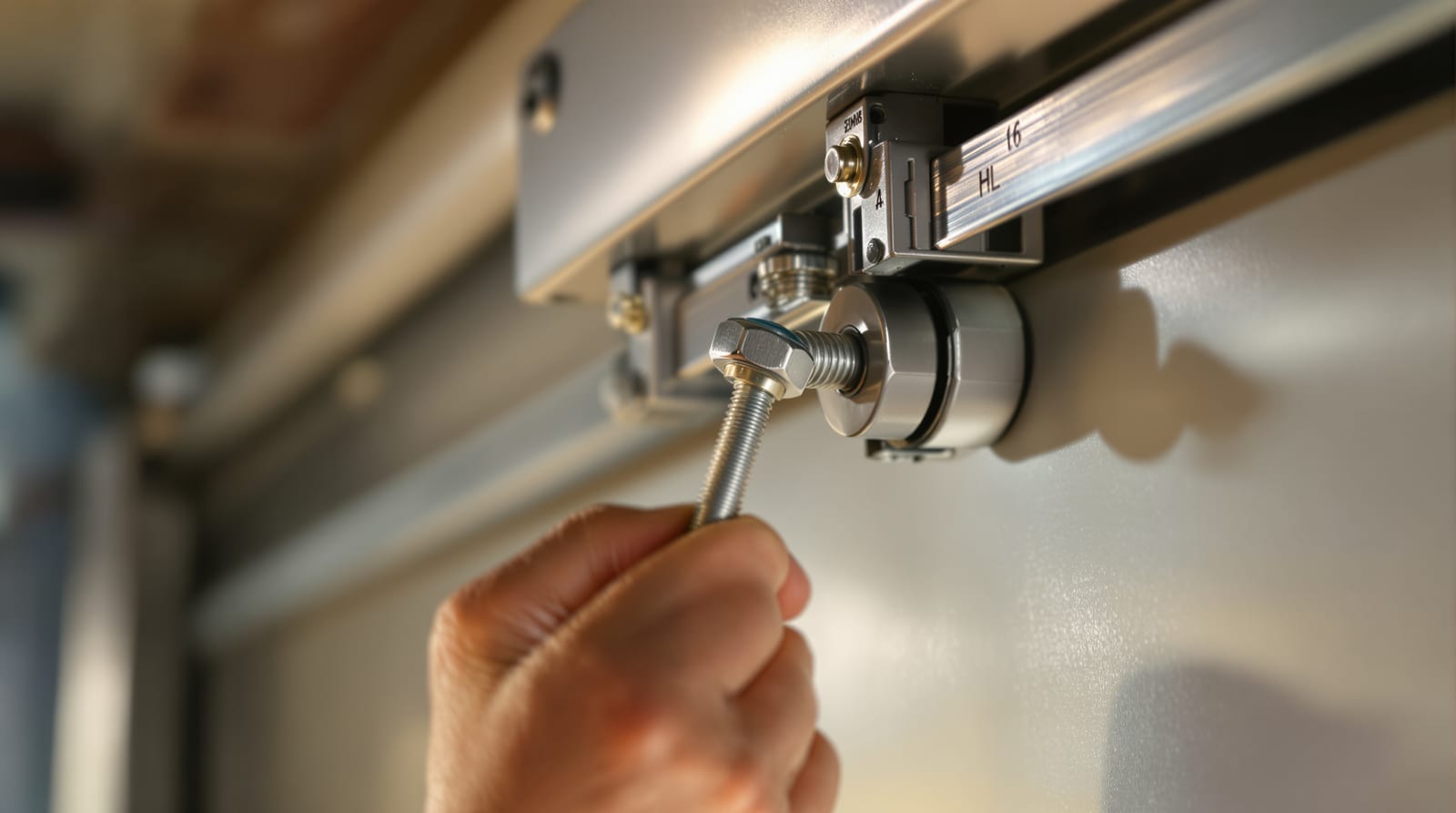
Door Closer Adjustment: Tune Speed & Latch (India 2026)
Tame a slamming or sluggish hydraulic door closer using its sweep, latch and backcheck valves — small turns, big difference.
If your door slams hard enough to rattle the frame, or drifts shut so slowly it never latches, the fix is almost always a small door closer adjustment — not a new closer. The pneumatic or hydraulic unit mounted at the top of your door has two or three tiny brass valves that control exactly how it closes. Turn them a fraction of a turn at a time and you can make the door swing shut smoothly, then snap the latch home with a satisfying, gentle click. This guide explains what each valve does, how to tune them step by step, and when a closer is simply worn out and needs replacing. Difficulty: easy. Time: 15-30 minutes.
How a hydraulic door closer works
Inside the closer body is a spring (which pushes the door shut) and an oil-filled chamber with adjustment valves (which control the speed of that push). When you open the door you compress the spring; as it relaxes, oil is forced through narrow passages, and the valves decide how fast the oil — and therefore the door — is allowed to move.
Most closers sold in India are two-valve (sweep + latch) or three-valve (sweep + latch + backcheck). The valves are usually small slotted or hex screws on the end or front face of the body, often marked S and L, sometimes 1, 2, 3, or BC.
What each valve does
| Valve | Marking | Controls | Turn IN (clockwise) | Turn OUT (anti-clockwise) |
|---|---|---|---|---|
| Sweep speed | S / 1 | Main closing arc (door ~90 to ~15 deg) | Slower sweep | Faster sweep |
| Latch speed | L / 2 | Final few degrees into the frame | Slower, softer latch | Faster, firmer latch |
| Backcheck | BC / 3 | Resists hard opening near full swing | More resistance | Less resistance |
Golden rule: turning a valve IN slows that stage; OUT speeds it up. Never unscrew a valve fully — back it out only a turn or two at most. If oil weeps from a valve, you have gone too far; screw it back in. The internal oil should never be drained.
Tools & materials you'll need
- A small flat-head screwdriver, or the hex/Allen key the valves take (often 3-4 mm)
- A torch — closer markings are tiny and often dusty
- A soft cloth to wipe grease and check for oil leaks
- A step stool (the closer sits at the top of the door)
- Optional: a phone stopwatch to time the closing cycle
No consumables are needed for adjustment. Keep silicone spray and a cloth handy if you also want to clean the arm pivot.
Step-by-step: adjusting your door closer
1. Locate the valves. Stand on the stool and look at the small end or front face of the closer body. You will see 2-3 recessed screws. Wipe them clean and note any S / L / BC or number markings with your torch.
2. Make tiny moves only. Adjust one valve at a time, 1/8 of a turn (45 degrees), then test. Small turns make large differences in oil flow; a full turn can swing the door from a crawl to a slam.
3. Set the sweep speed first. Open the door fully and let go. It should close steadily over about 5-7 seconds until the last few centimetres. Too fast? Turn the S valve IN slightly. Too slow/stalling? Turn S OUT slightly.
4. Set the latch speed. Watch the final 10-15 cm into the frame. The door should accelerate gently and push the latch fully home without banging. Slamming at the end? Turn L IN. Door stops short and doesn't latch? Turn L OUT a touch so it has enough speed to engage the strike.
5. Set the backcheck (if fitted). If the door flies open and bangs the wall, turn BC IN to add cushioning near full swing. Only adjust enough to stop the bang — too much backcheck makes the door hard to open for children or the elderly.
6. Re-test the full cycle several times from different open angles. Re-tune sweep and latch in small steps until the door closes calmly and latches reliably every time.
7. Wipe and check. Look for any oil seepage around the valves. A dry, smooth-closing door is done.
Spring power / closer size
If the door barely closes against draught or a slight breeze holds it open, the closer may be under-powered for the door, not just maladjusted. Closers are rated by EN power size 1-7 (and many Indian closers are sold simply by door weight/width). Some adjustable units have a spring tension screw or a movable arm bracket.
| EN size | Suits door width | Typical door weight |
|---|---|---|
| EN 2 | up to ~850 mm | up to ~40 kg |
| EN 3 | up to ~950 mm | up to ~60 kg |
| EN 4 | up to ~1100 mm | up to ~80 kg |
| EN 5-6 | wide / heavy main doors | up to ~120 kg |
If an adjustable spring won't generate enough force, or a small EN-2 unit is fitted on a heavy teak main door, no amount of valve tuning will fix it — fit a correctly sized closer. See our door hardware guide for choosing one.
Common faults: symptom, cause, fix
| Symptom | Likely cause | Fix | DIY? |
|---|---|---|---|
| Door slams hard | Latch valve too open; spring too strong | Turn L IN 1/8; check backcheck | Easy |
| Closes too slow / stalls | Sweep valve too closed; cold/thick oil; weak spring | Turn S OUT; if persists, replace | Easy |
| Doesn't latch / stops short | Latch valve too closed; closer under-sized; misaligned strike | Turn L OUT; check strike plate alignment | Easy |
| Closes unevenly / jerky | Worn internal seals; low oil | Replace closer | Pro |
| Oil leaking from body | Failed seal | Replace closer (cannot be refilled) | Pro |
| Arm loose or rattling | Loose mounting screws | Tighten bracket screws | Easy |
A quick valve map
India realities & when to stop
In the monsoon, thicker humid air and a slightly swollen door can make the closer seem weaker — re-tune the sweep a touch, but if the leaf itself is dragging, see fix swollen door monsoon. In peak summer heat the oil thins and the door speeds up, so a small seasonal tweak is normal. Hard water and dust on the arm pivot cause squeak and stiffness; a wipe and a little silicone spray help, as in lubricate door hinges.
Stop and call a carpenter or replace the unit if: oil is leaking (seals are gone and cannot be refilled), the closing is jerky/uneven even after tuning, the arm or bracket has pulled out of the frame, or the closer is clearly under-sized for a heavy door. Never touch an automatic/sensor or electric closer's wiring without isolating the power — those are covered in automatic door troubleshooting. For a closer that has truly failed internally, see door closer repair.
What it costs in India (2026)
| Job | DIY parts | Carpenter |
|---|---|---|
| Valve adjustment | ₹0 (your time) | ₹300-600 visit |
| Tighten/re-mount arm | screws ₹20-80 | ₹300-700 |
| New hydraulic closer (supply) | ₹600-3,000 | + ₹400-800 fitting |
| Heavy main-door closer EN 4-6 | ₹1,500-4,000 | + ₹500-1,000 fitting |
GST of 18% applies on the closer hardware. Most adjustments cost nothing but a few minutes. For a full hardware refresh, the home doors complete guide and the door troubleshooting hub walk through the rest of the door. To weigh fixing versus swapping the unit, try the repair-vs-replace door calculator or estimate a fitter's bill with the door repair cost estimator.
Frequently asked questions
Which way do I turn the door closer screw to slow it down?
Turn the valve clockwise (IN) to slow that stage and anti-clockwise (OUT) to speed it up. Move only 1/8 turn at a time and test before turning more — these valves are very sensitive.
My door slams no matter what I do. What's wrong?
First turn the latch (L) valve IN in small steps. If it still slams, the spring is too strong (closer over-sized) or the internal seals have failed and oil is bypassing — in that case replace the closer. Check the strike alignment too, as a misaligned latch can make the door bounce shut.
Why won't my door latch fully anymore?
The latch speed may be set too slow, so the door loses momentum before the bolt reaches the strike. Turn L OUT slightly. If it still won't engage, the strike plate may be misaligned or the closer is under-powered for the door.
Can I refill the oil in a hydraulic door closer?
No. Hydraulic closers are sealed units — if oil is leaking, the seals have failed and the unit must be replaced. Do not try to open or top up the body. A new closer costs ₹600-3,000 for most home doors.
How often should I adjust my door closer?
Once set, a good closer holds for months. Expect a small seasonal tweak — slightly faster in summer heat, slightly slower in monsoon humidity. Check the closing cycle a couple of times a year and after any season change.
Is adjusting a door closer a DIY job?
Yes — valve adjustment is easy and needs only a screwdriver or Allen key and 15-30 minutes. Replacing a failed closer or working on an automatic/electric operator is best left to a carpenter or technician, especially anything involving glass doors or wiring.
Export this guide
Related Guides — Deep-dive reading
Door Closer Repair: Fix or Replace a Failed Unit India 2026
Loose mount, bent arm or a leaking oil closer? Here is how to diagnose, fix what is fixable and pick the right replacement.
Home Doors & EntrancesDoor Not Closing Properly? Fix It Step-by-Step (India 2026)
A clear decision tree for a door that won't shut — latch, hinge-bind, swelling, sag, warp or a moved frame — with DIY fixes and ₹ costs.
Home Doors & EntrancesDoor Lock Repair: Fix Stiff & Sticky Locks (India 2026)
A stiff, sticky or hard-to-turn lock is usually a clean, lubricate and realign job, not a replacement. Here is the full DIY fix-it guide.
Home Doors & EntrancesRelated Tools — Try Free
Door Security Rating Calculator
Score your main door out of 100 across leaf, frame, lock and hardware — and see the top upgrades.
Security ToolMonsoon-Readiness Checklist
Pre-rain home audit across 9 categories — terrace, drains, waterproofing, electrical, HVAC, pest, vehicles, documents.
Seasonal AuditDoor Hardware Cost Estimator
Estimate the all-in hardware cost for a door — hinges, lock, handle, closer, bolts, stopper and fitting — with GST.
Door Calculator