
How to Lubricate Door Hinges, Locks & Tracks India 2026
The right lubricant for hinges, locks, latches and tracks — plus the lift-the-pin trick and why WD-40 and cooking oil are a mistake.
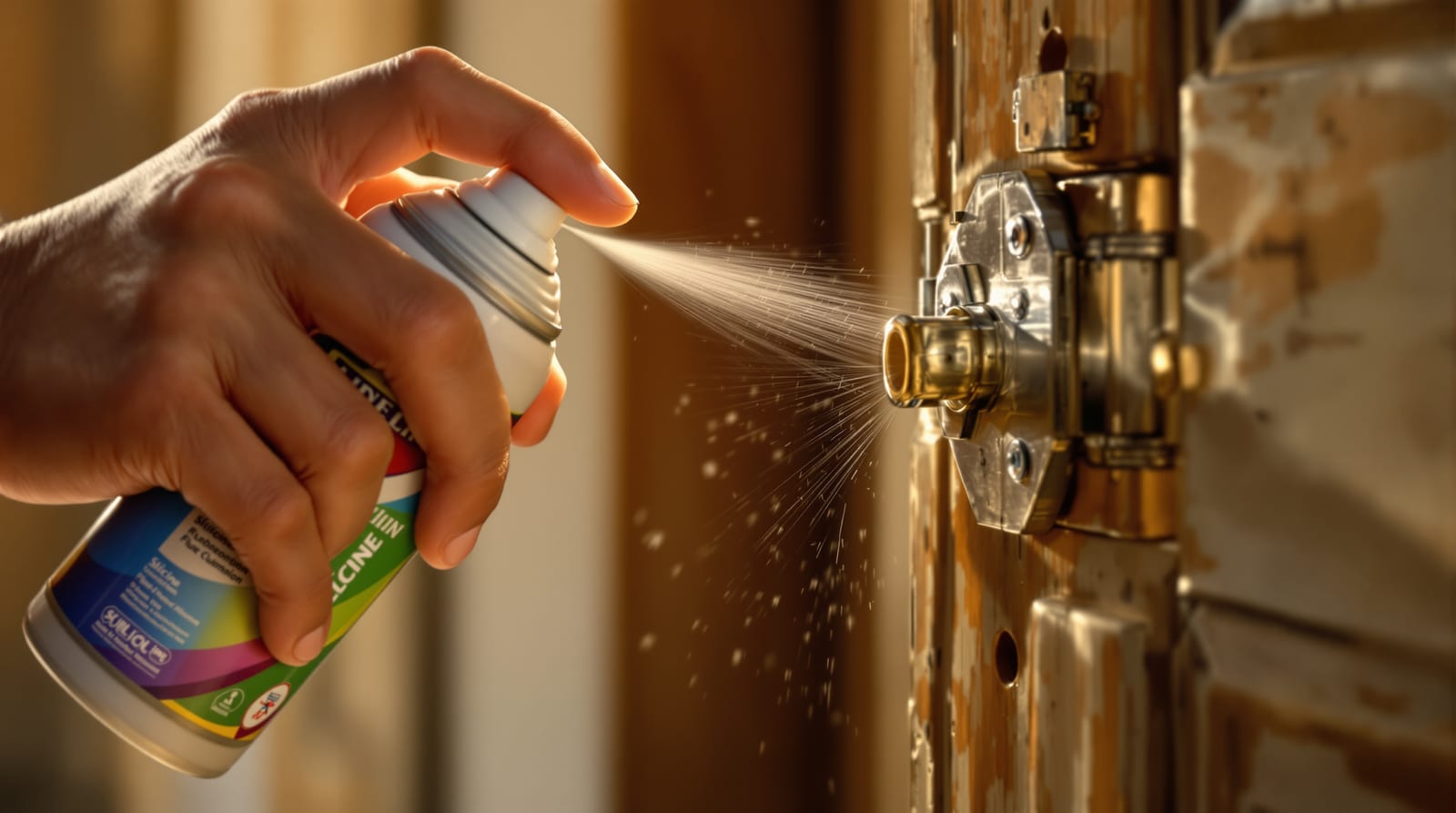
Most door noises and stiffness are not broken parts — they are dry friction. Learn to lubricate door hinges (and the lock, latch and any sliding track) with the right product and the job takes ten minutes, costs almost nothing, and a squeak that drove the whole house mad simply vanishes. The catch is that the wrong lubricant makes things worse: it attracts dust, gums up, and in India's humidity it can even speed up rust. This guide tells you exactly what to use where, how to do it cleanly, and when a noisy door is actually telling you something bigger is wrong.
Difficulty: easy. Time: 10-20 minutes for a whole house of doors. No carpenter needed for routine lubrication.
Why the right lubricant matters
A door hinge is a metal pin turning inside a metal knuckle. With nothing between them, metal grinds on metal — that is your squeak. The job of a lubricant is to put a thin slippery film in that gap. But not every slippery thing belongs there.
The big mistake is treating WD-40 and cooking oil as lubricants. WD-40 is mainly a water-displacing solvent — brilliant for freeing a seized, rusty part for a few minutes, but it is thin, evaporates, and leaves a sticky residue that grabs dust. Use it to clean and free a stuck hinge, then follow with a real lubricant. Cooking oil, ghee or vegetable oil is worse: it goes rancid, turns gummy, attracts grime and in our humidity can encourage corrosion. Both are short-term tricks, not maintenance.
Which lubricant for which part
| Part | Best lubricant | Why | Avoid |
|---|---|---|---|
| Door hinges (interior) | Silicone spray or white lithium grease | Clean, lasting, dust-resistant | Cooking oil, WD-40 as final coat |
| Hinges (outdoor/monsoon-exposed) | White lithium grease | Water-resistant, clings in humidity | Thin oils that wash off |
| Locks & cylinders (key barrel) | Graphite powder (dry) or PTFE/silicone | Dry — does not attract dust into pins | Any oil or grease (gums pins) |
| Latch & strike plate | Silicone spray or a rub of graphite | Dries clean, no transfer to clothes | Sticky grease near hands |
| Sliding door rollers & track | Silicone spray (dry-film) | Repels the hard-water grit our tracks collect | Grease (turns track into a dust magnet) |
| Tower bolt / aldrop / latch bolt | Silicone or light machine oil | Smooth slide | Over-oiling that drips on floor |
| Petroleum jelly (Vaseline) | Quick fix for a small squeak or a lock bolt | Handy, mildly water-resistant | Thick layers; melts in heat, gathers dust |
Rule of thumb: wet lubricants (grease, silicone) for hinges and tracks; dry lubricants (graphite, PTFE) for locks. Putting oil in a lock is the single most common way people jam a lock — the oil traps dust around the tiny pins until the key stops turning.
Tools & materials you'll need
- Silicone spray (₹150-350) — the all-rounder for hinges, latches and tracks
- White lithium grease, spray or tube (₹150-400) — for outdoor or heavy hinges
- Graphite powder lock lubricant (₹80-200) — for key locks and cylinders
- A clean rag or two, plus old newspaper to catch drips
- A flat screwdriver and a hammer (for the lift-the-pin method)
- An old toothbrush or cloth for cleaning grime first
- Optional: WD-40 only to clean/free a seized part before real lubricant
Total kit: roughly ₹400-900, and it lubricates every door in the house for years.
The lift-the-pin method (the clean way to do hinges)
Most people just spray the outside of a hinge. That helps a little, but the friction is inside the knuckle, around the pin. The trick is to lift the pin partway so lubricant reaches the surfaces that actually rub.
1. Open the door and wedge something under it so it cannot swing or drop while you work.
2. Find the pin head — the small cap at the top of each hinge knuckle.
3. Tap it up. Place a flat screwdriver tip under the pin head (or against a nail from below) and tap gently with a hammer. The pin should rise a few centimetres. You do not need to remove it fully.
4. Spray or wipe lubricant onto the exposed pin shaft. Silicone spray for indoor doors; white lithium for outdoor.
5. Tap the pin back down flush.
6. Swing the door ten or so times to work the lubricant through the knuckle.
7. Wipe off the excess at once — drips on a wooden door can mark the polish.
8. Repeat for each hinge (most doors have two or three).
If a pin is rusted solid and won't lift, spray WD-40 first, wait a few minutes, then try again. A pin that simply will not move — or a hinge that is bent — is a sign to read rusted hinges rather than force it.
Lubricating locks, latches and sliding tracks
Locks and key cylinders — go dry
For a stiff key or a sticky cylinder, use graphite powder, not oil. Puff a little graphite into the keyhole (most bottles have a thin nozzle), insert the key, and work it in and out several times. Wipe the key. A PTFE or silicone-based dry lubricant also works. The whole point is to leave a slippery film without anything sticky for dust to cling to. If a lock is so seized that graphite won't help, see fix a stuck door lock.
Latch and strike plate
A grinding or sticky latch responds well to a quick shot of silicone spray on the latch bolt, or a rub of graphite. If the latch isn't meeting the hole cleanly, lubricant only masks the real issue — alignment — covered in strike plate alignment.
Sliding door rollers and tracks
Indian sliding tracks collect a paste of dust and hard-water residue. Clean first, then use a dry silicone spray — never thick grease, which turns the track into a grit trap. For a track that is choked, start with sliding door track cleaning before you lubricate.
How often should you lubricate?
| Item | Indoor doors | Outdoor / main door | Monsoon note |
|---|---|---|---|
| Hinges | Every 6-12 months | Every 3-6 months | Re-check after the rains |
| Locks (graphite) | Once a year | Twice a year | Humidity stiffens locks fast |
| Sliding tracks | Every 3-4 months | Every 2-3 months | Clean grit before each monsoon |
| Latch / tower bolt | When it sticks | Twice a year | Salt air on coasts speeds wear |
The simplest habit: lubricate everything once before the monsoon and once after. India's humidity is the real enemy — doors that were silent in March start squeaking in July as moisture flushes lubricant out and starts the first specks of rust. You can build a reminder schedule for your whole home with the home door maintenance planner, and a quick diagnosis of an odd noise with the door problem diagnoser.
When lubrication is NOT the answer
Lubricant fixes friction. It does not fix these — stop and look closer, or call a carpenter (₹400-800 for a visit):
- The door drags or sags even after lubricating — that is loose hinges or a dropping frame. See fix a sagging door.
- A persistent squeak that returns in days — the hinge may be worn out and need replacement (hinge part ₹150-700), see door hinge replacement.
- Hinges flaking with rust — clean and treat the rust, don't just spray over it: rusted door hinges.
- A swollen door rubbing the frame in the rains — that is moisture, not friction: fix a swollen door.
For the bigger picture on keeping doors healthy, the door maintenance guide and the cluster complete door guide cover everything from polish to seals; for a squeak specifically, fix a squeaky door walks through the noise diagnosis. If the noise is part of a wider fault, start at door troubleshooting.
Frequently asked questions
Can I use WD-40 on door hinges?
Use it only to clean and free a stuck or rusty hinge — spray, wait, work the door. Then wipe and apply a real lubricant (silicone spray or white lithium grease). As a long-term lube WD-40 is too thin, evaporates, and its residue attracts dust, so the squeak returns.
What is the best lubricant for a squeaky door hinge?
Silicone spray for most indoor doors, and white lithium grease for outdoor or heavy doors because it resists our humidity and rain. Apply it inside the knuckle using the lift-the-pin method rather than just spraying the surface.
Why shouldn't I oil my door lock?
Oil and grease trap dust around the tiny pins inside the cylinder until the key stops turning. Use a dry lubricant instead — graphite powder or a PTFE/silicone product — which leaves a slippery film with nothing sticky for grime to cling to.
Is petroleum jelly (Vaseline) okay for hinges?
It works as a quick fix for a small squeak or a sticky bolt and is mildly water-resistant. But it softens in summer heat and gathers dust over time, so it is a stopgap, not a substitute for silicone or lithium grease.
How often should I lubricate doors in India?
Indoor hinges every 6-12 months, outdoor and main-door hinges every 3-6 months, and sliding tracks every few months. The easiest rule is once before the monsoon and once after, since humidity is what flushes lubricant out and starts rust.
My door still squeaks after lubricating — what now?
If the noise returns within days, the hinge is probably worn out or the door is sagging on loose hinges. Lubricant cannot fix worn metal or a dropping frame — check fix loose door hinges or replace the hinge.
Export this guide
Related Guides — Deep-dive reading
Door Lock Repair: Fix Stiff & Sticky Locks (India 2026)
A stiff, sticky or hard-to-turn lock is usually a clean, lubricate and realign job, not a replacement. Here is the full DIY fix-it guide.
Home Doors & EntrancesSliding Door Track Cleaning: Easy DIY Fix (India 2026)
Why Indian sliding doors get stiff — dust, grime and hard-water scale in the track — and the step-by-step clean-dry-lubricate routine that fixes it.
Home Doors & EntrancesHow to Fix a Squeaky Door India: Lubricate, Tighten, Sand — DIY in 15 Minutes
A quick DIY how-to for the creaky door every Indian home has — diagnose whether it is the hinge, the pin, or a rubbing leaf, then fix it with what is already in your house.
Home Doors & EntrancesRelated Tools — Try Free
Door Problem Diagnoser
Tell us the symptom and get the likely cause, the fix, DIY difficulty and indicative cost for any door fault.
Diagnostic ToolDoor Security Rating Calculator
Score your main door out of 100 across leaf, frame, lock and hardware — and see the top upgrades.
Security ToolAccess-Control Schedule Generator
Build the time schedules that decide when each access group can enter — an editable list for your integrator.
Time Schedules