
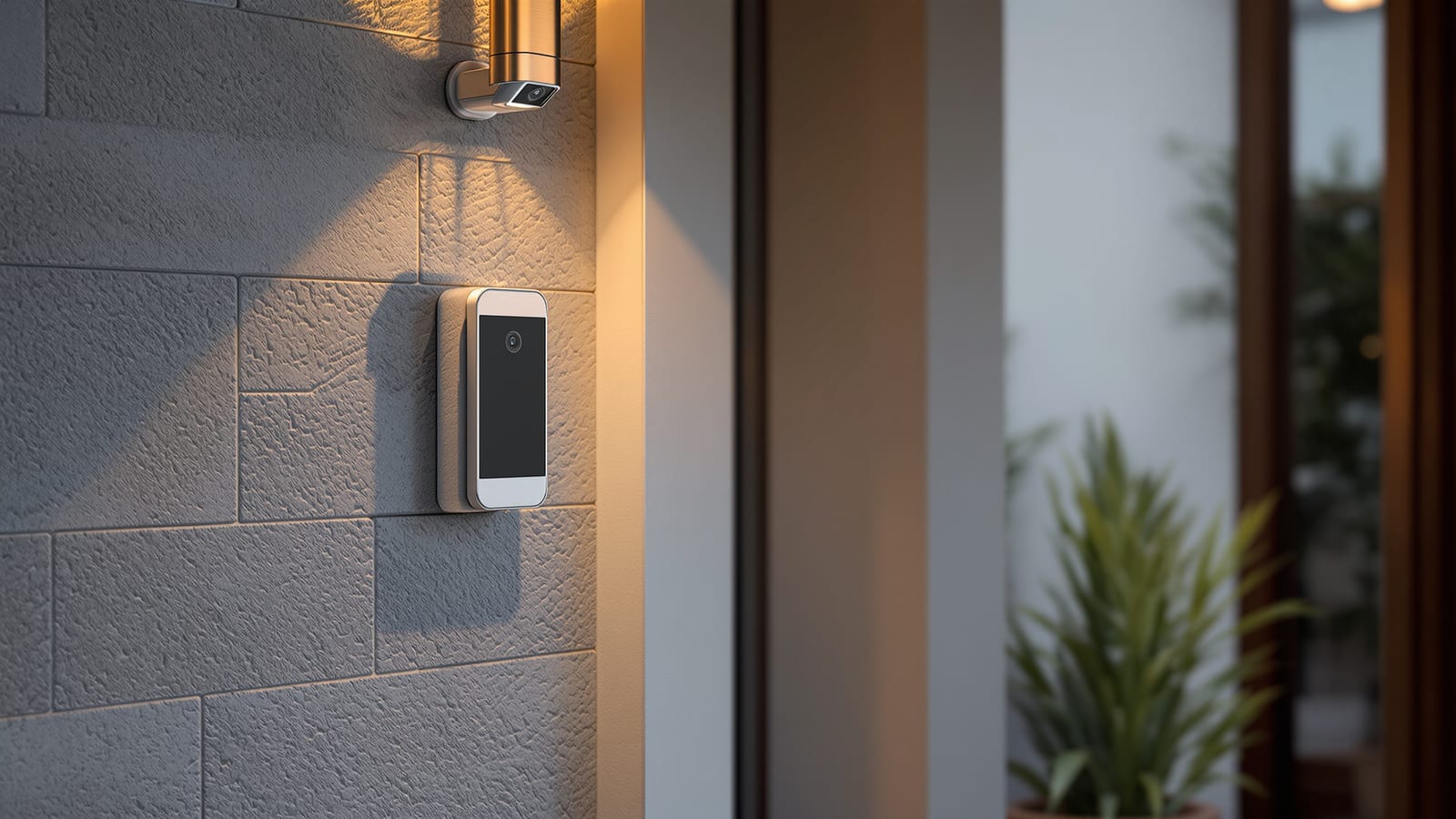
Smart Home Security Systems in India: CCTV, Sensors, Alarms & AI
How to think in layers — perimeter, entry, interior — and build a system that actually protects an Indian home: AI cameras, video door phones, door and glass-break sensors, alarms, panic buttons, gate automation, monitoring and DPDP-aware privacy, with real brands and rupee costs.
Home security in India is changing shape. The old model was a boundary wall, a grille, a padlock and, if you could afford it, a guard. The new model adds a layer of sensing on top: cameras that recognise a person from a passing cat, a doorbell that shows a courier on your phone from your office, a sensor that pings you the instant a window opens. Done well, this is a genuine upgrade in safety and peace of mind. Done badly — a jumble of cheap cameras nobody checks and alerts everyone has muted — it is theatre. This guide shows how to think about it properly, in layers, for real Indian homes and budgets.
A camera does not stop a break-in; it records one. Real security is layered — something to deter, something to detect, something to delay, and someone or something to respond. Buy for all four, not just the one that films.
Security is one half of a smart home; comfort and lighting are the other. Read this alongside the ultimate guide to smart homes in India, the home automation guide for India, and its companion smart lighting guide — lighting and security work best together, as we will see.
Think in layers, not gadgets
The single most useful idea in home security is layering. Instead of asking "which camera should I buy," ask "what happens at each ring of my home as a threat moves inward." Each layer buys time and a second chance to detect.
| Layer | What it is | Typical devices |
|---|---|---|
| Perimeter | Your boundary and gate — the first line | Bullet cameras, gate motion light, gate motor, boundary floodlights |
| Entry | Doors and windows — where intruders actually cross | Video door phone, smart lock, door and window contact sensors, glass-break sensors |
| Interior | Inside the home — the last line, and the one that protects people | Motion sensors, indoor camera, siren, panic button, hub |
A ₹3,000 door sensor that alerts you the moment a door opens can be worth more than a ₹30,000 camera nobody watches, because detection at the entry layer is what wakes you up in time. Spread your budget across the layers rather than sinking it all into one.
Smart CCTV and AI cameras
Cameras are the backbone of most Indian home security, and the market is deep: CP Plus and Hikvision dominate wired systems, Godrej Security Solutions covers the premium end, and Qubo (Hero Group), Mi, TP-Link Tapo and Imou own the affordable Wi-Fi tier. Ring (Amazon) sells doorbells and cameras here too.
Two decisions matter far more than megapixels.
Local NVR versus cloud storage
Where does your footage live? This is the core CCTV decision in India, where broadband and power are not always reliable.
| Approach | How it works | Pros | Cons |
|---|---|---|---|
| Local NVR/DVR | Cameras record to a hard disk box at home | One-time cost, footage stays in your home, works without internet | Box can be stolen or fail; remote view needs decent upload; you manage it |
| Cloud | Footage uploads to the provider's servers | Off-site (safe if unit is stolen), easy app access, AI features | Monthly fee, needs steady internet, your video sits on a company's servers |
| Hybrid | Local recording plus short cloud clips of events | Best of both, resilient | Costs the most; more to set up |
For most Indian homes a hybrid is ideal: a local NVR (CP Plus, Hikvision) for continuous 24x7 footage on a 1-2TB disk, plus a couple of cloud-clip cameras (Qubo, Ring) at the gate and main door so that even if the NVR is stolen, the clip of the person who took it is already off-site. If you pick cloud-only, size your internet plan for the constant upload and expect a recurring subscription (roughly ₹100-500 per camera per month).
AI features worth having
Modern cameras add on-device AI, and a few features genuinely cut noise:
- Person and vehicle detection — alerts only for people or cars, not every moth or shadow. This alone makes alerts usable.
- Line-crossing and intrusion zones — draw a virtual boundary; get alerted only when someone crosses it.
- Face and familiar-face recognition — "unknown person at gate" versus recognising family; treat as convenience, and mind the privacy notes below.
- Two-way audio — talk to a courier or warn off a loiterer from your phone.
Practical placement matters as much as features: cover every door and the gate, mount cameras high and angled down, avoid pointing at the sun (it silhouettes faces), and overlap fields of view at critical entries so a blind spot in one is covered by another.
Video door phones and smart doorbells
The entry layer is where a threat actually crosses, and the humble video door phone (VDP) is the workhorse here. A wired VDP (CP Plus, Hikvision, Godrej, Panasonic) with a gate outdoor unit and an indoor monitor is the standard for Indian houses and gated villas — reliable, no subscription, and it lets you see and buzz in visitors. A smart video doorbell (Ring, Qubo, TP-Link) adds phone alerts, cloud clips, and two-way talk from anywhere, so you can answer a delivery while at work.
For most independent houses, a wired VDP for the household plus a Wi-Fi doorbell for remote answering is a strong combination. Watch the power and wiring: doorbells often need a transformer or continuous supply, and Indian gate distances can exceed a Wi-Fi doorbell's reliable range, so a wired outdoor unit frequently wins at the gate.
Door, window, glass-break, motion and vibration sensors
Sensors are the cheapest, highest-value layer and the one most people skip. They detect, quietly, before anyone is inside.
| Sensor | Detects | Best placed | Note |
|---|---|---|---|
| Contact (door/window) | Door or window opening | Main door, back door, accessible windows | Two-part magnet; instant alert |
| Glass-break | Sound or shock of breaking glass | Rooms with large windows, sliding doors | Covers what a contact sensor misses |
| Motion (PIR) | Movement in a space | Living room, corridor, staircase | Use pet-immune versions if you have animals |
| Vibration | Tampering, drilling, forced entry | Safes, main gate, grilles | Good for detecting an attempt early |
Aqara, Qubo, Godrej and CP Plus all sell these, usually battery-powered and wireless, linked to a hub that raises the alarm and sends the alert. The magic is combination: a door contact plus an interior motion sensor plus a siren means an intruder trips detection at the entry layer and again inside, with a loud response either way.
Smart alarms, sirens and panic buttons
Detection is useless without a response, and the loudest, cheapest response is a siren. A 100dB-plus indoor or outdoor siren tied to your sensors does two jobs: it frightens off most opportunists immediately, and it alerts you and the neighbours. Pair it with the smart lighting "away" and "panic" scenes so a trigger also floods the house and compound with light — a burglar in a suddenly bright, screaming house rarely stays.
A panic button — physical (Godrej, CP Plus) or a phone shortcut — lets a resident raise the alarm instantly during a threat, medical emergency or intrusion, triggering the siren and notifying your contacts or a monitoring service. Keep one at the bedside and one near the main living area. For elderly parents living alone, a panic button plus a couple of sensors is often more valuable than a wall of cameras.
Gate and garage automation
Automating the gate and garage is both convenience and a security layer. A motorised gate (sliding or swing) with remote and app control means you never step out of the car into a dark lane to open it, and it can auto-close so the gate is never left ajar. Integrate the gate camera and a motion-triggered light so approaching the gate at night lights it and starts a recording. This overlaps heavily with vehicle-entry systems — see the door automation guide for India for gate motors, sensors and safety edges in detail.
Integration with smart locks
Security gets smarter when the layers talk. A smart lock at the door (covered fully in the smart door locks guide for India) can trigger and be triggered by the rest of the system: arm the alarm automatically when the door locks and everyone leaves; disarm and light the hall when a family member unlocks with a fingerprint; log every entry with a timestamp and, paired with the door camera, a face. This "who came and went, and when" record is one of the most reassuring things a connected home offers, especially for tracking domestic help, deliveries and children returning from school.
Monitoring: self versus professional
Who watches when the alarm goes off?
| Model | How it works | Cost | Best for |
|---|---|---|---|
| Self-monitoring | Alerts go to your phone; you decide and call for help | No monthly fee (device cost only) | Most Indian homeowners; tech-comfortable families |
| Professional monitoring | A control room watches your alarms 24x7 and dispatches response | Monthly/annual fee | Frequent travellers, large properties, businesses |
Most Indian homes self-monitor, and it works well when alerts are tuned (person-only, entry sensors) so you are not desensitised by false pings. Professional monitoring — offered by security firms and some brands — makes sense if you travel often, own a large or second property, or want a guaranteed response when you cannot answer. Many gated communities also run a central control room you can tie into. Whatever you choose, agree in advance who calls the police or the society guard, because an alert nobody acts on protects nothing.
Privacy, data and the DPDP Act
Security cameras and AI create real privacy duties, and India now has a law that matters. The Digital Personal Data Protection Act, 2023 (DPDP) governs personal data, and camera footage of identifiable people is personal data. For a home this mostly means good sense, but the principles are worth respecting:
- Do not point cameras into private spaces — bedrooms, bathrooms, and ideally not a neighbour's windows or the public street beyond what you need. Cameras aimed into a neighbour's home can invite complaints and legal trouble.
- Prefer local storage or a reputable cloud — understand where your video goes and who can see it, especially with budget brands whose servers and security practices vary.
- Secure the system itself — change default passwords, keep firmware updated, and use strong Wi-Fi security; unsecured cameras are routinely hijacked and their feeds leaked.
- Tell household staff and regular visitors that cameras are in use; it is both courteous and, for staff, the fair thing.
The same data-hygiene logic runs through the whole smart home design guide for India: convenience should never quietly cost you control of your own home's data.
Cost bands
Treat these as 2026 planning bands for an independent Indian house, not quotes.
| Setup | Typical India cost (2026) | What you get |
|---|---|---|
| Entry Wi-Fi kit | ₹8,000 - ₹20,000 | 1-2 Wi-Fi cameras, a video doorbell, a couple of sensors, self-monitored |
| Mid wired CCTV + sensors | ₹30,000 - ₹70,000 | 4-8 camera NVR system, VDP, door/window sensors, siren, professional install |
| Comprehensive layered | ₹1,00,000 - ₹3,00,000+ | Full CCTV, AI cameras, gate automation, smart locks, alarm, integration |
| Add-on: cloud storage | ₹100 - ₹500 per camera/month | Off-site event clips and AI features |
| Add-on: professional monitoring | ₹500 - ₹2,500/month | 24x7 control-room response |
For a whole-home estimate that blends security with the rest of your automation, use the smart home cost calculator.
The honest closing advice: build in layers and start where an intruder starts — the gate and the doors. A wired VDP or doorbell, contact sensors on your entry points, a siren and one or two well-placed cameras will protect the average Indian home far better than a dozen cameras and nothing else. Add interior sensors and AI as budget allows, keep the system secure and private, and make sure someone — you or a service — will actually respond when it calls for help.
References
- Digital Personal Data Protection Act, 2023 — MeitY
- BIS IS 16910 (Part series): CCTV surveillance systems — requirements
- IEC 62676: Video surveillance systems for use in security applications
- Hikvision India — support and product documentation
- CP Plus — home security cameras and NVR range
- Godrej Security Solutions — home security systems
Export this guide
Related Guides — Deep-dive reading
CCTV vs Video Door Phone: Which Does Your Home Need?
They look similar and get confused constantly, but a CCTV camera and a video door phone do different jobs — one watches the whole property and records, the other answers your door and controls who comes in. This guide settles CCTV vs video door phone for Indian homes: what each is for, where they overlap, real rupee costs, apartment versus villa relevance, and why most homes end up wanting both.
Smart HomeRemote Security Monitoring in India (2026): Watching and Responding From Anywhere
Watching your home from your phone is easy; making an alert lead to a real response is the hard part. The two honest models compared — self-monitoring by you and your family versus a paid professional monitoring centre — plus the secure tech behind remote access, the privacy stakes of a stranger watching inside your home, and why remote monitoring is only ever as good as the responder behind it.
SecuritySecurity for People Living Alone in India (2026): Calm, Practical Habits When There Is No Second Person to Notice
Living alone is an ordinary and growing part of Indian life - the student in a new city, the working single, the elder whose children are abroad, the person after a separation. It does not call for fear. It calls for a few deliberate habits, because there is no second person in the home to notice trouble, raise the alarm, or catch an accident. This is calm self-reliance, layer by layer.
SecurityRelated Tools — Try Free
CCTV Camera Coverage & Count Calculator
Estimate how many CCTV cameras you need, the NVR channels, storage in TB for your retention period, and an indicative all-in cost with GST.
CCTV CalculatorCCTV Cloud vs Local Cost Calculator
Compare cloud CCTV subscription against a local NVR + HDD — upfront, 5-year total, monthly fee and break-even.
Cloud vs LocalAcoustic Privacy (STC) Visualizer
Indian healthcare acoustic visualizer — compare wall assemblies and noise sources, see received SPL after STC attenuation, and check FGI 2018 / IS 1950 / NABH speech-privacy compliance with live dual-canvas waveform.
Acoustic Tool