
Porch Flooring in India: Anti-Slip, Stone & Heritage Sit-Out Materials (2026)
How to choose porch, verandah and sit-out flooring that grips in the monsoon, shrugs off sun and grit, cleans in minutes and welcomes every guest.
The porch is the first floor anyone touches when they reach an Indian home — the covered-but-open sit-out, the verandah, the old-world otla where the family catches the evening breeze and a guest waits to be welcomed in. It is a transition zone: roofed against the worst sun, but wide open to driven monsoon rain, dust, fallen leaves and the grit walked in from the garden and gate. That mix is exactly what trips up the wrong floor. A glossy living-room tile carried out here turns into a skating rink the moment rain blows in; a porous, untreated stone stains with leaf-fall and tea spills. This guide picks the floors that actually belong on an Indian porch, ranks them for grip, durability and welcome, and gives the ₹/sq ft so the floor looks gracious, grips in the rain and wipes clean in minutes.
What a porch floor actually has to handle
A porch sits halfway between indoors and out, so it carries the demands of both — and a few that are uniquely its own.
Anti-slip when rain blows in — the safety driver. A porch is roofed but not enclosed. Driven monsoon rain wets the outer edge, leaf-fall holds moisture, and morning dew settles overnight. A polished or high-gloss surface here is genuinely dangerous, especially for elders settling into a chair. The porch wants a matte, textured or naturally riven face rated for the wet — DIN 51130 R10 as a sensible minimum, and R11 on the exposed outer band where rain reaches. Slip safety, not shine, is the first rule of a sit-out.
Durability against sun, rain and grit. The floor takes UV at the open edge, thermal swing between cool nights and hot afternoons, wet-dry cycling through the monsoon, and constant abrasion from shoes, sandals, garden grit and the scrape of moved chairs. It must not fade, spall, lift or wear a path over a decade of this. Frost is irrelevant in most of India, but heat and water cycling are not.
Easy to clean — dust, leaves and spills. A sit-out collects dust, dry leaves, bird droppings, the odd spilt cup of tea and muddy footprints from the garden. The floor should sweep and swab clean without staining, ideally without sealing fuss. Tight joints and a non-porous or sealed surface keep the daily clean to minutes.
A welcoming first impression. This is the face of the house — the floor a guest sees before the door opens. It should read warm and gracious, not utilitarian. Material, colour and a considered border do a lot of the welcoming work, which is why heritage finishes earn their place here even when a plain tile would technically do.
Cool and comfortable underfoot for sitting. People sit, stand and walk barefoot on a porch in the evening. Natural stone and terracotta stay cool and pleasant underfoot far longer into a hot day than dark glossy tile, which is part of why the traditional verandah was always stone or oxide.
A graceful transition to entrance and garden. The porch links the open garden or driveway to the front door, usually with a step down to the lawn. The floor should resolve that transition — a border or a change of material at the step, a coordinated but not identical finish to the foyer and entrance inside, and a clean edge where it meets the garden path or courtyard.
The right porch floor — recommendation and cost table
The table ranks the floors that win on an Indian porch, the indicative installed cost in 2026, and the one driver that should decide each. Costs are broad ranges; confirm against current quotes and the flooring cost per square foot guide.
| Porch floor | Grip (wet) | Durability | Look | ₹/sq ft (installed) | Best for |
|---|---|---|---|---|---|
| Matte / anti-skid vitrified (PGVT, full-body) | R10-R11 textured | Excellent | Clean, modern, any shade | 90-220 | Low-maintenance, easy-clean sit-outs |
| Kota stone (matte/leather finish) | Good when matte | Excellent | Earthy green-grey, classic | 60-150 | Traditional, cool, ages well |
| Shahabad stone | Good (natural) | Excellent | Rustic grey, heritage | 60-150 | Old-world verandahs, courtyards |
| Sandstone (natural / flamed) | Very good (riven) | Very good | Warm beige, red, mint | 90-220 | Warm, characterful porches |
| Granite (flamed / leathered) | Very good flamed | Outstanding | Premium, dark or speckled | 130-350 | Long-life, low-care, premium look |
| Terracotta / clay tiles | Good (matte) | Good (seal it) | Warm rustic charm | 80-180 | Heritage, cool underfoot |
| Red-oxide / IPS | Good (matte) | Very good | Glossy-warm, vintage | 90-220 | Period homes, seamless look |
| Athangudi / cement (encaustic) tiles | Moderate (seal it) | Good | Hand-made patterned charm | 120-300 | Statement heritage porches |
A welcoming verandah floor — the design idea
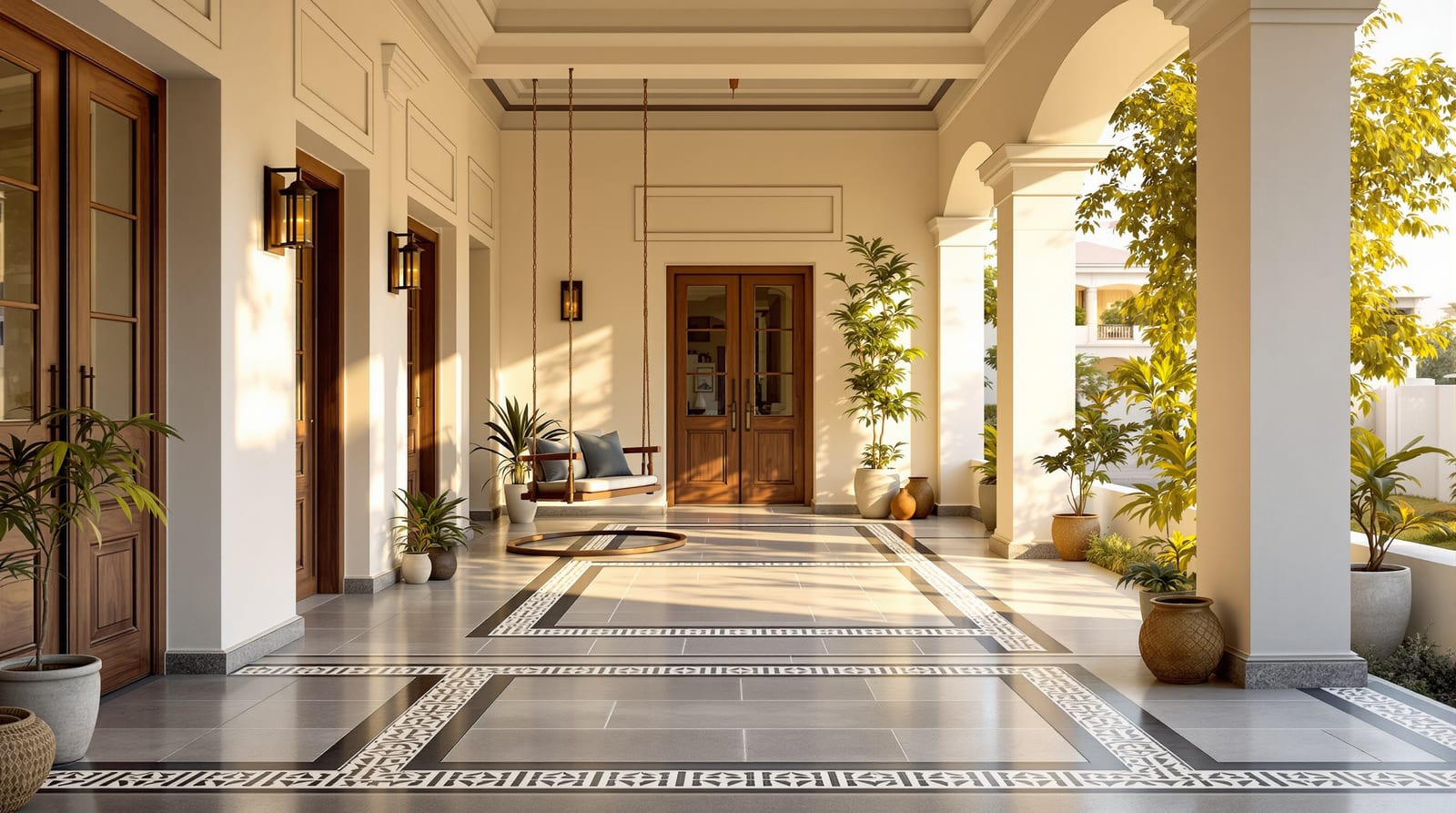
This sketch shows the porch as three pieces of one floor: a sheltered inner field that can be a finer finish, an anti-slip outer band where rain reaches, a decorative border that frames the sit-out, and a clean step down to the garden.
Anti-slip vitrified and porcelain — the low-maintenance default
For most modern Indian homes the easiest porch floor is a matte or anti-skid vitrified tile — full-body GVT or a textured PGVT in a 600x600 or large format. It is hard, non-porous, fade-resistant, needs no sealing, and a textured R10-R11 face grips even when rain blows across it. It mops clean of dust and tea spills in seconds, comes in every shade from stone-look to wood-look, and lets you run a coordinated but distinct finish from the foyer inside. The one rule: never carry a glossy living-room tile onto the porch — specify the anti-skid variant and check the rating against the anti-slip flooring for wet areas guide. For grade and finish selection, see vitrified tile flooring and its PGVT cousin; to match a zone to an R-rating fast, use the anti-slip rating selector.
Natural stone — traditional, cool and ageing beautifully
Stone is the classic verandah floor in India for good reason: it stays cool underfoot, survives sun and rain for generations, and looks better as it weathers.
Kota stone in a matte or leather finish is the workhorse — earthy green-grey, tough, cheap at ₹60-150/sq ft installed, and naturally grippy when not mirror-polished. It is the default verandah stone across much of India. Shahabad stone is its rustic grey cousin, a heritage favourite for old-world verandahs and adjoining courtyards. Sandstone — beige, red or mint, in a natural-cleft or flamed finish — brings warmth and excellent wet grip from its riven face. For a premium, near-zero-care porch, flamed or leathered granite is outstanding: it shrugs off everything and the textured finish grips in the rain, at ₹130-350/sq ft. Keep any stone matte or flamed, not polished, on the porch — and seal porous stones once a year so leaf-fall and spills do not stain.
Terracotta, red-oxide and Athangudi — heritage charm
If the home has character — a courtyard house, a restored bungalow, a Kerala or Chettinad sensibility — the heritage finishes belong on the porch.
Terracotta and clay tiles give the warm, rustic, cool-underfoot charm of the traditional otla; seal them to resist staining and they will patina gracefully. Red-oxide and IPS deliver the seamless, glossy-warm vintage floor of South Indian and old Bombay homes — jointless, cool, and unmistakably period; keep the finish matte rather than waxed-glossy on the exposed band for grip. Athangudi and patterned cement (encaustic) tiles turn the porch into a statement: hand-made, jewel-toned, geometric, and full of welcome. Cement and Athangudi tiles are more porous and a touch slick when wet, so seal them well and reserve the most decorative pattern for the sheltered inner field, with a grippier matte border or stone band at the rain-exposed edge.
Design and detailing tips
A porch floor is as much about the layout as the material. Run a border — a contrasting stone strip, a cement-tile band, a granite frame — to define the sit-out and frame the welcome. Slope the floor 1-2 percent away from the front door so blown-in rain drains to the garden, not under the threshold. Keep the threshold low (under 12mm where it meets the door) for an easy, accessible step in, per NBC and accessibility good practice. Change material or drop a step at the garden edge to resolve the transition cleanly. And coordinate, don't copy the foyer inside — a related tone with a grippier outdoor finish reads as one considered journey from gate to door. Shortlist the right finish for your exact sit-out with the space flooring selector, and budget it with the flooring cost calculator.
Do and don't for porch floors
Do specify a matte or anti-skid finish — R10 minimum, R11 on the rain-exposed outer band. Do slope the floor away from the door and keep the threshold low. Do seal porous stone, terracotta, oxide and cement tiles, and renew the seal yearly. Do use a border or a change of material to frame the sit-out and resolve the step to the garden. Do coordinate the tone with the foyer for a continuous welcome.
Don't carry a glossy living-room tile onto the porch — it is a slip hazard the moment rain blows in. Don't leave porous heritage floors unsealed; leaf-fall and tea will stain them. Don't trap water at the threshold with a flat or back-falling slope. Don't over-pattern the rain-exposed edge with a slick decorative tile; save the statement for the sheltered field. Don't forget the porch is the first impression — it deserves a considered floor, not the offcuts.
Frequently asked questions
What is the best flooring for a porch or verandah in India?
For low maintenance, a matte or anti-skid vitrified tile (R10-R11) is the easiest choice — non-porous, fade-proof and clean in seconds. For tradition and a cool-underfoot sit-out, natural stone wins: kota stone, shahabad, sandstone or flamed granite, all kept matte rather than polished. For heritage charm, terracotta, red-oxide or patterned cement tiles bring character — sealed against stains.
How do I make a porch floor anti-slip for the monsoon?
Choose a matte, textured or naturally riven face rather than a polished one, rated DIN 51130 R10 as a minimum and R11 on the outer band where driven rain reaches. Flamed or leathered stone, riven sandstone and anti-skid PGVT all grip when wet. Slope the floor 1-2 percent away from the door so water drains to the garden. Check ratings with the anti-slip flooring for wet areas guide and the anti-slip rating selector.
How much does porch flooring cost per square foot in India?
Indicatively in 2026: matte/anti-skid vitrified ₹90-220/sq ft, kota and shahabad stone ₹60-150, sandstone ₹90-220, flamed granite ₹130-350, terracotta ₹80-180, red-oxide/IPS ₹90-220, and Athangudi or patterned cement tiles ₹120-300. Add a border and the step detail. Model your own with the flooring cost calculator.
Should the porch floor match the indoor entrance floor?
Coordinate, don't copy. The porch is wet-exposed and the foyer inside is not, so the two need different finishes — a grippier matte or flamed surface outdoors, a more refined one indoors. A related tone or material across the threshold, with a clean change at the door, reads as one welcoming journey from garden to door while keeping each floor right for its conditions.
Can I use heritage cement or Athangudi tiles on an open porch?
Yes, with care. Cement and Athangudi tiles bring unmatched hand-made charm but are porous and a little slick when wet, so seal them well and renew the seal yearly. Reserve the most decorative pattern for the sheltered inner field, and run a grippier matte stone or anti-skid band along the rain-exposed outer edge for safe footing in the monsoon.
Export this guide
Related Guides — Deep-dive reading
Anti Slip Flooring for Bathroom and Wet Areas in India: R-Ratings, Finishes and Genuinely Safe Tile Choices
How to choose genuinely safe flooring for bathrooms, kitchens, balconies, pools, entrances and elderly- or child-friendly homes — the R-rating system, finishes that grip wet feet, anti-skid natural stone, slope to drains and the tiles to avoid.
Flooring & SurfacesFoyer & Entrance Flooring in India: Best Materials, Anti-Skid Picks, Vastu & Cost
The floor that makes the first impression and takes the hardest hits — grit, monsoon mud and footfall — done durable, impressive and safe, with a dirt-trapping entry zone and Vastu welcome notes.
Flooring & SurfacesCourtyard Flooring in India: Cool, Anti-Slip Stone & Aangan Materials (2026)
How to floor an open-to-sky aangan or central courtyard so it stays cool underfoot, grips in the rain, drains to a central point and ages beautifully.
Flooring & SurfacesRelated Tools — Try Free
Flooring Cost Calculator
Estimate the all-in cost of a floor — material, laying, wastage, skirting and GST — by area and material.
Flooring CalculatorFlooring Material Selector
Get the best flooring material for your room, budget and climate, with anti-slip checks for wet areas.
Flooring ToolDoor Cost Calculator
Estimate the all-in cost of a door — leaf, frame, hardware, fitting and GST — by type, material and size.
Door Calculator