
Landscape Planning for Corner Plots
The landscape of a two-frontage plot — the wraparound garden, double kerb appeal, screening two roads, the splayed corner, and tucking the private garden into the sheltered inner corner
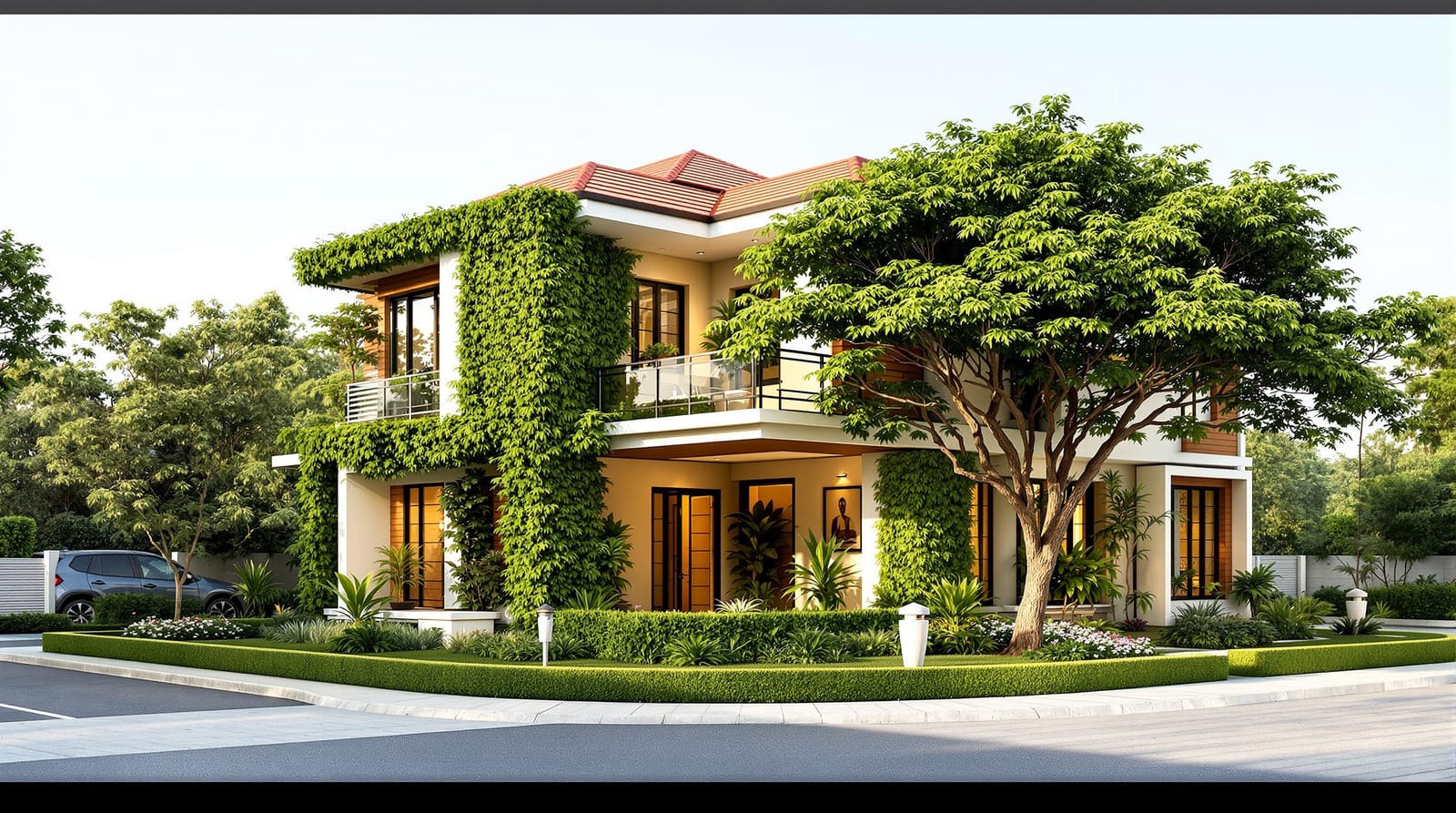
A corner plot is the only residential site that gives a garden two stages to perform on — two street frontages, two stretches of setback, twice the kerb appeal — and the homeowners who treat that second frontage as a planting opportunity rather than a problem end up with the greenest, most admired house on the layout.
Most of the corner-plot conversation in India is about the building: how much buildable area you lose to the second setback, where the gate goes, what the byelaws and Vastu allow. That ground is already covered thoroughly in our sibling guide, Corner Plot Design Strategies — read it for setbacks, FSI, plot layout and gate logic. This guide deliberately stays out of that lane. Here we are interested in one thing only: the landscape of a corner plot — the wraparound garden, the screening, the splayed corner, the drainage and the security planting that the two-frontage geometry both rewards and demands.
Why a corner plot is a landscape gift
An intermediate plot — sandwiched between two neighbours — has exactly one public face: the front. Everything else is a side margin you share with a boundary wall and a neighbour's drainpipe. A corner plot is different. It has two adjoining road frontages, which changes the planting arithmetic completely.
- More setback area to plant. Because byelaws demand a margin from each road, a corner plot carries setback along two sides instead of one. That "lost" buildable land is, from a gardener's point of view, found garden. On a typical 40×60 corner site you may have 250–400 sq ft more open, plantable ground than an intermediate plot of the same dimensions.
- Two stages for kerb appeal. Passers-by, neighbours and prospective buyers see your home from two streets. A well-planted corner reads as a small civic landmark — the house everyone uses to give directions.
- A natural wraparound. The open ground flows continuously around two sides, so a single garden idea can sweep around the corner rather than being chopped into front-and-back fragments.
This is the same logic that makes corner plots prized for villa landscape design: more perimeter, more frontage, more room for the garden to breathe. But it comes with a matching cost, and the rest of this guide is about banking the gift while paying that cost intelligently.
The matching challenge: double exposure
Two frontages mean twice the exposure. Everything that makes a corner plot generous also makes it more public:
- Less privacy. Two streets look in on you instead of one. The classic intermediate-plot trick — a private back garden screened by neighbours' walls — simply isn't available on two of your sides.
- More street noise and dust. Vehicles slow, turn and accelerate at junctions, so a corner sees more honking, braking and stop-start exhaust than a mid-block plot. Dust thrown up from two roads settles on two sides of your garden.
- Security on two sides. A burglar or trespasser has two boundaries to probe instead of one, and corners are often less overlooked by neighbours than the middle of a block.
The good news is that planting is the cheapest, most beautiful tool for all three problems at once — a layered green buffer screens eyes, filters dust, absorbs some noise and deters intruders, all while looking like a garden rather than a fortification. The art is doing it without turning your home into a walled bunker, which is exactly the balance our Landscape Privacy Design guide explores in depth.
The wraparound garden strategy
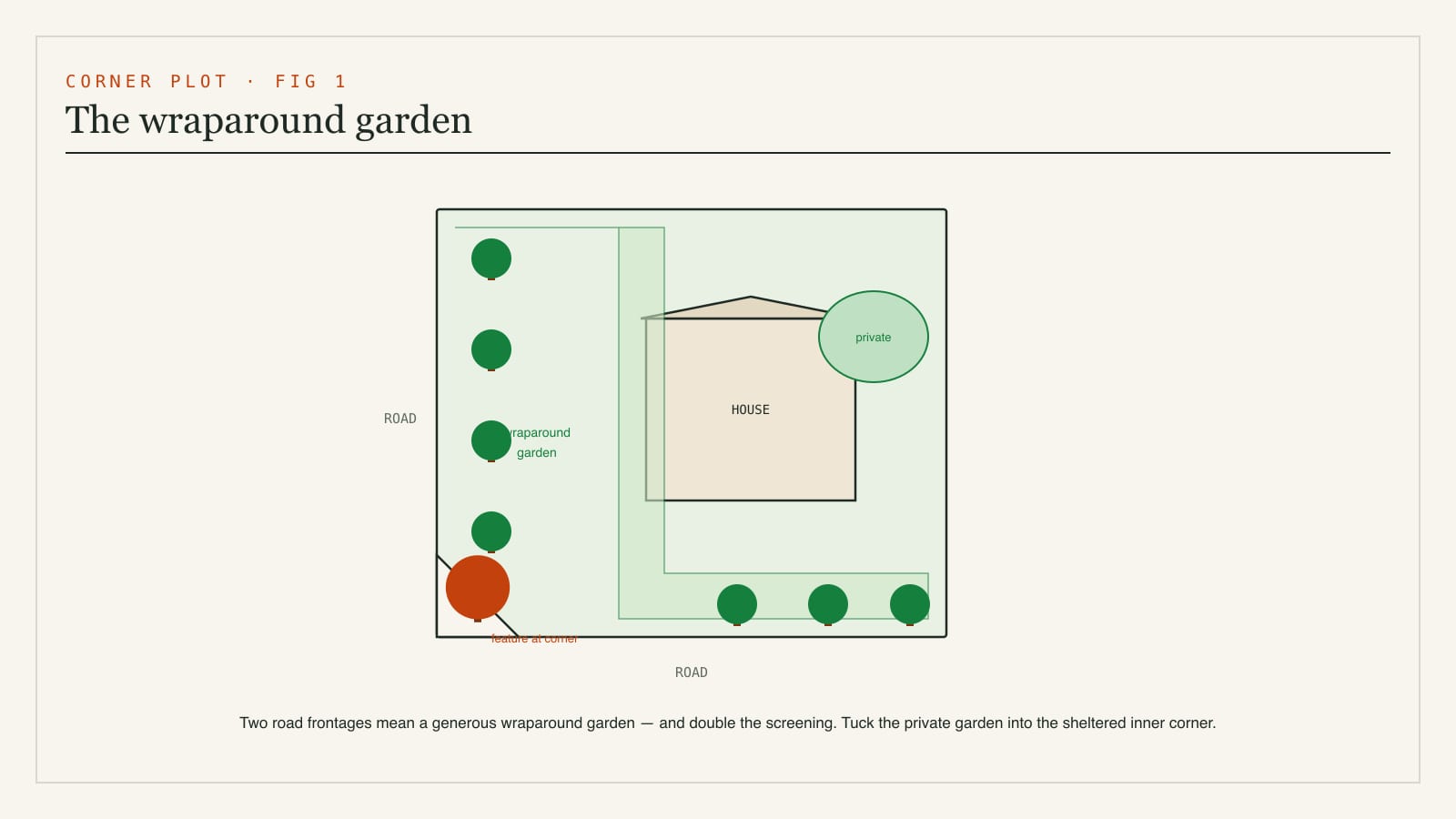
The defining landscape move on a corner plot is the wraparound garden: a continuous planted band that flows around both street-facing sides and turns the corner, rather than three disconnected strips.
Think of the plot as having two zones:
1. The public face — the L-shaped band along the two roads. This is where screening, kerb appeal and the splayed-corner feature live. It is seen, so it must look good year-round and forgive a little neglect.
2. The private garden — tucked into the inner corner, the quadrant of the plot furthest from both junctions, where the building's own mass shelters it from the two streets. This is your family's outdoor room: the lawn, the seating, the kids' play, the kitchen garden.
To make the wraparound read as one idea and not a patchwork, carry a continuous unifying element around the corner — a single ground-cover species, a low evergreen hedge, a repeated palette of terracotta planters, or a band of the same paving. Then vary the planting behind that unifying line. This is the principle of designing the landscape as a whole site rather than room-by-room, which we set out in Landscape Planning Before Building Design.
A typical wraparound layering, from road inward, looks like this:
| Layer | Position | Purpose | India-real choices |
|---|---|---|---|
| Edge / kerb line | At the compound wall or fence | Define, soften the hard boundary | Mondo grass, mother-in-law's tongue (Sansevieria), low Duranta hedge |
| Screening shrub band | 0.6–1.2 m inside | Privacy, dust capture at eye level | Murraya (kamini), Clusia, Tecoma stans, bamboo (clumping, e.g. Bambusa multiplex) |
| Canopy / feature trees | At the corner & key gaps | Shade, scale, kerb appeal | Plumeria (frangipani), Tabebuia, Lagerstroemia (crepe myrtle), Cassia fistula (amaltas) |
| Inner private planting | Inner corner | Family enjoyment, soft underfoot | Lawn (Bermuda/Selection-1), fragrant Jasminum sambac, edibles |
Choosing which side faces the public — and which holds the private garden
On a corner plot you get to choose the orientation of your privacy, and that choice deserves thought rather than defaulting to whatever side the gate lands on.
Weigh four factors:
- Road hierarchy. Almost every corner plot meets one busier road and one quieter side road. Put the private family garden along the quieter road, where there is less noise, dust and prying. Reserve the busier frontage for the public-face screening band.
- Sun and the harsh west. In most of India the western edge bakes from afternoon into evening. If a frontage faces west, lean toward planting it with tough, sun-hardy screening trees (which double as shade) rather than placing tender seating or a lawn there. A north- or east-facing frontage is gentler and friendlier to a usable garden.
- Views and overlooking. Note where neighbours' upper windows, a temple, a park or an ugly transformer sit, and tune the screening density accordingly.
- The building's own shelter. The inner corner, shadowed from both streets by the house itself, is the natural home for the private garden — sheltered, overlooked only by your own windows, and the quietest spot on the plot.
This is essentially landscape zoning for family activities applied to the special geometry of a corner: public buffer outside, private room inside, with the house as the wall between them.
Layered screening along two roads — privacy without a fortress
The instinct on an exposed corner is to build a tall, solid compound wall on both roads. Resist it. A blank 6-foot wall on two sides reads as hostile, kills your kerb appeal, traps heat and — counter-intuitively — advertises that there is something worth hiding. Layered planting does the same job far better.
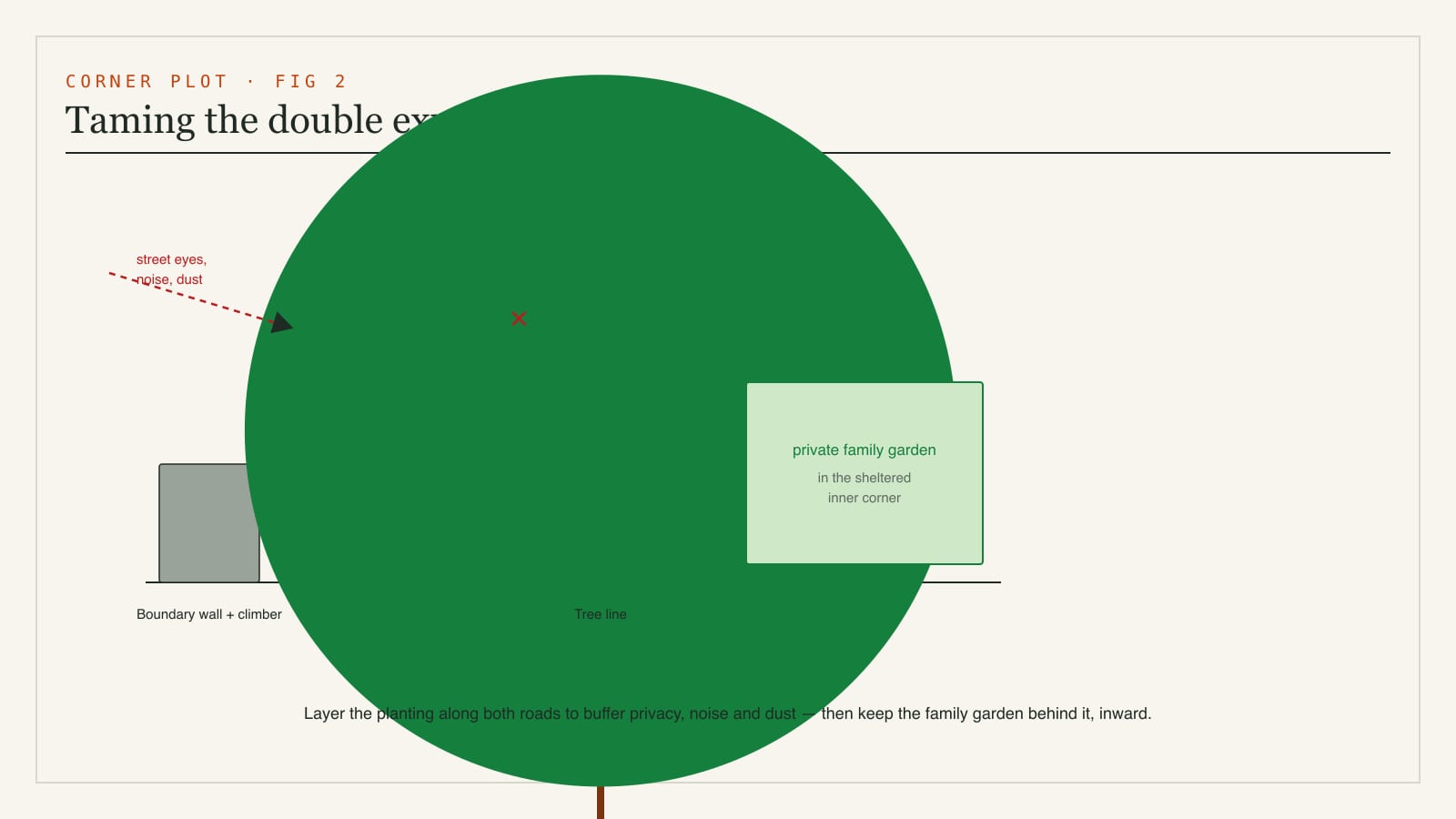
The principle is layered planting: stack plants of different heights so the eye is interrupted at several levels rather than blocked by one wall.
- Privacy comes from breaking sightlines at sitting and standing eye level (roughly 1.1 m and 1.7 m). A staggered double row of shrubs achieves this with gaps that still let breeze through.
- Noise is softened — not silenced — by a deep, dense band of foliage and a raised earth berm if you have room; expect a real but modest reduction (a 3–5 m deep planting belt typically trims perceived traffic noise by a few decibels, and the visual block of seeing the road matters as much psychologically).
- Dust is genuinely captured by leaf surfaces. Hairy, broad or sticky leaves trap particulate; species like Ficus benjamina, Murraya and bamboo are good dust filters along a roadside.
A worked screening palette for the two road edges:
| Role | Species | Mature height | Notes |
|---|---|---|---|
| Tall evergreen screen | Bamboo (Bambusa multiplex, clumping) | 3–5 m | Fast, dense, contain the rhizomes; superb dust filter |
| Flowering screen | Tecoma stans, Tabernaemontana (chandni) | 2–3 m | Year-round colour on the public face |
| Mid hedge | Murraya paniculata (kamini), Duranta erecta | 1.5–2.5 m | Clippable, fragrant (Murraya), forgiving |
| Low front line | Ixora, Hamelia patens, Sansevieria | 0.5–1 m | Defines the kerb edge, softens the wall base |
Keep the screen discontinuous at the gate and at the splayed corner so the house still feels welcoming and the planting reads as a garden, not a barricade. The goal is a green wall you can see into in glimpses, not one you are walled behind. For the deeper craft of this balance — privacy that doesn't feel defensive — lean on Landscape Privacy Design.
The splayed corner: your landscape's hero moment
Many municipal byelaws require the actual corner to be splayed or chamfered — cut back on a diagonal — to keep the road junction visible for turning traffic. (The geometry and the rule itself belong to the architecture guide.) From a landscape point of view, this chamfer is a gift: it creates a small triangular forecourt at the most-seen point of your entire property.
Treat it as the focal moment of the whole garden:
- A feature tree. A single sculptural specimen at the chamfer is the strongest kerb-appeal move you can make. A Plumeria (frangipani) for fragrance and form, a Tabebuia for a seasonal blaze, an amaltas (Cassia fistula) for golden summer chains, or a well-shaped Lagerstroemia all earn their place. Pick the best individual you can find at the nursery from our shortlist of best trees for Indian homes.
- A focal planting bed. Around the tree, a low, tidy planting — clipped Duranta, a sweep of Ixora, or a seasonal flower bed — that frames it.
- Crucially, keep it low and clear. The chamfer exists for traffic visibility, so the planting here must not block sightlines for turning vehicles. Use one clean-trunked tree (canopy well above eye level) over low ground cover; never a dense, head-height shrub mass at the junction. This is the one spot where a safety rule overrides a privacy instinct.
- Lighting. An uplight on the feature tree turns the corner into a small landmark after dark and improves junction safety.
Done well, the splayed corner becomes the photograph people take of your house — a calm, green full stop at the meeting of two streets.
Corner-plot drainage: water arriving from two sides
Here is a landscape problem unique to corners that the architecture guide does not address: stormwater arrives from two road sides. During a heavy monsoon, runoff sheets off two carriageways toward your boundary, and the low point of a junction often sits — unhelpfully — right at your splayed corner.
Plan the garden's grading around this:
- Grade away from the building, toward the roads' kerb drains, so water never ponds against the plinth or the inner private garden.
- Intercept road runoff at the boundary. A shallow planted swale or a French drain running just inside the compound wall along both frontages catches incoming road water and carries it to the municipal storm drain, rather than letting it flood your lawn.
- Protect the splayed corner. Because it is often the local low point, the chamfer's planting bed should be free-draining (raised, with gravel sub-base) so your feature tree isn't standing in monsoon water for days.
- Harvest it. With water arriving from two frontages, a corner plot is an unusually good candidate for rainwater harvesting — a recharge pit fed by the boundary swales puts that doubled runoff back into the ground instead of the gutter, which is both good practice and, in many Indian cities, a byelaw requirement.
Choose species that tolerate the wet-then-dry cycle of Indian seasons for these drainage zones — Canna, Cyperus, and other marginal plants thrive in a swale that floods in July and dries by November. Matching planting to your monsoon and to your region is the heart of climate-responsive landscape design.
Security planting on two exposed sides
Two boundaries to defend, often with less neighbourly overlooking than a mid-block plot, means security deserves a deliberate landscape answer — and planting does it more gracefully than spikes and grilles.
- Thorny barrier shrubs at vulnerable points. A dense, prickly hedge is a genuine deterrent. Bougainvillea (gloriously thorny and flowering), Carissa carandas (karonda), Duranta, or Citrus along the boundary make climbing-over deeply unappealing while looking like a garden.
- Keep sightlines open, not screened, near the gate and house. This is the deliberate tension: privacy screening wants density, but security wants visibility of approaches. Resolve it by keeping planting low (below 1 m) or high-canopied (clear trunks above 2 m) in the zones right around the gate and ground-floor windows, so an intruder has nowhere to hide. Reserve the dense mid-height screening for the stretches between entries.
- Avoid creating ladders and hiding spots. Don't plant a stout tree or a heavy pergola right against a boundary wall where it offers a leg-up to an upper floor; keep climbable mass away from the perimeter.
- Light the two frontages. Motion-sensor and low-level path lighting around both road sides removes the dark cover a corner can otherwise offer.
| Security goal | Planting move | Watch-out |
|---|---|---|
| Deter climbing the wall | Thorny hedge (Bougainvillea, Carissa, Citrus) on boundary | Keep clear of gate sightlines |
| No hiding near house | Low ground cover or clear-trunk trees by windows/gate | Avoid dense head-height shrubs here |
| No "ladder" to upper floor | Keep heavy trees/structures off the perimeter wall | Mind branch reach as trees mature |
| Eyes on the approach | Path + motion lighting on both frontages | Warm, low glare; respect neighbours |
The trick throughout is the same one that runs through this whole guide: let the garden do the defensive work so the home never looks defended. Good outdoor circulation design — clear, well-lit, overlooked paths — reinforces both safety and welcome.
Putting it together: a corner-plot landscape checklist
- [ ] Decide which frontage is public (busier road) and which shelters the private garden (quieter road / inner corner).
- [ ] Design the wraparound as ONE continuous idea, unified by a single edge element around the corner.
- [ ] Layer the roadside screening (low edge + mid hedge + canopy) for privacy, dust and noise — never a single blank wall.
- [ ] Make the splayed corner the hero: one feature tree, low framing planting, kept clear for traffic visibility.
- [ ] Grade and drain for water arriving from two roads; add boundary swales and a recharge pit.
- [ ] Plant thorny security barriers between entries; keep gate and windows open to view; light both frontages.
- [ ] Tuck the family lawn and seating into the sheltered inner corner.
A rough budget
Costs vary widely by city and plant size, but for the extra landscape a corner plot enables, plan in these ranges (2026 metro pricing):
| Item | Indicative cost (₹) |
|---|---|
| Layered screening hedge, per running metre (3-layer, planted) | 1,200–3,000 |
| Feature tree at the chamfer (specimen, 8–10 ft, planted) | 3,000–12,000 |
| Boundary swale / French drain, per running metre | 800–2,000 |
| Rainwater recharge pit (basic, fed by swales) | 25,000–60,000 |
| Lawn establishment, per sq ft | 25–60 |
| Drip irrigation for the two frontages | 18,000–45,000 |
Spend first on the screening and drainage — they solve the corner's real problems — then on the feature corner and lawn, which deliver the kerb appeal that makes a corner plot the proudest address on the layout. If part of your wraparound can earn its keep, fold in a few productive species along the kitchen-garden edge; our edible landscapes guide shows how curry leaf, lemon, drumstick and chillies sit happily within an ornamental scheme.
References & further reading
1. Indian Society of Landscape Architects (ISOLA) — guidance notes on residential landscape, planting buffers and screening.
2. Bureau of Indian Standards — National Building Code of India 2016, Part 10: Landscape Development, Signs and Outdoor Display Structures — planting, site grading and outdoor development provisions.
3. ICAR / Indian Institute of Horticultural Research (IIHR), Bengaluru — ornamental and avenue species, dust-tolerant and screening plants for Indian conditions.
4. Central Public Works Department (CPWD) — Horticulture Manual — species selection, hedge and avenue planting standards for Indian sites.
5. Royal Horticultural Society (RHS) — Encyclopedia of Garden Design — principles of layered planting, screening and boundary treatment.
6. Central Ground Water Board (CGWB), India — Manual on Artificial Recharge of Ground Water / Rainwater Harvesting Guidelines — recharge-pit sizing and stormwater interception for plots.
Read next: Corner Plot Design Strategies for the building-side setbacks and FSI, then Landscape Privacy Design to take the two-frontage screening deeper.
Export this guide
Related Guides — Deep-dive reading
The Best Trees for Indian Homes
A research-grade guide to choosing and placing trees around an Indian home — the real cooling and clean-air numbers, the right species for shade, flowers, fragrance and fruit, and the placement science that keeps roots out of your walls and drains.
LandscapeDesigning for Views and Privacy
The site-level craft of capturing the good view while screening the neighbour's window three metres away — tuned for dense Indian plots.
Site PlanningOrientation, Light & Views: Designing With Your Space, Not Against It
How reading your plot's sun, breeze and views — and placing each room on the right face — gives an Indian home that is cooler, brighter and quietly right, instead of one that fights its site forever.
Design PrinciplesRelated Tools — Try Free
Cross-Ventilation Analyzer
Estimate airflow and air changes per hour (ACH) from room size, window areas, layout, and local wind — with NBC 2016 Part 8 compliance check.
Ventilation CalculatorRainwater Tank Sizer
How big should your rainwater tank be? Computes annual harvest, recommended tank capacity in litres, water-bill savings, and payback — for 10 Indian cities.
RWH CalculatorGarden Planning Toolkit
Get a tailored garden plan — planting layers, Indian species, features and a checklist — from your climate, space, sun and goals.
Planner