
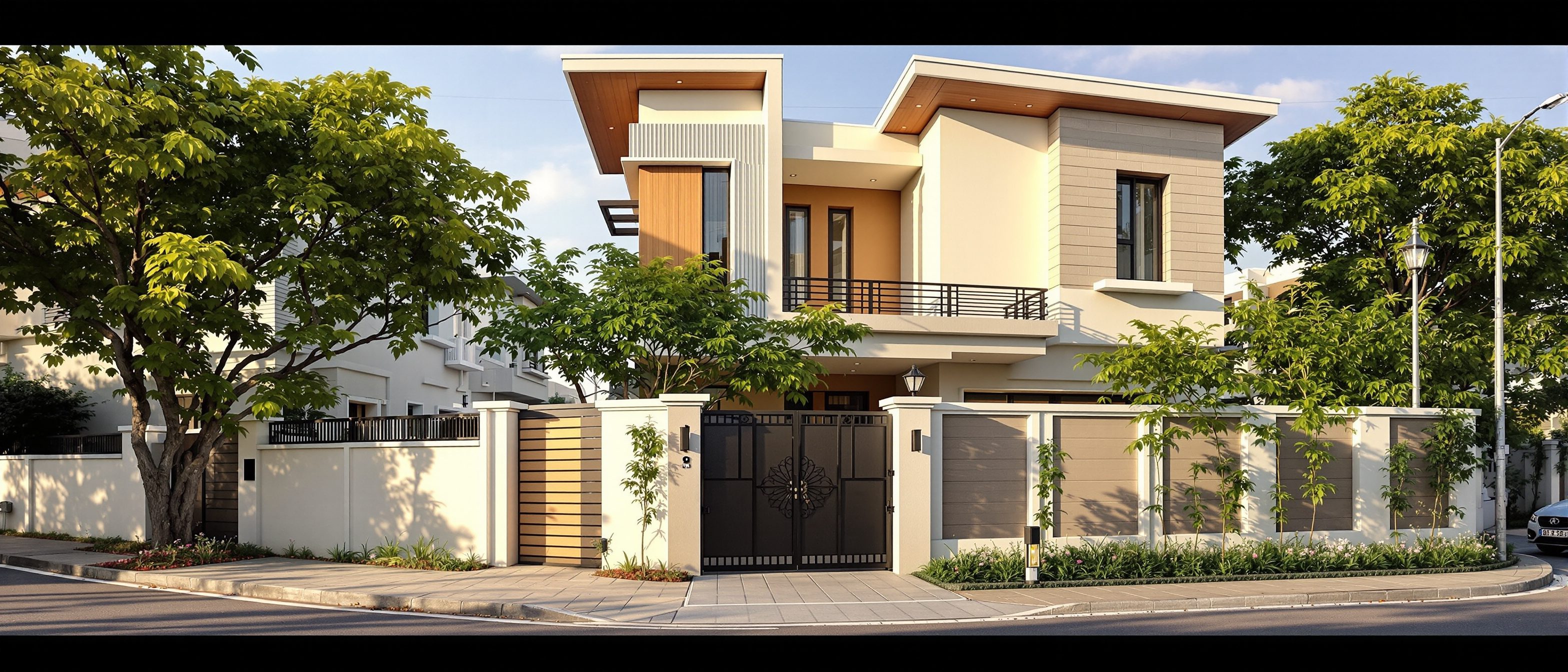
Corner Plot Design Strategies
Two road-facing sides give you more light, air and access than any other plot — but only if you design around the extra setback they cost you.
A family in a Bengaluru BDA layout is choosing between two plots of identical size — 30 ft × 50 ft, same price band. One sits in the middle of the row; the other is the corner unit where the lane meets the main road. The broker calls the corner "premium" and quotes a little more. The family's first instinct is that a corner is obviously better — two open sides, the car can swing in from the quieter lane, the living room can face the breeze. Their architect, however, pulls out a calculator and says: "It is a better plot, but you will build a smaller house on it. Let me show you why before you fall in love with it."
That sentence captures the whole corner-plot story. A corner gives genuine daily-life advantages an intermediate plot can never match — but it also asks you to surrender a strip of land on a second side, and in a country where every square foot is fought for, that trade-off deserves real arithmetic, not a sales pitch. Good corner-plot design is not about whether the corner is "good" or "bad"; it is about deliberately spending the area you lose to setbacks on the light, air, access and frontage you gain.
A corner plot costs you buildable area on a second side and buys you light, air, access and frontage on that same side — design so that what you gain is worth more than what you give up.
1. Why a corner is different: two fronts, not one
An intermediate (mid-row) plot touches a road on one side only. Its other three edges sit against neighbours, so the bylaw asks for a generous front setback and only modest side and rear margins. A corner plot touches roads on two sides. In almost every Indian development control regulation (DCR), any boundary that abuts a road is treated as a "front" — which means you owe the larger front-style setback on both road-facing edges, not just one.
That single rule drives everything else. More open boundary means more daylight and breeze, easier access and double the street frontage — but it also means a second wide setback eating into your footprint, two sides of exposure to traffic and noise, and a junction that brings its own safety and bylaw quirks (splays, sight lines, gate restrictions).
| What you gain on a corner | What it costs you |
|---|---|
| Daylight and ventilation on two adjacent faces, not one | A second road-side setback — typically the wider "front" margin, not the small side margin |
| Two access points possible (separate people and vehicle entries) | Less buildable footprint per floor; often a smaller or reshaped house |
| Double street frontage — better address, signage, future shop/office potential where zoning permits | Two sides of street noise, dust and headlight glare to manage |
| A wrap-around corner for garden, porch or a dramatic entrance | Corner splay / rounding requirement that clips the junction corner |
| Easier emergency and service access | Privacy exposure on two sides; passers-by on two streets |
| True cross-ventilation (inlet and outlet on different faces) | Higher compound-wall and gate cost (two long road edges to build and secure) |
Use our setback visualizer to draw your own plot and watch the buildable envelope shrink as you apply the two road-side margins — it makes the trade-off concrete in a way a table cannot.
2. The buildable-area hit: putting numbers on it
This is the part the broker rarely explains. Consider two plots of exactly the same size — say 12 m × 15 m (about 1,940 sq ft, a common Indian residential parcel). Assume a typical small-plot setback regime: 3 m front, 1 m on each side, 2 m rear for the intermediate plot.
On the intermediate plot, only the road edge is a front. After 3 m front, 1 m + 1 m sides and 2 m rear, the buildable rectangle is roughly 10 m × 10 m = 100 m² per floor.
On the corner plot, the side that faces the second road is now a front too. So instead of a 1 m side margin there, you give the 3 m road-side setback. The buildable rectangle becomes roughly 8 m × 10 m = 80 m² per floor — a loss of about a fifth of your footprint on every storey.
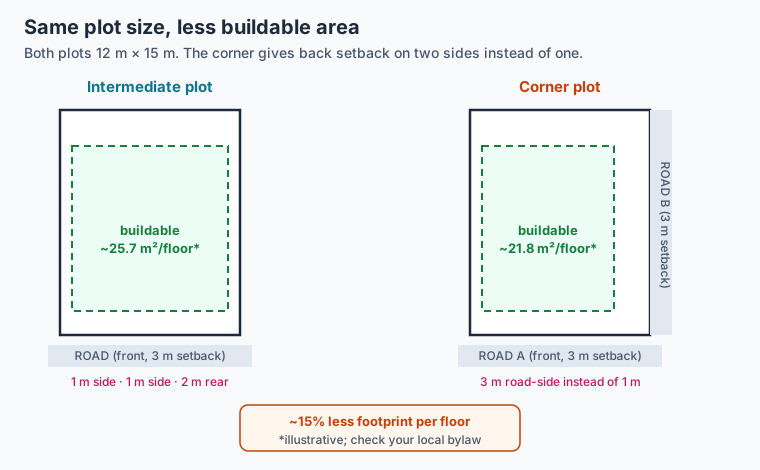
Figure 1: Same plot dimensions, different rules — the corner plot's second road-side setback removes a strip from the footprint on every floor. Exact figures depend on your local DCR; the relationship is what matters.
Now stack the floors. Your FSI (Floor Space Index, also called FAR) caps the total built-up area, but on a tight plot the setback envelope — not the FSI — is often the real limit, because you simply cannot place walls on the setback strip. If your permissible FSI is, say, 1.75 on a 180 m² plot (315 m² allowed), the intermediate plot can chase that across three floors comfortably, while the corner plot's 80 m² footprint may need an extra storey or a compromised layout to reach the same built-up area. The exact crossover depends entirely on your city's numbers, so run your plot through our FAR / FSI calculator alongside the setback tool — together they tell you whether the setback or the FSI is your binding constraint.
"In all cases where a plot abuts more than one street, the front open space shall be provided along each such street." — paraphrasing the standard corner-plot provision found across Indian Development Control Regulations and informed by the National Building Code of India, NBC 2016 (Part 3, Development Control Rules & General Building Requirements).
A quick reality check
| Plot type (12 m × 15 m) | Setbacks applied | Approx. footprint / floor | Relative to intermediate |
|---|---|---|---|
| Intermediate | 3 m front · 1 m + 1 m side · 2 m rear | ~100 m² | baseline |
| Corner (one extra front) | 3 m front · 3 m road-side · 1 m side · 2 m rear | ~80 m² | about 20% less |
| Corner with corner splay | as above, minus the clipped junction corner | slightly less again | a little under 80 m² |
These are illustrative. Bengaluru, Pune, Hyderabad and the Delhi MPD each set their own margins, and many states grant corner plots a small relaxation or extra FSI to compensate. The discipline is the same everywhere: find your two road-side setbacks, subtract, and only then judge the plot.
3. Corner splays, sight lines and the junction
Most municipal bylaws require the building line (and often the compound wall) at a road junction to be splayed or rounded — the sharp corner is cut back along a chamfer of typically 1.5 m to 4.5 m, or rounded to a similar radius, depending on the road widths meeting there. The purpose is a clear sight triangle: a driver turning at the junction must see oncoming traffic and pedestrians without a wall blocking the view.
For you this means two things. First, you lose a small triangular sliver of the corner from your usable plot — confirm the splay dimension before you finalise the footprint. Second, the splay is actually a gift in disguise: it is the natural place for a soft landscaped corner, a feature tree or a low planter rather than a blunt wall, which softens the building and improves the street.
Keep the splayed zone clear of solid boundary walls above the prescribed sight-line height, and never place a vehicle gate right on the junction (more on that next).
4. Gate and vehicle entry placement
The single most common corner-plot mistake is putting the car gate at or near the junction. It feels efficient, but it forces drivers to reverse or turn blind into a crossing — exactly where the sight triangle is supposed to be empty — and many municipalities will refuse the entry permission there outright.
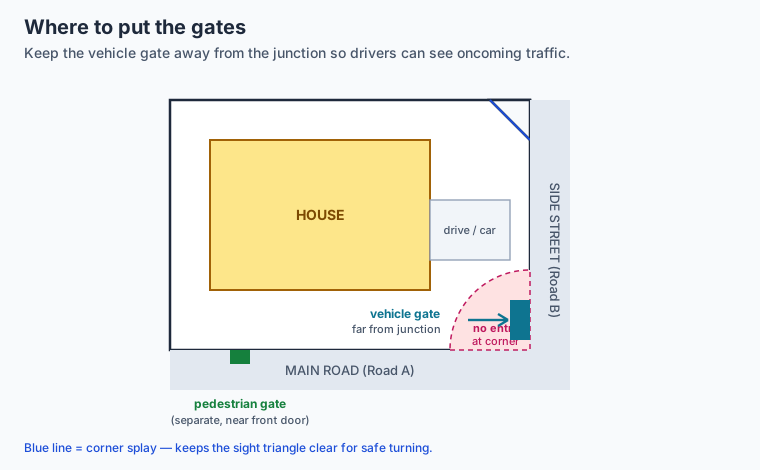
Figure 2: Pull the vehicle gate away from the junction — ideally onto the quieter side street — and give pedestrians a separate gate near the front door. The splay (blue) keeps the turning sight triangle open.
A few rules of thumb that travel well across Indian cities:
- Take the car off the quieter road. Put the vehicle gate on the secondary/side street, as far from the junction as the layout allows. This keeps the main-road frontage calm and the turning manoeuvre safe.
- Separate people from cars. A corner lets you give the pedestrian gate its own spot on the main road near the front door, while the car enters from the side. Visitors and family never thread past a parked vehicle.
- Mind the gradient and the drain. A gate opening onto two different road levels (corner plots often straddle a slight slope) needs the driveway ramp and storm-water drain checked on both edges.
- Leave a stacking length inside. Keep at least one car-length of flat apron inside the gate so a vehicle clears the road line while the gate opens — critical on a busy corner.
5. Privacy and noise from two streets
The flip side of two open faces is that two streets can see — and hear — into your home. On an intermediate plot you fight noise on one front; on a corner you fight it on two. The good news is that the same setback strip you grudged in Section 2 is your defence.
- Layer the corner. Compound wall or low plinth, then a planted setback strip, then the building line. Even 2–3 m of dense planting on the road sides cuts dust, glare and a useful amount of street noise.
- Put the noisy rooms toward the noisy edge. Garage, store, stair, utility and toilets can buffer the road-facing corner; keep bedrooms and the family living zone toward the two quieter internal edges.
- Glaze deliberately. Large windows on the two road faces invite both the view and the headlights — use higher sill heights, deep reveals, louvres or a jaali screen so you get light without a fishbowl. For how to balance the outlook against being overlooked, our sibling guide on designing for views and privacy goes deeper than we can here.
Christopher Alexander's idea that the edge of a building should be a place in its own right, not a hard line, is especially true at a corner — the setback wants to be an inhabited, planted threshold rather than a defensive wall.
"It is the edge which gives an open space its life" — Christopher Alexander, A Pattern Language (1977), on the importance of treating boundaries as living, layered places rather than mere lines.
6. Turning the corner into an asset
Here is where good design earns back the area you lost. Two adjacent open faces are a rare and valuable thing — most plots only ever get one.
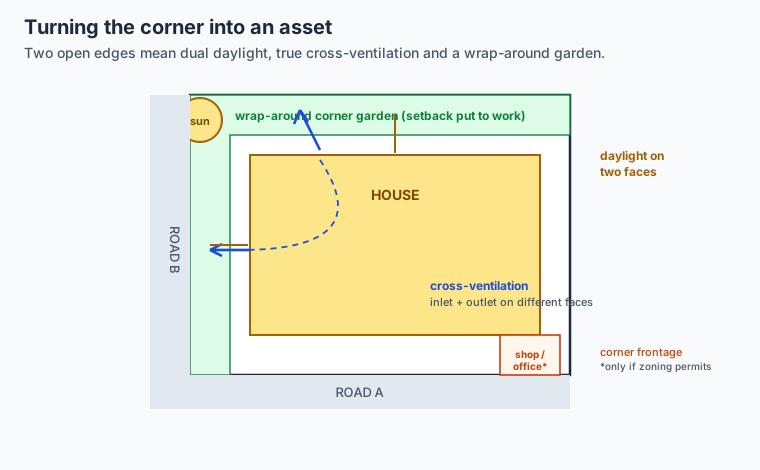
Figure 3: Spend the two open edges on what they do best — dual daylight, genuine cross-ventilation with inlet and outlet on different faces, a wrap-around garden, and (where permitted) a corner frontage for a shop or office.
The "make the corner an asset" checklist:
- True cross-ventilation. Because your openings sit on two different orientations, you can drive air right through the house — inlet on the breeze side, outlet on the lee side. This is far more effective than two windows on the same wall. Test your specific orientation with the cross-ventilation analyzer.
- Daylight on two faces. Habitable rooms can borrow light from two directions, cutting deep dark cores. Place the morning rooms (kitchen, breakfast, a child's study) toward the east-facing edge if the corner allows.
- A wrap-around garden. The two setback strips meet at the corner to form an L-shaped garden far more generous than a thin front strip — room for a real tree, a sit-out, or a kitchen-garden bed.
- A signature entrance. The corner is the most-seen point of your house. A recessed or splayed entrance, a feature wall, or a double-height element here reads beautifully from both streets.
- Frontage value. Where the zone permits mixed use, the corner is the prime spot for a small shop, clinic or studio with its own street access — a genuine future income or work-from-home option that an interior plot can rarely offer. Always confirm the land-use and DCR permission before counting on it.
- Solar and rain harvesting. Two roof edges and two open faces make it easier to position solar panels for the best tilt and to route rainwater to a recharge pit in the larger setback.
7. Vastu and the corner: the practical version
Many Indian buyers ask about Vastu before anything else, and corners are where Vastu folklore runs hottest — talk of the auspicious north-east corner, the cautionary south-west, and so on. Treat these as orientation heuristics, not absolutes: the genuinely useful core (open and light to the north/east, heavier and grounded to the south/west) overlaps neatly with good passive design in the Indian climate. A corner plot often makes it easier to honour both, because you can choose which two faces open up.
Rather than chase rules of thumb, score your specific plot and layout: our Vastu compliance tool checks a plan against the common principles, and the Vastu compass helps you fix the true orientation of the two road faces before you commit. The deeper treatment lives in our dedicated guides on Vastu house plans and Vastu for modern homes — design with the climate first, then reconcile with Vastu, and on a corner the two usually agree.
8. A decision and design checklist for corner buyers
| Stage | Do this | Why |
|---|---|---|
| Before you buy | Get the exact setbacks for both road widths from the local DCR | The two-front rule, not the listed plot size, sets your real area |
| Before you buy | Run the plot through the setback visualizer and FSI calculator | See whether setback or FSI is your binding limit |
| Before you buy | Ask if your city grants corner-plot FSI relief or extra ground coverage | Some states compensate corners; it changes the maths |
| Sketch stage | Check the corner-splay / sight-triangle requirement | A clipped corner shrinks the footprint and dictates the wall |
| Sketch stage | Place vehicle gate on the quieter road, away from the junction | Safety, sight lines and easier sanction |
| Sketch stage | Push noisy/service rooms to the road corner, living to the quiet edges | Buffer two-sided street noise |
| Design stage | Plan windows for cross-ventilation across the two open faces | The corner's biggest free benefit |
| Design stage | Make the two setbacks into a layered, planted L-garden | Privacy, dust control and amenity in one move |
| Design stage | Design the corner as the signature entrance / feature | It is the most-seen point of the house |
For the broader, plot-agnostic version of this thinking — reading sun, wind, slope, soil and neighbours — start with the cluster pillar, site analysis for homeowners, and pair it with plot selection mistakes to avoid so you don't pay corner prices for a plot whose setbacks make it the wrong choice.
Sources & further reading
1. Bureau of Indian Standards, National Building Code of India, NBC 2016 — Part 3, Development Control Rules & General Building Requirements (setbacks, road junctions, open spaces).
2. Bureau of Indian Standards, IS 8827 : Recommendations for Basic Requirements of School Buildings and allied IS site-planning guidance on open spaces and access (general principles applicable to plots).
3. Relevant State / Urban Development Authority Development Control Regulations — e.g. BBMP / BDA (Bengaluru), PMC (Pune), GHMC (Hyderabad) and the Delhi Master Plan / MPD — for city-specific corner-plot setbacks, splay and FSI provisions.
4. Francis D. K. Ching, Architecture: Form, Space & Order (4th ed., Wiley) — on orientation, approach and the design of building edges and thresholds.
5. Christopher Alexander et al., A Pattern Language (Oxford University Press, 1977) — patterns on building edges, entrances and the life of boundaries.
6. Energy Conservation Building Code (ECBC), Bureau of Energy Efficiency, Government of India — daylight, orientation and passive design principles.
7. Ministry of Housing & Urban Affairs, Government of India — Model Building Bye-Laws (reference for setback, ground coverage and corner-plot provisions adopted by states).
If you found this useful, read the cluster pillar site analysis for homeowners next, then compare with narrow-plot design strategies — the mirror-image problem of too little frontage — and avoid costly traps with plot selection mistakes to avoid.
Export this guide
Related Guides — Deep-dive reading
Orientation, Light & Views: Designing With Your Space, Not Against It
How reading your plot's sun, breeze and views — and placing each room on the right face — gives an Indian home that is cooler, brighter and quietly right, instead of one that fights its site forever.
Design PrinciplesSite Analysis for Homeowners: How to Read a Plot Before You Build
The master guide to reading your land — its legal envelope, sun, wind, slope, soil, access, neighbours, views, services and microclimate — before you buy a plot or draw a plan.
Site PlanningWhy Setbacks Matter: A Homeowner's Guide to the Open Space Around Your House
What setbacks are, the daylight, air, fire-access and privacy jobs they do, how they scale with plot and height, and why eating them up costs you your occupancy certificate and resale value
Building Regulations & ComplianceRelated Tools — Try Free
Cross-Ventilation Analyzer
Estimate airflow and air changes per hour (ACH) from room size, window areas, layout, and local wind — with NBC 2016 Part 8 compliance check.
Ventilation CalculatorBrise-Soleil Visualizer
Interactive horizontal-louvre cut-off angle calculator — sun altitude, louvre depth, and spacing inputs with a live shadow preview. Computes θ = arctan(spacing/depth) for façade shading, ECBC envelope compliance, hospital daylight design, and tropical sun-control detailing.
Sun Shading ToolVastu Window Planner
Vastu guidance for window placement and size by wall direction and room — rating and remedies.
Vastu