
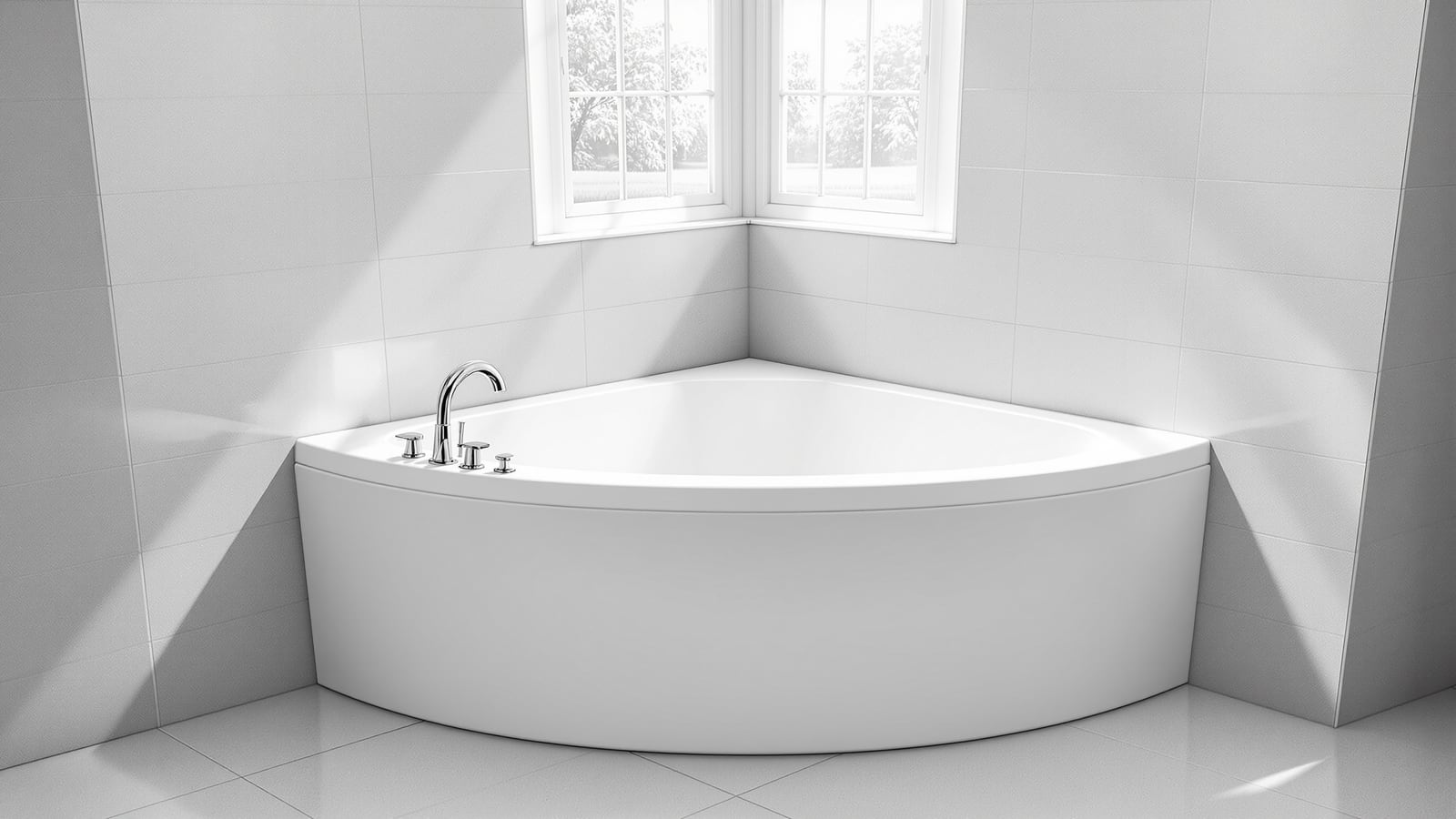
Corner Bathtub India: Sizes, Cost, Jets & Installation Guide
How triangular and pentagon corner bathtubs tuck into a wall junction to save floor space — sizing, load and water demand, whirlpool jets, the corner platform and plumbing, and honest costs for Indian homes.
A corner bathtub does one clever thing: it takes the tub's bulk and pushes it into the one part of a bathroom that is hardest to use well — the corner where two walls meet. Instead of a rectangular tub eating a full wall, a triangular or pentagon-shaped shell wraps the junction, leaving the room's centre and doorway swing free. For Indian homes, where a full bathtub often feels like an impossible luxury in a 6x8 ft room, the corner tub is frequently the only geometry that fits without killing circulation.
But "space-saving" is only half the story. Corner tubs are usually wider and deeper than a standard 1700 mm straight tub, built for a proper soak or for two people, and that generosity comes with real consequences: more water to heat, more load on the slab, and — very often — whirlpool jets, a pump and a power point in a wet zone. This guide walks through the geometry, the numbers, the plumbing and the honest costs so you can decide whether a corner bathtub belongs in your home. For the wider decision of which tub type suits you, start with the bathtub buying guide for India.
What a corner bathtub actually is
A corner bathtub is a tub whose footprint is a right-angled triangle or a five-sided (pentagon) shape, designed to sit against two adjacent walls. The two straight sides press flush to the walls; the long diagonal or curved edge faces the room. Most are drop-in / built-in shells — an acrylic or fibreglass tub dropped into a tiled masonry platform — though a few designer models are freestanding.
- Triangular (corner-angle) tubs — a true 90° corner, symmetric, usually a single generous bathing well. Common Indian sizes: 1200x1200, 1350x1350, 1500x1500 mm.
- Pentagon / offset-corner tubs — the outer edge is clipped or curved, giving a flatter room-facing side and often a built-in seat or ledge. Sizes like 1400x1400 or 1520x1520 mm.
- Two-person corner tubs — deeper (450–560 mm water depth) with twin backrests and often twin headrests, meant for shared soaking.
A corner bathtub trades floor area for wall length: it frees the middle of the room but demands two solid walls and a much bigger slab load and hot-water supply than any straight tub. Plan the structure and plumbing first, the tub second.
Sizes and space: does it really save the room?
The saving is real but subtle. A straight 1700x750 mm tub blocks a whole 1700 mm wall and projects 750 mm into the room. A 1350x1350 mm corner tub occupies a triangle in the corner — its diagonal face is what you see — and leaves both wall-runs beyond it usable for a WC, basin or shower. In a squarish bathroom the corner tub almost always circulates better.
| Corner tub size (mm) | Footprint type | Fits bathroom from | Typical fill (litres) | Best for |
|---|---|---|---|---|
| 1200 x 1200 | Triangular | 1.8 x 1.8 m | 180–230 | Compact soak, one adult |
| 1350 x 1350 | Triangular | 2.0 x 2.0 m | 240–300 | Comfortable single, deep |
| 1500 x 1500 | Triangular | 2.2 x 2.2 m | 300–380 | Two seated, whirlpool |
| 1400 x 1400 pentagon | Offset corner | 2.1 x 2.1 m | 260–330 | Seat ledge, easy step-in |
| 1520 x 1520 | Triangular | 2.3 x 2.3 m | 340–420 | Luxury two-person spa |
Notice the fill volumes. A deep 1500 mm corner tub can swallow 350+ litres — nearly double a shallow straight tub. That single number drives your geyser size, your water bill and, in an apartment, whether the society tank can keep up. If your bathroom is long and narrow rather than square, a corner tub wastes the geometry; a straight or large-bathroom layout with an alcove tub usually serves better.
The step-over and reach problem
A corner tub's diagonal outer wall means you step in over the longest, often highest edge, and the bathing well sits deep in the corner — a long reach for the taps and for cleaning. Plan a grab bar on one of the two solid walls, keep the water depth sensible for children and elderly users, and check the accessible bathroom guide if anyone in the home has limited mobility. The corner geometry that saves floor space is inherently harder to enter than a low freestanding tub.
Load, water and the two big engineering numbers
This is where corner tubs quietly become a structural and MEP decision, not just a fitting.
Dead + live load. Take a 1500 mm corner tub: shell ~40 kg, water ~350 kg, two bathers ~140 kg. That is well over 500 kg concentrated in one corner — plus the masonry platform and tile. Indian residential slabs are designed to IS 875 (Part 2) for a 2.0 kN/m² live load in bathrooms, which a large filled tub can locally approach or exceed. For anything above ~1350 mm, or on any upper floor, get a structural engineer to confirm the slab and, if needed, add a load-spreading platform or thickened slab. Never assume a filled two-person tub is "just like people standing there".
| Item | Straight tub 1700 mm | Corner tub 1500 mm | Why it matters |
|---|---|---|---|
| Water fill | 180–220 L | 300–380 L | Geyser + supply sizing |
| Filled + 2 bathers | ~380 kg | ~520 kg | Slab / platform load |
| Hot water for one fill | ~120 L at 40°C | ~200 L at 40°C | Needs 25 L+ geyser or instant |
| Fill time at 15 LPM | ~14 min | ~24 min | Twin inlets recommended |
Hot water. A comfortable 40°C soak in a big corner tub needs roughly 180–200 litres of hot water per fill. A single 15 or 25 litre storage geyser cannot deliver that in one go. Options: a 50+ litre geyser dedicated to the tub, a gas/instant water heater, or a solar tank with electric backup. Undersizing here is the single most common regret — the tub fills lukewarm.
Whirlpool jets: the common upgrade
Most corner tubs sold in India above the entry tier are whirlpool (air/water jet) tubs — the corner shape suits the deep, wide well that jets need to work. Understand what you are buying:
- Whirlpool (water jets) — a pump recirculates the tub water through jets; strong, targeted massage. The pipework holds residual water and must be flushed, or it grows biofilm.
- Air-spa (air jets) — a blower pushes air through fine holes; gentler, effervescent, self-draining and more hygienic.
- Combo — both systems; most expensive, most maintenance.
Jets mean a pump and blower (0.5–1.5 kW), a control panel and a dedicated wet-zone power supply. That electrical work must follow IS 732 and NBC 2016: a residual current device (RCD/RCCB, 30 mA), the pump on its own circuit, and a proper equipotential bond of the tub's metal parts. Keep the switch and control outside the 0.6 m tub safety zone. This is the same discipline described in the smart bathroom guide — treat jets as an electrical appliance in a wet room, not a plumbing accessory. For a full comparison of jet types, pump ratings and hygiene, see the whirlpool bathtub guide for India.
Hard water — the reality across much of India — scales up jet nozzles and pump impellers. Run a periodic descale/sanitise cycle, and consider a softener on the tub's feed if your TDS is high.
The corner platform and plumbing
A built-in corner tub sits in a masonry or brick-on-edge platform (the "deck") that supports the flange and hides the plumbing. Getting this right is 80% of a leak-free, long-lived installation.
Non-negotiables for the platform:
- Full mortar-bed support under the tub base — the shell must not span on its rim alone, or acrylic flexes and cracks. Bed it on a sand-cement or expanding-foam support per the maker's instructions.
- Tanked waterproofing to the deck and up the two walls, with a 150 mm upstand, lapped into the floor membrane. Follow the bathroom waterproofing guide — a tub deck is a high-risk leak zone.
- A removable access panel to reach the trap, overflow, jet pump and stop valves. A tiled-shut tub is a nightmare the day a jet pump fails.
- 50 mm waste trap with a proper overflow, and isolating valves on both hot and cold feeds inside the deck.
- Fall to the drain and a silicone-sealed, flexible joint where flange meets tile — never a rigid grout-only seal.
Cost in India: the full picture
The tub sticker price is the smallest part. Budget the platform, plumbing, waterproofing, electrical and the water heater together.
| Line item | Budget (₹) | Mid (₹) | Premium (₹) |
|---|---|---|---|
| Corner tub shell (plain soak) | 22,000–40,000 | 45,000–80,000 | 1,00,000–2,50,000 |
| Whirlpool / air-spa premium | +25,000 | +40,000–70,000 | +1,00,000+ |
| Masonry platform + tiling | 12,000–20,000 | 20,000–35,000 | 40,000+ |
| Waterproofing (deck + walls) | 6,000–12,000 | 12,000–20,000 | 25,000+ |
| Plumbing + electrical (jets) | 8,000–15,000 | 15,000–30,000 | 35,000+ |
| Dedicated water heater | 8,000–18,000 | 18,000–35,000 | 40,000+ |
| Typical installed total | ₹60,000–1,10,000 | ₹1.2–2.5 lakh | ₹3.5 lakh+ |
For most Indian homes a mid-tier acrylic whirlpool corner tub, fully installed with its platform and heater, lands around ₹1.5–2.5 lakh. Treat anything quoted far below that as leaving out the platform, waterproofing or a proper heater — the costs that actually determine whether the tub lasts.
Pros and cons — the honest ledger
| Pros | Cons |
|---|---|
| Frees the room's centre and doorway swing | Needs two solid, square walls |
| Wider/deeper — real two-person soak | Heavy slab load; upper floors need checking |
| Suits deep whirlpool wells | 2x the hot water and fill time |
| Feels like a spa focal point | Jets add pump, power point, maintenance |
| Good for squarish bathrooms | Harder step-in and reach; poor for narrow rooms |
| Hides plumbing in a tidy deck | Higher install and running cost |
Choose a corner tub if your bathroom is roughly square, at least ~2 m each way, sits on a ground floor or a checked slab, and you genuinely want a deep or shared soak. Skip it if the room is long and narrow, the slab is untested, hot-water supply is limited, or an elderly or very young user needs an easy step-in — in those cases a shallow alcove tub, a walk-in tub, or a good shower serves better.
Buying and install checklist
- Confirm the two corner walls are solid masonry, plumb and square before ordering.
- Get the slab checked by an engineer for any tub over ~1350 mm or on an upper floor.
- Size the water heater for one full fill (often 50+ L storage or an instant unit).
- Insist on full mortar-bed support, tanked waterproofing and a removable access panel.
- For jets: dedicated circuit, 30 mA RCCB, equipotential bond, controls outside the wet zone.
- Choose air-spa or self-draining jets in hard-water areas; plan a descale routine.
- Buy a tub with an anti-slip base texture and integral grab-point or add a wall grab bar.
References
- National Building Code of India (NBC) 2016, Part 9 (Plumbing Services) and Part 8 (Building Services / Electrical) — wet-zone plumbing, drainage and electrical safety.
- IS 875 (Part 2) — Code of practice for design loads (imposed/live loads) for buildings; bathroom floor loading.
- IS 732 — Code of practice for electrical wiring installations; RCD/earthing for wet areas.
- IS 2556 — Sanitary appliances / ceramic and allied requirements (reference for fittings quality).
- CPHEEO Manual on Water Supply & Sanitation, Ministry of Housing & Urban Affairs — water demand and drainage practice.
- Bureau of Indian Standards (BIS) — current product and installation standards for sanitaryware, water heaters and plumbing.
Export this guide
Related Guides — Deep-dive reading
Built-In Bathtub India: Drop-In & Alcove Tubs, the Masonry Deck, Apron & Access Panel (2026)
How a built-in bathtub actually gets installed in an Indian bathroom — set into a tiled brick platform or an alcove, the load the deck must carry, the apron or skirt, the all-important access panel for the trap, tiling and sealing the rim, running a shower over the bath, real sizes, 2026 rupee costs, and an honest comparison with freestanding tubs.
BathroomsSoaking Tub India: Deep Japanese-Style Ofuro Baths, Geyser Sizing, Load & Real Costs (2026)
Why a deep soaking tub gives a full-immersion soak from a small footprint — ofuro ergonomics, the extra-deep water line, how much hot water and geyser capacity you actually need, heat-retention materials, the structural load of a filled tub, and honest rupee ranges for an Indian home.
BathroomsCast Iron Bathtub India: The Heirloom Tub, Weight & Slab Load, Enamel Care & Cost (2026)
Why an enamelled cast-iron bathtub is the heirloom tub — unbeatable heat retention, a quiet soak and a vitreous-enamel surface that shrugs off scratches and stains for decades — set against the one thing India buyers must plan for: the sheer weight on the slab, the crew it takes to carry it up, chip repair, the cost premium, and an honest verdict versus acrylic.
BathroomsRelated Tools — Try Free
Electrical Safety & Load Audit
Home electrical audit — 10 categories, 65+ checkpoints across earthing, RCCB, MCB, wiring, switchboards, appliance circuits, DG/inverter backup.
Safety AuditPlumbing Pressure-Test & Leak Checklist
Pre-closure pressure and leak test — 9 categories, 60+ checkpoints across water supply, drainage, fixtures, waterproofing, hot water, tanks.
Pre-Closure TestRainwater Tank Sizer
How big should your rainwater tank be? Computes annual harvest, recommended tank capacity in litres, water-bill savings, and payback — for 10 Indian cities.
RWH Calculator