
Bathtub India: Types, Materials, Sizes, Load, Cost & Is It Worth It (2026)
The honest, India-first pillar guide to bathtubs — freestanding, built-in and corner types; acrylic, cast iron, FRP, stone and steel materials; the space, structural load and hot-water (geyser) capacity a tub really needs; drainage and overflow; a full comparison table, rupee costs, and a clear-eyed answer to whether a bathtub is worth it in an Indian home.
A bathtub is the most demanding fixture you can put in a bathroom. It asks for more floor than a shower, more hot water than a geyser usually holds, and more structural load than anything else in the room — a filled tub with a bather in it can weigh 300–500 kg concentrated over roughly two square metres of slab. In return it offers what no shower can: the ability to lie back in warm water and switch off. Whether that trade is worth it in an Indian home is a genuine question, and this guide answers it honestly before helping you choose.
This is the pillar page for bathtubs. It sits under the bathroom design guide for India, which frames the whole room, and links out to deep-dives on each type and material. The order of decisions matters: first decide whether a tub belongs in your bathroom at all, then choose the type (how it sits in the room), then the material (what it is made of), and only then size, plumbing and cost. Take them out of order and you get a beautiful tub that never gets used — the most common bathtub outcome in India.
A tub is three commitments at once — floor space, structural load and hot water. If your home can't comfortably give all three, a good shower will make you happier than a compromised bath.
First, the honest question — is a bathtub worth it in India?
Most Indian bathrooms are used the Indian way: a quick shower, often with a bucket and mug alongside, in a room kept humid by a health-faucet WC. Into that reality a bathtub brings real friction that showrooms never mention.
- Water and heating. A soak needs 120–220 litres of hot water. A typical 15–25 litre geyser cannot deliver that in one go; you need a large storage geyser, a gas water heater or a solar-plus-booster system. Filling a tub from a 15 L geyser means topping up with cold — a lukewarm, disappointing bath.
- Usage reality. In busy households a tub is used a handful of times a year, then becomes a shelf for buckets or a shower tray you have to step over. Ask honestly how often anyone will actually lie in it.
- Space. A tub occupies 1.5–1.7 m of wall and a metre of depth — space a small bathroom cannot spare without losing the shower or the vanity.
- Cleaning and hard water. Indian hard water scales the tub rim and jets; a whirlpool's pipework can harbour biofilm if not run regularly.
None of this means "never" — it means be deliberate. A bathtub earns its place when you have a master or luxury bathroom with room to spare, a hot-water supply sized for it, and at least one person (young children, someone who genuinely unwinds in a bath) who will use it. In a compact family or guest bathroom, the money is almost always better spent on a good shower, and the bathroom design guide will steer you there. If the answer is still yes, read on.
The three ways a tub sits in the room
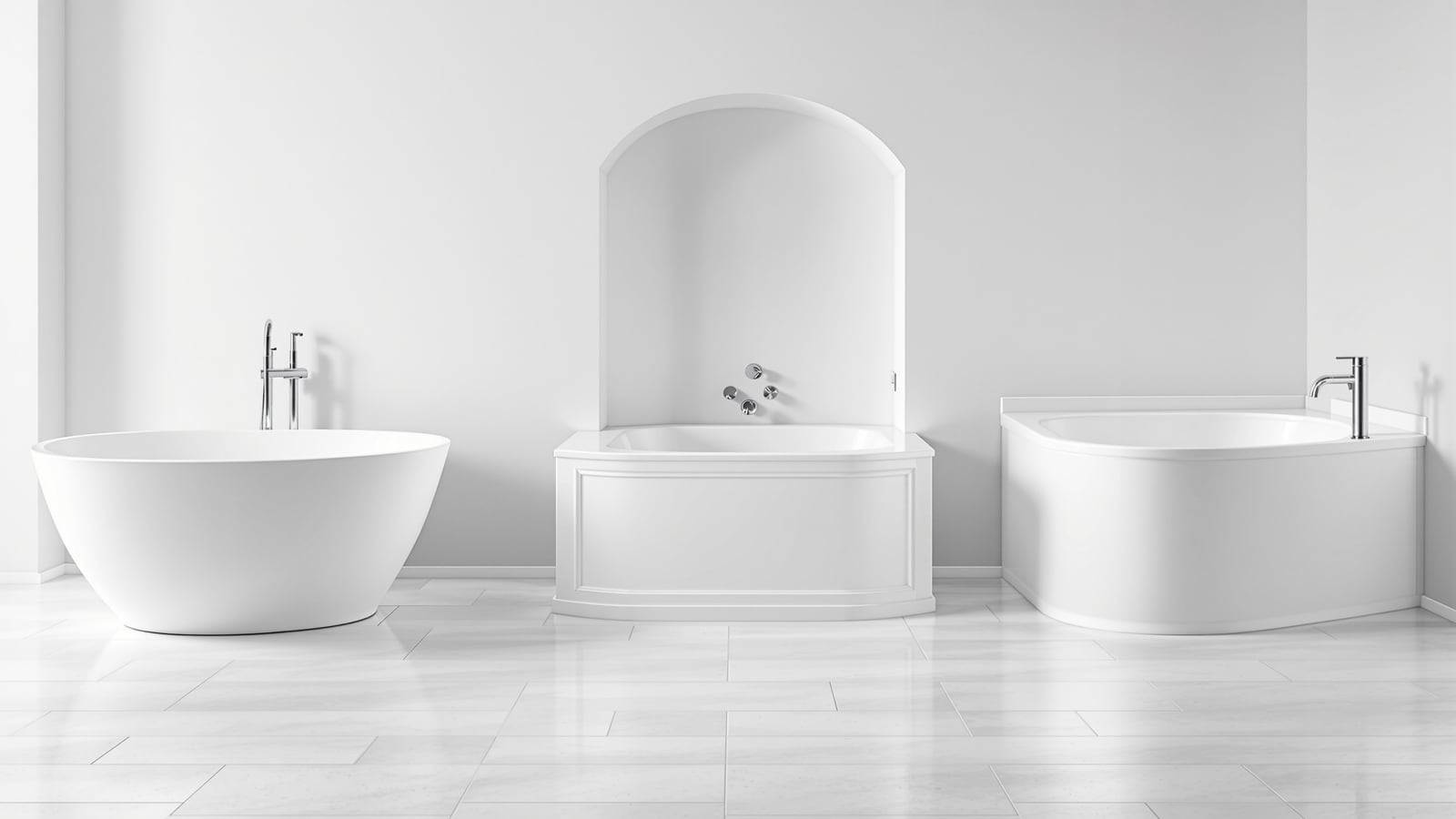
How a bathtub meets the floor and walls is the decision that drives plumbing, cost and the feel of the room. There are three families.
- Freestanding — the tub stands on its own on the floor (on feet or a solid plinth), finished on all sides, with the plumbing coming up through the floor or off a nearby wall. The luxury statement look. It needs open floor around it, a level slab, and floor-fed or wall-fed taps roughed in exactly. Deep-dive: freestanding bathtub for India.
- Built-in / drop-in — the tub drops into a tiled deck or is framed and tiled around three sides against a wall or in an alcove. The practical, space-efficient, best-value choice for most homes — the surround hides the plumbing and can double as a seat or shelf. Deep-dive: built-in bathtub for India.
- Corner — a triangular or offset tub that tucks into a corner, trading a larger footprint for a shorter wall run. Useful when you have depth but not a long wall, and often paired with a corner shower. Deep-dive: corner bathtub for India.
What tubs are made of — the material decision
Material sets the price, the weight, how warm the water stays, and how the tub ages under hard water. Five are common in India.
| Material | Feel & heat retention | Weight | Hard-water / durability | Indicative ₹ (tub only) |
|---|---|---|---|---|
| Acrylic (most common) | Warm to touch, keeps heat well, glossy | Light (25–40 kg) | Scratches can be buffed out; can flex if under-supported | ₹18,000 – ₹90,000 |
| FRP / fibreglass (gel-coat) | Warm, budget, lighter finish | Light (20–35 kg) | Gel-coat dulls and can craze in years; entry-level | ₹12,000 – ₹40,000 |
| Cast iron + enamel | Very warm-holding, solid, heavy, quiet | Very heavy (80–150 kg) | Extremely durable; enamel chips if struck; needs strong slab | ₹60,000 – ₹3,00,000+ |
| Pressed steel + enamel | Cools faster, firm, mid-weight | Medium (30–50 kg) | Tough enamel; can chip; noisier fill | ₹25,000 – ₹80,000 |
| Natural / cast stone (composite) | Coldest to start, sculptural, spa-like | Extremely heavy (150–300 kg+) | Luxurious; needs sealing and serious structural support | ₹1,50,000 – ₹6,00,000+ |
In plain terms: for most Indian homes, acrylic wins — light enough not to overload a slab, warm to sit in, repairable, and the widest choice of shapes. Cast iron is the heirloom choice for a solid, heat-holding soak if your structure can carry it. FRP is the budget entry point but ages fastest. Steel is a durable mid-tier. Stone is pure luxury and a structural project in its own right. The dedicated guides go deeper on the two extremes — acrylic bathtubs for India and cast iron bathtubs for India. If you want the deep, quiet soak, see soaking tubs for India; for jets and pumps, whirlpool bathtubs for India.
Size, structural load and hot water — the three numbers that decide feasibility
A tub is only right if the room, the slab and the water heater can all carry it. Check these before you buy anything.
Size
- Standard built-in: 1500–1700 mm long × 700–800 mm wide × 400–450 mm deep. The 1700 mm is the comfortable adult length; 1500 mm suits a compact bathroom or a child-focused tub.
- Freestanding: 1600–1800 mm long, plus 150–300 mm of clear floor on the sides you finish — never scale a freestanding tub tight to a wall.
- Soaking tubs run deeper (500–600 mm) for full immersion; corner tubs need 1200–1500 mm on each of the two walls.
- Leave at least 600–700 mm clear in front of the tub to get in and out and to clean.
Structural load
This is where Indian installations most often go wrong. Weight is tub + water + bather, concentrated on a small area:
- Water weight ≈ 1 kg per litre. A tub holding 200 L to the overflow is 200 kg of water alone, plus a 25–150 kg tub, plus a 60–90 kg bather — 300–500+ kg over roughly 1.5–2 m².
- A normal RCC residential slab carries this fine for acrylic/FRP/steel tubs. For cast iron and stone, tell your structural engineer at design stage — an upper-floor or cantilevered slab may need checking, and heavy tubs should sit over a beam or bearing wall, not mid-span.
- The tub must sit on a fully bedded, level base (mortar bed or the maker's feet/cradle) — an acrylic tub left to span on its rim edges will flex and crack.
Hot water (geyser capacity)
- Filling to a comfortable depth uses 120–220 litres, of which you want most of it hot.
- A 15–25 L instant/storage geyser cannot fill a tub hot. Plan a 50–100 L+ storage geyser, a gas water heater, or solar with an electric booster dedicated to that bathroom.
- Account for load-shedding — a solar or gas backup means a bath is still possible when the grid is down.
Drainage, overflow and waterproofing
A tub drains differently from a shower and must be planned into the slab early.
- Waste (drain) and overflow are usually a linked assembly: the waste at the base and an overflow near the rim, joined and taken to a P-trap that holds a water seal against drain smell — non-negotiable under NBC 2016 Part 9. A tub drain wants a 40–50 mm waste pipe with adequate fall.
- Rough-in first. The drain, overflow and trap position must be set into the slab and tested before tiling the surround or setting a freestanding tub — retrofitting means breaking floor.
- Access panel. Built-in surrounds should include a removable panel so the trap and connections can be reached; a fully sealed tiled box means chiselling tile if anything leaks.
- Waterproofing. The tub zone is a wet area — tank the floor and the lower surround as part of the room's system. See the waterproofing guide for the membrane and the bathroom flooring guide for slip-safe surrounds. A tub-shower combination especially needs the full wall waterproofed to shower height.
Cost — what a bathtub really adds
Budget the installed cost, not just the tub sticker:
| Line item | Indicative ₹ |
|---|---|
| Acrylic / FRP tub (mid-range) | ₹18,000 – ₹90,000 |
| Cast iron / stone tub | ₹60,000 – ₹6,00,000+ |
| Whirlpool / jetted upgrade | +₹40,000 – ₹2,00,000 |
| Filler tap set (deck / floor / wall mixer) | ₹8,000 – ₹60,000 |
| Waste + overflow + trap assembly | ₹2,500 – ₹12,000 |
| Surround, plinth, tiling, waterproofing, plumbing labour | ₹25,000 – ₹1,00,000+ |
| Larger geyser / gas / solar for hot water | ₹12,000 – ₹80,000 |
A realistic all-in mid-range built-in acrylic tub lands around ₹60,000 – ₹1,50,000 installed; a freestanding cast iron or stone statement tub with jets can pass ₹5–8 lakh. Compare that honestly against a great shower before committing.
How to decide — a quick path
1. Pass the three-commitment test — floor space, structural load, hot-water supply. Fail any one and choose a shower.
2. Pick the type — built-in for value and space, freestanding for a statement, corner for a short-wall room.
3. Pick the material for weight and use — acrylic for most homes, cast iron for an heirloom soak (check the slab), FRP only on a tight budget.
4. Set the size and clearances, and size the geyser to actually fill it hot.
5. Rough in the drain, overflow and trap, leave an access panel, and waterproof before tiling.
Get these right and a tub becomes the quiet luxury it promises. Get them wrong and it becomes the most expensive bucket-shelf in the house — which is why the honest first question matters more than any showroom shape.
References
- NBC 2016 (National Building Code of India), Part 9 Plumbing Services — sanitary fixtures, traps, water seals, drainage fall and waste sizing.
- IS 2556 (Bureau of Indian Standards) — Vitreous sanitary appliances; referenced for sanitaryware quality and dimensions.
- IS 1172 — Basic requirements for water supply, drainage and sanitation in buildings.
- IS 456 — Plain and reinforced concrete: slab design and imposed-load principles relevant to heavy fixtures.
- CPHEEO Manual on Water Supply and Sanitation (Ministry of Housing and Urban Affairs) — fixture and drainage design guidance for Indian buildings.
Export this guide
Related Guides — Deep-dive reading
Freestanding Bathtub India: Materials, Floor Load, Concealed Plumbing & Cost (2026)
The statement centrepiece tub that stands free of every wall — how acrylic, stone-resin and cast-iron differ, the floor load a filled tub imposes, the concealed rough-in you must set out before the flooring goes down, the clear space it needs all around, drainage, and honest 2026 rupee costs.
BathroomsCast Iron Bathtub India: The Heirloom Tub, Weight & Slab Load, Enamel Care & Cost (2026)
Why an enamelled cast-iron bathtub is the heirloom tub — unbeatable heat retention, a quiet soak and a vitreous-enamel surface that shrugs off scratches and stains for decades — set against the one thing India buyers must plan for: the sheer weight on the slab, the crew it takes to carry it up, chip repair, the cost premium, and an honest verdict versus acrylic.
BathroomsSoaking Tub India: Deep Japanese-Style Ofuro Baths, Geyser Sizing, Load & Real Costs (2026)
Why a deep soaking tub gives a full-immersion soak from a small footprint — ofuro ergonomics, the extra-deep water line, how much hot water and geyser capacity you actually need, heat-retention materials, the structural load of a filled tub, and honest rupee ranges for an Indian home.
BathroomsRelated Tools — Try Free
Cross-Ventilation Analyzer
Estimate airflow and air changes per hour (ACH) from room size, window areas, layout, and local wind — with NBC 2016 Part 8 compliance check.
Ventilation CalculatorBefore vs After — Cost Reality Check
Compare what you expected to pay vs what you actually paid, category by category.
Reality CheckPlumbing Pressure-Test & Leak Checklist
Pre-closure pressure and leak test — 9 categories, 60+ checkpoints across water supply, drainage, fixtures, waterproofing, hot water, tanks.
Pre-Closure Test