
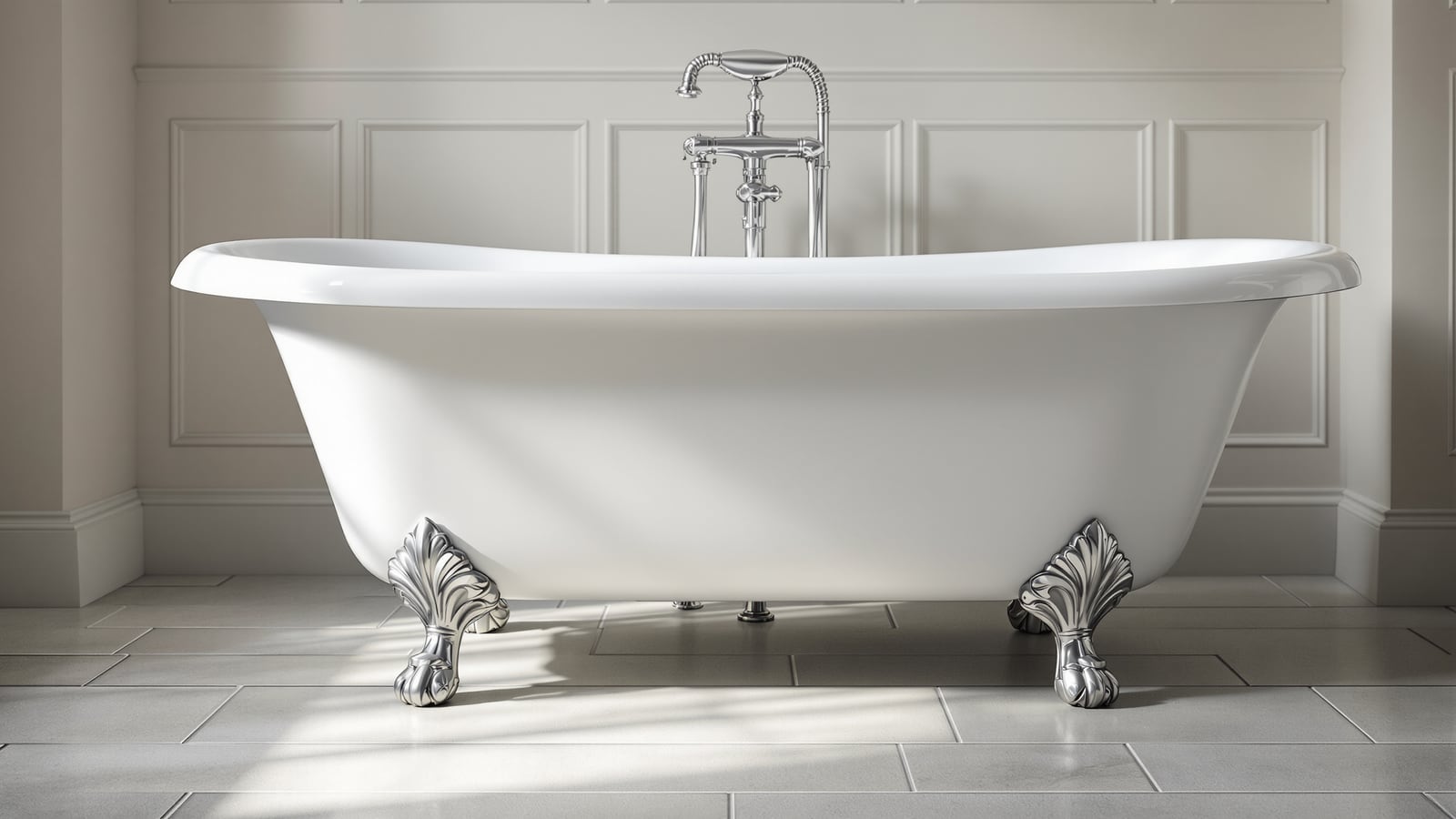
Cast Iron Bathtub India: The Heirloom Tub, Weight & Slab Load, Enamel Care & Cost (2026)
Why an enamelled cast-iron bathtub is the heirloom tub — unbeatable heat retention, a quiet soak and a vitreous-enamel surface that shrugs off scratches and stains for decades — set against the one thing India buyers must plan for: the sheer weight on the slab, the crew it takes to carry it up, chip repair, the cost premium, and an honest verdict versus acrylic.
A cast-iron bathtub is the tub you buy once and hand down. Beneath its glossy white face is a shell of iron poured into a mould, then fused with a thick coat of vitreous (porcelain) enamel at over 800 degrees Celsius so the glass and the metal become one surface. That construction is why a good cast-iron bath outlives the bathroom around it — the enamel does not fade, scratch or stain the way a moulded plastic tub does, and the mass of iron holds heat like nothing else you can install. It is, in the truest sense, an heirloom fitting.
It is also the single heaviest thing most people will ever carry into a bathroom, and in India that weight is not a footnote — it is the decision. This guide is India-first: it assumes an RCC slab that someone has to check, a stairwell the tub has to travel up, hard water that films every surface, and a family weighing a real cost premium against a lighter acrylic tub. It sits under the bathtub buying guide for India, which frames the whole tub decision; here we go deep on cast iron alone. For the lighter, cheaper mainstream option see acrylic bathtubs for India, and if you want the tub to stand as a sculptural object read freestanding bathtubs for India.
A cast-iron bathtub is not a tub choice — it is a structural choice. Confirm the slab can carry it, and that a crew can carry it up, before you fall in love with the finish. Everything else is the easy part.
Why cast iron is the heirloom tub
Strip away the romance and four real, measurable advantages remain.
- Heat retention that no other material matches. The iron shell is a thermal battery. Fill it and the mass of metal takes the chill, then gives it back to the water — a cast-iron bath holds bath temperature far longer than acrylic or steel, so a long winter soak stays warm without a top-up. In a load-shedding city where you cannot count on an instant geyser refill, that thermal inertia is genuinely useful.
- A quiet, solid soak. Water hitting a thin acrylic or pressed-steel tub drums and booms; water filling a cast-iron tub lands with a dull, dead thud. The mass kills vibration and noise, and the tub does not flex or creak when you climb in. It simply feels planted.
- Vitreous enamel that resists scratch and stain. The fused-glass surface is genuinely hard — it shrugs off the abrasion that dulls an acrylic tub over years, resists most household chemicals, and does not absorb dye from bath products or hair colour. Cleaned gently, it looks the same in twenty years as on day one.
- Decades-long life. An iron shell does not warp, sag or go brittle with age. The only real enemy is a hard impact that chips the enamel through to the iron — and even that is repairable. It is normal for a cast-iron bath to be resurfaced once and serve two generations.
The weight — the India consideration that comes first
Here is the number that changes everything. An empty cast-iron bathtub is not a two-person lift; a full one is a serious load on your floor.
| Cast iron | Acrylic | Pressed steel | |
|---|---|---|---|
| Empty tub weight | 100–150 kg (freestanding to 180 kg) | 25–40 kg | 30–45 kg |
| Water (170 L soak) | ~170 kg | ~170 kg | ~170 kg |
| A bather | ~70–90 kg | ~70–90 kg | ~70–90 kg |
| Total on the slab | ≈ 340–410 kg | ≈ 265–300 kg | ≈ 270–305 kg |
| People to carry it in | 2–3 minimum | 1 | 1–2 |
That 340–410 kg sits in a footprint barely 1.7 m long. Two things follow, and both are India-specific.
- The slab must be up to it. A sound RCC floor slab in a modern Indian home is designed for a residential imposed load of 2 kN/m² (about 200 kg/m²) under IS 875 (Part 2), and a bathroom is usually fine — but a cast-iron tub concentrates its load, and an old building, a cantilevered balcony bathroom, a chajja, or a filler-slab floor is a different story. On any pre-2000 structure, a top floor, or a doubtful slab, get a structural engineer to confirm before you buy. This is exactly the kind of check the bathroom planning stage for a new home exists for.
- It has to physically get there. Two to three people must carry 120-plus kilograms of iron up your staircase, round the landing, through the door and into position — without a lift in most low-rise Indian buildings, and without scarring the finished floor or the enamel. Freestanding tubs are worst: there is no frame to grab and the enamel is the finished face. Plan the route, protect the treads, and book the labour before delivery day.
Enamel care and chip repair
The vitreous-enamel surface is the tub's great strength and its one vulnerability. Treat it right and it is nearly indestructible; abuse it and you can dull or crack the glass.
- Clean gently. Warm water, a soft cloth and a mild pH-neutral cleaner is all it wants. Never use gritty scouring powders, steel wool or harsh acids — the very things people reach for against Indian hard-water scale will, over time, micro-scratch and dull the gloss. For limescale, a dilute vinegar wipe followed by a rinse is safer than an abrasive.
- Protect it from impact. The enamel is glass fused to iron; a heavy dropped object — a steel bucket, a tile, a geyser part during a renovation — can chip it through to the metal. Once bare iron is exposed it will rust and the chip can spread, so a chip is not cosmetic, it is urgent.
- Repairing a chip. A small chip is fixable at home with a two-part enamel touch-up / epoxy repair kit: clean and de-rust the spot, apply the matched paint or epoxy in thin coats, and cure. A larger area or a whole tired tub can be professionally resurfaced (re-enamelled/refinished) — sprayed and baked back to a fresh coat — which is precisely why a 40-year-old cast-iron bath is worth saving when an acrylic tub of the same age is landfill.
- Guard the enamel during the build. Most chips happen not in service but during installation and handling. Keep the tub crated until the last moment, protect it while tiling around it, and never stand on the rim.
Cast iron vs acrylic — the honest trade-off
This is the decision most India buyers are actually making. Neither is "better"; they suit different homes.
| Cast iron | Acrylic | |
|---|---|---|
| Heat retention | Excellent — holds a long soak warm | Modest — cools faster |
| Feel & noise | Solid, quiet, does not flex | Lighter, can drum/creak |
| Surface | Vitreous enamel; scratch & stain resistant; refinishable | Warm to touch; scratches, can dull, DIY-repairable |
| Weight | Very heavy — slab + route must be checked | Light — one person, any floor |
| Install crew | 2–3 people, strong slab | 1 person, simple |
| Lifespan | Decades; a two-generation fitting | 10–15 years typical |
| Shapes & colours | Fewer, classic (roll-top, drop-in) | Almost any shape, jets, colours |
| Cost | Premium | Budget to mid |
| Best for | Heirloom soak, feature bathrooms, ground floor | Most homes, upper floors, tight budgets, whirlpool tubs |
The short version: choose cast iron if you genuinely soak, value the warmth and silence, want a fitting that lasts generations, and have a slab (ideally a ground or low floor) that can take it. Choose acrylic if weight, upper-floor delivery, budget or a specific moulded shape or whirlpool feature drive the decision. If the look of a standalone tub is what you are after but the weight worries you, a modern acrylic or stone-composite freestanding bathtub gives much of the drama at a fraction of the mass.
What it costs in India (2026)
Ball-park 2026 retail rates for the tub alone, before waste, tap set, and installation labour. Cast iron carries a clear premium over acrylic — you are paying for the material, the enamel process, and the freight of shipping heavy iron.
| Item | Typical rate |
|---|---|
| Standard drop-in / built-in cast-iron bathtub | ₹45,000–1,20,000 |
| Freestanding roll-top / clawfoot cast-iron tub | ₹1,00,000–3,50,000+ |
| Comparable mainstream acrylic tub | ₹15,000–60,000 |
| Floor-standing / wall bath-filler mixer | ₹12,000–45,000 |
| Enamel chip touch-up kit | ₹600–2,500 |
| Professional re-enamelling / refinishing | ₹15,000–40,000 |
| Extra install labour (2–3 person carry + set) | ₹3,000–10,000 |
Brands you will see as examples across these ranges — Kohler, Jaquar, Hindware, Cera, Roca, Victoria + Albert (the last two often imported) — are brand-neutral illustrations. Buy to the enamel quality and the weight maths above, not the showroom lighting. A freestanding cast-iron tub is a substantial line item; budget it whole, and coordinate it early with the bathroom design guide for India and, on a retrofit, the bathroom renovation guide for India.
The verdict for an Indian home
A cast-iron bathtub rewards a specific buyer: someone who actually takes long soaks, wants the warmth and quiet no other tub delivers, values a fitting that can be refinished and passed down, and — crucially — has a slab and a delivery route that can carry the mass. For a ground-floor or low-floor bathroom, a feature bathroom, or a heritage/restoration project, it is the honest premium choice. For a fourth-floor flat with a doubtful slab, a tight budget, or a need for a moulded whirlpool shape, acrylic is the sensible answer and there is no shame in it. Decide the weight question first, confirm it with the bathtub buying guide for India, and only then enjoy choosing the finish.
References
- IS 2556: Vitreous Sanitary Appliances (Vitreous China) (BIS) — sanitaryware specification family; enamel and glaze quality benchmarks referenced for baths and appliances.
- National Building Code of India (NBC) 2016, Part 6 (Structural Design) and Part 9 (Plumbing Services) — structural loading and sanitary appliance fixing practice relevant to a heavy tub.
- IS 875 (Part 2): Code of Practice for Design Loads (Imposed Loads) (BIS) — residential floor imposed-load basis for checking a slab under a concentrated tub load.
- IS 1172: Code of Basic Requirements for Water Supply, Drainage and Sanitation (BIS) — plumbing and drainage basics for bath installation.
- CPWD Specifications (Central Public Works Department) — government workmanship benchmarks for sanitaryware fixing and heavy-fixture handling.
Export this guide
Related Guides — Deep-dive reading
Acrylic vs Cast Iron Bathtub: Which Is Better? (India, 2026)
A fair, India-first head-to-head between an acrylic bathtub and an enamelled cast-iron one — weighed on the factors that actually decide it here: slab load and handling, heat retention, durability, warmth to touch, repairability, price and installation — with a clear verdict by home type and budget.
BathroomsHow to Choose a Bathtub in India: Size, Material, Fit & Budget (2026 Buyer's Guide)
A buyer's decision guide to picking a bathtub for an Indian home — the first checks on bathroom size, floor load and geyser capacity, freestanding vs built-in vs corner by space, acrylic vs cast iron vs FRP, whether a whirlpool is worth it, good/better/best rupee tiers, delivery and install, warranty, and how to spot thin flexing acrylic.
BathroomsSoaking Tub India: Deep Japanese-Style Ofuro Baths, Geyser Sizing, Load & Real Costs (2026)
Why a deep soaking tub gives a full-immersion soak from a small footprint — ofuro ergonomics, the extra-deep water line, how much hot water and geyser capacity you actually need, heat-retention materials, the structural load of a filled tub, and honest rupee ranges for an Indian home.
BathroomsRelated Tools — Try Free
Before vs After — Cost Reality Check
Compare what you expected to pay vs what you actually paid, category by category.
Reality CheckBathroom Renovation Cost Calculator
Cost to renovate an existing bathroom with a replace-vs-keep model — demolition, re-waterproofing, tiles, fittings and the money saved by keeping items.
Bathroom CalculatorMaterial Comparison Sheet
India's interior material cheatsheet — plywood, finishes, hardware, countertops, paints, waterproofing.
Reference Guide