
Soaking Tub India: Deep Japanese-Style Ofuro Baths, Geyser Sizing, Load & Real Costs (2026)
Why a deep soaking tub gives a full-immersion soak from a small footprint — ofuro ergonomics, the extra-deep water line, how much hot water and geyser capacity you actually need, heat-retention materials, the structural load of a filled tub, and honest rupee ranges for an Indian home.
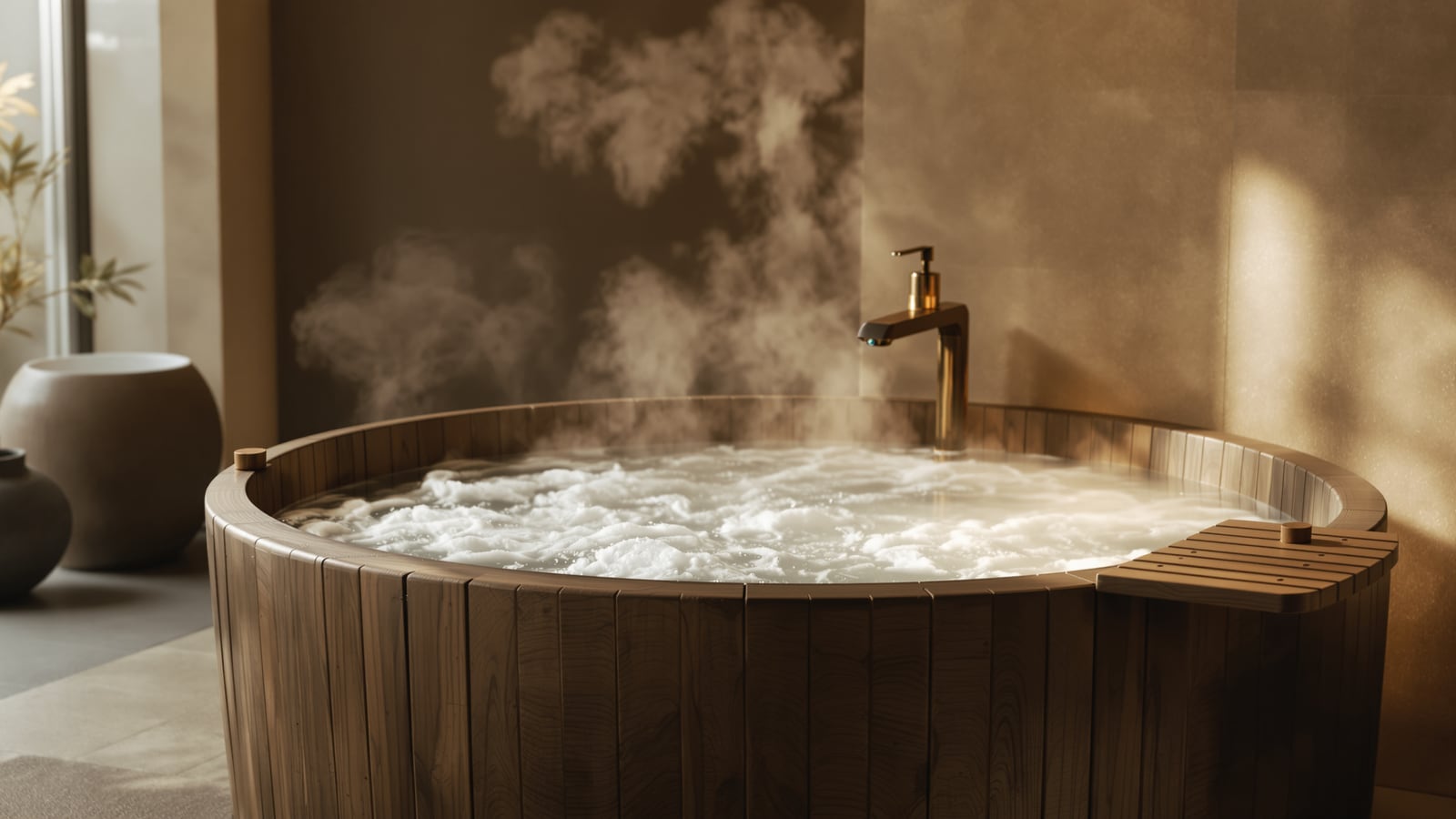
A standard bathtub in most Indian apartments is a shallow 40–43 cm-deep tray you half-lie in, shoulders cold, knees poking out of the water. A soaking tub is a different idea entirely: it is built deep — 50 to 68 cm of usable water — so you sit upright and the water covers you to the shoulders or the neck. The reference point is the Japanese ofuro, the short, deep tub the whole family soaks in after washing outside it. That geometry is why a soaking tub can be smaller in plan than a normal bath yet give a far better bath: it trades length for depth.
This guide is India-first — the geyser you actually have, the slab it sits on, the hard water and rupee quotes you will really face. Read it up to the bathtub guide for India for the full tub picture, and alongside the freestanding bathtub guide and the spa bathroom design guide if this soak is the centrepiece of a wellness bathroom.
A soaking tub is sized around immersion, not floor area. If you want a proper hot soak but have limited space, a deep tub beats a long shallow one every time — the constraints that decide it are hot-water supply and slab load, not the tile plan.
What makes a tub a "soaking" tub
Three things separate a true soaking tub from an ordinary bath:
- Water depth to overflow of 50 cm or more. An ordinary bath overflows at ~30–35 cm of water; a soaking tub is designed for 45–55 cm of actual water over the seat, so a seated adult is immersed to the chest or shoulders.
- A short, deep, often near-vertical form. Interior length is frequently only 1,050–1,400 mm because you sit rather than recline full-length. That is what lets it fit where a 1,700 mm bath cannot.
- An ergonomic seat or bench moulded into the base or one end, so you sit at a comfortable depth without sliding, knees drawn up ofuro-style.
Soaking tub vs standard bath vs whirlpool
| Feature | Standard alcove bath | Deep soaking tub (ofuro-style) | Whirlpool / jetted tub |
|---|---|---|---|
| Typical length | 1,600–1,700 mm | 1,050–1,500 mm | 1,700–1,800 mm |
| Water depth (soak) | 28–35 cm | 45–55 cm | 30–38 cm |
| Posture | Reclined, shoulders exposed | Seated upright, shoulder-deep | Reclined |
| Water to fill | 140–180 L | 190–320 L | 200–280 L |
| Best for | Quick bath, kids | Long hot soak, wellness | Massage jets |
| Running/maintenance | Low | Low (no pump) | Higher (pump, pipework hygiene) |
The soaking tub uses more water per fill despite a smaller footprint — depth costs volume. That is the single fact that drives everything downstream: your geyser, your fill time, and your slab.
The wellness case — why people soak
Immersion to the shoulders in 38–40 degree water raises the body's core temperature, dilates blood vessels and delivers a genuine physiological wind-down — the same mechanism behind the Japanese evening ofuro and Scandinavian bathing culture. Warm-water immersion is widely associated with easier muscle recovery, relief for lower-back and joint stiffness, and better sleep onset when taken 60–90 minutes before bed. Hydrostatic pressure — the gentle squeeze of being surrounded by water — is also why a deep soak feels more restorative than a shallow one: more of you is under it.
For an Indian household this reads as an at-home spa ritual after a long commute, monsoon-day warmth, and a shared family soak in homes that value it. It is a lifestyle purchase — worth being honest about — but a deep tub is what makes the ritual actually work.
The build-up: depth, seat and immersion line
Sizing the hot water — the make-or-break number
The commonest disappointment with a soaking tub in India is running out of hot water halfway. Do the arithmetic before you buy.
A deep tub holds 190–320 litres. Of that, roughly 55–65% needs to be hot (the rest cold, blended to ~40 degrees). So you may need 120–200 litres of hot water in one sitting — several times what a normal storage geyser holds.
| Water heater | Typical hot output before it runs cold | Enough for a soaking tub? |
|---|---|---|
| 15 L storage geyser | ~15 L then reheat | No — pointless |
| 25 L storage geyser | ~25 L per heat cycle | Only a very small tub, with waits |
| 50 L storage geyser | ~50 L per cycle | Marginal; expect a top-up wait |
| 100 L / twin-tank storage | 100 L+ | Workable for most soaking tubs |
| Gas instant heater (high kW) | Continuous, flow-limited | Good — sized on flow rate |
| Solar + electric backup / heat pump | Large tank, cheap to run | Best for a household that soaks often |
Practical rules:
- Match tank to tub. A 190 L tub wants roughly a 100 L storage geyser (or two geysers plumbed together), or a high-output gas/instant heater delivering continuous hot water.
- Fill time matters as much as volume. A 15 mm supply fills slowly; the first water cools while the last arrives. A short, wide filler on a 20–25 mm hot line fills faster, so less heat is lost mid-fill.
- Heat-retaining tubs hide a small shortfall. A material that holds temperature lets you soak longer on the same fill, or top up with less hot water.
- Consider a deck or wall-mounted bath filler with a decent flow rate rather than a slow spout — see the bathroom faucets guide.
Materials — heat retention, weight and hard water
The shell material decides how long the water stays warm, how heavy the tub is empty, and how it handles hard Indian water and cleaning.
| Material | Heat retention | Empty weight (approx) | Notes for India |
|---|---|---|---|
| Cast / twin-skin acrylic | Good (warm to touch) | Light, 25–45 kg | Most common; repairable; avoid abrasive cleaners |
| Stone resin / solid surface | Excellent (thick walls) | Heavy, 90–160 kg | Superb soak feel; premium; check slab load |
| Cast iron + enamel | Very good, but slow to warm | Very heavy, 120–200 kg | Durable, classic; needs strong support |
| Steel enamel | Poor (thin, loses heat) | Medium | Cheap; not ideal for a long soak |
| Copper / wood (ofuro) | Very good | Varies | Statement pieces; higher upkeep, hard-water care |
For a genuine soak in India, twin-skin acrylic is the value sweet spot and stone resin the luxury pick. Whatever the shell, hard water leaves scale — wipe down after each soak and avoid abrasive pads. Insulated/foam-backed shells noticeably extend how long the water stays hot.
Structural load — can your slab and society take it
This is the step most people skip. A filled soaking tub with a bather is a serious concentrated load, and in apartments it is also a society/RERA question.
- Do the sum: tub weight + water (1 litre ≈ 1 kg) + bather. A stone or cast-iron tub, filled, easily approaches or exceeds 400–500 kg concentrated over a few square feet.
- Most residential RCC slabs are designed to NBC 2016 imposed loads (commonly ~2 kN/m² for residential), so a heavy filled tub can approach the design intent — get a structural engineer to confirm for cast-iron/stone tubs or upper floors.
- Waterproofing is non-negotiable. A deep tub means big splashes and a big drain event; the wet zone must be properly tanked. Follow the waterproofing guide — bund the area, slope to a floor drain, and never rely on silicone alone.
- In apartments, check society bye-laws / RERA on plumbing modifications and slab loading before you commit.
Costs — honest rupee ranges (2026)
| Item | Budget | Mid-range | Premium |
|---|---|---|---|
| Deep acrylic soaking tub | ₹35,000–70,000 | ₹70,000–1.4 lakh | — |
| Stone-resin / solid-surface tub | — | ₹1.5–3 lakh | ₹3–8 lakh+ |
| Cast-iron / copper / wood ofuro | — | ₹2–4 lakh | ₹5–12 lakh+ |
| Bath filler / mixer | ₹6,000–15,000 | ₹15,000–40,000 | ₹40,000+ |
| Extra hot-water capacity (100 L geyser / gas heater) | ₹12,000–25,000 | ₹25,000–60,000 | ₹60,000+ |
| Waterproofing + plumbing + install | ₹20,000–50,000 | ₹50,000–1 lakh | ₹1 lakh+ |
Budget the whole system, not just the tub. A ₹60,000 tub with a 15 L geyser is a bad buy; the same tub with proper hot water and drainage is a nightly pleasure.
Do / Don't
- Do size the geyser to the tub's hot-water demand — this is the number one failure point.
- Do confirm slab load for heavy tubs and upper floors before ordering.
- Do insist on full waterproofing and a fall to the floor drain around the tub.
- Don't buy on length alone — depth and the seat decide the soak quality.
- Don't ignore hard-water care; wipe down and skip abrasives to protect the finish.
- Don't forget access for cleaning behind and a serviceable waste/overflow.
A deep soaking tub is one of the few bathroom features that reliably changes how a home feels to live in — provided the plumbing and slab behind it are sized for the job. Get those right and it earns its space many times over.
References
- NBC 2016 (National Building Code of India) — Part 9 Plumbing Services and imposed-load provisions relevant to bathroom loading and drainage.
- IS 2556 — Vitreous sanitary appliances / ceramic ware specifications (fixture reference for bathroom fittings).
- IS 1172 — Basic requirements for water supply, drainage and sanitation (per-fixture water and drainage planning).
- CPHEEO Manual on Water Supply & Sanitation — Ministry of Housing & Urban Affairs guidance on domestic water demand and plumbing.
- IGBC / GRIHA — green-building water-efficiency guidance relevant to high-volume fixtures like soaking tubs.
- BIS (Bureau of Indian Standards) — current sanitaryware, plumbing and electrical (water-heater) standards for specification.
Export this guide
Related Guides — Deep-dive reading
Freestanding Bathtub India: Materials, Floor Load, Concealed Plumbing & Cost (2026)
The statement centrepiece tub that stands free of every wall — how acrylic, stone-resin and cast-iron differ, the floor load a filled tub imposes, the concealed rough-in you must set out before the flooring goes down, the clear space it needs all around, drainage, and honest 2026 rupee costs.
BathroomsCast Iron Bathtub India: The Heirloom Tub, Weight & Slab Load, Enamel Care & Cost (2026)
Why an enamelled cast-iron bathtub is the heirloom tub — unbeatable heat retention, a quiet soak and a vitreous-enamel surface that shrugs off scratches and stains for decades — set against the one thing India buyers must plan for: the sheer weight on the slab, the crew it takes to carry it up, chip repair, the cost premium, and an honest verdict versus acrylic.
BathroomsBathtub India: Types, Materials, Sizes, Load, Cost & Is It Worth It (2026)
The honest, India-first pillar guide to bathtubs — freestanding, built-in and corner types; acrylic, cast iron, FRP, stone and steel materials; the space, structural load and hot-water (geyser) capacity a tub really needs; drainage and overflow; a full comparison table, rupee costs, and a clear-eyed answer to whether a bathtub is worth it in an Indian home.
BathroomsRelated Tools — Try Free
Rainwater Tank Sizer
How big should your rainwater tank be? Computes annual harvest, recommended tank capacity in litres, water-bill savings, and payback — for 10 Indian cities.
RWH CalculatorMonsoon-Readiness Checklist
Pre-rain home audit across 9 categories — terrace, drains, waterproofing, electrical, HVAC, pest, vehicles, documents.
Seasonal AuditApartment Video Door System Planner
Enter flats, entrances, floors and guard desk for a first-pass building intercom plan — door stations, indoor monitors, guard station, the right architecture and an indicative cost band.
Building Planner