
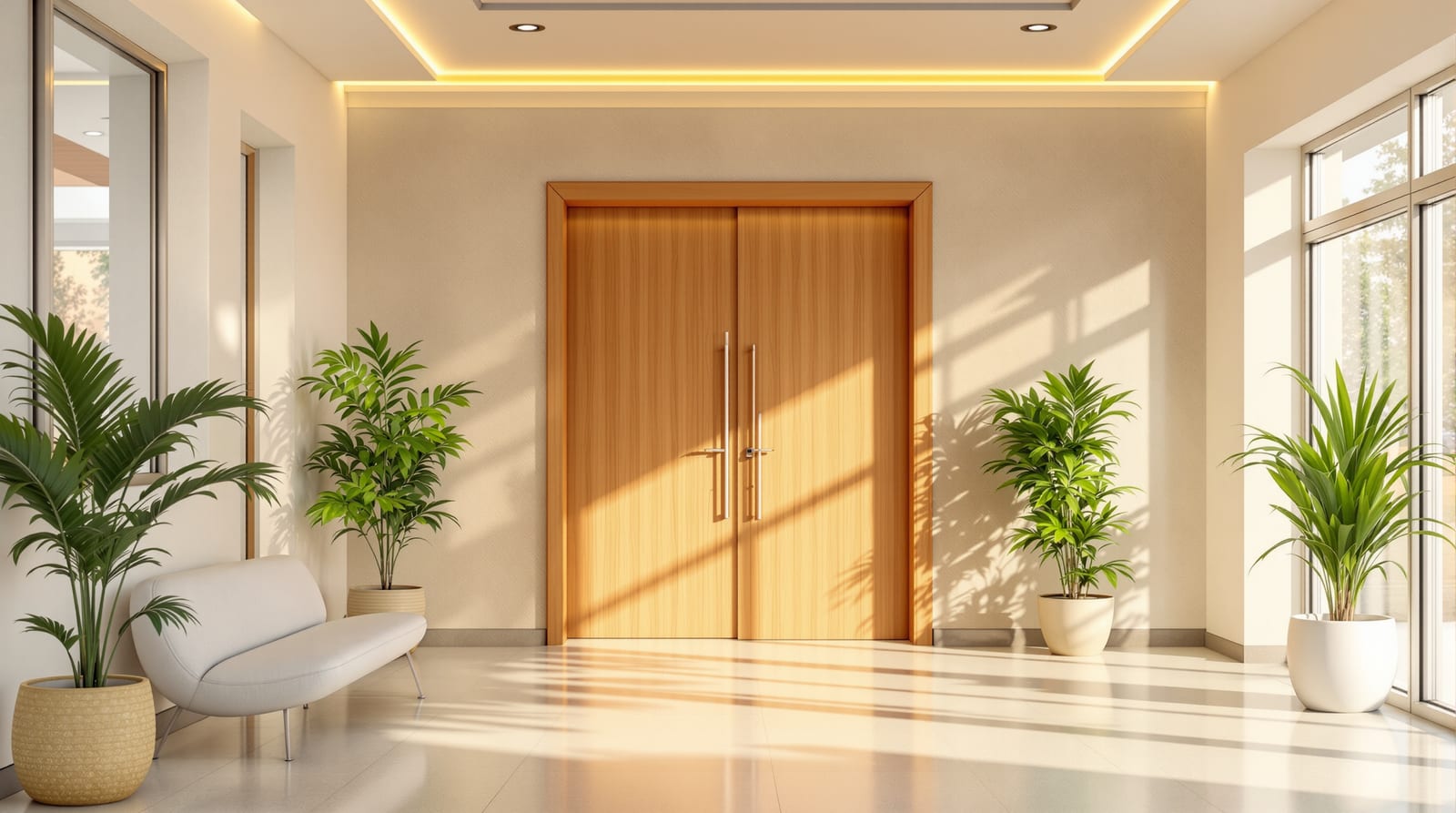
Clinic Door in India: Doors for Diagnostic Centres, Dental and Consultation Rooms (2026)
A room-by-room guide to specifying doors for a clinic or diagnostic centre in India - the welcoming accessible entrance, hygienic consultation and treatment-room doors, the essential lead-lined X-ray door, dental, washroom and waiting area - with the privacy, acoustic, hygiene and budget logic behind each, and indicative per-door costs.
A clinic is a hospital's logic compressed into a smaller, tighter, more budget-conscious building. The same forces that decide doors in a 300-bed hospital - patient privacy, infection control, accessibility, the immovable physics of radiation shielding - all apply to a two-room diagnostic centre or a dental practice on the first floor of a commercial complex. What changes is scale and money. You cannot specify a clinic the way you would a multi-speciality hospital, but you also cannot pretend a clinic is just an office with a stethoscope. The door at a consultation-room threshold is carrying a patient's right to a private conversation; the door at an X-ray room is carrying lead. Get those two wrong and you have either a privacy complaint or a radiation-safety violation, both of which a small practice can ill afford. This guide walks the clinic room by room, names the right door for each, explains the driver that decides it, and gives indicative 2026 per-door costs for an Indian practice. It is the small-footprint companion to the full hospital doors guide; where a question is shared with the larger building, this guide points you there rather than repeating it. For the wider logic of matching a door to its space, start with the master overview on choosing a door by space.
The six forces that shape every clinic door
A clinic door is decided by where it sits on these six demands. Unlike a home, where looks and warmth lead, a clinic weights them in a clinical order - and the weighting flips completely from the waiting room to the X-ray bunker.
- Patient privacy and confidentiality. The defining force in the consultation and treatment zone. A doctor-patient conversation, a counselling session, an examination - these must not be overheard from the waiting room. This is partly a door choice (solid, well-sealed, lockable) and partly an acoustic one. It is also an ethical and increasingly a legal expectation under medical-council confidentiality norms.
- Hygiene and cleanability. Every clinical surface must wipe down with hospital disinfectant without degrading. Doors near examination, dressing and dental areas need non-porous, antibacterial, easy-clean faces - not raw timber that absorbs spills and harbours microbes.
- Radiation shielding. Non-negotiable and physics-driven. Any room with an X-ray, CT, mammography or dental OPG unit needs a lead-lined door whose lead equivalence matches the AERB-approved shielding layout. There is no budget workaround for this one.
- Accessibility. Patients arrive unwell, elderly, on crutches, in wheelchairs, sometimes on a stretcher trolley. RPwD 2021 expects an accessible entrance and accessible toilet: clear width at least 900 mm, lever handles, threshold no higher than 12 mm.
- A welcoming, reassuring look. A clinic sells calm and competence. The entrance and waiting area should feel clean, bright and professional - not intimidating, not shabby. This is where glass and good light earn their place.
- Budget. A clinic is a small business. Unlike a hospital it cannot blanket every door in stainless steel. The skill is spending the money where the driver is non-negotiable (X-ray, accessible entrance, treatment hygiene) and using sensible, durable, cleanable economy elsewhere.
No single door scores high on all six. The craft is reading each room and specifying for its dominant force - then not overspending on the rest.
Clinic rooms and the door each one needs
Read the clinic as three zones of demand. The public zone (entrance, waiting, reception) is welcoming and accessible. The clinical zone (consultation, treatment, dressing, dental) is private and hygienic. The shielded zone (X-ray, imaging) is a radiation problem first and everything else second. Doors get more specialised and more expensive as you move from the waiting room toward the imaging room.
| Room / zone | Recommended door | Dominant driver | Indicative ₹ (per door, 2026) |
|---|---|---|---|
| Main entrance | Automatic sliding glass or wide frameless glass door, lever/auto, threshold under 12 mm | Welcoming + wheelchair accessible (RPwD 2021) | Auto sliding 1,50,000-4,00,000+; frameless glass swing 25,000-60,000 |
| Reception / office | Flush laminate door, lever handle, optional vision panel | Clean look, durable, low cost | 4,000-10,000 |
| Consultation room | Flush laminate door, privacy lever lock, acoustic seal + closer, optional small vision panel | Patient privacy + confidentiality acoustics | 6,000-16,000 (acoustic-sealed) |
| Treatment / dressing room | Flush door with antibacterial laminate or PVC face, lever, self-closing | Hygiene / wipe-clean + privacy | 6,000-14,000 |
| Dental operatory | Flush antibacterial-laminate door, wide leaf, lever, vision panel | Hygiene + equipment access + privacy | 7,000-15,000 |
| X-ray / imaging room | Lead-lined door (steel or HPL face), lead equivalence per AERB layout, lead-lined frame, viewing window optional | Radiation shielding - essential, no substitute | 60,000-2,50,000+ (by lead mm + size) |
| Sample collection / lab | Flush laminate or FRP door, wipe-clean, self-closing | Hygiene, durability | 5,000-12,000 |
| Patient / accessible washroom | PVC or WPC waterproof door, clear width >=900 mm, lever, outward swing, threshold <=12 mm | Moisture resistance + accessibility | 2,500-6,000 (PVC); 5,000-9,000 (WPC accessible) |
| Waiting area / passage | Wide flush or glass door, no full barrier where not needed | Flow, light, openness | 4,000-12,000 |
| Fire exit (if applicable) | Fire-rated door per occupancy, self-closing, outward swing | NBC 2016 egress | 14,000-40,000+ |
The entrance: welcoming, and genuinely accessible
The clinic entrance does two jobs at once. It must look open and reassuring - a sick or anxious patient should feel they are walking into a calm, competent place - and it must be usable by someone in a wheelchair, on crutches, or pushing an elderly parent.
For most clinics, a wide toughened-glass door is the right answer: it lets daylight into the waiting room, signals cleanliness, and reads as modern and welcoming. A diagnostic centre with steady footfall, or one wanting a hands-free hygienic entry, should consider an automatic sliding glass door - no handle to touch, opens for a trolley or wheelchair on its own, and closes behind to hold the air-conditioning. A smaller practice on a tight budget can use a frameless glass swing door on a floor spring instead.
Whichever you pick, the accessibility numbers are not optional. RPwD 2021 expects a clear opening width of at least 900 mm, a lever (not knob) handle within easy reach, and a threshold no higher than 12 mm so a wheelchair rolls over it. For the full accessibility detail, see wheelchair-accessible doors. Avoid a heavy self-closing door with a stiff closer at a clinic entrance - an elderly patient should not have to fight it; tune the closer light, or automate.
Consultation and treatment rooms: privacy is the product
This is where a clinic differs most from an office. The consultation-room door is protecting a confidential conversation. A patient describing symptoms, a doctor delivering a diagnosis, a counselling session - none of it should carry to the waiting room three metres away. Two things deliver that:
- A solid, well-sealed door. A flush laminate door with a solid or particleboard core, fitted with perimeter acoustic seals and a drop seal at the bottom, is the practical clinic answer. It blocks the casual overhearing that an air-gapped hollow door does not. For a psychiatry, counselling, audiology or any genuinely sound-sensitive room, step up to a proper soundproof door assembly with a higher STC rating.
- A privacy lock. A lever handle with a thumb-turn privacy function (engaged occupied, releasable from outside in an emergency) lets the doctor close the room without a key. Combine with a self-closer so the door never drifts open mid-consultation.
On the face material, the treatment and dressing rooms - where dressings, fluids and spills happen - want a non-porous, antibacterial, wipe-clean surface. An antibacterial-grade laminate or a PVC-faced flush door takes a daily wipe-down with disinfectant without swelling or staining the way bare timber would. A small vision panel in the door can be useful for treatment rooms (a nurse can check without barging in) but is the wrong choice for a counselling room, where privacy beats visibility - so specify the panel room by room, not as a blanket rule.
The X-ray and imaging room: the one door you cannot economise
Every clinic with an X-ray unit, a CT scanner, mammography, or even a dental OPG/cephalometric machine needs a lead-lined door. This is not a hygiene preference or an acoustic nicety - it is radiation physics and a legal requirement. The Atomic Energy Regulatory Board (AERB) reviews the shielding layout for any diagnostic X-ray installation in India, and the door's lead equivalence (typically expressed in millimetres of lead, e.g. 1.5 mm, 2 mm or more) must match what that approved layout specifies for the wall it sits in. Under-specify it and you fail the radiation-protection survey; you also expose your reception staff and the next patient in the corridor.
A few practical points specific to the imaging-room door:
- The lead goes in the leaf and the frame. A lead-lined leaf in an ordinary frame leaks radiation at the edges. The frame must be lead-lined too, and the leaf must overlap the frame so there is no straight-line gap for radiation to escape - the section in the diagram above shows the lead core continuing past the opening edge.
- It is heavy. Lead-lined doors are substantially heavier than a normal flush door, so they need proper heavy-duty hinges and a strong frame fixing. Many are detailed as sliding lead-lined doors for that reason, especially where a wide opening is wanted.
- Match the mm to the layout, not to the cheapest quote. The cost swings widely with lead thickness and door size - a small dental OPG door at 1.5 mm lead is far cheaper than a CT-room door at 2-3 mm lead. Always build to the AERB-approved figure for your specific room.
Because the lead requirement dominates everything, this door is its own line item in the budget and should be ordered from a specialist medical-door fabricator, not the general carpenter doing the rest of the clinic.
Dental, washroom and the rest
Dental operatory. Treat it like a treatment room with a slightly wider leaf for chair-side equipment and good antibacterial laminate. Remember that any dental room with an OPG or intra-oral X-ray needs the lead-lined door rule applied to that room too.
Patient and accessible washroom. A clinic washroom is a wet, frequently used, infection-sensitive space - a PVC or WPC waterproof door is the correct, low-cost, rot-proof answer; bare timber will swell and harbour damp. At least one washroom must be accessible: clear width 900 mm, lever handle, outward-opening leaf (so a patient who collapses against the door can still be reached), and a near-flush threshold.
Lab / sample collection. A wipe-clean flush laminate or FRP door with a self-closer keeps the area hygienic and contained.
Waiting and passages. Keep these open and light. Not every threshold needs a full door; where one is used, a wide flush or glass door keeps the flow easy for trolleys and wheelchairs.
For the architectural context that surrounds all of this - clinical zoning, infection-control layout and patient flow in healthcare buildings - see the companion overview on healthcare architecture.
Costs: where to spend, where to save
A clinic budget should follow the drivers. Spend confidently on the three non-negotiables - the lead-lined X-ray door, the accessible entrance, and acoustic sealing on consultation rooms - and use sensible economy everywhere the driver is mild.
| Door | Typical clinic spec | Indicative ₹ (2026) | Spend or save? |
|---|---|---|---|
| Lead-lined X-ray door | Steel/HPL face, lead per AERB layout, lead-lined frame | 60,000-2,50,000+ | Spend - essential, no substitute |
| Automatic glass entrance | Sensor sliding, accessible | 1,50,000-4,00,000+ | Spend if footfall justifies; else frameless glass swing 25,000-60,000 |
| Consultation door | Flush laminate, acoustic seal, privacy lock, closer | 6,000-16,000 | Spend on the seal + lock |
| Treatment / dental door | Antibacterial laminate flush, lever, closer | 6,000-15,000 | Mid - cleanable face matters |
| Reception / office / lab | Flush laminate / FRP | 4,000-12,000 | Save |
| Washroom (accessible) | WPC/PVC, lever, outward swing, low threshold | 2,500-9,000 | Save, but meet accessibility |
All figures are indicative, exclude 18% GST, and vary by size, finish, lead thickness, hardware and city. To price your own door schedule, the door cost calculator and the commercial door cost calculator help; to check a specific room against clinical norms, the hospital door selector covers clinic rooms too.
Standards and codes that apply
- AERB radiation protection. The X-ray/imaging room door lead equivalence must match the AERB-approved shielding layout for that installation. This governs the imaging-room door absolutely.
- RPwD 2021 accessibility. Accessible entrance and at least one accessible toilet: clear width >=900 mm, lever handles, threshold <=12 mm.
- NBC 2016. Door widths and, where the clinic's occupancy and floor warrant it, fire-exit and egress provisions. A small clinic inside a larger commercial building inherits that building's fire-exit and stairwell requirements - see fire-rated doors.
- IS 4351 (steel frames), IS 1003 (timber doors), IS 3614 (fire doors) for the relevant assemblies.
Do and don't
- Do lead-line the imaging-room door to the AERB figure - leaf and frame both - and order it from a medical-door specialist.
- Do seal and lock consultation-room doors for genuine privacy; tune closers light at the entrance for elderly patients.
- Do use antibacterial, wipe-clean faces in treatment, dental and lab rooms, and waterproof PVC/WPC in washrooms.
- Don't use raw or hollow timber doors in clinical or wet rooms - they absorb fluids, harbour microbes and swell.
- Don't treat the X-ray door as a place to save money; an under-specified lead door fails the radiation survey.
- Don't forget the accessible toilet and entrance - they are legal expectations, not extras.
Frequently asked questions
Does every clinic with an X-ray machine really need a lead-lined door?
Yes. Any room housing a diagnostic X-ray, CT, mammography or dental OPG unit needs a lead-lined door whose lead equivalence matches the AERB-approved shielding layout for that room. The lead must be in both the leaf and the frame, with the leaf overlapping the frame so radiation cannot escape at the edges. There is no compliant low-cost substitute - it is a radiation-safety requirement, not a finish choice.
What is the best door for a clinic consultation room?
A solid-core flush laminate door fitted with perimeter acoustic seals and a privacy lever lock, plus a self-closer. That combination gives the patient privacy and confidentiality a consultation needs at a sensible clinic cost. For counselling, psychiatry or audiology rooms, step up to a proper soundproof door assembly.
How do I make a clinic accessible to wheelchair patients on a budget?
You do not need to make every door wide - you need the right ones. Ensure the main entrance and at least one washroom give a clear width of at least 900 mm, a lever handle, and a threshold no higher than 12 mm, with the washroom door swinging outward. The detailed checklist is in wheelchair-accessible doors.
How much should I budget for clinic doors?
For a small diagnostic centre, plan roughly 4,000-16,000 per door for consultation, treatment, reception and lab doors, 2,500-9,000 for washrooms, and a separate, larger line of 60,000-2,50,000+ for the lead-lined X-ray door depending on lead thickness and size. The entrance ranges from a 25,000-60,000 frameless glass swing to a 1,50,000+ automatic sliding door. All figures exclude GST and vary by city and finish - price your schedule with the commercial door cost calculator.
How is a clinic different from a hospital for door selection?
The drivers are the same - privacy, hygiene, accessibility, radiation shielding - but the scale and budget are smaller. A clinic spends precisely where the driver is non-negotiable (X-ray, accessible entrance, treatment hygiene) and uses durable economy elsewhere, rather than blanketing every door in stainless steel as a large hospital might. The full large-building treatment is in the hospital doors guide, and clinical layout context is in healthcare architecture.
Export this guide
Related Guides — Deep-dive reading
Universal Design Doors for Indian Homes: Inclusive Doors That Work for Everyone (2026)
How to design and specify doors that serve children, the elderly, pregnant women, the injured and wheelchair users by default - generous width, lever handles, near-flush thresholds, low-force closing, contrast and good lighting - without your home ever looking medical.
Home Doors & EntrancesLibrary Door in India: Quiet, Access-Controlled and Anti-Theft Reading-Room Entrances (2026)
Doors for public, college and corporate libraries in India - acoustic silence, RFID security gates, controlled single entry and a calm scholarly look, with zone-by-zone choices and costs.
Home Doors & EntrancesGuest Room Door in India: Privacy, Quiet and Smart Picks Without Overspending (2026)
How to choose a guest bedroom door for an Indian home - privacy and acoustics so visitors feel comfortable, but budget-sensible for a room used only now and then: solid-core flush for quiet, panel or laminate for looks, the right privacy lock, simple soundproofing, and a finish that matches the rest of your doors - with picks ranked and indicative rupee costs.
Home Doors & EntrancesRelated Tools — Try Free
Acoustic Privacy (STC) Visualizer
Indian healthcare acoustic visualizer — compare wall assemblies and noise sources, see received SPL after STC attenuation, and check FGI 2018 / IS 1950 / NABH speech-privacy compliance with live dual-canvas waveform.
Acoustic ToolAccessible Door Checker
Check a door against wheelchair-accessibility guidance — clear width, threshold, handle and closer force per RPwD 2021.
Compliance ToolWindow Hardware Cost Calculator
Estimate window hardware cost — hinges, handles, locks, rollers and multipoint gears.
Window Calculator