
CCTV WDR Explained (India 2026): Beating Harsh Backlight & Glare
Why a face against a bright doorway, glass shopfront or west-facing gate turns into a silhouette, what wide dynamic range actually does, and how to tell true multi-exposure WDR from cheap digital WDR before you buy.
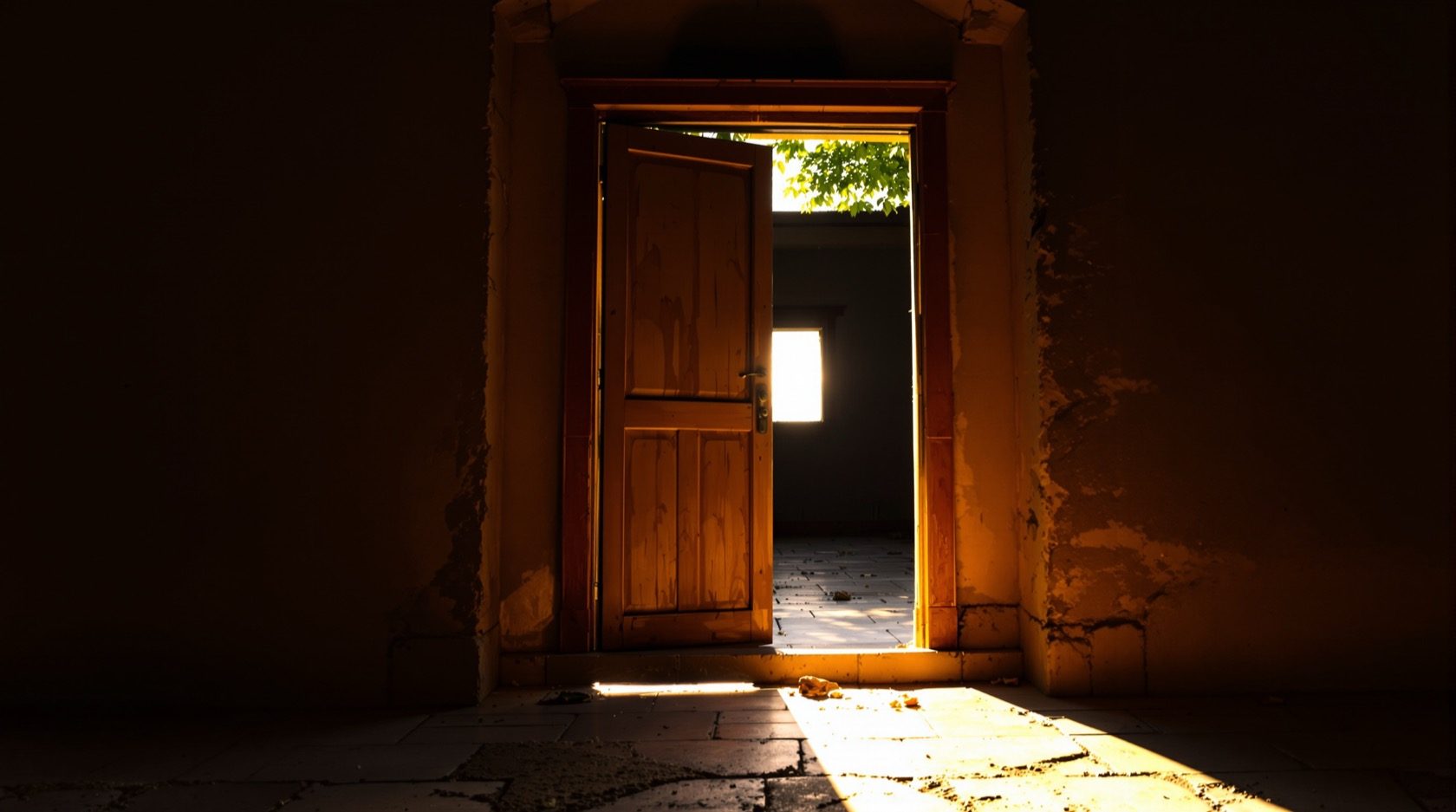
You point a camera at your main gate, review the footage, and the one thing you needed — the face of the person who rang the bell — is a flat black silhouette against a blazing white background. The number plate behind them is a smear of light. Everything is technically "recorded", and yet you can identify nobody. This is not a resolution problem, and buying an 8MP camera will not fix it. It is a dynamic range problem, and the spec-sheet line that addresses it is CCTV WDR — Wide Dynamic Range.
This guide is the focused explainer on WDR in Studio Matrx's CCTV hub. It sits alongside the other image-and-optics guides: how many megapixels you actually need is the job of the resolution guide; what makes an image good overall — sensor, aperture, codec — belongs to the image quality guide; and seeing in the dark is the low-light cameras guide. Here we stay in one lane: high-contrast scenes, where bright and dark sit in the same frame, and how WDR rescues them.
Scope & safety. This guide helps you understand a spec and choose it well, then brief an installer. Mounting at height, cabling and any mains-electrical work belong to licensed professionals — see the electrical hub. A sharper, more identifiable image also carries a heavier privacy duty: cameras belong only on your own property and shared areas, never bathrooms, bedrooms or changing areas, and should be positioned to respect neighbours and the spirit of the Digital Personal Data Protection Act, 2023.
What dynamic range means, in plain terms
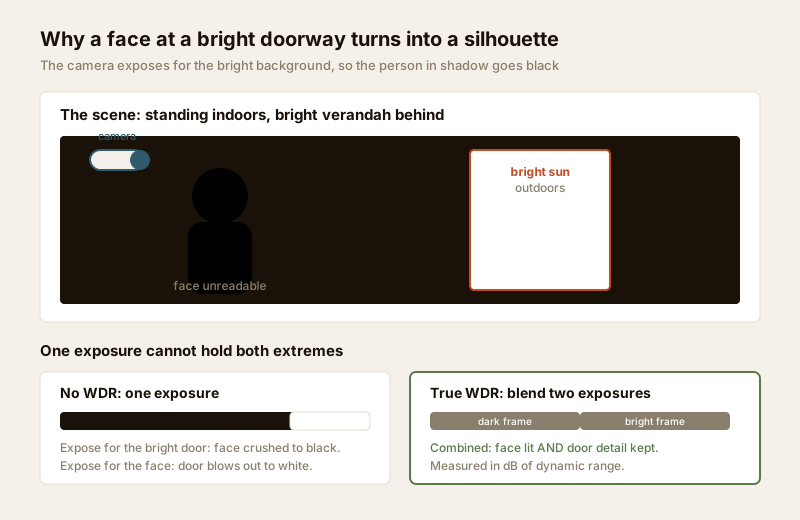
Your eye is astonishing at this. Stand in a dark room looking out through a sunlit door and you see both the room and the garden at once — your eye and brain juggle a huge range of brightness on the fly. A camera sensor cannot. It takes one exposure across the whole frame: it must pick a single brightness level to build the picture around.
- Expose for the bright doorway, and the sensor pulls everything down until the door looks right — which crushes the person in the shadow to black.
- Expose for the face in shadow, and the sensor lifts everything until the face is visible — which blows the doorway out to pure white and loses the plate, the vehicle, the street.
Dynamic range is simply the gap between the darkest and brightest thing a sensor can capture in a single frame and still keep detail in both. It is measured in decibels (dB). A basic camera manages roughly 60–70 dB — fine for evenly lit scenes, useless when sun and shadow share the frame.
What WDR actually does
Wide Dynamic Range (WDR) — sometimes labelled HDR on a spec sheet, the same idea as HDR on your phone — is the camera's answer to that impossible single exposure. Instead of one, a true-WDR camera captures multiple exposures of the same scene in quick succession: a short (dark) exposure that keeps the bright doorway from blowing out, and a long (bright) exposure that lifts the face out of shadow. It then merges them into one frame where both survive.
The result is a picture that looks closer to what your eye sees: the visitor's face is lit and readable, and the bright scene behind them keeps its detail. The higher the WDR number in dB, the harsher the contrast the camera can tame. Good WDR cameras are rated around 120 dB, with premium sensors going higher.
There is one honest caveat. Because true WDR blends frames captured a fraction apart, very fast motion in a high-contrast scene can show faint ghosting or artefacts. For a gate or doorway — where people pause — this is a non-issue. For a fast till or a busy road, weigh it against the frame rate guide.
True WDR vs digital WDR vs backlight compensation
This is where marketing muddies the water, so read carefully. Three different things get sold as "handles backlight", and they are not equal.
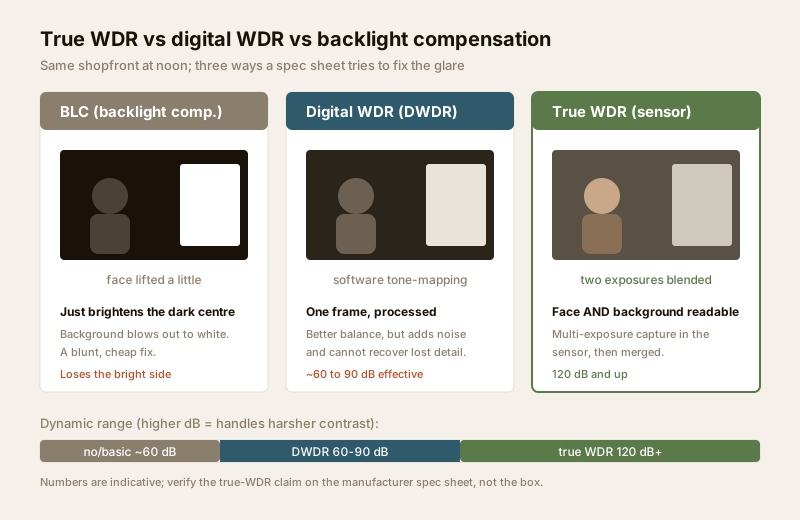
- BLC (Backlight Compensation) is the crudest. It simply brightens the dark centre of the frame so the subject is less black — while letting the bright background blow out completely. It is a blunt, decades-old fix. It lifts a face a little; it throws away the bright side entirely.
- DWDR (Digital / Software WDR) works on a single captured frame, using software tone-mapping to compress the contrast. It is better than BLC and costs almost nothing to add, which is why cheap cameras splash "WDR" on the box when they mean DWDR. But it cannot recover detail the sensor never captured, and pushing it adds visible noise. Effective range is roughly 60–90 dB.
- True WDR (Sensor / Hardware WDR) is the real thing: the multi-exposure capture-and-merge described above, done at the sensor. It genuinely extends what the camera can record — 120 dB and up — because it is capturing more information, not just squeezing what it has.
| Feature | BLC | Digital WDR (DWDR) | True WDR (sensor) |
|---|---|---|---|
| How it works | Brightens dark centre only | Software tone-maps one frame | Merges multiple exposures |
| Extra hardware | None | None | Yes — capable sensor |
| Effective range | Very limited | ~60–90 dB | 120 dB and up |
| Keeps bright detail? | No — background blows out | Partly | Yes |
| Downside | Loses the bright side | Adds noise; can look flat | Slight motion ghosting; costs more |
| On the spec sheet | "Backlight compensation" | "WDR", "D-WDR", "Digital WDR" | "True WDR", "Sensor WDR", "120 dB WDR" |
The buying rule: the word "WDR" alone on a box usually means DWDR. If backlight is your real problem, look for the phrase "true WDR" or "120 dB" on the manufacturer's own specification sheet — not the retail listing. If it does not state a dB figure, assume it is digital.
Where WDR earns its money in India — and where it does not
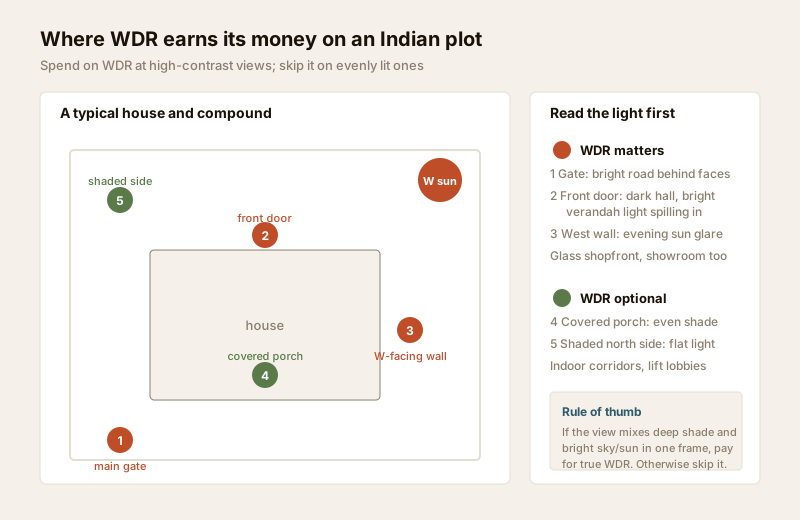
India's harsh, low-latitude sun makes this a bigger deal here than in cooler, greyer climates. But WDR costs money and can slightly complicate fast scenes, so spend it where the light demands it, not everywhere. Read each view's lighting before you buy.
| View | Why it is high-contrast | WDR priority |
|---|---|---|
| Main gate | Faces read against a bright road/sky behind | High — true WDR |
| Front door / entrance | Dark hall, bright verandah light spilling in | High — true WDR |
| West-facing gate or wall | Direct low evening sun straight into the lens | High — true WDR |
| Glass shopfront / showroom | Sun on glass, dark interior behind | High — true WDR |
| Covered porch / car park (shaded) | Even, diffuse light | Low — WDR optional |
| Indoor corridor, lift lobby | Steady artificial light, no glare | Low — skip WDR |
| Shaded north side / boundary | Flat, consistent light | Low — skip WDR |
A few India-specific notes on top of the table:
- East and west orientations are the trap. A gate that faces the rising or setting sun gets the light straight down the lens for an hour or two a day — exactly when people come and go. WDR helps, but so does aiming across the scene rather than into the sun, and a good sun-shield (see the bullet camera guide).
- Monsoon glare is real. A bright overcast sky is deceptively harsh — a flat white glare that silhouettes anyone beneath it. WDR handles this the same way it handles direct sun.
- WDR is not night vision. A high-contrast scene at night — a dark yard with one blazing security light — is a different job. There, low-light sensitivity and IR matter more; see low-light cameras and pair the camera with a proper lighting plan, which is the whole point of the lighting and visibility security assessment.
WDR and privacy — the honest note
WDR exists to make faces identifiable in bad light. That is its value, and also its responsibility. A camera that can now clearly read a visitor's face against your bright gate can equally read a neighbour walking past or a delivery worker who never consented to be catalogued. More identifiable footage means more privacy duty, not less. Keep the useful part of the frame — your gate, your door — and angle away from a neighbour's window or a public footpath. For a structured way to check this across a property, see the security and privacy assessment.
Price and what to look for
WDR is a sensor-and-processing feature, so it rides on the camera's price band rather than being a separate line item. Treat these as ballparks to sanity-check a quote, not fixed rates.
| Camera | Typical range (₹) | WDR reality |
|---|---|---|
| Entry 2MP camera | ₹1,200 – ₹3,000 | Usually DWDR only; ignore the "WDR" badge |
| Mid 4MP IP camera | ₹3,000 – ₹7,000 | Look for genuine true WDR here; the sweet spot |
| True-WDR 120 dB camera (4–5MP) | ₹6,000 – ₹14,000 | Worth it only at high-contrast views |
| Premium wide-DR / starlight combo | ₹12,000 + | Handles both harsh backlight and low light |
Two closing pointers when you read a quote or a box:
- Demand the dB number. "WDR supported" is meaningless. "120 dB true WDR" on the spec sheet is a commitment.
- Match WDR to the view, not the whole system. Put true-WDR cameras on the gate, the door and the west wall; save money with plain cameras on the shaded porch and indoor corridors. Size and cost the whole scheme with the camera coverage calculator.
When to bring in a professional. You can decide which views need WDR yourself using this guide and the figures above — that is a planning judgement about light, and you know your plot's sun better than anyone. Hand the rest to a licensed installer: mounting at height, cable pulling, weatherproof terminations and recorder commissioning, and any work at the mains board, which is a licensed electrician's job. Ask the installer to demo a candidate camera at your actual gate at the worst time of day — the sun angle that silhouettes people — before you commit to the model across the property.
Key takeaways
- WDR (Wide Dynamic Range) fixes high-contrast scenes — the black-silhouette-against-a-bright-doorway problem — which no amount of extra megapixels or resolution can solve.
- It works by capturing and merging multiple exposures; the effect is measured in dB, and good cameras hit 120 dB.
- True WDR is not the same as digital WDR or backlight compensation. The word "WDR" on a box usually means cheap DWDR; insist on "true WDR" or a dB figure on the manufacturer spec sheet.
- In India it matters most at gates, entrances, west-facing views and glass shopfronts — anywhere deep shade and bright sun or sky share the frame — and can be skipped on evenly lit porches, corridors and shaded sides.
- More identifiable footage means more privacy duty; keep WDR cameras trained on your own property, and route mounting, cabling and mains work to a licensed professional.
References
- Digital Personal Data Protection Act, 2023 — position cameras to cover only your own property and shared areas with a legitimate purpose; sharper, WDR-corrected footage is more identifiable and carries a greater duty of care.
- Dynamic range (dB) and true-WDR claims — verify the stated decibel figure and whether WDR is sensor-based or digital on the manufacturer's specification sheet before ordering; retail listings routinely overstate this.
- National Building Code of India (SP 7), Bureau of Indian Standards, and local municipal bye-laws for any structural, electrical or life-safety aspect of an install; verify the current edition via the BIS catalogue: https://www.services.bis.gov.in/
This is an educational overview. Mounting at height, cabling and any electrical work are qualified professional tasks — engage licensed installers and verify any standard's current status via the BIS catalogue before relying on it.
Export this guide
Related Guides — Deep-dive reading
How to Choose a CCTV Camera (2026): The Homeowner's Decision Guide for India
Cut through the spec-sheet noise and choose the right CCTV camera for each spot around an Indian home. What actually matters — sensor and low-light performance, lens and field of view, form factor, IP and IK ratings, honest smart features — and the marketing claims to ignore.
SecurityCCTV-Compatible Lighting for Indian Homes (2026): How to Light a Scene So the Camera Actually Sees It
The bridge between your lighting and your cameras — why a scene that looks fine to your eye can still be useless footage, and how uniformity, no light in the lens, the right white and flicker-free drivers make the difference.
SecurityInfrared vs Colour Night Vision CCTV in India (2026): Which Sees Better in the Dark?
A homeowner's head-to-head between traditional infrared (IR) night vision, which lights the scene invisibly and shows a black-and-white image, and colour night vision, which keeps the picture in colour at night using a very sensitive sensor and a little white light — with an honest verdict on when each wins and why a hybrid camera is usually the smartest buy.
SecurityRelated Tools — Try Free
Window Hardware Cost Calculator
Estimate window hardware cost — hinges, handles, locks, rollers and multipoint gears.
Window CalculatorCCTV Camera Coverage & Count Calculator
Estimate how many CCTV cameras you need, the NVR channels, storage in TB for your retention period, and an indicative all-in cost with GST.
CCTV CalculatorCCTV Identification-Distance Calculator
How far a camera can still identify a face or number plate (DORI 250 px/m), from resolution, lens and sensor.
Identify Distance