
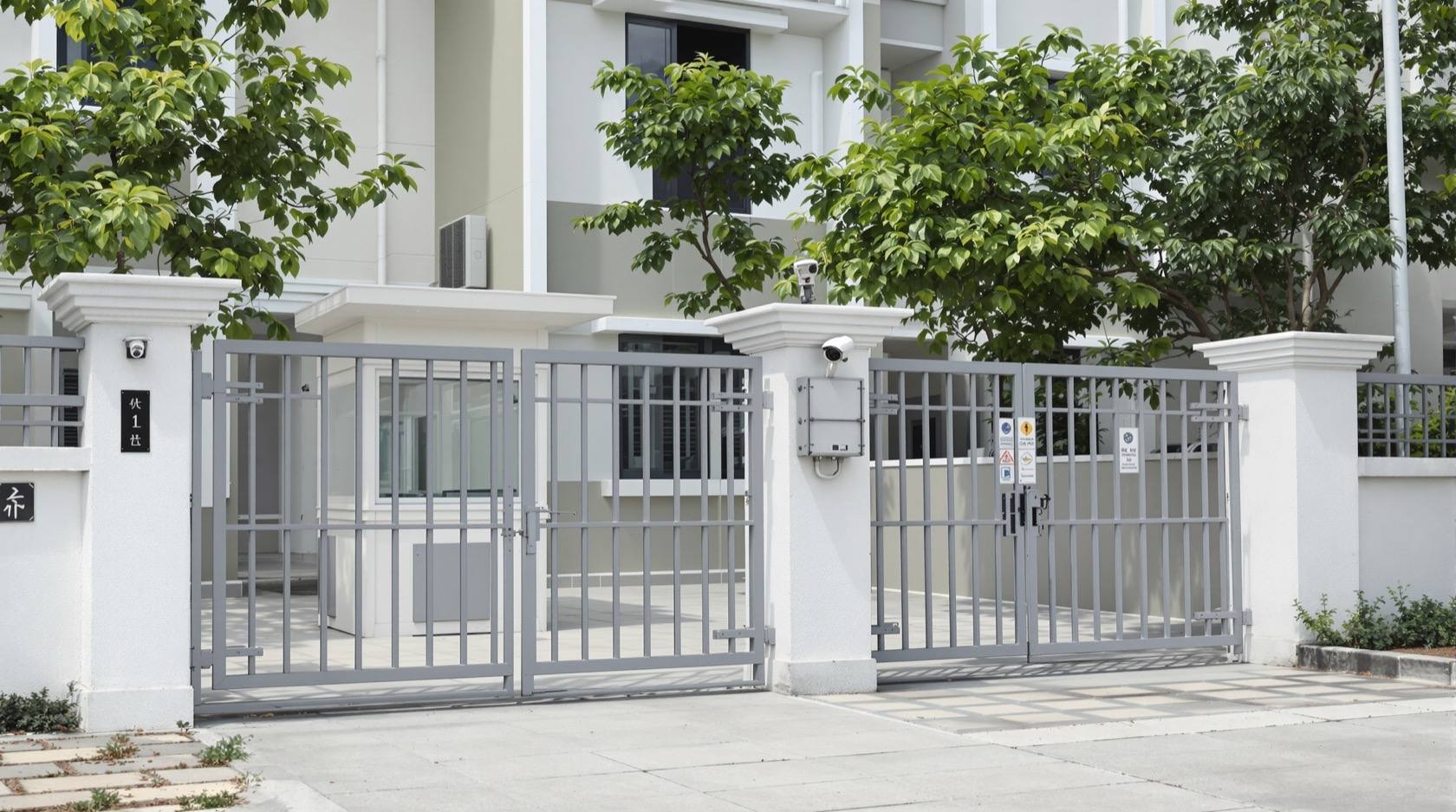
CCTV vs Physical Guarding in India (2026): Cameras, Guards or Both?
An honest head-to-head between electronic CCTV surveillance and manned physical guarding for a home, villa, gated community, shop or small site in India — what each really does, where each wins, and why the best answer is almost always a layered combination rather than one or the other.
"Should I put up cameras, or hire a guard?" It is one of the most common security questions an Indian homeowner, villa owner or resident-welfare committee asks — and it is usually framed as a straight either-or. The honest answer is that it is not really a contest at all. CCTV and physical guarding do different jobs. A camera records and deters but cannot walk to the gate and challenge a stranger. A guard can judge, question and respond but cannot be in six places at once, all night, every night, without a break. The right choice depends on your site, your budget, the value at risk and how much genuine coverage each option actually buys you.
So the useful question is not "which one" but "what mix, for my situation". For a small flat, a couple of cameras and an intercom may be plenty; for a gated community, cameras and guards together — with guards made far more effective by watching those cameras — is the sweet spot. This guide lays the two side by side, honestly.
Scope and how to read this. This is a neutral head-to-head to help you decide between electronic surveillance and manned guarding, not a sales pitch for either and not a price list. Both are legitimate, and for most sites the best answer is a layered combination, not one or the other. Indicative "generally cheaper or dearer" framing appears, but verify real quotes locally. CCTV footage is personal data under the Digital Personal Data Protection Act 2023 (DPDP); manned guards must be engaged through an agency licensed under the Private Security Agencies (Regulation) Act 2005 (PSARA). For how each fits a whole system, see how to choose a security system.
What each one actually is
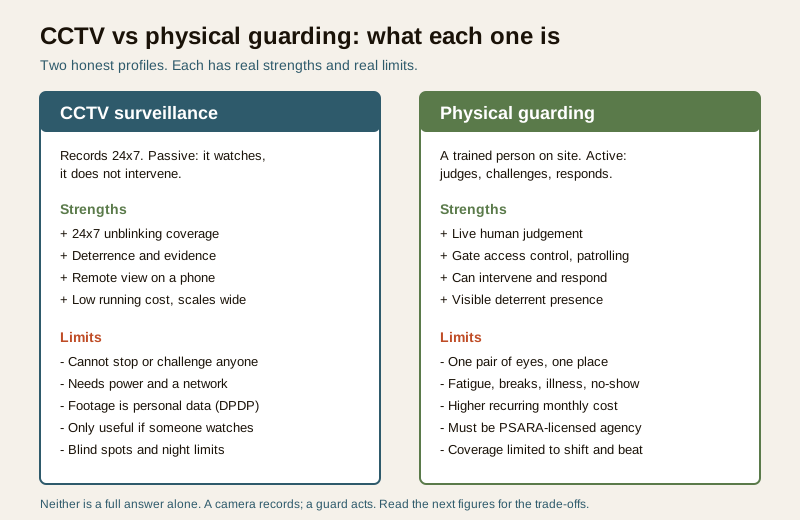
CCTV surveillance is a network of cameras recording to a local recorder or the cloud, usually viewable live on a phone. Its great virtue is that it never blinks: it watches every covered angle, 24x7, and keeps a replayable record. It deters casual intruders, it gives you evidence after the fact, and it lets you look in from anywhere. But it is fundamentally passive — it records an event, it does not stop one. A camera cannot open a gate, question a visitor, or chase off a trespasser. It needs power and a network to keep working, it has blind spots and night-time limits, and its footage is only as useful as the person who reviews it or the system that alerts on it.
Physical guarding is a trained person on the site — at the gate, in a control cabin, or walking a patrol. Its great virtue is live human judgement: a guard can verify a visitor, check a delivery, challenge someone who does not belong, respond to a disturbance, and make a call no camera can make. A guard is a visible deterrent and the closest thing to an on-site response you can have. But one guard is one pair of eyes in one place. Guards take breaks, tire on night shifts, fall ill, and occasionally do not turn up. Their coverage is limited to a shift and a beat, they cost a recurring salary every month, and — importantly in India — they must be supplied by a PSARA-licensed agency, not hired informally off the street.
Neither profile is "better". They are shaped differently, and they fail differently. That is exactly why they combine so well.
The head-to-head
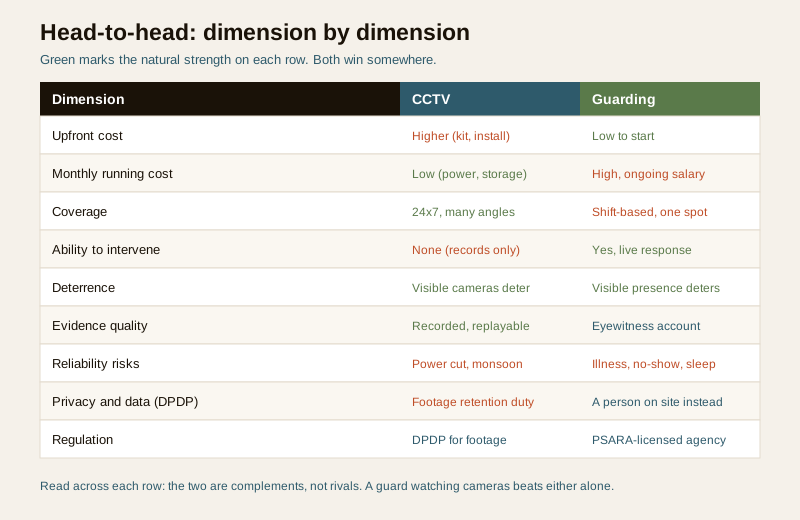
Laying the two against the dimensions that actually decide the choice:
| Dimension | CCTV | Physical guarding |
|---|---|---|
| Upfront cost | Higher — cameras, recorder, cabling, install | Low to start — just the deployment |
| Monthly running cost | Low — power, storage, occasional service | High and permanent — one or more salaries, round the clock |
| Coverage | 24x7 across many angles at once | Shift-based; one person, one location at a time |
| Ability to intervene | None — it records, it cannot act | Yes — a guard can challenge and respond live |
| Deterrence | Real — visible cameras discourage many | Real — a visible guard discourages many |
| Evidence quality | Strong — recorded, timestamped, replayable | An eyewitness account, no automatic record |
| Reliability risks | Power cuts, network drop, monsoon, lens fouling | Fatigue, illness, no-show, distraction, a single point of failure |
| Privacy and data | Footage is personal data with retention duties (DPDP) | A person on site instead of stored images |
| Scalability | Add cameras cheaply to cover more ground | Each extra guard is another full salary |
| Regulation | DPDP governs footage handling and retention | Must be a PSARA-licensed agency with trained, verified staff |
A few honest observations. On cost, the two are almost mirror images: CCTV is capital-heavy but cheap to run, while guarding is cheap to start but expensive forever — over a few years a single 24x7 guard post typically costs far more than a good camera system. On coverage, cameras win on breadth and hours; a guard wins on depth at a single point. On response, only a human can intervene. On reliability, both fail, but differently: a power cut blinds a camera while a monsoon night or a missed shift blinds a guard. And each carries its own duty — DPDP for what your cameras record, PSARA for how your guards are engaged.
The honest headline. Read across every row and the same truth appears: a camera records, a guard acts, and each covers the other's weakness. The strongest single upgrade for most growing sites is not "more cameras" or "another guard" — it is a guard watching the cameras. One trained person monitoring a well-placed CCTV control room covers far more ground than the same person walking a beat, and can send a real response the moment something is seen.
Which suits whom
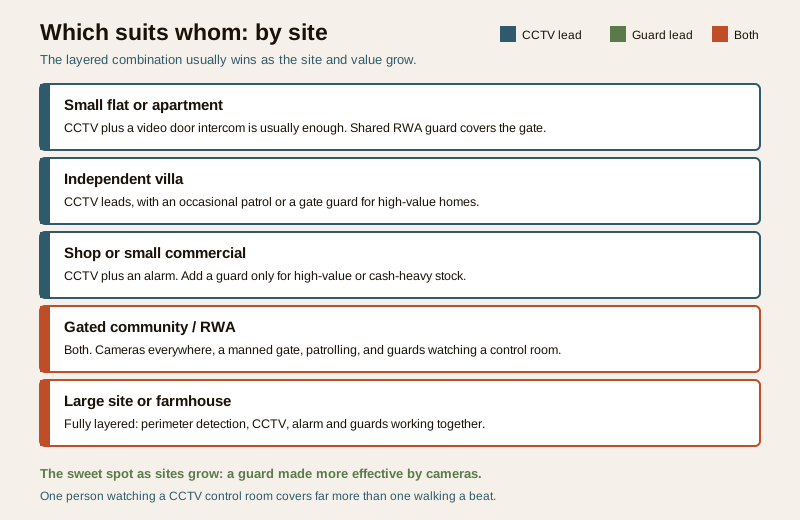
There is no universal winner — the right mix scales with the site and the value at risk.
Small flat or apartment. A couple of CCTV cameras covering the door and the approach, plus a video door intercom, is usually enough. You rarely need a dedicated guard, because the building or society already provides a manned gate downstairs. Here, CCTV leads and the shared guard is a bonus you already pay for.
Independent villa. CCTV is the backbone — cameras over the gate, the boundary, the entrances and the parking, viewable on a phone. A full-time guard is optional and depends on how much value and how much footfall you have; many villa owners add an occasional patrol, a night guard, or a gate guard for peace of mind rather than round-the-clock manning. CCTV leads, with guarding added to taste.
Shop or small commercial. CCTV plus an intrusion alarm is the standard base — cameras over the till, the entrance and the stockroom, with an alarm for the closed hours (see alarm monitoring services). A guard earns his cost only where the stock is high-value or cash-heavy, or where a visible presence at the door is itself the deterrent. CCTV plus alarm, guard only when the value justifies it.
Gated community or RWA. This is where the answer is clearly both. Cameras cover the perimeter, the common areas, the parking and the entry and exit lanes; a manned gate controls who comes in; patrolling covers the ground between cameras; and — the crucial part — guards watch a CCTV control room so the whole camera network becomes a live, responded-to system rather than a passive recorder. Cameras and guards here are not alternatives; they multiply each other.
Large site or farmhouse. A big, often isolated plot needs the full layered approach: perimeter detection, CCTV across the boundary and yard, an alarm on the closed building, and guards to respond — ideally with the guards monitoring cameras from a cabin rather than trying to watch a long boundary on foot. See the complete guide to perimeter security for composing this. Fully layered — everything, working together.
Complements, not rivals
The single most important idea in this comparison is that CCTV and guarding are complements. The modern best practice, from an RWA to an industrial site, is not to choose one but to let each cover the other's weakness:
- Cameras make a guard cover more ground. One guard in a control room, watching a screen wall, effectively "sees" the whole perimeter at once and can direct a patrol precisely where it is needed — far more than one walking a beat and hoping to be in the right place.
- A guard makes cameras act. The weakness of CCTV is that it only records; put a human behind the monitors and every camera gains the ability to trigger an immediate response.
- Alarms tie them together. An intrusion alarm can call a guard's attention, or a remote monitoring centre's, to the exact camera that matters at the exact moment.
This is why "cameras or guards" is usually the wrong question. For anything beyond a small flat, the money is best spent on a thin but complete layered system — cameras for breadth, a guard or a monitoring service for response, and an alarm to connect them — rather than pouring everything into one side.
How to decide
If you want a simple framework, decide in this order:
1. Start with your real threat and your site. A flat, a villa, a shop and a community are different problems. Map what you are actually defending and where value concentrates before buying anything — the building security systems guide walks through this.
2. Lay CCTV as the baseline. For almost every site, cameras are the cost-effective first layer: broad, 24x7, cheap to run, and the source of evidence. Get the coverage and siting right first.
3. Decide how you will get a response. A camera that no one watches is only useful after the event. Choose your response layer honestly: a full-time guard, a shared society guard, professional remote monitoring, or a mix. Weigh local vs professional monitoring to see who actually watches and reacts.
4. Add manned guarding where presence and intervention are worth the recurring cost — a controlled gate, a high-value site, or a community that needs someone to challenge and respond. Engage only a PSARA-licensed agency with trained, verified guards; a good guardhouse and an honest read of the guardhouse cost help you plan the post properly.
5. Wire them together. Wherever you have both, put the guard behind the cameras and connect the alarm so the system responds, not just records.
For a broader side-by-side of the choices that make up a home or community system — monitoring, professional versus DIY, and more — see the security comparison guide and DIY vs professional security.
Key takeaways
- It is not really either-or. CCTV records and deters; guarding judges and responds. They do different jobs and fail in different ways, which is exactly why they combine well.
- CCTV is capital-heavy but cheap to run; guarding is cheap to start but expensive forever. Over a few years a 24x7 guard post usually costs far more than a good camera system.
- Only a guard can intervene. A camera's honest limit is that it cannot act — so a camera without a response plan is evidence, not protection.
- The layered combination usually wins as the site grows — a small flat leans on CCTV; a gated community or large site needs both.
- The sweet spot is a guard watching the cameras. One person monitoring a control room covers far more than one walking a beat, and turns passive footage into a live response.
- Mind the rules on both sides — footage is personal data under DPDP; guards must come through a PSARA-licensed agency.
Where to go next
- How to choose a security system and the building security systems guide — fitting cameras and guards into one coherent system.
- CCTV control room monitoring and remote security monitoring — putting a human behind the cameras.
- Local vs professional monitoring and alarm monitoring services — how a response actually reaches your site.
- Guardhouse design and guardhouse cost — planning a manned post properly.
- Complete guide to perimeter security, the security comparison guide and DIY vs professional security — the wider set of choices.
References
- Digital Personal Data Protection Act, 2023 (DPDP) — CCTV footage is personal data; agree who may view it, how long it is retained, and how it is protected, and post notice where cameras record. Verify current status via the official source before relying on any provision.
- Private Security Agencies (Regulation) Act, 2005 (PSARA) — any manned guard must be supplied through a state-licensed private security agency with trained and verified personnel; verify the agency's licence before contracting.
- National Building Code of India (SP 7), Bureau of Indian Standards — for any gate, cabin or barrier, ensure security measures never obstruct means of egress; verify the current edition (SP 7:2026) via the BIS catalogue: https://www.services.bis.gov.in/
This is an educational, even-handed comparison to help homeowners and communities decide, not legal advice, a price list or an installation manual. Costs are indicative only — obtain real local quotes. Engage guards only through PSARA-licensed agencies, handle CCTV footage in line with the DPDP Act, and consult a qualified security professional for a specific site.
Export this guide
Related Guides — Deep-dive reading
CCTV vs Video Door Phone: Which Does Your Home Need?
They look similar and get confused constantly, but a CCTV camera and a video door phone do different jobs — one watches the whole property and records, the other answers your door and controls who comes in. This guide settles CCTV vs video door phone for Indian homes: what each is for, where they overlap, real rupee costs, apartment versus villa relevance, and why most homes end up wanting both.
Smart HomeRemote Security Monitoring in India (2026): Watching and Responding From Anywhere
Watching your home from your phone is easy; making an alert lead to a real response is the hard part. The two honest models compared — self-monitoring by you and your family versus a paid professional monitoring centre — plus the secure tech behind remote access, the privacy stakes of a stranger watching inside your home, and why remote monitoring is only ever as good as the responder behind it.
SecurityGuardhouse Design in India (2026): A Post That Sees Everything and Treats the Guard as Human
How to design the guard cabin so the guard can actually do the job — commanding sightlines to gate, approach and pedestrian entry, the controls within reach, and the shelter, water, toilet and shift that keep the post alert and manned rather than empty.
SecurityRelated Tools — Try Free
CCTV Camera Coverage & Count Calculator
Estimate how many CCTV cameras you need, the NVR channels, storage in TB for your retention period, and an indicative all-in cost with GST.
CCTV CalculatorApartment Video Door System Planner
Enter flats, entrances, floors and guard desk for a first-pass building intercom plan — door stations, indoor monitors, guard station, the right architecture and an indicative cost band.
Building PlannerApartment vs Villa Interior Planning Guide
Compare ceiling height, structural flexibility, lighting, storage, and services between apartments and villas.
Planning Guide