
Security Comparison Guide (2026): How to Weigh Any X vs Y Security Choice in India
The master decision framework for comparing security options in India — how to weigh any head-to-head choice across need, cost, performance, reliability, privacy, ease, scalability, maintenance and code, so your context decides the winner rather than a salesperson.
Almost every security decision arrives as a choice between two things. Analog camera or IP camera. Smart lock or a good old lever lock. Do it yourself or pay a professional. Wired system or wireless. Local recording or cloud. And almost every time, the person selling you one side has a confident, one-word answer for which is "better". The honest answer is longer and far more useful: it depends on you — your home, your real threat, your budget over years not months, your power supply, your internet, your patience for maintenance. There is rarely a universal winner. The right choice is the one that fits your situation, and the only way to find it is to weigh the same handful of dimensions every single time.
This guide is not about one product or one price list. It is the framework that sits underneath all the specific "X vs Y" guides — the way to think, so that when a salesperson, a WhatsApp forward or a neighbour tells you what is "best", you can quietly test it against your own context and decide for yourself. For the specific decisions, see the head-to-head library at security comparisons; for the money and the "which whole system" question, this framework points you to the buying library and the costs library at the right moments.
Scope and how to read this. This is a neutral decision framework, not a sales pitch and not a buying guide. Its whole premise is that both sides of most comparisons are legitimate — each wins in some context — so it will never crown one option "the best" in the abstract. Indicative "generally cheaper or dearer" framing is used, but no fabricated prices, brands or statistics; for real numbers use the costs library. Where cameras, biometrics, footage or cloud storage are involved, personal data is in play under the Digital Personal Data Protection Act 2023 (DPDP). And one dimension is never a free trade: fire and life-safety choices are made to code and application, never to price — defer to the National Building Code (NBC = SP 7:2026) and a fire professional.
Why there is rarely a universal winner
If one option were simply better than the other on every axis, the loser would not exist. Both sides of a real comparison survive in the market because each wins for some buyer, in some building, against some threat. The mistake is to ask "which is better?" as if it had a single answer. The right question is "which is better for me?" — and that turns a shouting match into a calm checklist.
The value of a framework is that it makes your reasoning visible. When you can name why you chose one side — "reliability mattered more than running cost here, because my internet drops daily" — you have a decision you can defend, revisit and explain to your family, instead of a purchase you half-regret. It also inoculates you against the two things that quietly make most bad security decisions: the false economy and the vendor's bias. We will come back to both.
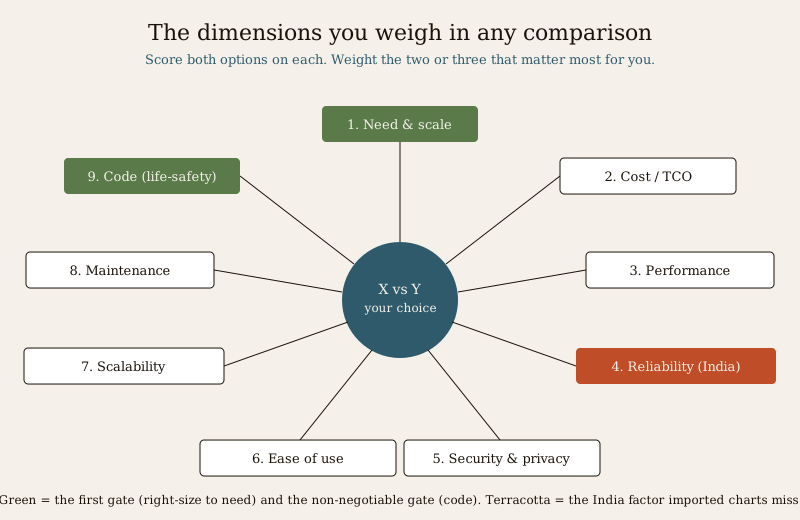
The nine dimensions you weigh in every comparison
Whatever the "X vs Y", you are really scoring both options against the same dimensions. Not all of them matter equally for a given choice — but you should at least glance at each, so nothing important is missed.
1. Need and threat, at your scale
Start here, always. What are you actually defending against, and how big is the site? A studio flat, a bungalow, a shop and a farmhouse have genuinely different threats, and the honest winner of any comparison can flip entirely with scale. An option that is overkill for a one-bedroom flat is exactly right for a large villa. Right-sizing to the real threat — not to fear, and not to the biggest system on offer — is the first filter. The how to choose a security system pillar walks through assessing your threat before you compare anything.
2. Cost — upfront versus running (the whole life, not the price tag)
The single most common error is comparing sticker prices. The number that matters is total cost of ownership (TCO): the upfront hardware and installation, plus everything that recurs — subscriptions, cloud storage, SIM or internet, battery replacements, annual maintenance, and eventual replacement. A cheaper box with a monthly cloud fee can cost far more over five years than a dearer one that records locally for free. Always compare over a realistic horizon, not on day one. The costs library is where you put real figures against this.
3. Performance and quality
What each option actually delivers when it matters — image clarity in low light, a lock's resistance to forcing, an alarm's reliability, a sensor's freedom from false triggers. Performance is worth paying for exactly where the threat is real, and worth not over-paying for where it is not.
4. Reliability — and the India factors
This is where imported comparison charts quietly mislead, because they were written for a different country. In India you must additionally ask: how does it behave through a power cut (does it have battery backup, does it fail secure or fail open)? Through the monsoon (is it rated for water and humidity)? In dust and heat? And when the internet drops — does a cloud-only or Wi-Fi-dependent option simply go blind? An option that tops the charts abroad can be the wrong answer on a street with daily outages and patchy broadband.
5. Security and privacy (including DPDP)
An ironic dimension: security products can create risk. A cloud camera with a default password is an open window; a biometric lock stores sensitive data. Weigh who can see your footage, where it is stored, whether it can be hardened, and — under the DPDP Act 2023 — what personal data is collected and how it is protected, especially anything pointing at neighbours, staff or a shared entrance.
6. Ease of install and use
A system nobody arms, or a lock the household finds fiddly, provides zero security. Weigh how hard it is to fit and — more importantly — whether your family will actually use it daily. This dimension is the whole heart of the DIY vs professional choice.
7. Scalability and future-proofing
Will this grow with you? Can you add cameras, doors or users later, or does the cheap option lock you into a dead end that must be ripped out? For a home you may stay in for decades, the option that extends cleanly can beat the one that is marginally cheaper today.
8. Maintenance
Every system has an upkeep burden — batteries, cleaning, firmware, service visits, testing. An option that is "cheaper" but demands constant attention has a hidden cost in your time and in the days it sits broken. Honest comparison counts the maintenance, not just the purchase.
9. Code compliance — never a cost choice for life-safety
For ordinary security kit, cost is a fair lever. For fire and life-safety, it is not. Smoke versus heat detector, conventional versus addressable fire alarm, sprinklers versus water mist, a lock versus free egress — these are chosen to the application and the code (NBC = SP 7:2026), with a fire professional, never "whichever is cheaper". A life-safety choice made on price is not an economy; it is a hazard. Treat code compliance as a gate the option must pass before its cost even enters the conversation.
No universal winner: the same choice, different winners
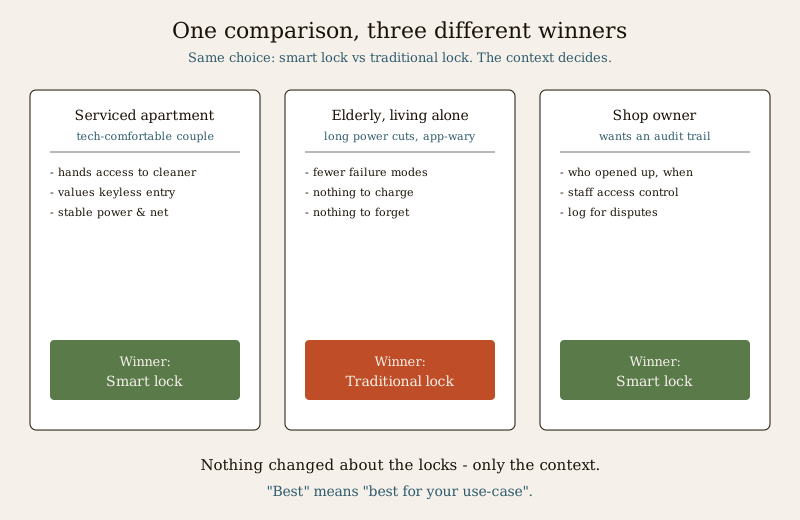
The clearest way to see the framework work is to watch a single comparison produce different winners in different homes. Take a familiar one — a smart lock versus a good traditional lock (covered in full at smart lock vs traditional lock).
- A tech-comfortable couple in a serviced apartment, who hand access to a cleaner and guests and value keyless convenience, may find the smart lock clearly wins.
- An elderly parent living alone in an area with long power cuts, uneasy with apps, may be far better served by a robust traditional lock — fewer failure modes, nothing to charge, nothing to forget.
- A shop owner may want a smart lock's audit trail of who opened up when, tipping the same choice back the other way.
Same product comparison, three defensible answers. Nothing changed about the locks — only the context. That is the whole point: "best" means "best for your use-case". The same pattern holds for analog versus IP cameras (see analog CCTV vs IP CCTV), wired versus wireless, and every other head-to-head in the comparisons library.
The two traps: false economy and vendor bias
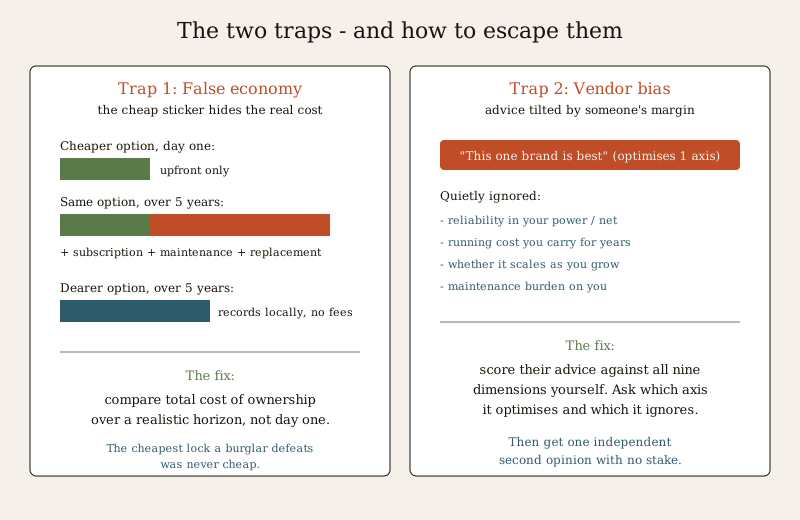
Two forces push most people toward the wrong side of a comparison. Naming them is half the defence.
The false economy is choosing the cheaper option on upfront price while ignoring the running cost, the maintenance, the reliability gap or the fact that it will not scale — so it costs more, or fails when needed, over its life. The antidote is the TCO habit from dimension 2: always compare over years, and count the recurring and the hidden. The cheapest lock that a burglar defeats, or the cheapest camera that is blind at night and offline in the monsoon, was never cheap.
Vendor bias is the tilt in advice from anyone who profits from one answer. An installer who only fits one brand, a shop that stocks one system, a "free WhatsApp expert" reselling a product — each has a confident recommendation shaped by their margin, not your context. This is not always dishonest; people genuinely believe in what they sell. The defence is the same either way: run their recommendation through the nine dimensions yourself, ask which dimension it optimises and which it quietly ignores, and get a second opinion from someone with no stake. Before you compare quotations, the buying library explains how to read a proposal for what it leaves out.
How to decide — the framework in five steps
Put together, comparing any "X vs Y" security choice comes down to a short, repeatable method:
1. Name your need and scale first. Write down what you are defending, and how big the site is, before you look at any product. This alone eliminates half the options.
2. Apply the code gate for anything life-safety. If the choice touches fire or escape, it is decided to NBC (SP 7:2026) and a professional, not to price. Settle that before cost.
3. Score both options across the nine dimensions. Give extra weight to the two or three that matter most for you — reliability if your power and internet are unstable, maintenance if you have no time, scalability if you plan to grow.
4. Compare on total cost of ownership, not sticker price. Project both over five years, including every recurring and hidden cost.
5. Sanity-check for the traps. Ask: am I choosing this because it is genuinely right, or because it is cheapest today, or because someone with a margin told me so? Get one independent opinion.
Whatever survives that method is your winner — and it may not be your neighbour's, which is exactly as it should be.
Key takeaways
- There is rarely a universal winner. Both sides of most comparisons exist because each is right for some buyer; the useful question is "best for me?", not "best?".
- Weigh the same nine dimensions every time — need and scale, cost/TCO, performance, reliability (with India's power, monsoon, dust and internet), security and privacy (DPDP), ease, scalability, maintenance, and code.
- Compare on total cost of ownership, not the sticker price — the cheapest box with a monthly fee is often the dearest over five years.
- Life-safety is never a cost choice. Smoke versus heat, conventional versus addressable, lock versus egress — decided to code (NBC = SP 7:2026) and a fire professional.
- Beware the false economy and vendor bias — score every recommendation across all nine dimensions and get an independent second opinion.
Where to go next
- How to choose a security system — the companion pillar for assessing your threat and choosing a whole system (distinct from this decision framework).
- The head-to-head security comparisons library — every specific "X vs Y", including analog CCTV vs IP CCTV, smart lock vs traditional lock and DIY vs professional security.
- The buying library and the costs library — for reading quotations and putting real numbers against the cost dimension.
- The main security hub — for the full picture this framework sits within.
References
- Digital Personal Data Protection Act, 2023 (DPDP) — any comparison involving cameras, biometrics, cloud storage or footage of neighbours, staff or shared spaces engages personal-data obligations; weigh where data is stored and how it is protected.
- National Building Code of India (SP 7), Bureau of Indian Standards — fire and life-safety choices (detection type, alarm architecture, suppression, egress) are made to occupancy and code, not to cost. Verify the current edition (SP 7:2026) via the BIS catalogue: https://www.services.bis.gov.in/
This is an educational decision framework for homeowners, not product advice, legal advice or an installation manual. It deliberately names no single option as universally best. Life-safety and code compliance take priority over cost; engage a licensed installer and, for fire, a fire professional, and verify any standard's current status via the BIS catalogue before relying on it.
Export this guide
Related Guides — Deep-dive reading
Wireless CCTV Cost in India (2026): Cheap to Buy, Read the Running Costs First
What Wi-Fi and wire-free CCTV really costs an Indian home — a low, DIY-friendly install price that hides a subscription, battery and reliability bill. An honest, capex-versus-opex look at where the money actually goes over three to five years, with indicative bands and the drivers that move them.
SecurityHow to Choose a Security System (2026): The Master Buying Guide for Indian Homes and Buildings
The mental model that ties the whole buying decision together: start from your own risk, not a product; build the layers your situation actually needs; make the big architecture choices (wired vs wireless, local vs cloud, DIY vs professional); tell real product quality from marketing; and choose a vendor you can trust.
SecurityLocal versus Cloud Security for Security Systems in India (2026): Where Should Your Footage Live?
The most important cyber choice you make about a camera or alarm is where its footage and control actually live: on-site in your hands, in a vendor's cloud, or both. This even-handed guide weighs privacy, resilience in India's outages, convenience and cost, and shows why a hybrid design is often the safest home answer.
SecurityRelated Tools — Try Free
CCTV Cloud vs Local Cost Calculator
Compare cloud CCTV subscription against a local NVR + HDD — upfront, 5-year total, monthly fee and break-even.
Cloud vs LocalCCTV Placement Compliance Checker
A quick DPDP-grounded privacy and safety self-check for where a camera is pointed — flags the items to fix.
ComplianceSecurity System Cost Estimator
Estimate the all-in capex with GST, annual running cost and 5-year total cost of ownership of a home or building security system.
Cost Estimator