
DIY vs Professional Security in India (2026): Self-Install or Hire a Pro?
An honest, even-handed head-to-head between buying a plug-and-play wireless kit and setting it up yourself, and having a vendor design, wire, install and maintain the system under an AMC. Which wins depends on your home, your needs and one hard line you must never cross.
You have decided your home needs better security. Now comes the fork in the road that trips up most people: do you buy an off-the-shelf wireless kit and set it up yourself over a weekend, or do you call a vendor who will survey the place, design a system, run the cabling, install and configure everything and then service it for you? Both are real, legitimate ways to secure a home in India in 2026, and both have satisfied customers. The honest answer is that neither wins outright.
DIY is cheaper, more flexible and genuinely empowering for a flat or a light setup. Professional wins on wired reliability, correct placement, integration, life-safety and warranty for anything bigger or safety-critical. And the line between them is moving every year as plug-and-play kits get better. So the real question is not "which is better" but "which is better for my home, my needs and my appetite for doing it myself" — and where the two should meet in the middle.
Scope and how to read this. This is a neutral head-to-head to help a homeowner decide, not a sales pitch for either camp. Both options are valid; both exist because both win in some context. It is not a price list — for real numbers see the cost and AMC libraries linked below, and treat any figure as indicative. One rule overrides everything that follows: fire alarms, mains-wired systems, electric fences and anything statutory or touching mains electricity must be professionally installed and certified — never a DIY job. Where cameras and app accounts are involved, your footage is personal data under the DPDP Act 2023, whichever route you take.
What each option actually is
It is worth being precise, because the two routes feel similar from the outside and are very different underneath.
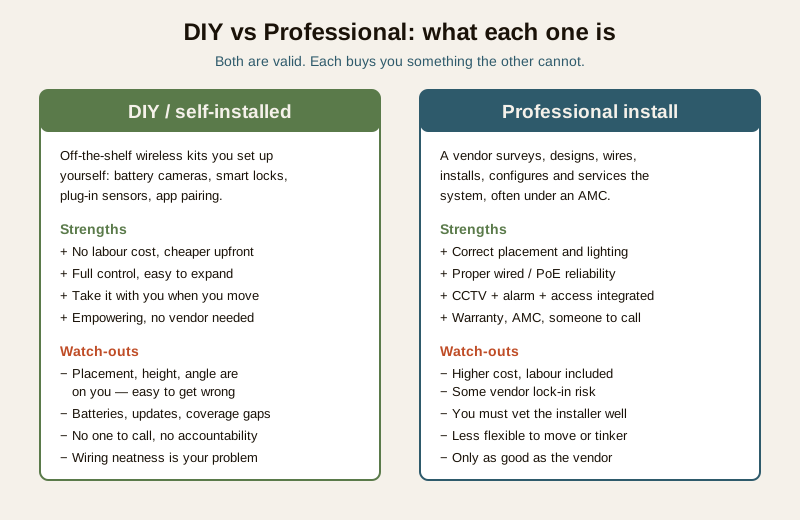
DIY / self-installed
You buy a consumer kit — battery or Wi-Fi cameras, a smart lock, a video doorbell, plug-in door and motion sensors, maybe a small hub — from a shop or online, and you set it up yourself. You mount the devices, pair them to an app, and you are the installer, the configurer and the maintenance department all at once. There is no labour bill, you keep full control, you can add a camera whenever you like, and when you move house you unscrew it all and take it with you.
The flip side is that every decision is yours. Getting a camera at the right height, angle and coverage is a real skill, and it is easy to mount one too high, point it into glare, or leave a blind spot over the very gate you meant to watch. Wiring neatness, firmware updates, battery swaps and coverage gaps all land on you, and when something fails at 2 a.m. there is no one to call and no one accountable but you.
Professionally installed and maintained
A vendor comes out, surveys your home, and designs a system to it: where the cameras go, what lux the lighting needs, how the cabling runs, how CCTV, alarm and access tie together. They install proper wired or PoE cabling, mount and aim everything correctly, commission the system, train you on it, and hand over a warranty. Many wrap ongoing service into an Annual Maintenance Contract, so testing, updates and repairs are someone else's job.
You pay for all of that, of course — the hardware plus labour plus the survey plus the AMC. There is some vendor lock-in risk, and the whole thing is only as good as the vendor you pick, so vetting them properly is the make-or-break step. Get the security vendor and installer evaluation right and this route is reassuringly hands-off; get it wrong and you have paid a premium for a mediocre job.
The life-safety line you must never cross
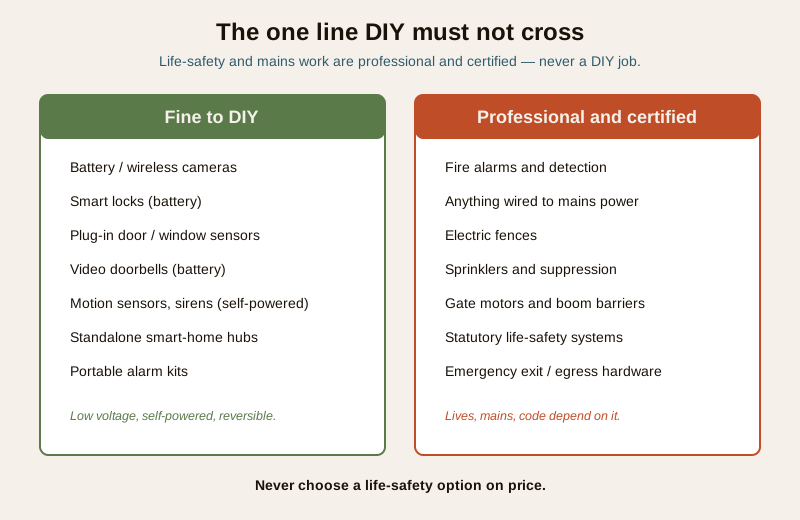
Before the head-to-head, the one non-negotiable. There is a category of work where "do it yourself" is simply the wrong answer, regardless of budget or confidence.
This crosses out of DIY, always. Fire alarms and detection, anything wired into mains electricity, electric fences, sprinklers and suppression, gate motors, and any statutory life-safety or emergency-egress hardware must be installed and certified by a qualified professional. These protect lives, involve mains voltage or code compliance, and a well-meaning DIY job here is not a saving — it is a hazard. DIY belongs to the low-voltage, self-powered, reversible world: battery cameras, smart locks, plug-in sensors, video doorbells. When in doubt, if it touches mains or it is meant to save a life, it is a professional job.
The head-to-head
With that line drawn, here is how the two routes compare across the dimensions that actually decide it. Neither column is all wins; read it as a balance sheet.
| Dimension | DIY / self-installed | Professional install |
|---|---|---|
| Upfront hardware cost | Lower; consumer kits are keenly priced | Higher; commercial-grade gear costs more |
| Labour cost | None — your own time | Included, and a real line item |
| Reliability | Good for wireless and battery; depends on Wi-Fi and battery discipline | Strong; wired and PoE do not drop off Wi-Fi or run flat |
| Placement and coverage | Down to your skill; easy to misjudge angle, height, blind spots | Surveyed and aimed correctly by someone who does it daily |
| Integration | Limited; works best as single-brand app silos | CCTV, alarm and access designed to work as one system |
| Warranty and accountability | Device warranty only; the install is on you | Whole-system warranty and a named party to hold responsible |
| Maintenance | Your job — batteries, updates, testing | Often an AMC; testing and repair are handled |
| Portability | Excellent — unscrew it and take it when you move | Poor; wired systems stay with the building |
| Scalability | Easy to add a device; harder to scale cleanly to a big site | Designed to scale; adding is a service call, not a click |
| Life-safety suitability | Only for non-life-safety, self-powered devices | Required for fire, mains and statutory systems |
| Skill and time needed | Meaningful — you are the installer and support desk | Minimal — you brief, they build |
The pattern is clear once you see it. DIY trades money and lock-in away in exchange for putting the skill, time and accountability on your own shoulders. Professional buys back the skill, the reliability of proper cabling, the integration and the "someone to call" — and asks you to pay for it and to choose your vendor well. For a deeper structured walk-through of these trade-offs across every buying decision, the security comparison guide and how to choose a security system sit alongside this one.
Which suits whom
This is the part that matters, because the answer genuinely changes with the home.
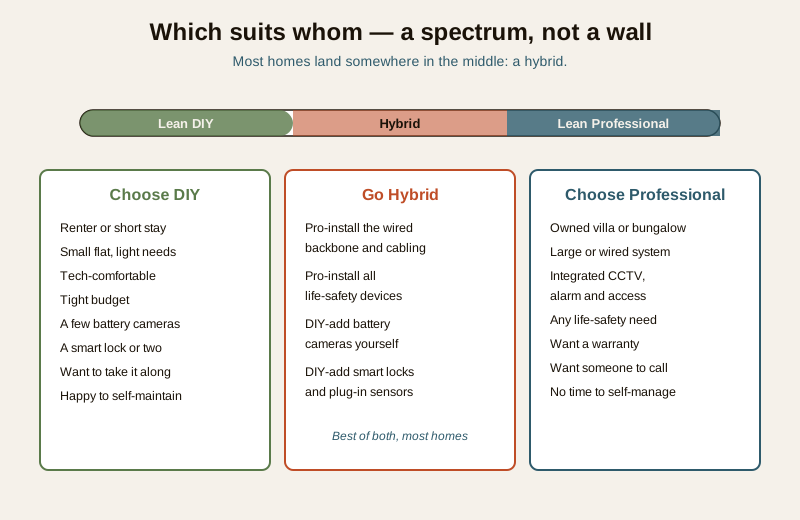
Lean DIY when
You rent, or you may move within a year or two. You have a small flat with light needs — a couple of doors, one approach, nothing sprawling. You are comfortable with apps, Wi-Fi and firmware, and you are happy to swap a battery and check the system yourself now and then. Your budget is tight and you would rather spend it on devices than on labour. For a flat where the job is a video doorbell, one or two battery cameras and a smart lock, self-installing is not a compromise — it is often the smart, right-sized choice. The smart security systems guide covers getting these consumer devices to work well together.
Lean professional when
You own a villa, bungalow or larger home you intend to stay in. The system is big, or it is wired — multiple PoE cameras, buried cable runs, an NVR. You want CCTV, an alarm and access control to behave as one integrated system rather than three apps. You have any life-safety element in the mix. You want a warranty and a number to ring when something breaks, and you would rather not be your own support desk. Here the survey, the correct cabling and the accountability earn their cost. For what that install typically involves and costs, see the CCTV installation cost guide; for keeping it alive afterwards, the security AMC buying guide and the security system maintenance guide.
Go hybrid — and most homes should
The false choice is thinking you must pick one camp for everything. In practice the best answer for a great many Indian homes is a hybrid: have a professional install the wired backbone and every life-safety device — the cabling, the NVR, the fire and mains work — and then DIY-add battery cameras, smart locks and plug-in sensors yourself over time. You get the reliability and certification where it counts, and the flexibility, savings and control where it is safe to have them. It is not a fence-sit; it is often the most sensible composition.
Two more decisions that ride alongside
The DIY-versus-professional question rarely arrives alone. Two related choices tend to travel with it, and it helps to decide them the same way.
- Who watches the alarm? Self-monitoring on your phone is the DIY reflex; a monitoring station is the professional one. The trade-offs are their own head-to-head — see local vs professional monitoring — and, like the install, many homes mix the two.
- Cameras or a guard? A DIY camera net and a professionally managed guard force answer different needs, and are frequently layered rather than swapped. The CCTV vs physical guarding comparison unpacks when each earns its place.
How to decide any "this or that" security question
This guide closes a whole run of head-to-head comparisons, so let it leave you with the habit rather than just one verdict. Across every "X versus Y" security choice — DIY or professional, wired or wireless, local or cloud, camera or guard, one detector type or another — the same quiet discipline works.
There is rarely a universal winner. Both options usually exist because each is the right answer in some real situation, so the useful move is never "which is best" but "which fits this home, this budget, this threat, this appetite for effort". Match the option to the scenario. Layer rather than agonise where layering makes sense, because the strongest security is almost always a sensible combination, not a single perfect pick — the hybrid install, the mixed monitoring, cameras and a guard. Lean toward reversible, low-commitment choices when you are unsure, and toward professional design and accountability as the stakes, the scale and the wiring grow. And hold one rule above all the arithmetic: never choose a life-safety option on price. Fire, egress, mains and structural safety are decided to the code and to the risk, by a professional, full stop — everything else is a genuine trade-off you are free to make with open eyes.
Decide it that way and you will not need a guide for the next comparison. You will already know how to weigh it.
Key takeaways
- Neither route wins outright. DIY is cheaper, flexible and empowering; professional wins on reliability, placement, integration, warranty and life-safety. The right answer is the one that fits your home.
- DIY suits renters, small flats, light needs and the tech-comfortable — battery cameras, smart locks and plug-in sensors you can take with you.
- Professional suits owned villas, large or wired systems, integrated setups and anyone who wants a warranty and someone to call.
- Most homes are best served by a hybrid — pro-install the wired backbone and life-safety, DIY-add the battery cameras and smart locks.
- The life-safety line is absolute: fire, mains, electric fences and statutory systems are professional and certified, never DIY.
- For any X-versus-Y security question: match the option to the scenario, layer where sensible, prefer reversible choices when unsure, and never decide a life-safety option on price.
Where to go next
- How to choose a security system and the security comparison guide — the wider decision framework this sits inside.
- Smart security systems guide — getting DIY consumer devices to work well together.
- CCTV installation cost, the security AMC buying guide and the security system maintenance guide — the money and upkeep side of going professional.
- Security vendor and installer evaluation — how to vet the pro before you commit.
- Local vs professional monitoring and CCTV vs physical guarding — the two companion comparisons.
References
- Digital Personal Data Protection Act, 2023 — home CCTV footage, smart-lock logs and app accounts hold personal data whether you self-install or use a vendor; agree who can view footage, how long it is kept, and how it is secured.
- National Building Code of India (SP 7), Bureau of Indian Standards — fire detection, suppression and means of egress are governed by code and must be professionally designed, installed and certified; verify the current edition (SP 7:2026) via the BIS catalogue: https://www.services.bis.gov.in/
- Consumer product warranties and installer terms — read what the device warranty covers on a DIY install versus a whole-system warranty and AMC on a professional one before you assume you are protected.
This is an educational, even-handed comparison for homeowners, not legal advice or an installation manual. Life-safety, fire and mains work must be carried out and certified by qualified professionals regardless of budget; verify any standard's current status via the BIS catalogue before relying on it.
Export this guide
Related Guides — Deep-dive reading
Security Fire Alarm Integration in India (2026): Smart Alerts, Certified Systems, Fail-Safe Egress
The most important sentence a smart-home designer can say about fire is also the least profitable: a smart-home smoke sensor or fire notification is a helpful add-on, not a substitute for a certified fire-alarm system. This guide draws the line hard — life-safety detection and alarm belongs to the NBC-governed certified system — and then covers the genuinely useful, correctly-scoped automations the smart layer can add on a verified fire signal: unlock for egress, open the gate for the fire tender, light the escape path, stop the away-scene, and notify everyone loudly. All of it fail-safe. None of it in the way of the system that actually saves lives.
SecurityPoE vs Wi-Fi CCTV: Which Home Security Cameras Are Better?
One camera type runs power and video down a single Cat6 cable to an NVR and almost never drops out; the other clips to a wall in minutes and streams over your home Wi-Fi. This guide settles PoE vs Wi-Fi CCTV for Indian homes — reliability, video quality and bandwidth, cabling and power, retrofit versus new-build effort, NVR versus SD and cloud storage, hacking risk, real rupee costs, scalability and outdoor use — and gives a clear verdict for each kind of home.
Smart HomeCCTV vs Physical Guarding in India (2026): Cameras, Guards or Both?
An honest head-to-head between electronic CCTV surveillance and manned physical guarding for a home, villa, gated community, shop or small site in India — what each really does, where each wins, and why the best answer is almost always a layered combination rather than one or the other.
SecurityRelated Tools — Try Free
CCTV Camera Coverage & Count Calculator
Estimate how many CCTV cameras you need, the NVR channels, storage in TB for your retention period, and an indicative all-in cost with GST.
CCTV CalculatorSecurity Vendor Evaluation Scorecard
Rate a CCTV/security installer or guarding agency across eight weighted criteria for a hire / negotiate / walk-away verdict.
Vendor ScorecardCCTV Cloud vs Local Cost Calculator
Compare cloud CCTV subscription against a local NVR + HDD — upfront, 5-year total, monthly fee and break-even.
Cloud vs Local