
Local vs Professional Monitoring in India (2026): Self-Watch or Pay a Station?
When your alarm or camera trips, who acts on it: you, from a push notification on your phone, or a manned central station that watches around the clock and escalates even when you cannot? An honest head-to-head on cost, reliability, who is really watching, and which model fits your home.
You have fitted an alarm, or a set of cameras, or both. Something trips at the back gate at two in the morning. The real question was never which sensor you bought. It is this: when that alert goes off, who sees it, and who does anything about it? There are only two honest answers. Either the alert lands on your phone and you, personally, look at it and decide what to do — that is local or self-monitoring. Or it lands at a manned central station where trained staff watch your signals around the clock, verify them and escalate on an agreed plan — that is professional monitoring. Everything else is detail.
The honest one-line answer is this: local monitoring is nearly free and hands you full control, but it works only when you are awake, reachable and able to act; professional monitoring costs a recurring fee but guarantees a trained human is always watching and will respond even when you cannot. Which is right for you turns almost entirely on one thing — how reliably you can answer and act when the alert lands. This guide walks through both models even-handedly, compares them across the dimensions that matter, and ends with a plain verdict by scenario.
Scope & how to read this. This is a neutral head-to-head to help you decide who watches your alarm, not a sales pitch for a subscription or a price list. Both models are legitimate and each wins in the right setting; the mistake is paying a station for a job you can do, or relying on yourself for hours you are never awake. This is not a buying or cost guide, and it names no fabricated prices. Note the separate decision of where footage is stored, covered in the local versus cloud guide below. When your footage or alarm signals travel to a third-party monitoring centre, that centre is processing your personal data under the Digital Personal Data Protection Act, 2023 — agree in writing who may view it, for how long, and to what end. There is no automatic police dispatch in India; verified human response is the realistic goal for either model.
What each model is
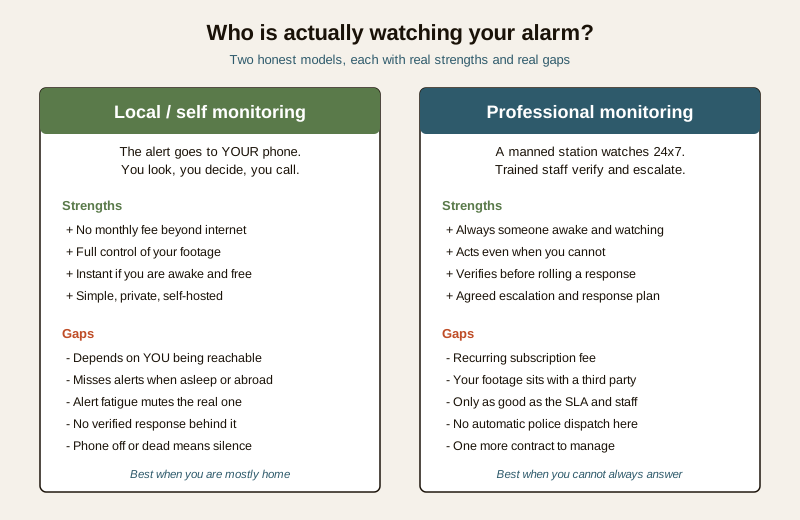
Local, or self-monitoring, means you are the monitoring station. Your alarm panel or camera system sends a push notification to an app on your phone the moment a sensor trips or motion is detected. You open the app, look at the live view or the clip, and you decide: ignore it, call your guard or neighbour, or call 100. There is no monthly monitoring fee — you pay for the hardware, your internet, and perhaps a small cloud-storage plan, and nothing more. The appeal is real: it is cheap, it is private, your footage stays under your control, and when you are home and holding your phone, you know within seconds and can act at once.
The catch is equally real, and it is the whole game: self-monitoring is only as reliable as you are. If you are asleep, the push may buzz on a silent phone on the far side of the bedroom. If you are on a flight, in a meeting, in a cinema, or in another timezone, the alert waits, unseen, while the event unfolds. If your phone is off, out of charge or out of signal, there is simply nobody watching. And there is a quieter failure — alert fatigue. A system that pings you fifteen times a day for a cat, a moth or a passing auto trains you to swipe every notification away without looking, so the one that matters gets dismissed with the rest.
Professional monitoring means a manned central monitoring station watches your signals for you, around the clock. When your alarm trips, the signal does not go to your phone first — it goes to a control room where an operator is on duty at three in the morning as much as at three in the afternoon. Good stations do not just relay the alarm; they verify it, looking at your cameras or listening on an audio channel to judge whether it is a real intrusion or a false trip. Then they escalate on a plan you agreed in advance: call you, then a second keyholder, then dispatch a guard or contact the authorities. The defining virtue is that someone is always awake and watching, and will act even when you cannot.
Its costs are also honest. It is a recurring subscription, month after month or year after year. Your footage and alarm data sit with a third party, which is a privacy and DPDP consideration you must be comfortable with. And the service is only ever as good as the station behind it — the response time it promises, whether that promise is written into a service-level agreement, and whether the staff and links actually perform on the night it counts. For a fuller picture of how these services work, see alarm monitoring services and, for cameras specifically, remote security monitoring.
The head-to-head
Both models watch the same sensors and cameras. What differs is who receives the alert, how reliably, and what happens next. Read each row for what it means to you rather than as a scoreline.
| Dimension | Local / self-monitoring | Professional monitoring |
|---|---|---|
| Cost shape | One-off hardware plus internet and maybe cloud storage; no monitoring fee | Recurring subscription on top of the hardware |
| Who watches | You, on your phone | Trained station staff, 24x7 |
| 24x7 reliability | Only while you are awake and reachable | Continuous by design; someone is always on shift |
| When you are unreachable | Alert waits, unseen; nobody acts | Station acts on the agreed plan without you |
| Alarm verification | You judge each alert yourself | Operator verifies on camera or audio, filtering false alarms |
| Speed of escalation | As fast as you notice and choose to call | Immediate, scripted call and dispatch chain |
| Control and privacy | Footage stays with you; nothing shared | Footage handled by a third party; a DPDP agreement matters |
| Dependence on your phone | Total; phone off means no watcher | Independent of your phone once the signal is sent |
| Suitability for travel | Weak; the more you travel, the bigger the gap | Strong; this is exactly what it is built for |
| Ongoing effort | You are always on call | Handed off; you review, you do not stand watch |
Notice that neither column is all green. Local monitoring genuinely wins on cost, privacy and immediacy when you are present. Professional monitoring genuinely wins on the hours you are absent or asleep and on filtering false alarms so a real one is taken seriously. The right choice is not the cheaper or the fancier one — it is the one whose strengths line up with how you actually live.
The honest caveat, both ways. Local monitoring is not "no monitoring" — it is a real, capable model for the many hours you are home and alert, and for a tech-comfortable resident it is often entirely enough. Professional monitoring is not a guarantee of rescue — it is a guarantee of a watching human and a defined response, whose value depends on the station being competent and the plan being sound. And in India, neither delivers automatic police dispatch. Judge a station on its verification, its written response time and its keyholder chain, not on a promise of the police arriving.
The test that decides it: the alarm at 3am
The clearest way to choose is to imagine the same event under both models. Your back-gate sensor trips at three in the morning while you are away on a trip. Under self-monitoring, the app fires a push — but your phone is on silent in another timezone, the alert goes unseen for hours, and nobody calls the guard or the police because the only person who could was asleep. Under professional monitoring, the signal reaches the station, an operator verifies it on camera, calls you, then your keyholder, and dispatches a guard on the agreed plan — all while you sleep. Same intrusion, two entirely different next hours.
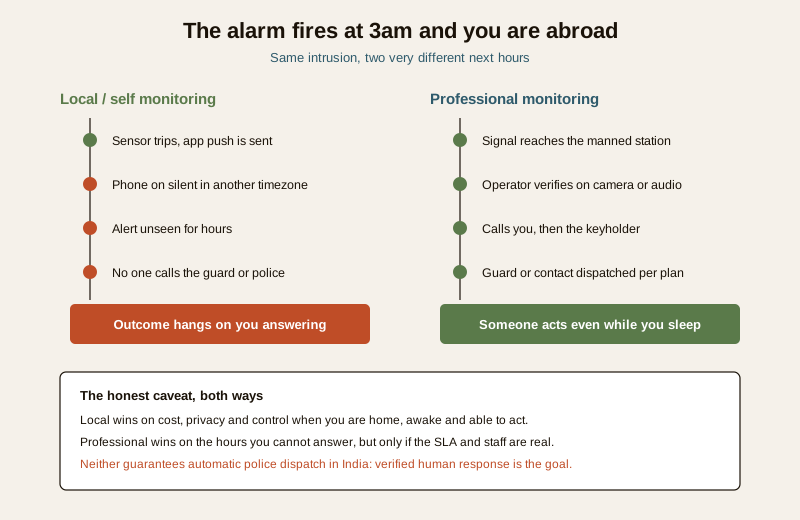
This is why the deciding question is so simple: can you reliably answer and act when the alert lands? If the honest answer is "yes, almost always", self-monitoring covers you well. If it is "often no", you are paying for hardware whose alerts have no one behind them, and a station earns its fee. This mirrors the wider DIY versus professional security trade-off — self-reliance saves money right up to the moment you are not available.
Which suits whom
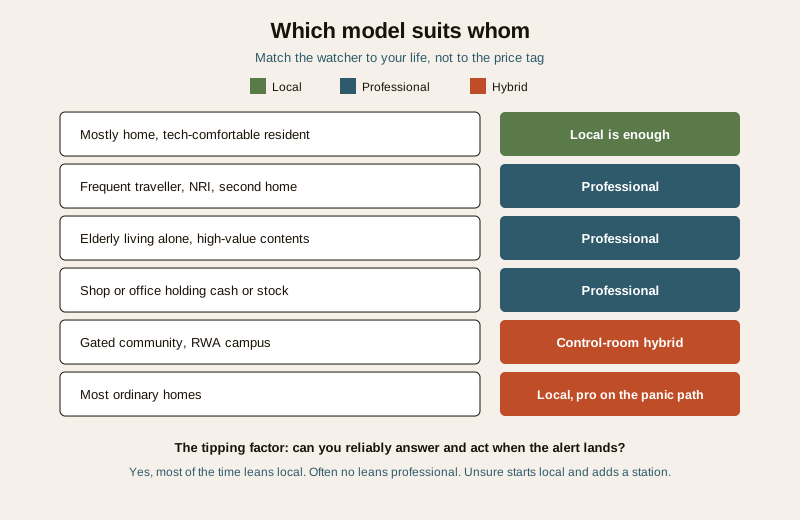
There is no universal winner. Match the watcher to your life.
- A resident who is mostly home and comfortable with an app — local. You are present for most hours, you will hear and act on a push, and you value keeping footage entirely to yourself. Paying a station to watch a house you are usually sitting in is money spent on hours you already cover.
- Frequent travellers, NRIs and second-home owners — professional. The more time your home spends empty while you are unreachable, the more a self-alert is a notification with nobody behind it. This is precisely the gap a station fills.
- Elderly relatives living alone, and homes with high-value contents — professional. When the resident may not be able to act, or when the loss from a missed intrusion is large, an always-awake human watching is worth the fee.
- A shop or small office holding cash or stock overnight — professional. The premises are unmanned exactly when the risk peaks, so the after-hours watch cannot be you.
- A gated community or RWA campus — usually a hybrid. The society's control room already does professional-style monitoring for the whole campus, watching the perimeter and common areas around the clock; see CCTV control-room monitoring for how that is run. Inside your own flat, local monitoring of your own cameras often layers neatly on top.
- Most ordinary homes — start local, add professional on the panic path. Self-monitor your everyday cameras, and put a professionally monitored channel behind the one thing that must never be missed: the intrusion alarm or a panic button. You get the low cost and control of local for the day-to-day, and a guaranteed watcher for the emergency.
A related but separate decision: where the footage lives
It is easy to confuse two choices that feel similar. Who is watching (you or a station) is not the same as where the recording is stored (a box in your home or a cloud server). You can self-monitor cameras that record to the cloud, and you can have a professional station watch cameras that record to a local NVR. Storage location is about resilience and access to the recording after the fact; monitoring is about who responds while the event is happening. Decide them separately — the local versus cloud security guide covers the storage side, and this guide covers the watcher side.
How to decide
Work through it in order rather than reaching for the cheapest or the most reassuring option.
1. Score your availability honestly. Across a normal month, in what share of hours could you actually see an alert and act on it within minutes? High share leans local; low share leans professional.
2. Weigh the stakes. Ordinary contents and a quick-to-replace loss tolerate a missed alert; irreplaceable valuables, a vulnerable resident or a cash-holding premises do not.
3. Separate the storage question. Decide where footage lives on its own merits; do not let it drag the monitoring decision.
4. Consider a hybrid. For most homes, self-monitor the everyday and put a monitored channel behind the alarm and panic path — you rarely have to choose all-or-nothing.
5. If you go professional, read the service, not the brochure. Insist on written verification steps, a stated response time in an SLA, a clear keyholder-escalation chain, and DPDP terms on your footage. The guidance in how to choose a security system helps you judge the contract and the wider system it sits in.
Key takeaways
- The choice is who acts on the alert. Local monitoring puts it on your phone for you to handle; professional monitoring puts it in front of a manned station that watches 24x7 and escalates.
- Local is nearly free and fully private, but only as reliable as you are — asleep, abroad or with your phone off, there is no watcher.
- Professional costs a recurring fee but guarantees an always-awake human, verified response and a defined escalation plan for the hours you cannot cover.
- Neither is a universal winner, and neither means automatic police dispatch in India — verified human response is the realistic goal.
- Match the model to your availability: mostly-home residents lean local; travellers, NRIs, elderly-alone homes and cash-holding shops lean professional; most homes do best with local everyday plus professional on the panic path.
- Keep storage and monitoring as separate decisions — where footage lives is not the same as who is watching.
- If you pay for a station, judge the SLA, verification and DPDP terms, not the marketing.
References
- Digital Personal Data Protection Act, 2023 — when alarm signals or CCTV footage are sent to a third-party monitoring centre, that centre processes your personal data; agree in writing who may view it, the retention period, and the purpose. Verify the current rules position before contracting.
- National Building Code of India (SP 7), Bureau of Indian Standards — for any alarm or monitoring that ties into life-safety functions, life-safety and egress provisions take priority. Verify the current edition via the BIS catalogue: https://www.services.bis.gov.in/
- Private Security Agencies (Regulation) Act, 2005 (PSARA) — any guard deployed as part of a monitored response, whether a station's or an RWA's, must be supplied through a PSARA-registered agency.
This is an educational head-to-head for homeowners, not legal advice, a product endorsement or a price list. Both monitoring models are legitimate; there is no automatic police dispatch in India, so judge any professional service on its written verification, response-time SLA and DPDP terms, and verify any standard's current status via the BIS catalogue before relying on it.
Export this guide
Related Guides — Deep-dive reading
Remote Security Monitoring in India (2026): Watching and Responding From Anywhere
Watching your home from your phone is easy; making an alert lead to a real response is the hard part. The two honest models compared — self-monitoring by you and your family versus a paid professional monitoring centre — plus the secure tech behind remote access, the privacy stakes of a stranger watching inside your home, and why remote monitoring is only ever as good as the responder behind it.
SecurityLocal Storage vs Cloud CCTV in India (2026): Where Your Footage Should Live
A homeowner's honest head-to-head on where CCTV footage is kept — on a hard disk in the recorder at home, or uploaded to a per-camera cloud plan — across cost, theft resilience, internet dependence, retention, remote access and DPDP privacy, ending in a clear which-suits-whom, with hybrid usually the smartest answer.
SecuritySecurity for People Living Alone in India (2026): Calm, Practical Habits When There Is No Second Person to Notice
Living alone is an ordinary and growing part of Indian life - the student in a new city, the working single, the elder whose children are abroad, the person after a separation. It does not call for fear. It calls for a few deliberate habits, because there is no second person in the home to notice trouble, raise the alarm, or catch an accident. This is calm self-reliance, layer by layer.
SecurityRelated Tools — Try Free
CCTV Cloud vs Local Cost Calculator
Compare cloud CCTV subscription against a local NVR + HDD — upfront, 5-year total, monthly fee and break-even.
Cloud vs LocalCCTV Camera Coverage & Count Calculator
Estimate how many CCTV cameras you need, the NVR channels, storage in TB for your retention period, and an indicative all-in cost with GST.
CCTV CalculatorCircadian Light Meter
Patient-centric circadian lighting visualizer for Indian healthcare design — time-of-day × intensity → CCT, melanopic lux (EML / mEDI), melatonin suppression, and an alertness curve. Calibrated against WELL v2 L03 Circadian Lighting Design, CIE S 026:2018, Brainard 2001, and Lucas et al. 2014.
Circadian Tool