
CCTV Weatherproof IP Rating in India (2026): Decoding IP65, IP66 & IP67
How to read the two-digit IP code, what IP65 vs IP66 vs IP67 really means for Indian monsoon, dust and coastal salt air, and how to pick a minimum rating by where the camera is mounted.
Every outdoor CCTV camera sold in India carries an IP rating on its box — IP65, IP66, IP67 and so on. It is one of the few genuinely useful, standardised numbers on the spec sheet, yet most buyers treat it as "higher must be better" and stop there. That is the wrong instinct. The cctv weatherproof ip rating is a precise, two-part code that tells you exactly which hazards a housing has been tested against, and matching it to where the camera actually sits saves you both from a drowned camera in the first monsoon and from over-paying for protection you will never use.
This guide is the environmental-rating explainer in Studio Matrx's CCTV hub. It sits alongside its twin, the vandal-proof IK rating guide — IP is about weather, IK is about impact — and the two together decide whether a camera survives the outdoors. To decode any camera's IP or IK code interactively, use the new IP/IK rating decoder.
Scope & safety. This guide helps you read a rating and choose a camera. Mounting at height, running cable, weatherproof terminations and any mains-electrical work belong to a licensed professional — plan the positions here, have them installed by a qualified installer, and route anything at the board to a licensed electrician via the electrical hub. A camera must never block a window, door or fire-escape route, and belongs only on your own property and shared areas, positioned in the spirit of the Digital Personal Data Protection Act, 2023.
What "IP" actually stands for
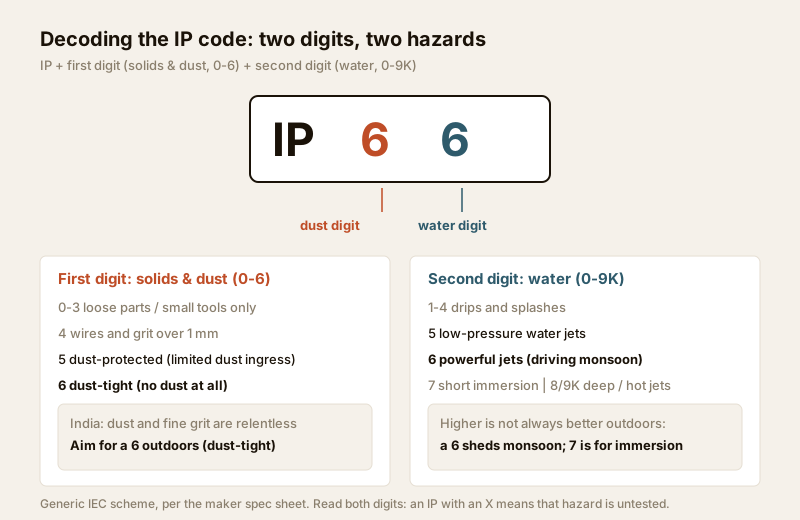
IP means Ingress Protection — a standardised code (the generic IEC scheme, the same one used across electrical enclosures worldwide) that rates how well a sealed housing keeps two things out: solid objects and dust, and water. It is written as the letters IP followed by two digits, and each digit is a separate, independent scale.
- First digit — solids and dust, 0 to 6. How well the housing resists fingers, tools, wires, grit and, at the top, fine dust.
- Second digit — water, 0 to 9K. How well it resists dripping, spraying, jetting, immersion and, at the very top, high-pressure hot-water jets.
Read them separately. IP66 means "6 for dust, 6 for water" — dust-tight and protected against powerful water jets. If a digit is shown as X (for example IPX6), that hazard simply was not tested — not that it scored zero, but you have no assurance for it. For an outdoor camera in India you want a real number in both positions.
The first digit: dust and solids (0-6)
For a home camera, only the top of this scale matters. India's dry seasons throw fine dust and grit at everything, and dust that works past a seal settles on the sensor and lens over months, softening the image.
| First digit | Protection | Good enough outdoors in India? |
|---|---|---|
| 0-3 | Large objects, tools, thick wires | No — indoor only |
| 4 | Wires and grit over 1 mm | Marginal, sheltered only |
| 5 | Dust-protected — limited dust may enter but not enough to harm | Acceptable under deep shelter |
| 6 | Dust-tight — no dust ingress at all | Yes — the outdoor target |
The practical rule: insist on a 6 as the first digit for anything outdoors. A dust-tight housing is the single biggest factor in a camera still looking sharp after two or three Indian summers.
The second digit: water (0-9K)
This is where "higher is better" breaks down. The water scale is not a simple ladder — the tests measure different kinds of water exposure, and past a point they stop describing what an outdoor camera faces.
| Second digit | Water test | What it means for a camera |
|---|---|---|
| 1-4 | Dripping, then spraying | Splash only — not real rain |
| 5 | Low-pressure jets from any direction | Handles rain; borderline for driving monsoon |
| 6 | Powerful jets from any direction | Sheds driving monsoon and wind-blown rain |
| 7 | Temporary immersion (up to ~1 m, 30 min) | Survives a brief dunk — not what a wall camera needs |
| 8 / 9K | Continuous immersion / high-pressure hot jets | Industrial; irrelevant for home CCTV |
Here is the counter-intuitive part: a "6" (jet-proof) is often the right choice for a wall-mounted camera, even though a "7" (immersion-proof) sounds stronger. The two protect against different things. IP66 is designed to shrug off water arriving at pressure and angle — exactly what monsoon wind does. IP67 is designed to survive being submerged, which a wall camera never is. Some cameras are rated both (IP66/IP67), which is genuinely useful for the most exposed spots; but do not pay a premium for a bare IP67 over an IP66 for an ordinary wall position — the "6" second digit is the monsoon number.
IP65 vs IP66 vs IP67 — the real-world comparison
| Rating | Dust | Water | Best home use in India |
|---|---|---|---|
| IP65 | Dust-tight | Low-pressure jets | Under an eave, verandah, deep porch — sheltered but open to air |
| IP66 | Dust-tight | Powerful jets | Open walls, gate posts, poles — the outdoor workhorse for monsoon India |
| IP67 | Dust-tight | Temporary immersion | Ground-level, flood-prone or spray-heavy spots; often paired as IP66/IP67 |
| IPX6 / IP5X | Untested digit | Untested digit | Avoid outdoors — a gap you cannot verify |
For a typical Indian home, IP66 is the sensible default outdoors and IP65 is fine anywhere genuinely covered. Step up to IP67 (ideally IP66/IP67) only for the harshest positions — a low camera that could sit in a puddle during a cloudburst, a coastal wall taking salt spray, or a spot that gets hosed during cleaning.
Matching the rating to the mounting spot
The smartest move is to rate each camera by its exposure, not to buy one rating for the whole house. Weatherproofing you do not need is wasted money; weatherproofing you skip is a dead camera.
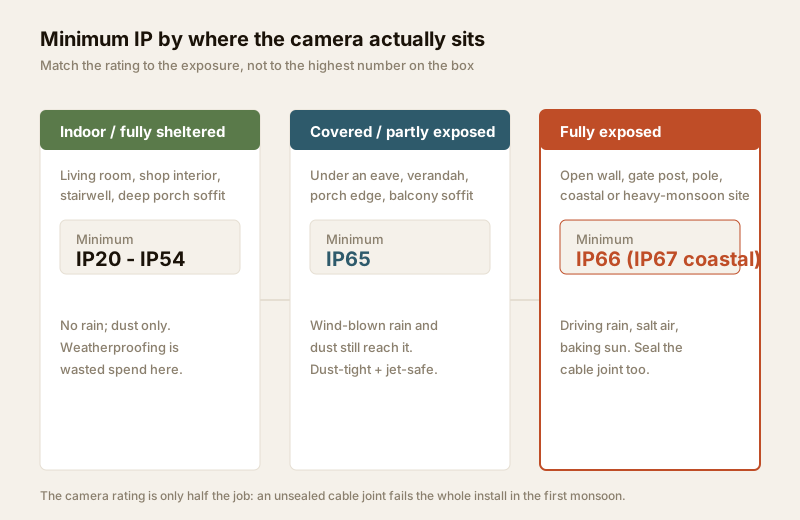
- Indoor / fully sheltered (living room, shop interior, deep porch soffit): IP20-IP54 is plenty. No rain reaches it; only dust matters. Paying for IP66 here is wasted.
- Covered / partly exposed (under an eave, verandah, balcony soffit): IP65 minimum. Wind still drives rain and dust sideways into these spots, so you want dust-tight plus jet-resistant water protection.
- Fully exposed (open wall, gate post, pole, rooftop): IP66 minimum. Direct monsoon, driving rain and blowing dust demand the jet-proof "6" water digit.
- Coastal or extreme (sea-facing wall, salt-air site, flood-prone ground level): IP66/IP67, and prefer a metal or marine-grade housing — salt corrodes cheap plastics and gaskets faster than rain ever will.
This matches the layered outdoor logic in the outdoor CCTV guide; a bullet camera on an exposed gate line is the classic "needs IP66" case, while a dome under a porch ceiling can sit at IP65.
The part the rating does not cover: sealing the joint
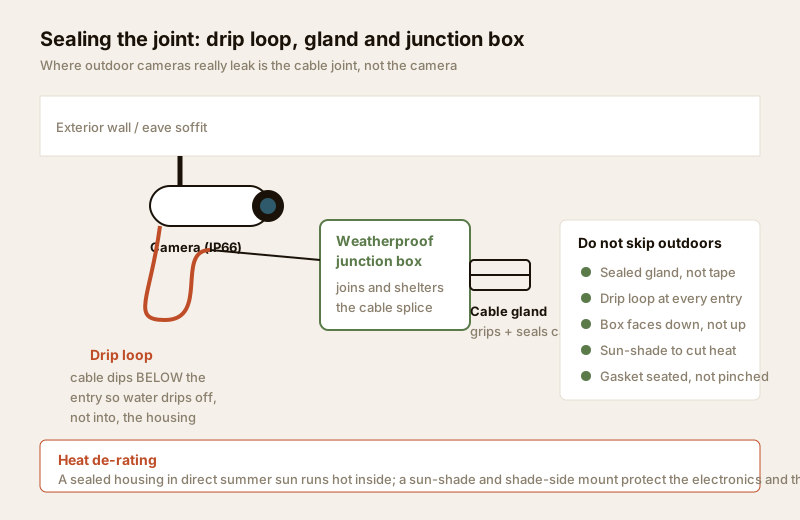
Here is the mistake that fails more outdoor cameras in India than any weak IP number: the camera is IP66, but the cable joint behind it is a twist of wire wrapped in tape. The IP rating certifies the camera housing only. Water finds the weakest point, and on most bad installs that is the cable termination.
Three things seal the rest of the install:
- A weatherproof junction box. The cable splice lives inside a sealed box, ideally mounted with its openings facing down, never up. A taped joint on an open wall leaks in the first heavy rain.
- A cable gland. A proper gland grips and seals the cable where it enters the box or camera, so water cannot track along the cable jacket into the housing.
- A drip loop. The cable should dip below the entry point before rising into it, so gravity pulls water off the low point of the loop instead of running straight into the connector.
Sun, heat and salt: India's other three enemies
Water is only one of the four things that kill an outdoor camera in India.
- Heat de-rating. A sealed housing baking in direct summer sun runs hot inside — sealed enclosures cannot shed heat easily. Sustained heat shortens the life of the electronics and can soften seals. Mount on the shaded side where you can, fit the camera's sun-shade (weather-shield), and check the maker's stated operating-temperature range against a 45 C-plus afternoon.
- UV on the housing. Years of harsh sun make cheap plastic housings chalk and crack, breaking the very seal the IP rating depends on. A quality housing and a sun-shade both help.
- Salt air near the coast. In Chennai, Mumbai, Goa, Kochi and other coastal belts, salt is more corrosive over time than rain. Prefer metal or marine-grade housings, stainless fixings, and inspect seals more often.
- Thermal cycling and condensation. Hot days and cooler nights make the air inside a housing expand and contract, which can draw in moist air through a tired gasket and fog the lens. A properly seated gasket and, on better cameras, a small desiccant or breather membrane manage this.
Price bands and what to actually buy (indicative)
Prices move with brand, sensor and season — treat these as ballparks to sanity-check a quote, not fixed rates.
| Item | Typical range (₹) | Notes |
|---|---|---|
| IP65 outdoor camera (covered spots) | ₹1,500 - ₹4,000 | Fine under an eave or verandah |
| IP66 outdoor camera (open walls) | ₹2,500 - ₹6,500 | The monsoon workhorse; the default outdoors |
| IP66/IP67 metal-housing camera (coastal/extreme) | ₹5,000 - ₹12,000 | Salt air, flood-prone or hose-down spots |
| Weatherproof junction box | ₹300 - ₹900 | Do not skip outdoors |
| Cable gland set | ₹100 - ₹400 | Seals the cable entry |
| Sun-shade / weather-shield (if not built in) | ₹200 - ₹700 | Cuts heat and glare, protects the seal |
The pattern: spend on the right IP for the spot and on sealing the joint, not on an inflated water digit you will never use. An IP66 camera with a sealed junction box beats an IP67 camera on a taped joint every single monsoon.
When to bring in a professional. Decide the IP rating and camera positions yourself — then hand the mounting at height, cable pulling, weatherproof junction boxes, glands and drip loops, and recorder commissioning to a licensed installer. Anything at the mains board is a licensed electrician's job; see the electrical hub. A correctly sealed IP66 install by a professional is worth far more than a higher-rated camera fitted badly. This is general guidance, not a substitute for site-specific professional advice.
Key takeaways
- The cctv weatherproof ip rating is two independent digits: first = dust/solids (0-6), second = water (0-9K) — read both, and treat an X as "untested".
- Insist on a 6 as the first digit outdoors (dust-tight) — dust is relentless in India and softens the image over time.
- For the water digit, a "6" (jet-proof, IP66) is the monsoon number for wall cameras; IP67 (immersion) sounds stronger but suits low, flood-prone or spray spots, not ordinary walls.
- Match the rating to the spot: IP20-IP54 indoors, IP65 covered, IP66 fully exposed, IP66/IP67 coastal or extreme — check any code with the IP/IK rating decoder.
- The rating covers only the camera: seal the cable joint with a weatherproof junction box, cable gland and drip loop, mind heat, UV and salt air, and route mounting, cabling and mains work to a licensed professional.
References
- Ingress Protection (IP) ratings — the generic IEC two-digit scheme (first digit solids/dust 0-6, second digit water 0-9K). Verify a camera's exact rating and tested digits on the manufacturer's specification sheet before ordering.
- Digital Personal Data Protection Act, 2023 — position cameras to cover only your own property and shared areas with a legitimate purpose; avoid capturing neighbours' private spaces.
- National Building Code of India (SP 7), Bureau of Indian Standards, and local municipal bye-laws for any structural, electrical or life-safety aspect of an install; verify the current edition via the BIS catalogue: https://www.services.bis.gov.in/
This is an educational overview, not legal or engineering advice. Mounting at height, cabling and any electrical work are qualified professional tasks — engage licensed installers and verify any standard's current status via the BIS catalogue before relying on it.
Export this guide
Related Guides — Deep-dive reading
How to Choose a CCTV Camera (2026): The Homeowner's Decision Guide for India
Cut through the spec-sheet noise and choose the right CCTV camera for each spot around an Indian home. What actually matters — sensor and low-light performance, lens and field of view, form factor, IP and IK ratings, honest smart features — and the marketing claims to ignore.
SecurityVideo Door Phone Placement in India (2026): Where to Mount the Door Station and Indoor Monitor
The single most-skipped step: where the outdoor door station and the indoor monitor actually go. Camera height, latch-side siting, rain-hoods, backlight, neighbour privacy, and a second monitor so you never miss the door.
SecurityElectrical Safety for Security Systems in India (2026): Powering It Without Peril
A homeowner's guide to the power side of home and RWA security systems, CCTV, alarms, gates, access control and NVRs, done so it protects you instead of quietly becoming a shock or fire hazard. What makes a supply safe, what to insist on, and why the mains work belongs to a licensed electrician.
SecurityRelated Tools — Try Free
CCTV IP & IK Rating Decoder
Decode weatherproof (IP) and vandal-proof (IK) ratings and get the minimum you need for each mounting spot in Indian weather.
IP & IK RatingsInterior Contract Clause Checklist
16 sections and 98 checkboxes covering scope, BOQ, milestones, penalties, warranty, and disputes.
Contract ChecklistCCTV Cloud vs Local Cost Calculator
Compare cloud CCTV subscription against a local NVR + HDD — upfront, 5-year total, monthly fee and break-even.
Cloud vs Local