
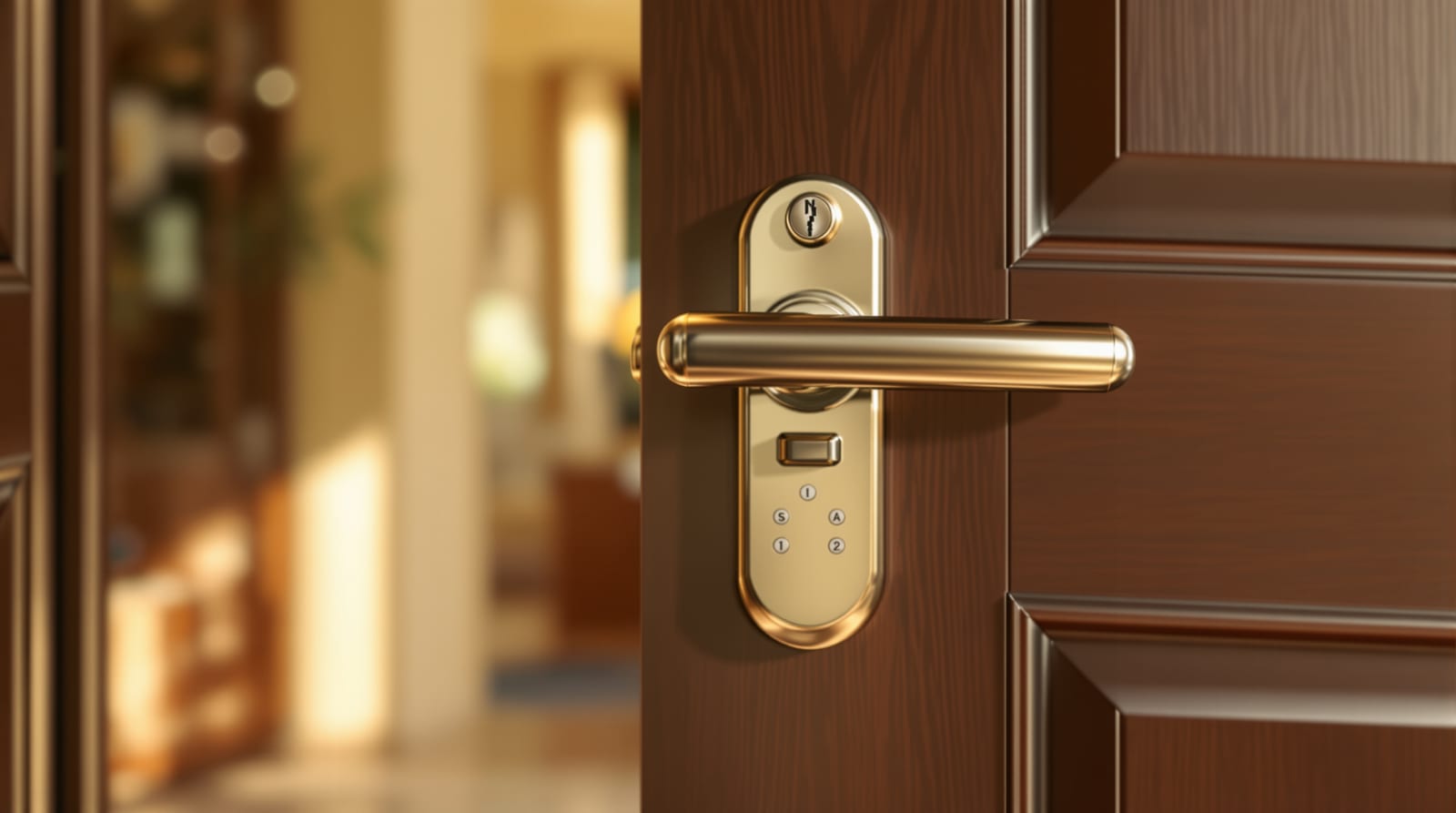
Security Door Grades Explained for India: ANSI, EN & BIS Ratings (2026)
How to read lock grades, EN burglary-resistance classes and BIS/IS marks so you buy real security, not marketing claims.
Walk into any showroom in India and you will hear the same three words on every door and lock: "high security", "burglar-proof", "anti-theft". None of those words mean anything. They are marketing. What actually means something is a grade — a number tied to a published standard, tested in a lab, printed on a certificate. The problem for an Indian buyer is that three different grading systems collide on our shelves at once: American ANSI/BHMA grades on imported locks, European EN classes on premium hardware, and BIS/IS marks on Indian-made products. This guide decodes all three, shows you what is certified versus what is merely claimed, teaches you to read a real spec sheet, and tells you plainly which grade is enough for a flat versus an independent house. For the design and selection overview, pair this with our door security guide for India; for the door construction itself see burglar-proof doors and residential door standards.
Why "grade" beats "high security" every time
A grade is a falsifiable claim. When a lock says "ANSI Grade 1", that maps to a defined number of operating cycles, a defined force the bolt resists, and a defined number of hammer/pull tests it survived — all auditable. When a product says "high security" with no standard cited, there is nothing to audit and nothing to dispute later. The single most useful habit you can build is this: ignore adjectives, look for a standard code plus a class number plus a certification body. No code, no number, no body — treat it as decoration.
Three things get graded separately, and you must check all three because a door is only as strong as its weakest graded part:
- The lock body / latch / bolt (the mechanism) — graded mainly by ANSI/BHMA in the US system.
- The cylinder (the part the key turns, the part most attacks target) — graded by EN 1303 in the European system.
- The whole door set as installed (leaf + frame + lock + hinges working together) — graded by EN 1627 RC ("Resistance Class") burglary testing, and in India by the relevant IS construction standards plus, for fire, IS 3614.
A Grade 1 lock bolted into a hollow flush door in a soft pine frame is not a Grade 1 door. The grade on the box is a component grade, not a system grade — remember that distinction and you will already be ahead of most buyers.
The three grading systems, side by side
Here is the master table you can carry into a showroom. Match what is on the box to this, and ask for the certificate number when a claim is made.
| Standard | What it grades | Top tier (best) | Mid tier | Entry tier | Where it applies in India |
|---|---|---|---|---|---|
| ANSI/BHMA A156 (US) | Lock body, latch, bolt — durability + strength | Grade 1 (commercial / heavy duty) | Grade 2 (light commercial / good residential) | Grade 3 (basic residential) | Imported and premium Indian-branded mortise/deadbolt locks (Yale, Dorset, some Godrej premium) |
| EN 1303 (Europe) | Cylinders — key combinations, durability, drill/pick attack resistance | Key security 6, Attack resistance 2 | Mostly key 4-5 | Key 1-3, attack 0-1 | Euro-profile cylinders on UPVC/composite/premium wooden doors |
| EN 1627 RC (Europe) | The whole door SET as installed — burglary resistance | RC 4-6 (specialist, heavy attack) | RC 3 (experienced burglar, ~5 min tools) | RC 2 (casual burglar, basic tools) | Imported security doors, premium steel/composite door sets |
| EN 12209 (Europe) | Mechanical lock performance | Higher digits in the 11-digit code | — | — | Often quoted alongside EN 1303 on European hardware |
| BIS / IS construction standards | Indian door and frame manufacture (not a "burglary class") | ISI mark + correct IS number | — | — | Indian-made flush, panel, steel, FRP doors and frames |
| IS 3614 Pt 1/2 | Fire-check (fire-resistance) of doors, not burglary | 120 min | 60-90 min | 30 min | Fire doors in apartments, stairwells, basements |
Two cautions on this table. First, ANSI grade and EN RC class are not interchangeable — one grades a component for durability and strength, the other grades a whole assembly against a human burglar with tools and a time limit. A door can have a Grade 1 lock and still be RC 1 (effectively unrated) as a system. Second, BIS/IS for doors is largely a manufacturing-quality standard (correct materials, glue bond, tolerances), not a burglary-resistance class — so an ISI mark tells you the door is well made, not that it will defeat a crowbar for five minutes. India does not yet have a widely adopted, mandatory burglary-resistance class for residential doors equivalent to EN 1627, which is precisely why imported security doors quote RC numbers.
ANSI/BHMA Grade 1, 2, 3 — what the numbers actually test
This is the most common grading you will see in India because so much branded lock hardware follows the American system. The grade compresses three test families into one number:
- Operational cycles — Grade 1 locks survive far more open/close cycles than Grade 3 (think a busy main door over many years versus an occasional store-room).
- Strength — how much force the latch/bolt resists before it deforms or fails (pull, impact, torque on the knob/lever).
- Security tests — bolt projection and resistance to a few defined attacks.
Plain-language takeaway: Grade 1 is heavy-duty/commercial-grade and the sensible target for a main entrance door if your budget allows. Grade 2 is solid for residential main and good-quality internal doors. Grade 3 is basic — fine for a bathroom or a low-risk internal door, not for your front door. When a salesperson says "Grade 1 lock", ask which part is Grade 1 — the deadbolt, the latch, or the lever — because the box grade is for the whole assembly only if the certificate says so. See our mortise locks guide for how the mechanism itself differs from rim and cylindrical locks, and the door locks types guide for the full family.
EN 1303 cylinders — the part burglars actually attack
Most break-ins through a locked door do not defeat the lock body — they defeat the cylinder, by snapping, drilling, picking or bumping it. That is why Europe grades the cylinder on its own. The EN 1303 mark is a string of digits; the two that matter most to a buyer are key-related security (how many real key differs / pick resistance, on a scale to 6) and attack resistance (drill and physical attack, the final digit, where 2 is the highest and most cylinders sit at 0 or 1). A premium Euro-profile cylinder will also carry anti-snap, anti-drill (hardened pins) and anti-bump features — look for those words backed by the EN 1303 string, not instead of it.
For Indian apartments fitted with UPVC or composite doors, the cylinder grade is often the single highest-leverage upgrade you can make: swapping a basic cylinder for an anti-snap, high-attack-resistance one is cheap relative to the door and closes the most common attack path. For traditional Indian mortise locks, the equivalent vulnerability is the lock body and strike — covered below.
EN 1627 RC — the only grade that scores the whole door
If you want a single number that describes how long your installed door resists a real burglar, EN 1627 Resistance Class is it. The test puts a trained attacker with a defined tool set against the complete door set (leaf, frame, lock, hinges, glazing) and measures resistance time and effort:
| RC class | Attacker profile | Tools | Typical resistance | Sensible use in India |
|---|---|---|---|---|
| RC 1 | Opportunist, bodily force | Kicks, shoulder, body weight | Very basic | Below the bar for a main door |
| RC 2 | Casual burglar | Screwdriver, pliers, wedge | ~3 min under attack | Good baseline for a flat main door |
| RC 3 | Experienced burglar | Crowbar, second screwdriver | ~5 min | Strong choice for an independent house front door |
| RC 4 | Experienced, heavier tools | Saw, hammer, chisel, cordless drill | ~10 min | High-risk / ground-floor independent house |
| RC 5-6 | Specialist | Power tools, angle grinder | 15+ min | Vaults, high-value targets — rarely needed residentially |
The key insight: RC is a system grade. You cannot achieve RC 3 by buying an RC-3 lock and screwing it into any door — the door, frame anchoring, hinges and glazing must all be part of the tested assembly. When an imported security door quotes "RC2/RC3", ask whether the certificate covers the configuration you are buying (some certificates are for a specific frame fixing detail). This is the same component-vs-system trap as ANSI, scaled up to the whole opening. For how to build that system in practice — frame anchoring, hinge bolts, strike reinforcement — see door reinforcement and multipoint locking doors.
BIS / IS marks — what to actually look for in India
For Indian-made doors and frames, the ISI mark plus the correct IS number is your quality signal. It does not give you a burglary class, but it confirms the door is built to spec — which matters, because a flimsy door defeats any good lock. Look for these on the product, the invoice, or the manufacturer's certificate:
| Component | IS standard to look for | What it confirms |
|---|---|---|
| Flush door | IS 2202 | Construction, glue bond, dimensional tolerance |
| Panelled / glazed wooden door | IS 1003 | Joinery and panel construction quality |
| Timber door frame | IS 4021 | Frame section and seasoning |
| Steel door frame | IS 4351 | Pressed-steel frame manufacture |
| FRP door | IS 14856 | FRP shutter quality |
| Steel butt hinges | IS 1341 | Hinge gauge and strength |
| Tower bolts | IS 7196 | Bolt strength |
| Handles | IS 208 | Handle manufacture |
| Door closers | IS 3564 | Closer performance |
| Fire-check door | IS 3614 Pt 1/2 (30/60/90/120 min) | Fire resistance (not burglary) |
Practical reading rule for India: a genuinely secure door package will cite an IS number for the door, an ANSI grade or EN 1303 string for the lock/cylinder, and ideally an EN 1627 RC class for an imported security set. A package that cites only "premium grade" or "ISI" with no door IS number and no lock standard is under-specified. Indicative pricing, varies by city and vendor and +18% GST: a properly graded mortise lock + handle set runs ₹600-6,000 (Godrej, Yale, Dorset, Europa); a multipoint-locking or imported security door set runs ₹8,000-25,000 and upward; a fire-rated set (IS 3614) ₹6,000-25,000+. You can sanity-check budgets with our door cost calculator and benchmark a product's claimed protection with the door security rating tool.
Marketing words vs certified claims — a translation table
| What the label says | What it means | What to ask for |
|---|---|---|
| "High security" | Nothing certified | "Which standard and class?" |
| "Burglar-proof" / "anti-theft" | Nothing certified | EN 1627 RC class with certificate |
| "Anti-pick, anti-bump, anti-drill" | Plausible features | EN 1303 string showing key + attack digits |
| "7-lever lock" | Lever count (older Indian metric) | Still useful, but pair with ANSI/EN grade |
| "Grade 1" | Could be real ANSI | "Grade 1 to ANSI/BHMA A156 — which test?" |
| "ISI / IS marked" | Indian manufacturing quality | The exact IS number |
| "RC2 / RC3 certified" | Real burglary class | Certificate covering YOUR configuration |
| "Fireproof door" | Misleading | IS 3614 rating in minutes (30/60/90/120) |
The honest summary: lever count and ISI marks tell you the product is competently made; ANSI/EN grades and EN 1627 RC tell you how it performs against time, wear and a determined attacker. You want both layers of evidence.
Which grade is "enough" — flat vs independent house
You do not need RC 4 on a sixth-floor flat, and you should not settle for a Grade 3 lock on a ground-floor bungalow. Match the grade to the risk:
- Apartment / flat (mid or upper floor, single secured entry, building gate + guard): an ANSI Grade 1 or 2 mortise lock with a good EN 1303 anti-snap cylinder on a solid-core or steel door is genuinely enough. The building's outer perimeter does much of the work. If the door is UPVC/composite, prioritise the cylinder upgrade. RC 2 as a system is a reasonable ceiling.
- Independent house, upper-floor or well-fenced: Grade 1 lock, multipoint locking, anti-snap cylinder, reinforced strike and hinge side — aim for an RC 2-3 system. Ground-floor and main entries deserve the higher end.
- Independent house, ground-floor main door, isolated plot or higher-risk area: target an RC 3 (or RC 4) certified door set — leaf, frame anchoring, hinges and lock tested together — not just a strong lock on an ordinary door. Add a graded steel/security door if the budget allows (₹8,000-25,000+).
- Fire-rated openings (stairwell, basement, common-area doors in apartments): the governing grade is IS 3614 fire resistance in minutes per NBC 2016 Part 4, not burglary class. Don't confuse the two — fire-rated doors in escape routes must open in the direction of egress.
Use the main door security checklist before you buy, and for anti-theft hardening of an existing door see anti-theft door guide and fire-rated doors.
Frequently asked questions
Is an ANSI Grade 1 lock the same as an RC 3 door?
No, and conflating them is the most common mistake. ANSI Grade 1 grades the lock component for durability and strength. EN 1627 RC 3 grades the entire installed door set against a burglar with tools for a defined time. You can have a Grade 1 lock on an RC 1 (effectively unrated) door if the leaf and frame are weak. For real protection you want a strong graded lock inside a graded or reinforced door system.
Does an ISI / BIS mark mean a door is burglar-proof?
No. India's IS standards for doors (IS 2202, IS 1003, IS 4351 and so on) are manufacturing-quality standards — correct materials, glue bond, tolerances. They confirm the door is well made, not that it resists a crowbar. India does not yet have a widely used mandatory residential burglary-resistance class like EN 1627, which is why imported security doors quote RC numbers. Look for ISI for build quality and an ANSI/EN lock grade for security.
What single upgrade gives the most security for the money?
On UPVC/composite/Euro-profile doors common in apartments, swapping a basic cylinder for a high EN 1303 cylinder (anti-snap, anti-drill, high attack-resistance digit) closes the most common attack path cheaply. On traditional wooden doors with Indian mortise locks, reinforcing the strike plate and frame anchoring, plus a Grade 1 lock, gives the biggest jump. Both cost far less than replacing the whole door.
How do I read a lock's spec sheet without getting fooled?
Ignore adjectives. Find a standard code (ANSI/BHMA A156, EN 1303, EN 1627), a class or grade number, and a certifying body or certificate number. If any of the three is missing, downgrade your trust. For Indian doors, also confirm the door's own IS number and, for fire doors, the IS 3614 rating in minutes.
Do I need a fire-rated door for security?
Fire rating (IS 3614, in minutes) and burglary resistance (EN 1627 RC, against tools) are different things and are tested separately. A door can be excellent at one and poor at the other. Apartments need fire-rated doors in escape routes per NBC 2016 Part 4 regardless of security; for break-in protection you separately need a graded lock and a strong door system.
Export this guide
Related Guides — Deep-dive reading
Reinforced Wooden Doors in India (2026): Making the Timber Main Door Actually Secure
A homeowner's decision guide to choosing or upgrading the wooden main or flat door most Indian homes actually have, so it genuinely resists a break-in, without pretending a hollow flush door is secure.
SecurityBurglar-Proof Doors in India: What Actually Stops a Break-In (2026)
A burglar-resistant main door is a system — solid leaf, anchored frame, multipoint lock, anti-saw bolts and visibility — not just an expensive lock. Here is how each layer works and what it costs to upgrade.
Home Doors & EntrancesBurglar-Resistant Doors India 2026: RC1-RC6 Security Guide
How EN 1627 resistance classes RC1 to RC6 work, what each grade actually resists, and how to spec a tested anti-burglary door set for Indian homes and shops.
Home Doors & EntrancesRelated Tools — Try Free
Door Security Rating Calculator
Score your main door out of 100 across leaf, frame, lock and hardware — and see the top upgrades.
Security ToolDoor Cost Calculator
Estimate the all-in cost of a door — leaf, frame, hardware, fitting and GST — by type, material and size.
Door CalculatorWindow Hardware Cost Calculator
Estimate window hardware cost — hinges, handles, locks, rollers and multipoint gears.
Window Calculator