
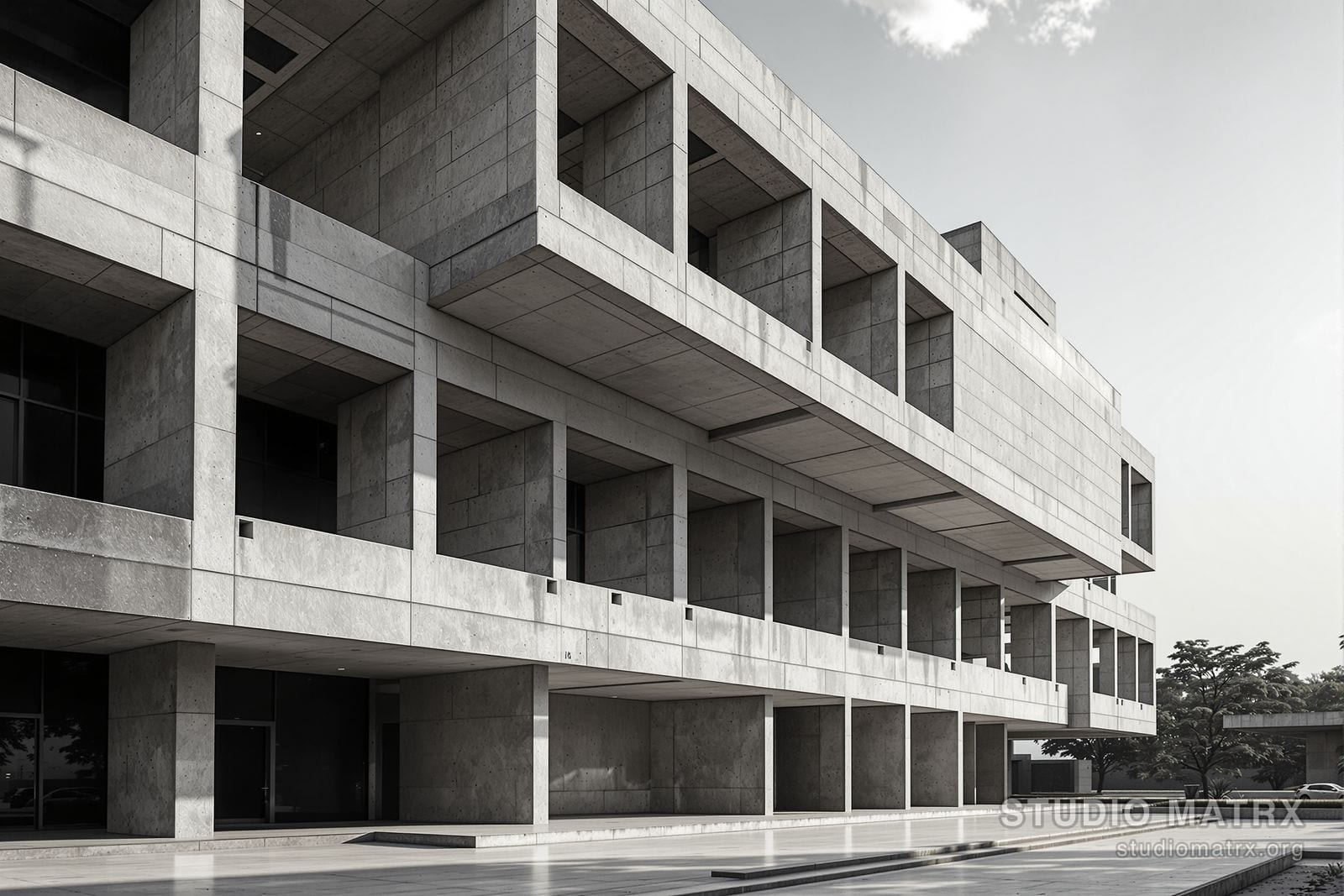
Brutalist Architecture in India
Beton brut and the concrete legacy of independent India
India has one of the richest brutalist legacies in the world, and it is no accident. When the country set out to build itself after 1947, raw concrete - honest, monumental, modern and cheap to build at scale - became the natural material of a confident new nation. Le Corbusier laid out an entire city at Chandigarh; Louis Kahn raised the brick-and-concrete masterpiece of IIM Ahmedabad; Balkrishna Doshi carved IIM Bangalore into a shaded concrete landscape; Raj Rewal spanned Delhi's Hall of Nations in folded concrete. For three decades, brutalism was the architecture of independent India's institutions.
The name comes from the French beton brut - raw concrete - not from brutality. The style is about honesty: showing a building's structure and material plainly, with no cladding to soften or disguise. Today that same raw, sculptural language is having a quiet residential revival, as homeowners tire of fragile finishes and rediscover the calm, permanent weight of exposed concrete.
What defines it
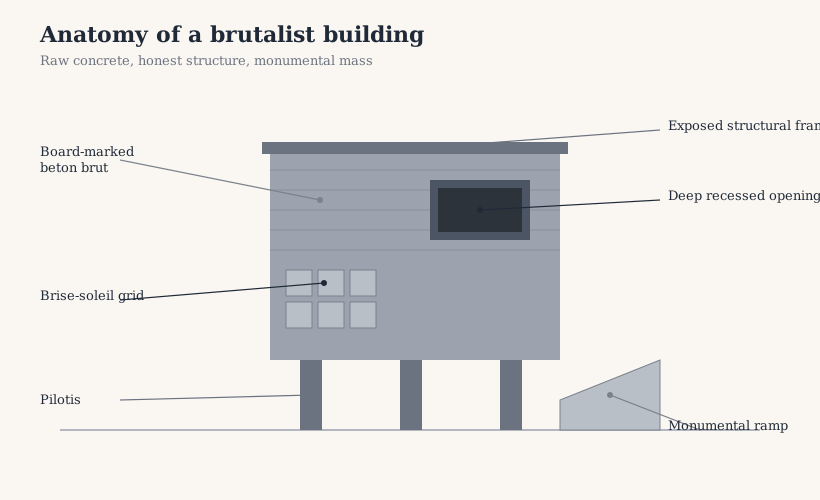
Brutalism is the architecture of honesty and mass - nothing hidden, nothing applied.
| Trait | What it looks like | The idea behind it |
|---|---|---|
| Raw concrete (beton brut) | Board-marked, off-form concrete left exposed | Truth to material - the structure is the finish |
| Monolithic mass | Bold, heavy, sculptural forms | Permanence and presence over delicacy |
| Honest structure | Frame, services and circulation expressed | A building that explains how it is made |
| Modular repetition | Repeated bays, grids and units | Rational, buildable, economical at scale |
Done well, brutalism is not grim. The best Indian examples - Kahn's IIM, Doshi's campuses - use concrete to make deep shade, soft top-light and a powerful sense of calm. The material is heavy; the spaces are serene.
The design elements
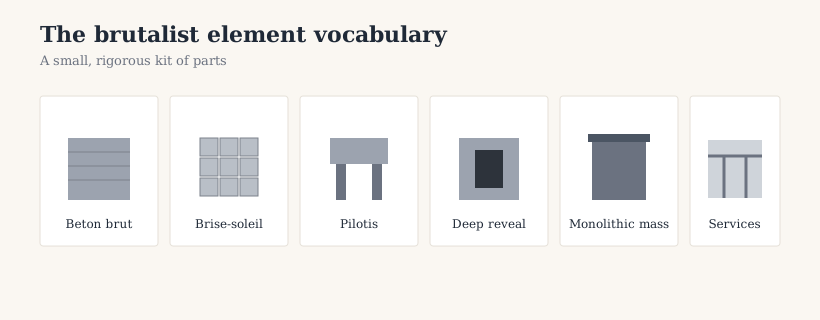
A small, rigorous kit of parts does all the work.
| Element | What it is | Why it matters in India |
|---|---|---|
| Beton brut | Concrete cast against timber boards, left raw | The signature surface - and one that needs careful detailing against monsoon staining |
| Brise-soleil | A deep concrete grid of sun-breakers | Shades the glass and walls - climate control as architecture |
| Pilotis | Columns lifting the mass off the ground | Shade, airflow and flood clearance below |
| Deep reveals | Windows set far back in thick walls | Self-shading openings, strong shadow |
| Exposed services | Beams, ducts and stairs left visible | The honesty principle, and easy maintenance |
| Monolithic massing | Heavy, sculptural, unbroken forms | Thermal mass and quiet monumentality |
Where you'll find it
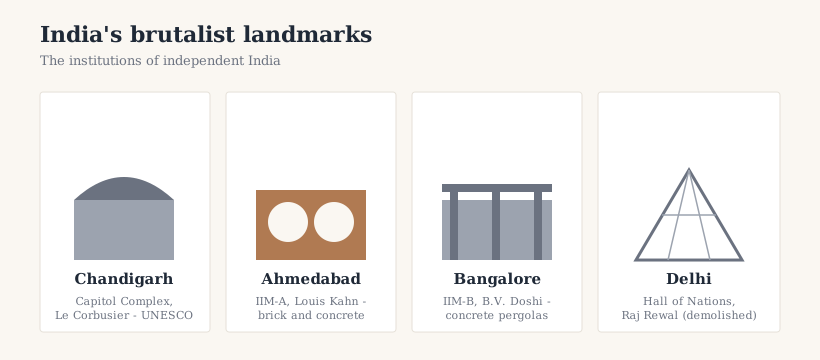
India's brutalism is overwhelmingly institutional - the campuses, capitols and cultural buildings of the Nehruvian decades.
| Place | Landmark | Architect |
|---|---|---|
| Chandigarh | The Capitol Complex - a UNESCO World Heritage Site | Le Corbusier |
| Ahmedabad | IIM Ahmedabad; the Mill Owners' Association | Louis Kahn; Le Corbusier |
| Bangalore | IIM Bangalore - concrete pergolas and courts | Balkrishna Doshi |
| Delhi | The Hall of Nations (since demolished), institutional Lutyens-belt concrete | Raj Rewal |
The thread running through all of it is concrete used with intelligence - which begins with understanding concrete strength and choosing the right grade.
Best for
Brutalism asks for conviction, but it rewards it. It suits:
- Homeowners who want honesty and permanence - raw concrete, exposed brick, no fragile finishes to maintain or replace.
- Hot-climate and weekend homes, where thermal mass and a brise-soleil do real climatic work and a little monsoon weathering only adds character.
- Art-led and gallery-like interiors, where the bare concrete shell becomes a calm, neutral backdrop - close cousin to minimalism.
It is unforgiving of poor workmanship: off-form concrete shows every flaw, and in the Indian monsoon it needs sound detailing, drips and water-shedding profiles to age well rather than streak. Built carelessly, it stains; built well, it lasts for generations with almost no maintenance.
Notable architects
India's brutalism was the work of giants. Le Corbusier gave the country Chandigarh and, through it, a whole concrete language; Louis Kahn brought monumental light and geometry to Ahmedabad; Balkrishna Doshi, the 2018 Pritzker laureate, indigenised it across his campuses; Charles Correa and Achyut Kanvinde carried the idiom into housing and institutions. Their buildings remain the reason brutalism still feels, in India, less like an import than a national inheritance.
For neighbouring styles, see our Contemporary Indian Architecture guide and the Neo-Traditional profile, and the climate-responsive case in tropical architecture.
Brutalism endures in India because it was always more than a look: it was a belief that a building should be honest about what it is and built to last. Stripped of its grim reputation, raw concrete - well-detailed, deeply shaded, full of soft light - is one of the calmest and most permanent ways to build a modern Indian home.
This profile refreshes every 12 months. Last verified: June 2026 · Next verify: June 2027.
Export this guide
Related Guides — Deep-dive reading
What Is Brutalism?
Raw concrete, honest structure, and the most misunderstood movement in modern architecture
Design StylesLouis Kahn's Façade Signature: Wrapping Ruins, Brick Arches, and Monumental Light
How Louis Kahn shaded the glass behind giant geometric screen walls, asked the brick to be an arch, and built monumental façades of fair-faced concrete and light — and what that hot-climate logic teaches Indian builders today.
Building FacadesThe Capitol Complex, Chandigarh: Le Corbusier's Concrete City for a New Nation
How a free India handed a Swiss-French modernist a blank plain in Punjab, and got back a landscape of raw concrete, upturned roofs and sun-breakers that argued a newly independent country need not build like its past
Architectural WondersRelated Tools — Try Free
Brise-Soleil Visualizer
Interactive horizontal-louvre cut-off angle calculator — sun altitude, louvre depth, and spacing inputs with a live shadow preview. Computes θ = arctan(spacing/depth) for façade shading, ECBC envelope compliance, hospital daylight design, and tropical sun-control detailing.
Sun Shading ToolCross-Ventilation Analyzer
Estimate airflow and air changes per hour (ACH) from room size, window areas, layout, and local wind — with NBC 2016 Part 8 compliance check.
Ventilation CalculatorConcept Generator
Get 3 AI-generated design concepts for any room with style, materials, and cost estimate.
DesignAI