

Choosing the Right Concrete Grade
Which concrete grade (M10, M20, M25...) for which part of your house, and why — nominal vs design mix, exposure conditions, and how not to overspend or underspecify.
Your contractor has just called from the site. "Sir, M20 everywhere — columns, footings, slab. Simple. Don't confuse yourself." You nod, because what else are you going to say? He has thirty projects under his belt. You have one. And yet, somewhere in your gut, you feel that a single grade for every part of a house cannot be the whole story — a footing buried two metres underground in moist soil cannot need exactly the same concrete as a drawing-room slab.
Your gut is right. Concrete grade is a decision, not a default. A good contractor makes that decision from a table of elements and conditions. A lazy one picks a number that sounds respectable and applies it everywhere, occasionally under-specifying and occasionally (wastefully) over-specifying.
This guide is that decision table, written for you — the person paying for the concrete.
The concrete grade (M10, M20, M25 and so on) is the characteristic compressive strength the mix must achieve at 28 days, measured in N/mm², and the right grade is determined by the structural element it goes into, the exposure environment it will face, and nothing else — not habit, not convenience.
1. What the M Number Actually Means
The "M" stands for Mix. The number is the target 28-day characteristic compressive strength in N/mm² (newtons per square millimetre — the same as megapascals, MPa). IS 456 : 2000 (Plain and Reinforced Concrete — Code of Practice) defines the grades and lays down the minimum grades permissible for structural concrete.
So M20 means: a standard cube of this concrete, cured for 28 days, must withstand 20 N/mm² of compressive force before it fails — and 95% of cubes tested must meet or exceed this value. The "characteristic" part is statistical — you are specifying a floor below which only 5% of test results may fall.
What the grade does NOT tell you: the mix proportions, the water-cement ratio, the cement type, the aggregate gradation. All of those are downstream decisions that produce the grade. The grade is the performance target; everything else is how you hit it.
2. The Grade Ladder — M5 to M40
IS 456 : 2000 lists the standard grades. Here is the full ladder relevant to residential construction, with their characteristic strength and typical purpose:
| Grade | fck (N/mm²) | IS 456 Classification | Typical Use |
|---|---|---|---|
| M5 | 5 | Lean concrete | Blinding layers under footings in dry, clean soil |
| M7.5 | 7.5 | Lean concrete | PCC in semi-exposed, non-structural infill |
| M10 | 10 | Ordinary concrete | PCC/levelling courses, pathways, non-load areas |
| M15 | 15 | Ordinary concrete | Boundary walls, garden paths, mass concrete fill |
| M20 | 20 | Standard concrete | Residential RCC: beams, slabs, most footings |
| M25 | 25 | Standard concrete | Columns, heavily-loaded footings, staircases, tanks |
| M30 | 30 | Standard concrete | Basement retaining walls, ground-floor columns for G+3+ |
| M35 | 35 | High-strength concrete | Multi-storey columns, transfer beams, industrial |
| M40 | 40 | High-strength concrete | Bridge girders, piled foundations in aggressive ground |
For a typical Indian ground-plus-two (G+2) residential house, the range you will encounter is M10 (PCC levelling) through M25 (columns and water tanks). M30 and above rarely appear in standalone houses unless the structural consultant has a specific reason — aggressive soil, heavily-loaded columns, or a basement.
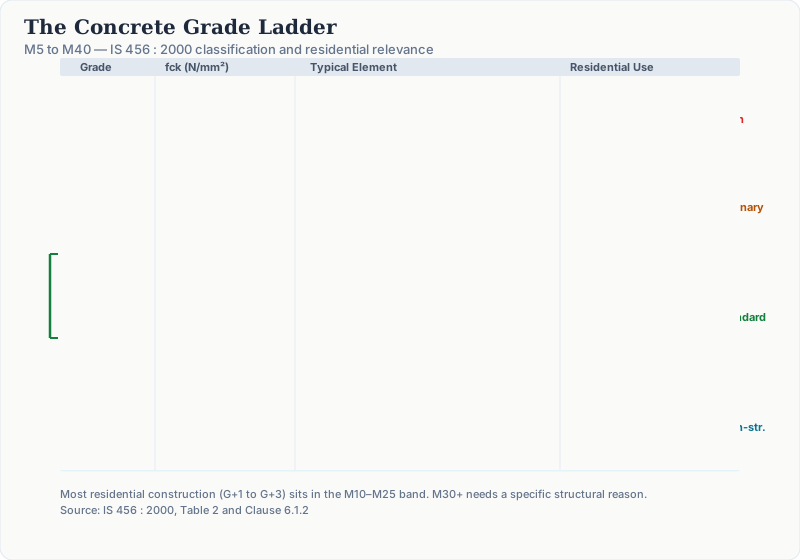
The grade ladder: from lean concrete at M5 to high-strength at M40. Most residential construction sits in the M10–M25 band.
3. Nominal Mix vs Design Mix — The Numbers Contractors Quote
When your contractor says "one-two-four" or "1:1.5:3," he is quoting a nominal mix — a fixed volumetric ratio of cement : fine aggregate (sand) : coarse aggregate. This practice is decades old, came from site convenience, and IS 456 still permits it up to M20. Here is the map:
| Nominal Mix Ratio (Cement : FA : CA) | Approximate Grade | Typical Application |
|---|---|---|
| 1 : 3 : 6 | M10 | PCC, mass fill |
| 1 : 2 : 4 | M15 | PCC, boundary walls, lintels (non-critical) |
| 1 : 1.5 : 3 | M20 | General residential RCC |
| 1 : 1 : 2 | M25 (approximate) | Columns, tanks (nominal barely reaches this) |
The problem with nominal mixes is that they assume dry, well-graded aggregates of fixed specific gravity — conditions that rarely exist perfectly on a site. Sand from the Cauvery river grades differently from Yamuna sand. Aggregate moisture content changes daily. When the assumed variables shift, the actual strength deviates. IS 456 : 2000 Clause 9.3 is explicit: nominal mixes are only permitted up to M20, and even then, the standard "recommends" design mix because nominal mixes are "not always reliable."
Design mix (also called proportioned mix or IS 10262 mix) starts from test data. The mix designer measures the specific gravity, gradation, and absorption of the actual aggregates on site and calculates the water-cement ratio to achieve the target mean strength — which includes a margin above fck to account for variability. The result is a mix that reliably hits the grade even when materials vary slightly. Ready-Mix Concrete (RMC) is always a design mix; that is part of its value proposition.
"The nominal mix approach is permissible but inferior; for controlled quality construction, designed mixes based on actual materials are essential."
— IS 10262 : 2019, Concrete Mix Proportioning — Guidelines, Bureau of Indian Standards
Nominal mix is a recipe by habit; design mix is a recipe by evidence. For structural RCC, always prefer design mix.
4. Grade by Element — The Heart of the Decision
This is the table your contractor should be working from. Every element in your house has a load type, an exposure condition, and a minimum grade that IS 456 mandates or structural practice demands. When a single grade is prescribed for everything, at least some elements are either under-specified or over-specified.
| Element | Recommended Grade | Notes |
|---|---|---|
| PCC blinding / levelling layer | M10 | Non-structural; fills irregularities below footing |
| Isolated footings (mild exposure) | M20 | IS 456 Cl 6.1.2 minimum for structural RCC |
| Combined / raft footings | M20–M25 | Higher for heavy loads or moist soil |
| Plinth beam | M20 | Ties foundation; M25 in seismic zones |
| Ground-floor columns (G+2) | M25 | Carries axial load + bending; never below M20 |
| Upper-floor columns | M20–M25 | Reduce with height if load reduces |
| Beams (all floors) | M20–M25 | Flexure + shear; M25 in span > 5 m |
| Roof / floor slabs | M20 | Standard; M25 for waterproofed sunken slabs |
| Staircase flight and landing | M25 | Thin, high-stress section; better durability |
| Lintels | M20 | Small pre-cast elements; often nominal mix 1:1.5:3 |
| Retaining walls | M25–M30 | Earth pressure + water penetration; higher cover |
| Underground water tanks (sump) | M25 + waterproofing admixture | Must be watertight; IS 3370 governs |
| Overhead water tank | M25 + waterproofing admixture | Cyclic wetting/drying accelerates deterioration |
| Driveway / parking slab | M25 | Abrasion + wheel loads; M30 if heavy vehicles |
| Pathway / courtyard PCC | M15 | Non-structural; aesthetic |
The principle behind this table: increase grade where you have (a) high or eccentric loads, (b) thin sections with dense reinforcement, (c) water contact, (d) abrasion, or (e) chemical aggression from soil or environment.
For a complete, element-by-element structural picture — which also covers the rebar requirements alongside the concrete grade — see why reinforcement steel matters and the structural-design companion at structural safety for residential buildings.
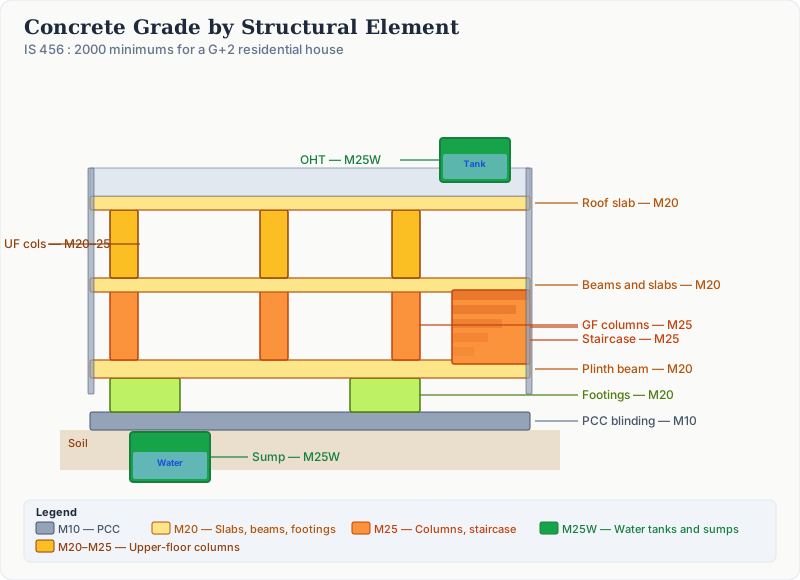
Every element in your house warrants its own grade. This cutaway maps the M-number to the element — from M10 at the blinding layer to M25 at the sump and staircase.
5. Exposure Conditions — The Environment Decides the Floor
The element table above assumes a mild inland environment. Real sites are not always so forgiving. IS 456 : 2000 Table 3 (Exposure Conditions) divides environments into five categories, each raising the minimum concrete grade, minimum cement content, and maximum water-cement ratio:
| Exposure Class | IS 456 Description | Examples | Min Grade (RCC) | Min Cement (kg/m³) | Max w/c |
|---|---|---|---|---|---|
| Mild | Protected against weather | Interior columns, slabs | M20 | 300 | 0.55 |
| Moderate | Exposed to condensation/rain | External walls, balconies | M25 | 300 | 0.50 |
| Severe | Intermittent/continuous water or chemicals | Exposed foundations, plinth in moist soil | M30 | 320 | 0.45 |
| Very Severe | Sea water spray, aggressive ground | Coastal sites within 1–2 km of sea | M35 | 340 | 0.45 |
| Extreme | Tidal/splash zones, acid sulphate soils | Coastal pile caps, industrial effluent | M40 | 360 | 0.40 |
If you are building in coastal Karnataka, Tamil Nadu, Gujarat, Maharashtra, or Odisha within two kilometres of the sea, your engineer should be specifying M30–M35 for all structural elements — and M25 is not enough. Salt-laden air and moisture cycles accelerate corrosion of the reinforcement inside the concrete; the denser, lower-permeability concrete of a higher grade buys you decades.
Cover — the concrete thickness between the rebar and the outer surface — also increases with exposure class, from 20 mm (mild, slab) to 50 mm (very severe). The concrete grade and the cover are a system: better concrete is not a substitute for adequate cover, and adequate cover is not a substitute for minimum grade.
"Durability of concrete is related to its resistance to deterioration and to the environment in which it is placed. The primary mechanism of attack is transport of aggressive agents through the concrete matrix."
— P.K. Mehta & P.J.M. Monteiro, Concrete: Microstructure, Properties and Materials, 4th edn, McGraw-Hill
For a deeper treatment of how exposure degrades concrete over the decades — and how to counter it — the guide on science behind durable buildings is the companion read.
IS 456 exposure classes drive minimum grade and cover. Building near the sea? M35 is your new M20.
6. Why Higher Is Not Always Better
Here is the argument you should push back on when a contractor (or an enthusiastic engineer) suggests "let's just do M30 everywhere for safety." Higher grade concrete is not free:
- Cost escalates steeply. An M30 RMC mix costs roughly 15–20% more per cubic metre than M20 in most Indian cities (2026 rates, discussed below). For a 1,200 sq ft house requiring perhaps 60–80 cubic metres of concrete, that is a real sum.
- Heat of hydration rises. Richer mixes (more cement content) generate more heat as the cement hydrates. In large pours — thick rafts, retaining walls — this thermal gradient causes internal micro-cracking, the very thing you are trying to avoid.
- Drying shrinkage increases. More cement paste means more shrinkage as the concrete loses moisture. Cracks can form, especially if curing is inadequate.
- Brittleness. Very high-strength concrete fractures with less warning than moderate-strength mixes. For typical residential members, M20–M25 offers sufficient ductility alongside the steel.
The goal is not the strongest possible concrete; it is the correct concrete for the element and exposure. Over-specifying wastes money and can create fresh problems. What makes buildings crack explains how both under-specification and over-rich mixes can be crack triggers.
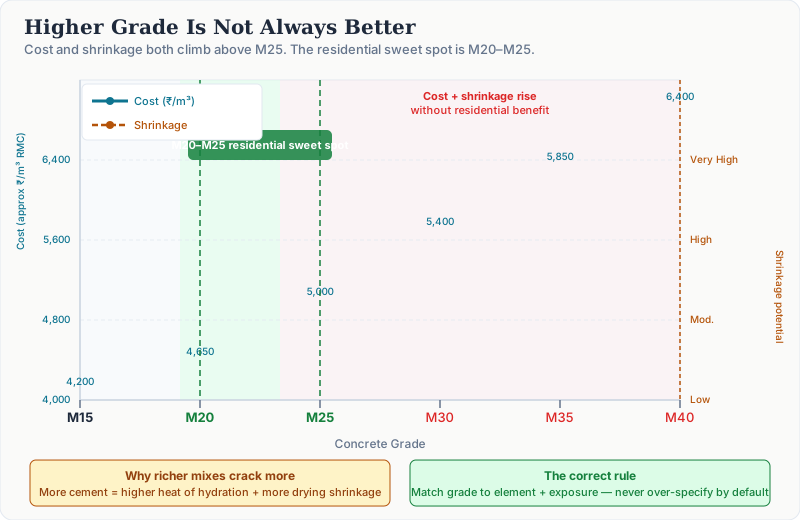
Cost and shrinkage both climb with grade. The residential sweet spot is M20–M25; there is no structural benefit to going higher without a specific reason.
7. Mix Ingredients and Proportions in Practice
A concrete mix has four primary ingredients. Understanding them helps you verify what is actually going into your structure.
Cement — the binder. OPC 43 grade is the baseline for M20 and below. OPC 53 or PPC is used for higher grades and where sulphate resistance is needed. Refer to how cement works for a full treatment of cement types. For M25 and above, IS 456 recommends that the cement content stay below 450 kg/m³ to limit heat of hydration.
Fine aggregate (sand) — river sand (IS 383 Zone II or III preferred), manufactured sand (M-sand), or crushed stone fines. The gradation zone affects workability and segregation. M-sand is now standard in many states where river sand is scarce or banned.
Coarse aggregate — crushed granite or gravel of nominal maximum size (NMS). The size choice is element-dependent:
| Element | Maximum Aggregate Size |
|---|---|
| Beams (reinforcement spacing > 75 mm) | 20 mm |
| Slabs (> 75 mm thick) | 20 mm |
| Columns with dense steel | 12.5 or 16 mm |
| Mass concrete / footings | 40 mm |
| Thin shell / sunken slab | 10 or 12.5 mm |
As a rule, aggregate should not exceed one-quarter of the minimum section dimension and should pass freely between reinforcement bars.
Water — clean, free of chlorides and sulfates (IS 456 Clause 5.4). The water-cement ratio (w/c) is the single most important factor in determining strength and durability: lower w/c → stronger and less permeable concrete, but reduced workability. Superplasticisers (chemical admixtures) allow you to lower w/c without losing workability — standard in all RMC and in any M25+ site mix.
Admixtures — accelerators, retarders, air-entraining agents, waterproofing admixtures (crystalline or pore-blocking). For underground sumps and water tanks, a waterproofing admixture is not optional; it is the baseline. For summer pours in Rajasthan or the Deccan, a retarder extends the workability window.
8. Nominal Mix vs Volumetric Batching on Site
Even when a nominal mix is prescribed, the actual proportions on site often drift — workers guess volumes rather than measure. A 1:1.5:3 mix batched by eye can easily produce a 1:2:3.5 mix. The result is concrete that tests well below M20. If your project uses site-mixed concrete (rather than RMC), insist on:
- Gauge boxes (farmas) of fixed volume for each ingredient, not "one pan" estimates.
- Batching by weight for cement — a 50 kg OPC bag is the standard unit. Do not split bags or mix across different grades.
- Free-moisture correction for sand — wet sand holds 2–6% water by mass; this water counts toward the w/c ratio and must be deducted from the mixing water.
For a G+2 residential structure today, RMC from a certified plant is almost always the better choice for structural elements. The cost premium (₹ 150–300/m³ over site mixing after accounting for labour, wastage, and consistency) is repaid in confidence.
9. Specifying and Verifying: Contractual and Site Checks
Choosing the right grade is half the work. Ensuring the right grade is actually delivered is the other half. Here is the full verify-and-specify loop:
In the contract / BOQ:
- Specify grade by element — not "M20 RCC throughout" but "M20 for beams and slabs; M25 for columns, footings, staircase, and underground tank."
- Require design mix conforming to IS 10262 : 2019.
- Require BIS-certified cement (IS 269 or IS 1489 mark).
- For RMC: specify test certificate per batch from the plant.
At the time of pour:
- Check the RMC delivery challan — it must state the grade, w/c ratio, cement content, admixture type, and plant batch number.
- Check slump (flow consistency) at the point of placement, not at the plant. Typical slump for structural RCC: 75–125 mm. A very wet mix (slump 200+ mm) has been watered down on the way.
- Reject any truck that has been in transit beyond 90 minutes or 300 drum revolutions (standard IS 4926 RMC clause).
Cube samples:
- Take one set of three 150 × 150 × 150 mm cubes per 50 m³ of concrete (or per floor, whichever is more frequent) per IS 456 Clause 15.
- Mark cubes with date, pour location, and grade. Cure in water for 28 days. Send to a NABL-accredited lab.
- Minimum acceptable: characteristic strength ≥ fck; no individual result < fck − 3 N/mm² (IS 456 Acceptance Criteria).
| Site Verification Step | When | What to Check |
|---|---|---|
| Review mix design certificate | Before pour begins | Grade, w/c, cement content, admixture |
| Check delivery challan (RMC) | On truck arrival | Grade matches specification, transit time |
| Slump test | At point of placement | 75–125 mm for structural RCC |
| Cube sampling | Per 50 m³ or per floor | Three cubes per set, lab-tested at 28 days |
| Compaction (vibration) | During pour | No cold joints, vibrator penetrates lower layer |
| Curing | Days 1–28 | Wet curing minimum 7 days (IS 456 Cl 13.5) |
For a deeper dive on site quality practices — not just concrete but formwork, curing, and lab testing — construction quality control for homeowners is the companion guide in this series. You can also use Studio Matrx DesignAI to generate site inspection checklists and specification language tailored to your project type.
10. Indicative Cost by Grade (RMC, 2026)
Prices vary significantly by city, plant proximity, and batch size. The following are indicative ranges for ready-mix concrete delivered to a residential site in a major Indian city in 2026. These are not quotes — verify with your local RMC supplier.
| Grade | Indicative RMC Price (₹/m³) | Typical Site-Mix Cost (₹/m³, incl. labour) | Notes |
|---|---|---|---|
| M10 | 3,800–4,200 | 3,200–3,600 | Rarely ordered as RMC; mostly site-mixed PCC |
| M15 | 4,000–4,400 | 3,400–3,800 | Boundary walls, paths |
| M20 | 4,400–4,900 | 3,800–4,300 | Most common residential grade |
| M25 | 4,700–5,300 | 4,200–4,800 | Columns, staircase, tank |
| M30 | 5,100–5,700 | 4,700–5,200 | Retaining walls, basements |
| M35 | 5,500–6,200 | Rarely site-mixed | Coastal structures, heavy load |
| M40 | 6,000–6,800 | Rarely site-mixed | Piles, bridge elements |
The cost difference between M20 and M25 for an entire house is typically ₹ 15,000–35,000 for a 1,200–1,500 sq ft G+2 structure. That is a small fraction of total construction cost. The false economy of specifying M15 for columns to save ₹ 8,000 is not worth the structural risk — and if a column fails or needs to be demolished and rebuilt, the rectification cost is many times more.
"The most expensive concrete is the concrete that fails."
— Field maxim in Indian structural engineering practice
11. Putting It All Together — Your Specification Checklist
Before concrete is poured on your site, confirm the following:
| Item | Yes / No / NA |
|---|---|
| Grade specified per element in BOQ | |
| Design mix certificate from plant received | |
| Cement brand and grade confirmed (OPC 43/53 or PPC) | |
| Waterproofing admixture specified for tanks and sumps | |
| Cube sampling plan agreed with contractor | |
| RMC plant NABL or BIS certification checked | |
| Site cube moulds, tamping rod, and slump cone available | |
| Curing regime agreed (wet jute / curing compound) | |
| No watering down by truck driver — slump test on arrival | |
| Lab test results to be shared before next floor RCC |
Use this table with your site engineer before every major pour. Construction quality control for homeowners expands each item into the detailed site protocol.
12. Summary Decision Rules
- PCC / levelling layers → M10 (site-mixed nominal 1:3:6 is fine).
- All structural RCC in a standard inland G+1–G+3 house → M20 for beams, slabs, and lintels; M25 for columns, footings, staircase, and water tanks. If you can only use one grade for structural RCC, use M25 — it is not a big cost step up.
- Exposed or coastal environments → add one exposure class minimum; in very severe/extreme zones follow IS 456 Table 3 strictly.
- Nominal mix is acceptable for M15 and below on site; prefer design mix for all M20+ structural work.
- RMC is safer than site-mixing for columns, beams, and slabs because consistency is plant-controlled.
- Take cube samples — there is no other way to know what actually went into your structure.
For the broader context of how concrete grade fits into the complete material picture of an Indian house, the pillar guide modern construction materials for Indian homes and the companion spoke on understanding concrete strength fill in the science before and after this practical decision guide.
Author's Note
My father built our house in the early 1990s. The contractor gave him one grade, one mix, no cube test, no challan, no questions asked. The house stands, but two columns have visible cracks and the underground sump has leaked every monsoon since 2004. Had someone handed him this table thirty years ago, the outcome might have been different.
Concrete grade is not the most glamorous topic in construction — but it is the most consequential one that is routinely left to contractor habit. The element-by-element table in this guide is not exotic engineering; it is IS 456, written in 2000 and updated since, freely available to every citizen. You now have it too. Use it.
— Amogh N P
Disclaimer
This guide is for educational purposes. Concrete prices quoted are indicative 2026 ranges and will vary by city, plant, and procurement volume. IS code clause numbers cited reflect IS 456 : 2000 and IS 10262 : 2019 — verify the current editions. All structural decisions — grades, sections, reinforcement, cover — must be made by a qualified structural engineer holding a valid licence. The author and Studio Matrx accept no liability for construction decisions made solely on the basis of this article.
References
1. Bureau of Indian Standards. IS 456 : 2000 (Reaffirmed 2021). Plain and Reinforced Concrete — Code of Practice (Fourth Revision). BIS, New Delhi.
2. Bureau of Indian Standards. IS 10262 : 2019. Concrete Mix Proportioning — Guidelines (Second Revision). BIS, New Delhi.
3. Bureau of Indian Standards. IS 383 : 2016. Coarse and Fine Aggregate for Concrete — Specification (Third Revision). BIS, New Delhi.
4. Bureau of Indian Standards. IS 4926 : 2003. Ready Mixed Concrete — Code of Practice. BIS, New Delhi.
5. Bureau of Indian Standards. IS 3370 : 2009 (Parts I–IV). Concrete Structures for the Storage of Liquids — Code of Practice. BIS, New Delhi.
6. Bureau of Indian Standards. SP 23 : 1982 (Reprint 2002). Handbook on Concrete Mixes (Based on IS 456 : 1978). BIS, New Delhi.
7. Neville, A.M. (2011). Properties of Concrete, 5th edn. Pearson Education, Harlow.
8. Mehta, P.K. and Monteiro, P.J.M. (2014). Concrete: Microstructure, Properties and Materials, 4th edn. McGraw-Hill Education, New York.
9. Shetty, M.S. (2019). Concrete Technology: Theory and Practice, revised edn. S. Chand, New Delhi.
10. Gambhir, M.L. (2013). Concrete Technology: Theory and Practice, 5th edn. Tata McGraw-Hill, New Delhi.
11. Duggal, S.K. (2017). Building Materials, 4th edn. New Age International, New Delhi.
12. Varghese, P.C. (2012). Building Materials, 2nd edn. PHI Learning, New Delhi.
13. Indian Concrete Institute. (2022). Ready Mixed Concrete in India: Quality and Usage Guidelines. ICI, Chennai.
14. National Building Code of India (NBC 2016). Part 6: Structural Design, Section 5 — Concrete. Bureau of Indian Standards, New Delhi.
Word count: approximately 3,350 words
Export this guide
Related Guides — Deep-dive reading
Construction Aggregates in India: Sizes, Quality & Selection (2026)
What coarse aggregate actually does in concrete, how to pick the right nominal size (10mm, 20mm, 40mm), and the field and lab checks that separate strong stone from a bad load - a specify-and-select guide for Indian homes.
Building MaterialsCompound Wall Piers and Columns in India: Spacing, Reinforcement and Stability (2026)
Why a long, free-standing boundary wall needs intermediate piers or RCC columns to stay up — the physics of overturning in plain terms, thickened masonry piers vs reinforced-concrete columns on footings, indicative spacing that an engineer sets to your height and wind zone, the coping or tie beam that braces the top, and where to break a long run with movement joints.
Compound WallsConstruction Quality Control for Homeowners
How to make sure your house is actually built well, stage by stage, without an engineering degree — concrete, steel, cover and curing, the cardinal site sins to refuse, and the simple checks anyone can do.
Structural SafetyRelated Tools — Try Free
Interior Contract Clause Checklist
16 sections and 98 checkboxes covering scope, BOQ, milestones, penalties, warranty, and disputes.
Contract ChecklistMonsoon-Readiness Checklist
Pre-rain home audit across 9 categories — terrace, drains, waterproofing, electrical, HVAC, pest, vehicles, documents.
Seasonal AuditCross-Ventilation Analyzer
Estimate airflow and air changes per hour (ACH) from room size, window areas, layout, and local wind — with NBC 2016 Part 8 compliance check.
Ventilation Calculator