
Load-Bearing vs Frame Structures: Which System Holds Up Your Home
The two fundamental ways a house stands up — masonry walls that carry the load versus an RCC column-and-beam skeleton — how to tell which you have, and what it means for renovating, extending and safety.
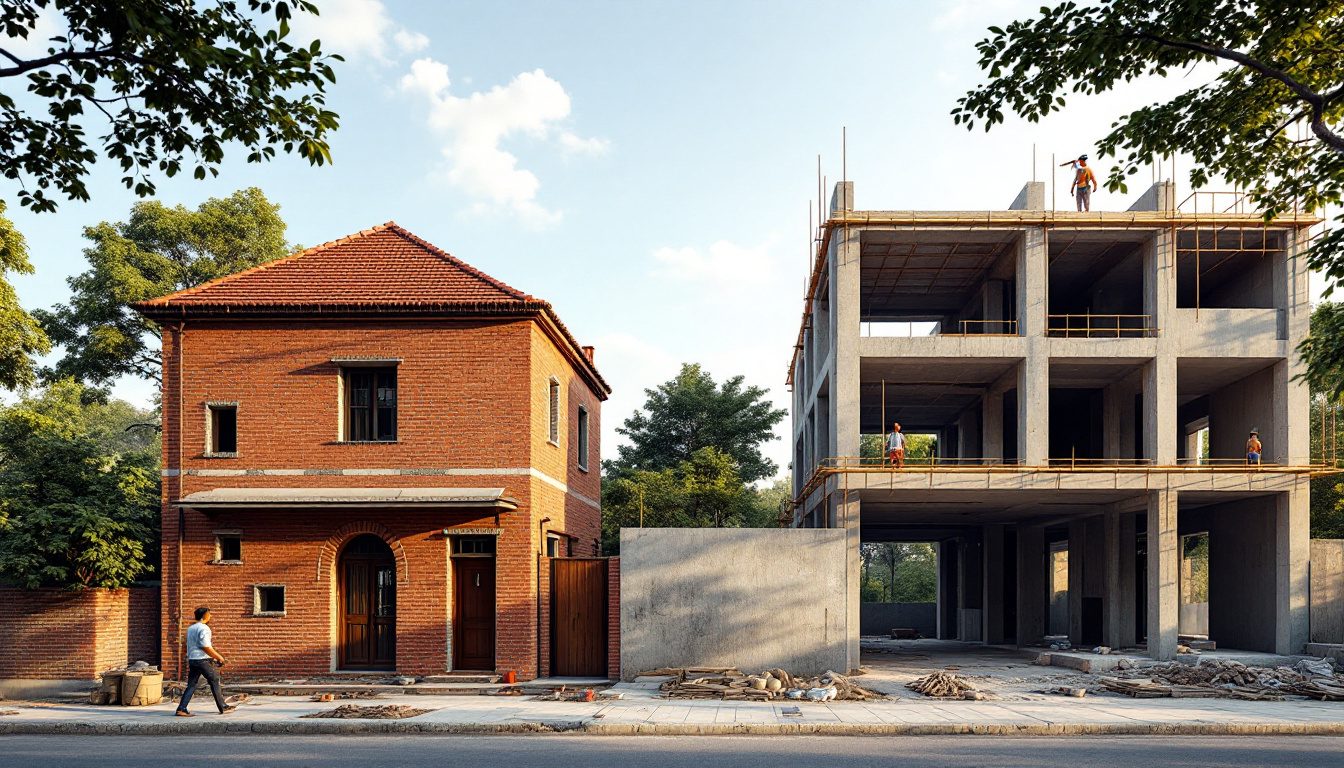
Walk down almost any older Indian street and you will see two kinds of buildings standing side by side — and unless someone points it out, they look like cousins. On one side, a solid 1960s brick house: thick walls, small windows framed in chunky masonry, the whole thing looking like it was hewn from a single block of earth. On the other, a 2020s apartment building mid-construction: slender concrete columns rising floor by floor, a skeleton of beams and slabs, the gaps between filled in with thin block walls after the frame goes up. Both buildings do exactly the same job — they hold a roof over people's heads and carry every kilo of furniture, person, and monsoon rain down to the earth. But the way they do that job is completely opposite.
Understanding the difference is not an engineering exercise. It is homeowner literacy. Whether you are buying a resale flat in a 1980s building, renovating a G+1 ancestral home, commissioning a new house from scratch, or just wondering why your architect keeps talking about "columns" — the structural system your building uses shapes everything from how thick the walls need to be, to whether you can knock one down, to how the building will behave in an earthquake.
This guide explains the two fundamental systems from the ground up — literally. When the conversation shifts from "how does my building stand?" to "can I remove THIS particular wall in my flat?", that is the precise moment to open the companion guide Understanding Structural Walls Before Renovation, which owns that territory. We will hand you off to it explicitly when we get there.
1. The Two Systems, Defined
A load-bearing structure carries gravity loads through its walls, which act as both enclosure and structure; an RCC framed structure carries loads through a skeleton of columns and beams, with walls serving only as non-structural infill.
That one sentence is the entire story. Everything else is detail — important, useful, actionable detail, but always flowing from that single distinction. Think of it this way: in a load-bearing building, if you remove a wall you have potentially removed a structural member. In a framed building, if you remove a non-structural infill wall you have done something roughly equivalent to removing a curtain — the curtain was blocking light and providing privacy, but the building does not miss it structurally. (Whether your specific wall in your specific flat is structural infill or an RCC shear wall is a different question — and the renovation companion guide covers it in full.)
2. Load-Bearing Masonry: Walls That Work
In a load-bearing masonry structure, every load — the weight of the slab above, the weight of occupants, furniture, water tanks, the roof itself — travels through the walls. The walls are not just enclosing space; they are the structure. They carry compression all the way down from roof to foundation.
This is one of humanity's oldest structural ideas. The walls of ancient stone temples in India, the thick mud-brick houses of Rajasthan, the colonial-era bungalows of Chennai and Pune, the 1950s and 1960s brick homes in every Indian city — all load-bearing. The physics is simple and forgiving: masonry is excellent in compression, meaning it resists being squeezed. Stack bricks with good mortar, make the wall thick enough, and it will carry enormous loads without complaint.
The governing Indian standard for unreinforced masonry is IS 1905 (Code of Practice for Structural Use of Unreinforced Masonry). Foundation design follows IS 1904 (Design and Construction of Foundations in Soils). The National Building Code (NBC) 2016 Part 6 Section 4 covers masonry buildings in detail.
Key characteristics of load-bearing masonry:
- Wall thickness is structural, not cosmetic. Typical Indian brick walls in load-bearing construction are 230 mm (one brick length, the "9-inch wall") for internal walls, 345 mm (one and a half bricks) or 460 mm (two bricks) for external or highly loaded walls. Thicker walls at the base, sometimes stepping to thinner walls on upper floors, is common practice.
- Openings — doors, windows — must be small relative to the wall length. IS 1905 limits the openings in any wall panel to roughly one-third of the wall's length (the exact limit depends on wall height and thickness ratio). Every opening has to be spanned by a lintel, which redirects the load around it.
- Height is inherently limited. Unreinforced brick masonry buildings in India are generally kept to G+2 (ground plus two upper floors) in practice, sometimes G+3 with careful engineering. Beyond that, the compressive loads and the need for earthquake resistance make framed construction more efficient. IS 1905 provides slenderness ratio limits that effectively cap height unless the walls become impractically thick.
- The foundation under a load-bearing building is typically a strip footing running continuously under each load-bearing wall — a direct reflection of the load path.
How to recognise a load-bearing building:
Walk into the house. Look at the walls. If every wall — including the internal walls separating rooms — feels solid, thick (knock on it and you hear a dull thud, not a hollow tap), and measures 230 mm or more in thickness, you are probably in a load-bearing building. If the building was built before roughly 1985–1990 in most Indian cities, and is three storeys or fewer, load-bearing masonry is a strong candidate. Window openings tend to be narrower. There will be no visible concrete column bumps projecting from the wall plane.
"Masonry in compression is almost invincible. The challenge has always been tension and lateral load — which is why unreinforced masonry and earthquakes are a dangerous combination." — Field maxim among Indian structural engineers working in seismic zones.
3. RCC Framed Structures: The Skeleton Approach
In a reinforced cement concrete (RCC) framed structure, a skeleton of columns, beams, and slabs carries all the loads. The columns are the vertical load-carrying members, transferring gravity loads to isolated or raft foundations below. The beams span horizontally between columns, carrying slab loads and distributing them to columns. The slabs span between beams, carrying the floor and roof loads.
The walls — even the heavy-looking external walls — are infill. They are placed after the frame is cast and cured. They carry their own self-weight (which is transferred to the beam below them), but they do not participate in carrying the gravity loads of the floors above. Remove a non-structural infill wall and the frame does not notice. The building stands exactly as before.
This is why apartment buildings built since the 1990s in India can have open-plan living areas, large glass windows spanning nearly floor to ceiling, and layouts that are completely free of the grid imposed by load-bearing walls. The architect is designing within a cage of columns, not around a grid of structural walls.
The governing Indian standard for RCC design is IS 456:2000 (Plain and Reinforced Concrete — Code of Practice), with seismic ductility detailing covered by IS 13920:2016 (Ductile Design and Detailing of Reinforced Concrete Structures Subjected to Seismic Forces). Foundation design for framed buildings typically uses IS 2950 for raft foundations and IS 2911 for pile foundations.
Key characteristics of RCC framed structures:
- Columns are the giveaway. In India, columns in residential framed buildings are commonly 230 mm × 450 mm, 300 mm × 450 mm, or 300 mm × 600 mm in plan, depending on load. They often project slightly from the finished wall plane, creating the characteristic "column bump" or "pillar" that is visible on the inside of many Indian flats.
- Infill walls are thin. Because they carry no structural load (other than their own weight), infill walls can be 115 mm thick (half-brick), or use AAC (autoclaved aerated concrete) blocks at 100–150 mm, or hollow clay blocks. This is why newer apartments feel less "solid" to the knock test than old load-bearing buildings.
- Large openings are feasible. A framed building can have a window occupying 70–80% of a wall bay without any structural consequence, as long as the lintel above carries the infill wall's self-weight to the columns on either side.
- Height is not inherently limited by the system (within seismic and wind design requirements). High-rise apartments, commercial towers, and multi-storeyed housing all use RCC frames, often combined with shear walls for lateral resistance.
- Foundations are typically isolated column footings (one pad under each column) or a combined raft, reflecting the point-load nature of columns rather than the continuous-line loads of load-bearing walls.
How to recognise an RCC framed building:
Look for column bumps at the corners of rooms and at regular intervals along walls — these are the columns. Tap the wall between two column bumps: if it sounds hollow or noticeably thinner, it is infill. Measure the wall thickness: if it is 115 mm or less, it is almost certainly non-structural infill. Check the building drawings if accessible — they will clearly label RC columns and beams. In high-rise apartments in particular, you may also see a plinth beam at floor level connecting the column bases, and ring beams at each floor level tying the frame together.
Two houses, one job, opposite logic: the load-bearing house carries gravity through every wall; the framed house channels it through a discrete skeleton.
4. The Big Comparison
| Parameter | Load-Bearing Masonry | RCC Framed Structure |
|---|---|---|
| Load path | Through walls → strip footing | Through columns + beams → isolated/raft footing |
| Wall function | Structural AND enclosing | Enclosing only (non-structural infill) |
| Typical wall thickness | 230–460 mm | 115–200 mm (infill); columns 230–300 mm |
| Practical height limit | G+2 to G+3 (IS 1905 slenderness) | No inherent height limit; seismic/wind design governs |
| Opening freedom | Limited (max ~1/3 of wall length) | High (large openings freely possible) |
| Primary material | Brick / stone + lime or cement mortar | M20/M25/M30 concrete + Fe500 steel rebar |
| Approx. material cost (2026 bands) | ₹1,200–1,600 per sqft (structure) | ₹1,600–2,200 per sqft (structure) |
| Seismic behaviour | Brittle failure unless retrofitted / banded | Ductile if designed to IS 13920; soft-storey risk |
| Renovation flexibility | Low — walls are structure | High — infill can be modified (with caveats) |
| Typical lifespan (well-maintained) | 60–100+ years | 60–100+ years (both depend on cover/waterproofing) |
| IS codes applicable | IS 1905, IS 4326, IS 1904 | IS 456, IS 13920, IS 1893 |
"No structural system is inherently superior. Each is a tool suited to its context — soil, seismicity, height, span, and the skill of the team building it." — Adapted from Mario Salvadori, Why Buildings Stand Up (W.W. Norton, 1980).
5. Why India Shifted from Load-Bearing to Frame
In the 1950s and 1960s, most Indian residential construction was load-bearing masonry. The shift to RCC framing accelerated through the 1970s and particularly the 1980s and 1990s, driven by several converging forces.
Cement availability: Post-independence, India's cement industry expanded dramatically. By the 1980s, cement was widely available at accessible cost, making RCC construction practical even for mid-income housing. Before that, lime mortars and traditional masonry were the norm by necessity.
Height and density: As Indian cities grew denser and land became expensive, the incentive to build upward increased. FSI (Floor Space Index) regulations in metropolitan areas encouraged multi-storeyed construction. Load-bearing masonry is not practical above four or five storeys — columns and slabs handle height efficiently.
Flexible floor plans: Urban lifestyles changed. The mid-20th-century norm of fixed room layouts gave way to demand for open-plan living, large windows, corner glazing, and layouts that could be modified. RCC framing enables all of this; load-bearing masonry resists it.
Seismic performance: The Latur earthquake of 1993 (Richter 6.2, ~10,000 deaths) and particularly the Bhuj earthquake of 2001 (Mw 7.7, ~20,000 deaths) dramatically changed Indian building policy. Unreinforced masonry — which is brittle and collapses without warning under seismic loads — was identified as the primary killer in both disasters. The updated IS 1893:2002 and IS 13920:2002 (since revised) pushed engineered framed construction as the preferred approach in seismic zones. For more on seismic design implications for your home, the earthquake zones and home design guide covers the national seismic map and zone-wise requirements in full.
Contractor familiarity: Once a critical mass of contractors learned RCC framing in the 1980s–1990s, the knowledge became widespread. Today, even a small-town contractor can build a G+1 RCC frame; skilled load-bearing masonry detailing is becoming rarer.
6. Seismic Behaviour: The Critical Difference
This deserves its own section because the stakes are high. In a seismic event, a building is shaken laterally — horizontally. Gravity-optimised structures must also resist this lateral force, and the two systems handle it very differently.
Load-bearing masonry is inherently brittle under lateral load. Mortar joints are weak in tension. When the ground shakes, cracks propagate through mortar joints, walls separate at corners, and the building can collapse suddenly and catastrophically. IS 4326 (Earthquake Resistant Design and Construction of Buildings) provides mitigation: horizontal RC bands (plinth band, lintel band, roof band) and vertical reinforcing bars at corners and jambs dramatically improve seismic performance of masonry buildings. But unreinforced masonry — very common in rural India and in pre-1970 urban stock — remains the most dangerous structural system in an earthquake.
RCC framed structures, designed to IS 456 with ductile detailing per IS 13920, perform far better. The steel reinforcement in columns and beams provides tensile capacity; ductile detailing (closely spaced stirrups, proper lap lengths, confinement of column ends) allows the frame to absorb seismic energy by deforming without sudden failure. IS 13920:2016 is mandatory for buildings in seismic zones III, IV, and V.
However, RCC frames have their own seismic vulnerability: the soft storey. If the ground floor is open (a common Indian design for parking, or a commercial ground floor under a residential tower), it is much weaker in lateral stiffness than the upper floors. In a strong earthquake, the deformation concentrates in this weak storey, columns fail, and the upper floors collapse as a unit — the "pancake" failure mode seen in several Indian earthquakes. IS 13920 addresses this with soft-storey provisions, but older buildings built before 2002 may not have them.

IS 4326 bands protect masonry; IS 13920 ductile detailing protects frames — but older buildings without either system are the vulnerability.
| Seismic Parameter | Load-Bearing Masonry | RCC Frame (well-designed) |
|---|---|---|
| Failure mode | Brittle; sudden wall collapse | Ductile (with IS 13920 detailing) |
| Warning before collapse | Minimal in unreinforced masonry | Usually shows cracking first |
| Key mitigation | IS 4326 RC bands at plinth/lintel/roof | IS 13920 ductile detailing; shear walls |
| Soft-storey risk | Not applicable (walls throughout) | High in open ground-floor designs |
| Mandatory zones for ductile detailing | Not applicable | Seismic Zones III, IV, V |
| Applicable IS codes | IS 4326, IS 1893 | IS 13920, IS 1893, IS 456 |
For the full picture on how Indian seismic zones map onto your location and what it means for building requirements, see the earthquake zones and home design guide.
7. Composite and Other Structural Systems
Real India is messier than textbooks. Many buildings, especially those built piecemeal over decades, use hybrid or transitional systems.
Load-bearing walls with RCC slabs: Extremely common in Indian G+1 and G+2 construction from the 1970s through the 1990s. The walls are load-bearing brick masonry, but the roof/floor slabs are cast RCC rather than the traditional Madras terrace or jack-arch system. This combination carries loads through the walls (as in pure masonry) but gains the spanning and waterproofing advantages of RCC slabs. Many ancestral homes in South India use this system.
Confined masonry: A system distinct from both pure load-bearing masonry and pure RCC frame. RC columns and beams are cast after (or simultaneously with) the masonry walls, in direct contact with the masonry — confining it on all four sides. This dramatically improves seismic performance compared to unreinforced masonry, while using less steel than a full RCC frame. IS 4326 and BMTPC guidelines cover this system. It is increasingly recommended for low-cost housing in seismic zones.
AAC block infill in RCC frames: Autoclaved aerated concrete blocks (brands like Siporex, Magicrete, Renacon) are now the dominant infill material in many Indian cities, replacing the traditional clay brick infill. AAC is lighter (approximately 600–700 kg/m³ vs 1,800 kg/m³ for clay brick), thermally superior, and can be cut with a hand saw. The structural frame is identical to a conventional RCC frame; AAC simply replaces brick as the infill material. The walls are still non-structural.
Steel frame: Used in industrial buildings, commercial high-rises, and increasingly in prefabricated homes. Columns and beams of structural steel (IS 2062 grade) carry loads; the system is faster to erect, allows longer spans, and is highly ductile in earthquakes. In residential use, steel frame with AAC or precast panel infill is growing in premium and fast-track projects. Costs are typically 20–30% higher than equivalent RCC for the structural frame alone.
Precast concrete: Individual structural elements — columns, beams, hollow-core slabs — are factory-cast and assembled on site. Used extensively in large housing projects (affordable housing programmes, government townships). Quality can be superior to site-cast concrete; the challenge is the precision required in connections.
Shear-wall / tunnel-form construction: In high-rise apartments (typically 15+ storeys), structural walls of RCC (called shear walls) take over the lateral load resistance function, supplementing or replacing a moment frame. Tunnel-form construction casts walls and slabs together in a single operation using steel formwork, producing highly regular residential blocks quickly. Most large-format affordable housing towers in Indian cities use some variant of this.

India's built stock mixes all four systems; knowing which one you have is the first step to understanding what your building can and cannot do.
8. How to Tell Which System YOUR Home Is
This is the practical payoff of all the theory above. You do not need a structural engineer to make an initial informed guess about your own home — though an engineer's assessment is irreplaceable before any renovation involving walls or slabs. Here is a homeowner's detection table.
| Indicator | Load-Bearing Masonry | RCC Framed |
|---|---|---|
| Wall thickness | 230 mm or more throughout | 115–200 mm (infill); column bumps 230–300 mm wide |
| Visible column projections | None — walls are flush or nearly so | Yes — column bumps at room corners and intervals |
| Knock test on interior walls | Dull thud, dense feel | Hollow tap or noticeably thinner between columns |
| Window and door sizes | Smaller, proportional to wall | Larger openings possible, sometimes floor to ceiling |
| Building age and height | Pre-1990, G+1 to G+3 | Typically post-1985; any height |
| Foundation type (if visible during construction or from drawings) | Continuous strip under walls | Isolated pads or raft under columns |
| Building drawings | Structural drawings show "masonry walls" as structure | Structural drawings show columns, beams, slabs |
| Builder/society records | "Load-bearing construction" noted | "RCC frame" or "framed structure" noted |
| RCC bands at lintel and sill level | May have IS 4326 bands | Frame is continuous; bands not needed |

The column bump and the knock test: two quick clues that tell you which structural world you are in.
If after this exercise you are still unsure — and especially if you are planning any renovation — engage a licensed structural engineer for a site assessment. The structural safety guide covers what to expect from such an assessment and what questions to ask.
"Buildings don't fail because of what engineers know. They fail because of what was assumed without checking." — Adapted from Matthys Levy and Mario Salvadori, Why Buildings Fall Down (W.W. Norton, 1992).
9. The Load Path: Following the Force
Understanding the load path — the route that a load travels from the point it is applied to the ground — is the single most useful concept in structural literacy. It converts abstract engineering into a story you can trace with your eyes.
Imagine you place a heavy water tank on the roof of your house. Where does that weight go?
In a load-bearing house: The tank's weight presses on the roof slab (or roof beam). The slab transfers it to the walls below. The walls carry it in compression, storey by storey, down to the foundation. The foundation spreads it into the soil. Every wall in that path is structural; every wall carries a share of that tank.
In a framed house: The tank's weight presses on the roof slab. The slab transfers it to the beams that support it. The beams transfer it to the columns at their ends. The columns carry it down — column by column — to the isolated footings below each one. The infill walls sitting between the columns carry nothing except their own weight and the lateral pressure of wind or earthquake.
This is why the load path matters for renovation. If you are in a load-bearing house and you want to remove a wall or make a large opening, you are intervening in a load path that may be carrying everything above it. If you are in a framed house and the wall is a confirmed non-structural infill, the load path runs around that wall, not through it. But — and this is a critical but — even framed buildings can have structural RC shear walls that look like infill. That is the territory of the renovation companion guide on structural walls. Read it before touching any wall.

Trace the red arrows: in masonry, the load is everywhere in the wall; in a frame, it concentrates in columns.
10. What the Structural System Means for You
The system your home uses has practical implications across the building's lifecycle — not just at construction. Here is a summary of the most common homeowner questions.
Hanging heavy loads (water heaters, kitchen cabinets, AC units):
In both systems, anchor into RCC elements where possible — the RCC beam, the RCC column, or the RCC slab soffit. In load-bearing masonry walls, expansion bolts or chemical anchors into brick are feasible for moderate loads (30–50 kg). In thin AAC infill walls, the masonry itself cannot take significant pullout loads — anchor into the adjacent RCC column or use a toggle bolt rated for AAC. Never rely on AAC infill alone for heavy equipment.
Adding a floor (vertical extension):
This is a major structural intervention in either system. In a load-bearing building, the original walls were designed for a specific number of floors; adding another floor increases the compressive load in the walls and the seismic weight of the building. A structural engineer must verify remaining capacity. In a framed building, columns were designed with a specific number of floors in mind; adding floors requires verifying column and foundation capacity. Both require municipal sanctioned drawings and structural certification. Do not add a floor without an engineer — regardless of system.
Opening up space / removing walls:
This is where the systems diverge most sharply for a homeowner. In a framed building, confirmed non-structural infill walls can often be removed with minimal structural consequence (though plumbing, electrical, and finishing work remain). In a load-bearing building, no wall should be removed or significantly opened without an engineer assessing the load path. For the step-by-step guidance on identifying which walls are safe to modify in your specific home, the renovation guide on structural walls is the right resource — it covers the tap test, drawings, and when to call an engineer.
Cracks: Both systems can crack. Understanding whether a crack is structural or superficial — and why buildings crack in the first place — is covered in depth in the companion spoke what makes buildings crack. For a load-bearing building, diagonal cracks in corners and at window jambs are higher-concern indicators than in a framed building, because they may indicate wall distress in a structural member.
Waterproofing and durability: The structural system influences how water enters the building and where it does damage. A load-bearing masonry wall that is chronically wet loses mortar strength and gradually reduces its load capacity. In a framed building, water infiltration into the RCC is the threat — carbonation and chloride ingress corrode the rebar, leading to spalling and loss of section. Both are serious; neither is immediate. The science behind durable buildings and waterproofing failures guides cover this in detail.
| "Can I do X?" | Load-Bearing House | RCC Frame Apartment |
|---|---|---|
| Hang a 50 kg AC outdoor unit on wall | Yes — bolt into wall (chemical anchor in brick) | Anchor into RCC column or beam, NOT thin infill |
| Remove a full interior wall | NO without engineer assessment — likely structural | Possible if confirmed non-structural infill — get drawings first |
| Make a large window in an exterior wall | Needs engineering — may affect load path | Possible if wall is infill; engineer required if near column |
| Add a floor above | Needs full structural assessment — foundation + wall capacity | Needs full structural assessment — column + foundation capacity |
| Build a mezzanine inside | Needs to be supported on existing walls or new posts | Can anchor to RCC beam/slab soffit with proper engineering |
| Lay heavy Italian marble throughout | Extra dead load — verify with structural engineer | Slab typically can handle it; verify with engineer for very heavy stone |
"The goal of structural engineering is not to prevent failure — it is to ensure that if something fails, it fails safely and predictably, giving people time to get out." — Paraphrase of the design philosophy in IS 456:2000 commentary on limit state design.
For a more complete picture of how India's structural codes govern your home's safety, the structural design essentials guide covers IS 456 clauses, concrete grades, and the design process in homeowner-friendly terms.
11. Maintenance and Lifespan
A well-built and well-maintained building of either system can last 60 to 100 years or more. The load path does not determine lifespan — maintenance, material quality, and detailing do.
| Maintenance Factor | Load-Bearing Masonry | RCC Framed Structure |
|---|---|---|
| Primary long-term risk | Water infiltration; mortar deterioration; seismic vulnerability | Rebar corrosion from water/carbonation; spalling |
| Annual inspection priority | Check mortar joints; look for cracking at corners and lintels | Check slab soffits and column faces for spalling; check expansion joints |
| Repointing / repair cycle | Every 10–15 years in wet climates | Column and slab waterproofing every 10–15 years |
| Structural deterioration signs | Diagonal cracks at window corners; wall bulging | Rust stains, spalling concrete at column faces; slab drips |
| Cost of major repair | Moderate (repointing, patching) | High if rebar exposed (requires concrete breaking, re-bar repair, recast) |
| Seismic retrofitting cost | High (adding RC bands, corner reinforcement) | Moderate (soft-storey strengthening, shear walls) |
The construction quality control guide covers what to watch for during the building process — including concrete mix ratios, cover requirements, and curing — all of which directly determine how long the structure lasts.
12. A Note on Cost
Cost comparison between systems is inherently approximate — it depends on region, soil condition, concrete grade, steel prices (volatile in India), and contractor skill. These are indicative 2026 bands for the structural shell only, not the full finished building.
| Cost Component | Load-Bearing Masonry (G+1, approx.) | RCC Framed (G+1, approx.) |
|---|---|---|
| Structural material cost per sqft (shell) | ₹1,200–1,600 | ₹1,600–2,200 |
| Foundation type | Strip footing (typically less expensive) | Isolated/combined footing (depends on soil) |
| Formwork and centering | Minimal (slabs only) | Significant (columns, beams, slabs) |
| Skilled labour premium | Moderate (mason skill) | Moderate (shuttering, bar bending) |
| Time to structural completion | Slower (brick by brick) | Faster (frame then infill) |
| Seismic upgrade cost (if required) | High relative to original cost | Lower (built into initial design if IS 13920 followed) |
The RCC frame costs more upfront but delivers higher flexibility, greater height potential, and better seismic performance when properly detailed. For a low-budget G+1 house in a seismic Zone II area, confined masonry can be a cost-effective and safer alternative to unreinforced load-bearing masonry.
If you are evaluating the structural system as part of a broader design decision, Studio Matrx DesignAI can help you map your site constraints and design requirements to the structural options most suited to your context.
Author's Note
The two structural systems in this guide are not competing philosophies — they are tools. When I think about what it means to help homeowners understand how their buildings stand, I keep coming back to one thing: the wall. A wall in a load-bearing house is doing two jobs simultaneously — it is holding up the building AND giving you privacy and keeping out the rain. That double duty is elegant and ancient and honest. The RCC column does one job and does it precisely, letting the wall around it be just a wall.
Neither is better. Both fail when the material is poor, the detailing is careless, or the maintenance is neglected. The difference that matters — the one that costs lives in earthquakes and money in renovations — is whether the person living in the building knows which system they are in. Structural literacy is not a luxury for engineers. It is basic knowledge for anyone who owns or rents or builds a home in India. This guide exists to start that conversation.
Disclaimer
This guide is an educational resource intended to build general structural literacy for Indian homeowners, students, and interested readers. It does not constitute a structural engineering assessment, advice, or certification for any specific building. Every building is unique — soil conditions, construction quality, age, and regional factors all determine actual structural behaviour. Before undertaking any renovation, extension, or modification to your home, engage a licensed structural engineer (with a valid COA registration) for a site-specific assessment. In seismic zones III, IV, and V, this is not optional — it is essential for your safety.
References
1. Bureau of Indian Standards. IS 456:2000 — Plain and Reinforced Concrete: Code of Practice (4th revision). New Delhi: BIS, 2000.
2. Bureau of Indian Standards. IS 13920:2016 — Ductile Design and Detailing of Reinforced Concrete Structures Subjected to Seismic Forces: Code of Practice. New Delhi: BIS, 2016.
3. Bureau of Indian Standards. IS 1905:1987 — Code of Practice for Structural Use of Unreinforced Masonry (3rd revision). New Delhi: BIS, 1987.
4. Bureau of Indian Standards. IS 4326:2013 — Earthquake Resistant Design and Construction of Buildings: Code of Practice (3rd revision). New Delhi: BIS, 2013.
5. Bureau of Indian Standards. IS 1893 (Part 1):2016 — Criteria for Earthquake Resistant Design of Structures. New Delhi: BIS, 2016.
6. Bureau of Indian Standards. IS 1904:1986 — Design and Construction of Foundations in Soils: General Requirements. New Delhi: BIS, 1986.
7. Ministry of Housing and Urban Affairs. National Building Code of India 2016, Part 6: Structural Design, Section 4: Masonry. New Delhi: BIS, 2016.
8. Salvadori, M. Why Buildings Stand Up: The Strength of Architecture. New York: W.W. Norton, 1980.
9. Levy, M. and Salvadori, M. Why Buildings Fall Down: How Structures Fail. New York: W.W. Norton, 1992.
10. Pillai, S.U. and Menon, D. Reinforced Concrete Design (3rd edition). New Delhi: Tata McGraw-Hill, 2009.
11. Duggal, S.K. Earthquake Resistant Design of Structures (2nd edition). New Delhi: Oxford University Press, 2013.
12. Gambhir, M.L. Concrete Technology: Theory and Practice (5th edition). New Delhi: Tata McGraw-Hill, 2013.
13. Building Materials and Technology Promotion Council (BMTPC). Earthquake Resistant Construction: Confined Masonry. New Delhi: BMTPC, 2014.
14. Jain, S.K. et al. "Seismic performance of buildings during the Bhuj earthquake of January 26, 2001." ISET Journal of Earthquake Technology, 39(1–2), 2002.
15. Arya, A.S., Boen, T. and Murai, Y. Guidelines for Earthquake Resistant Non-Engineered Construction. Paris: UNESCO, 1986 (revised edition). Applicable to confined masonry and low-cost housing in Indian context.
Export this guide
Related Guides — Deep-dive reading
Understanding Structural Walls Before Renovation
Which walls hold your home up — and the costly, dangerous mistake of removing the wrong one
Design EducationHow Earthquake Zones Affect Your Home's Design
What India's seismic zones mean for an ordinary homeowner — finding your zone, the features that make a house earthquake-resilient, the soft-storey danger, and the questions to ask before you build or buy.
Structural SafetyConstruction Quality Control for Homeowners
How to make sure your house is actually built well, stage by stage, without an engineering degree — concrete, steel, cover and curing, the cardinal site sins to refuse, and the simple checks anyone can do.
Structural SafetyRelated Tools — Try Free
Cross-Ventilation Analyzer
Estimate airflow and air changes per hour (ACH) from room size, window areas, layout, and local wind — with NBC 2016 Part 8 compliance check.
Ventilation CalculatorInterior Layout Planner — Printable Graph Grid
Printable graph grid to sketch room layouts to scale before committing to furniture placement.
Layout ToolHome Building & Interior Cost Calculator — 20 Cities
Construction + interior costs for 20 Indian cities across kitchen, wardrobes, flooring, painting, ceiling.
Cost Calculator