
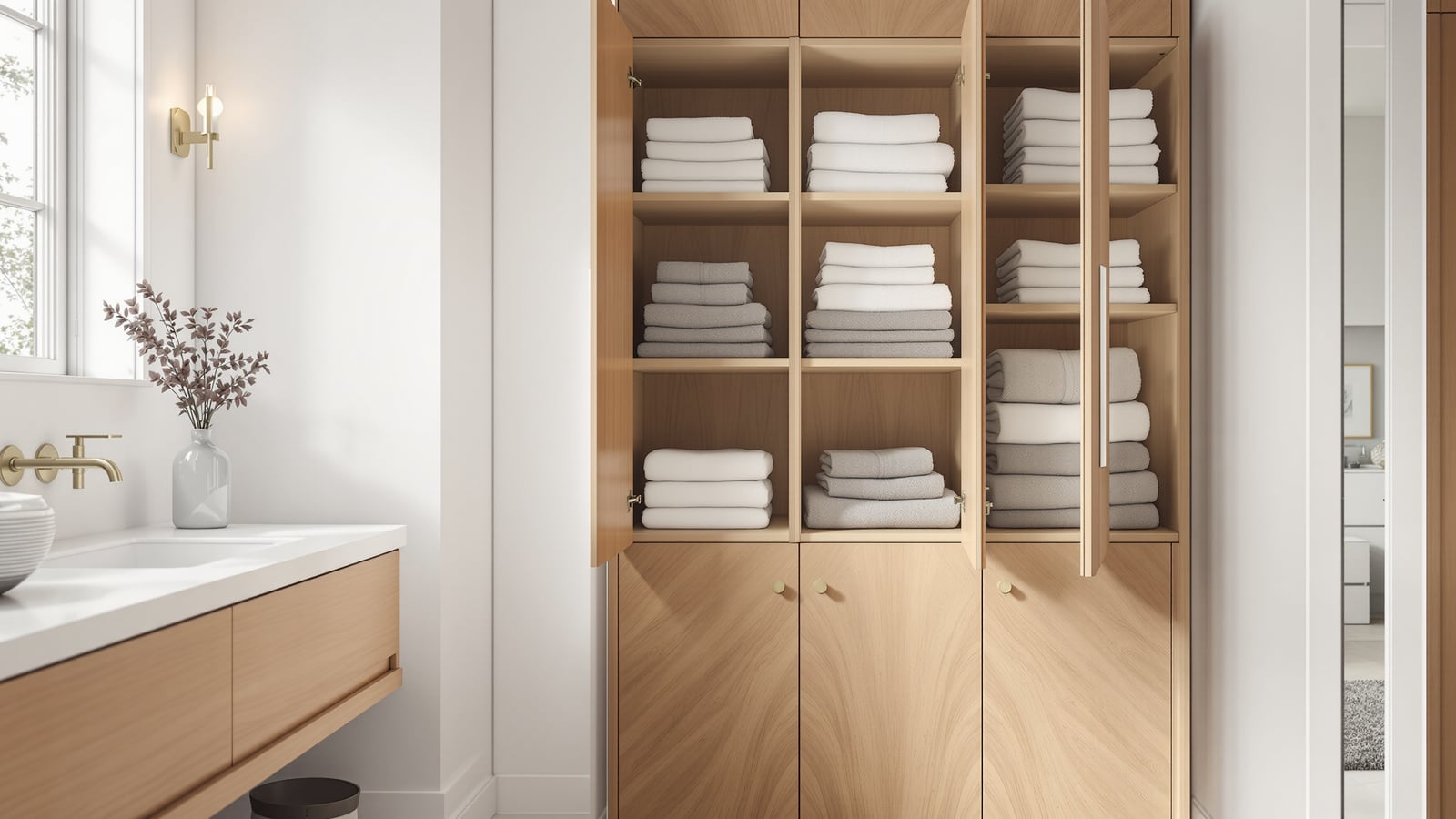
Bathroom Linen Storage India: Tall Linen Cupboards, Towel Columns & Keeping Stock Dry (2026)
How to store towels, bed linen and toilet-roll stock in a humid Indian bathroom without warping or mildew — tall linen columns vs a landing linen closet, why solid MDF fails and ventilated shelves win, drawer vs shelf sizing for folded towels, heated towel rail vs plain shelf, materials and 2026 rupee costs.
Linen storage is the part of a bathroom nobody photographs and everybody misses. The vanity gets the design attention, the shower gets the budget — and then the family discovers there is nowhere dry to keep spare towels, the bedsheets they iron on a Sunday, or the six rolls of toilet paper bought when they were on offer. In an Indian bathroom, "nowhere dry" is not a figure of speech: monsoon humidity, a health-faucet WC that keeps the air damp, and poor cross-ventilation mean that a cupboard built the wrong way will grow that unmistakable musty smell within one wet season.
This guide is India-first and practical. It sits under the bathroom design guide for India and the residential bathroom guide, and it pairs closely with the bathroom vanity guide that handles the sink cabinetry. Here we deal only with linen — the towels, sheets and stock — and the single hardest question about it: how to keep soft goods dry in a room designed to get wet.
The linen decision is really a moisture decision. Solve the humidity first — ventilation, a moisture-tolerant carcass, a gap between shelf and wet zone — and the rest is just shelf maths.
In-bathroom cupboard vs a landing linen closet
The first choice is where the linen lives, and the honest answer for many Indian homes is not inside the bathroom at all.
- A landing / passage linen closet — a shallow cupboard just outside the bathroom or in the corridor — keeps bed linen and spare towels in dry, room-humidity air. This is the traditional and still the best home for bedsheets, duvets, extra blankets and bulk toilet-roll stock, because these rarely need to be grabbed wet-handed and they suffer most from damp.
- An in-bathroom linen column — a tall narrow cupboard beside the vanity or in a dry corner — earns its place for the linen you actually use in the room: two or three days of fresh towels, a hand towel stack, and a small roll reserve. Keep it out of the direct splash and shower zone (see wet and dry zoning).
The realistic layout for most 3-BHK apartments is a split: a small ventilated column inside the bathroom for daily towels and a modest roll stock, and the bulk of the linen — sheets, spare towels, off-season blankets — in a landing closet or bedroom wardrobe where the air is dry. Trying to cram all household linen into a humid bathroom is the classic mistake that ends in mildew.
Why solid MDF warps — and what to build instead
The temptation, because it is cheap and cuts crisply, is to build the linen cupboard from the same MDF or particle board the carpenter used for the bedroom wardrobe. In a bathroom this fails, and it fails predictably.
- Plain MDF and particle board are wood fibres bonded with resin. They wick moisture from humid air, swell along the edges, and once the edge-banding lifts the swelling accelerates — the shelf sags, the door stops closing, and mildew colonises the swollen fibre. One monsoon is often enough.
- BWR / BWP grade plywood (IS 303 / IS 710) is the honest carcass for any bathroom cabinetry. BWR (boiling-water resistant) uses a moisture-resistant phenolic glue line; BWP / marine (IS 710) is the top grade for genuinely wet exposure. The plies still need sealed edges — an exposed ply edge drinks water.
- WPC and PVC boards (the same family used for WPC wall panels and PVC ceilings) are effectively waterproof and a strong choice for a shelf carcass in a very humid bathroom, though they flex more than ply under heavy stacks and need closer shelf supports.
- Powder-coated steel or aluminium frames with ventilated shelves shrug off humidity entirely and are ideal for open towel columns, if you accept the more utilitarian look.
Whatever the carcass, the finish and the edges do the waterproofing. A BWR-ply shelf with laminate faces but a raw, unsealed edge will still swell at that edge. Seal every cut edge, band it, and keep the cupboard base off a floor that ever floods.
| Carcass material | Humidity behaviour | Best use | Relative cost |
|---|---|---|---|
| Plain MDF / particle board | Swells, sags, mildews — avoid | Nowhere in a bathroom | ₹ (lowest) |
| BWR plywood (IS 303) | Good if all edges sealed | Enclosed linen column, doors | ₹₹ |
| BWP / marine ply (IS 710) | Best ply grade for wet zones | Shelves near shower / splash | ₹₹₹ |
| WPC / PVC board | Waterproof; flexes under load | Open shelves, very humid rooms | ₹₹ |
| Powder-coated steel / aluminium | Immune to humidity | Ventilated towel racks & columns | ₹₹–₹₹₹ |
Ventilated shelves keep linen dry
A closed box of towels in a humid room is a mildew incubator. The fix is airflow, and it is cheap to design in.
- Slatted or perforated shelves — timber slats with 8–12 mm gaps, a perforated steel tray, or a wire shelf — let air move around the stack instead of trapping damp against a solid board. This is the single most effective, lowest-cost anti-mildew move.
- Louvred or vented doors on an enclosed column let the cupboard breathe. A solid, tightly sealed door on a bathroom linen cupboard traps moisture with the towels; a louvre or a discreet vent grille at top and bottom lets it dry out.
- A 25–50 mm gap between the back of the shelf and the wall, and between the cupboard base and the floor, keeps a damp wall from soaking into the stack and lets any splash drain and dry.
- Never store towels that are still damp. Hang them to dry on a rail first; folding a used damp towel into a closed shelf is how the whole cupboard starts to smell. Pair the cupboard with enough rail or a warm rail, below.
This is the same open-air logic behind bathroom open shelving: exposed, ventilated storage stays fresher than a sealed box in a wet room. For the cabinetry directly under the basin, where plumbing and cleaning supplies compete for space, see under-sink storage for India.
Drawer vs shelf — and sizing for folded towels
How you size the openings decides whether the cupboard is a pleasure or a wrestling match. Towels are bulky, and Indian bath towels tend to be thick, so the standard bedroom-wardrobe shelf pitch is too tight.
- Open shelves suit towels best: you see the whole stack, air circulates, and you refold as you go. Keep stacks to 3–4 towels so the bottom one is reachable without collapsing the pile.
- Deep drawers suit hand towels, washcloths, spare toiletries and roll stock — anything small that gets lost on a deep shelf. A drawer on soft-close runners keeps small items tidy and dust-free. Full-extension runners matter, or the back third is dead space.
- A pull-out basket / wire drawer is the best of both for towels: ventilated like a shelf, contained like a drawer.
Sizing the clear internal opening to the folded item is what carpenters most often get wrong:
| Item | Folded size (approx.) | Clear shelf height to allow | Notes |
|---|---|---|---|
| Bath towel (thick) | 300 × 250 × 90 mm | 300–330 mm for a 3-stack | Depth ≥ 350 mm so it doesn't overhang |
| Bath sheet / large towel | 350 × 280 × 110 mm | 360–400 mm for a 3-stack | Needs a deeper shelf, 400 mm+ |
| Hand towel | 250 × 200 × 50 mm | 180–220 mm | Ideal for a drawer or half-shelf |
| Bedsheet set (folded) | 300 × 250 × 120 mm | 300 mm | Prefer the dry landing closet |
| Toilet-roll pack (×8–12) | 250 × 250 × 250 mm | 260–300 mm | Keep in a sealed-ish drawer, dry |
| Bath mat | 400 × 300 × 40 mm | 120 mm slot | Store dry, never damp |
A workable in-bathroom linen column is roughly 350–400 mm wide, 400–450 mm deep and full height, giving four to five towel shelves plus a drawer bank at the bottom for small stock. Anything shallower than 350 mm and a folded bath towel overhangs the edge.
Heated towel rail vs a plain shelf
A shelf stores a towel; it does not dry one. In humid or monsoon India a used towel folded onto a shelf stays damp for hours and sours. This is where a towel rail — and specifically a heated towel rail (towel warmer) — earns its place.
- A plain rail or ring is the minimum: every bathroom needs enough rail length that each user's towel hangs spread out, not bunched, so it dries between uses. Bunched towels on a hook stay wet in the fold.
- A heated towel rail (an electric ladder rail, typically 80–150 W) gently warms the towel so it dries fully even in monsoon, kills the musty smell, and takes the chill off in a hill-station winter. It is a genuine humidity tool, not just a luxury — it means towels go back onto the shelf dry, which protects the whole linen cupboard.
- Electrical safety matters. A heated rail is a wet-zone electrical appliance: wire it on an RCD/RCCB-protected circuit to IS 732, use an IP-rated unit suited to its zone, and have a licensed electrician install it. Do not run it off a bathroom extension lead.
- Timer or thermostat control keeps running cost trivial — a couple of hours around bath times is enough; it need not run all day. This dovetails with a smart bathroom setup if you have one.
The honest hierarchy: every bathroom needs adequate plain rail first; add a heated rail in humid regions, master bathrooms, or wherever towels never seem to dry. The linen cupboard then stores only genuinely dry, fresh linen — which is the whole point.
What it costs in India (2026)
Ball-park 2026 rates. Carpentry is usually quoted per running foot or per square foot of shutter; heated rails are bought as units.
| Item | Typical rate |
|---|---|
| BWR-ply linen column, laminate finish (carpentry) | ₹1,400–2,600 / sq ft of shutter |
| WPC / PVC-board linen shelving | ₹1,200–2,200 / sq ft |
| Powder-coated steel ventilated towel column | ₹6,000–18,000 |
| Ready-made tall bathroom storage cabinet | ₹5,000–20,000 |
| Louvred / vented shutter upgrade | +₹300–700 / sq ft |
| Plain SS towel rail (600–750 mm) | ₹700–3,500 |
| Electric heated towel rail (ladder, timer) | ₹6,000–25,000 |
| Pull-out wire basket / drawer runners (per unit) | ₹1,500–5,000 |
A complete in-bathroom ventilated linen column in BWR ply with a drawer bank commonly lands at ₹18,000–45,000, and a heated rail adds ₹6,000–25,000 on top. As always, brands such as Jaquar, Hindware, Cera, Kohler (rails and fittings) and ply brands like Century, Greenply or Kitply are examples only — buy to the IS 303 / IS 710 plywood grade and the shelf-sizing maths above, not the showroom display.
Get three things right and bathroom linen storage just works: keep bulk linen in dry air outside the wet room, build the in-bathroom column from sealed BWR ply with ventilated shelves, and dry every towel on a rail before it ever goes back on a shelf.
References
- IS 303: Plywood for General Purposes (BIS) — grades including MR and BWR moisture-resistance classes for cabinetry.
- IS 710: Marine Plywood (BIS) — the top boiling-water-proof (BWP) grade for genuinely wet exposure.
- IS 732: Code of Practice for Electrical Wiring Installations (BIS) — RCD/RCCB protection and safe wiring of bathroom electrical appliances such as heated rails.
- National Building Code of India (NBC) 2016, Part 8 (Building Services) and Part 9 (Plumbing Services) — ventilation and services provisions for bathrooms.
- IS 2556: Vitreous Sanitary Appliances (BIS) — referenced for coordinating storage with sanitaryware fixing.
- CPWD Specifications — government workmanship benchmarks for joinery, plywood and cabinet fixing.
Export this guide
Related Guides — Deep-dive reading
Bathroom Vanity India: Floor-Standing vs Wall-Hung Units, Materials & Cost
The complete India-first guide to bathroom vanity units — floor-standing versus wall-hung (floating), the carcass materials that actually survive Indian bathroom humidity, counter tops and basin fixing, sizes, heights and honest ₹ costs.
BathroomsHeated Towel Rail India: Electric Towel Warmers, Running Cost, Wiring & When It's Worth It
An honest guide to heated towel rails for Indian bathrooms — electric versus hot-water types, warm dry towels plus the genuine humid-climate bonus of helping dry a damp room and fight mould, where it makes sense, wattage and running cost, IP and RCD wiring, sizes, mounting and real rupee budgets.
BathroomsFreestanding Bathtub India: Materials, Floor Load, Concealed Plumbing & Cost (2026)
The statement centrepiece tub that stands free of every wall — how acrylic, stone-resin and cast-iron differ, the floor load a filled tub imposes, the concealed rough-in you must set out before the flooring goes down, the clear space it needs all around, drainage, and honest 2026 rupee costs.
BathroomsRelated Tools — Try Free
Cross-Ventilation Analyzer
Estimate airflow and air changes per hour (ACH) from room size, window areas, layout, and local wind — with NBC 2016 Part 8 compliance check.
Ventilation CalculatorElectrical Safety & Load Audit
Home electrical audit — 10 categories, 65+ checkpoints across earthing, RCCB, MCB, wiring, switchboards, appliance circuits, DG/inverter backup.
Safety AuditDoor Material Comparison Tool
Compare 2–4 door materials on cost, durability, maintenance, security and moisture resistance.
Comparison Tool