
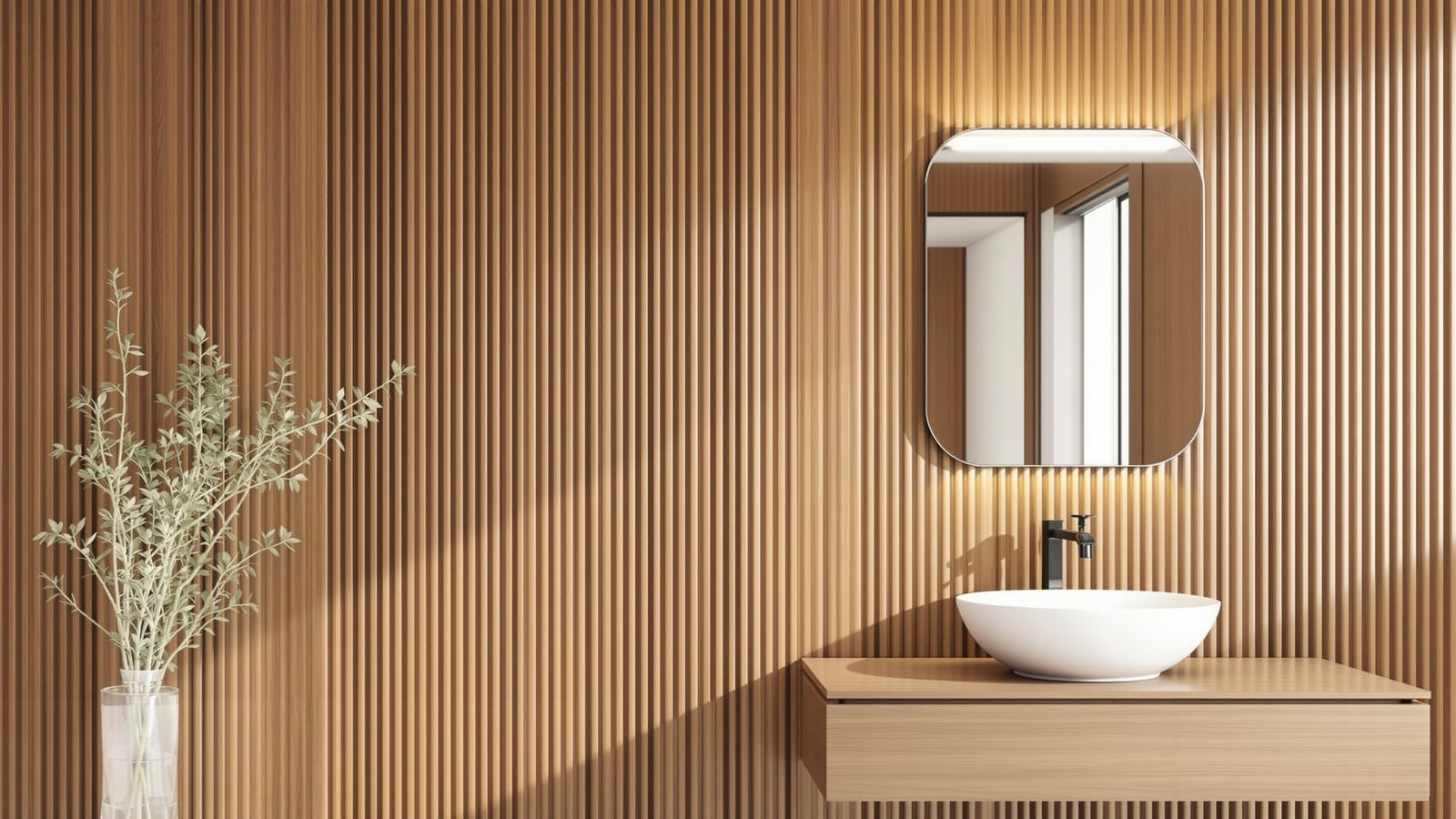
WPC Wall Panels for Bathrooms in India: Fixing, Cost & WPC vs PVC vs Tiles
A practical, India-first guide to wood-plastic composite wall panels for bathrooms — how they behave in humidity, how they are fixed, what they cost per sq ft, and when to pick them over PVC or tiles.
Tiles are still the default for Indian bathroom walls — but they are no longer the only serious option. Over the last few years, WPC (wood-plastic composite) wall panels have moved from commercial fit-outs into homes, and they answer a very specific brief: a warm, wood-like or fluted wall that goes up fast, hides uneven masonry, and shrugs off splashes. They are thicker and considerably more rigid than the thin PVC panels sold at the same counters, which is exactly why people confuse the two and end up disappointed.
This guide is written for the Indian bathroom — hard water, monsoon humidity, health-faucet spray, and the reality that most walls are brick-and-plaster, not stud partitions. We cover what WPC actually is, how it behaves when it gets wet, how it is fixed, what it costs in ₹ per sq ft, and — most importantly — where WPC beats PVC and tiles, and where it quietly loses to them.
What "WPC" actually means
WPC is a composite of wood flour (fine wood powder or fibre), a thermoplastic polymer (usually PVC or polyethylene), and additives — UV stabilisers, foaming agents, and coupling agents that bond the wood to the plastic. The result is a board that machines like timber but does not rot, warp or host termites the way solid wood does.
For bathroom walls you will meet WPC in a few forms:
- Flat cladding panels — typically 2440–3050 mm long, 200–300 mm wide, with a printed wood-grain or stone laminate face, tongue-and-groove edges.
- Louvre / fluted panels — the popular "feature wall" look: a flat backer with evenly spaced vertical ribs (louvres) that throw a soft shadow line. Panel width is usually 150–160 mm, so ribs repeat cleanly across a wall.
- WPC boards / sheets — 5–18 mm plain composite board used as a moisture-safe substrate behind vanities, or as the backing for a laminate finish.
The single most useful thing to understand: WPC is a sturdier, thicker, more premium cousin of PVC — not a cheaper cousin of tile. Buy it for the look and the speed, not because you expect it to be indestructible.
How WPC behaves with water and humidity
This is where honest guidance matters, because the marketing word "waterproof" hides a lot.
The polymer matrix of WPC is genuinely water-resistant — a WPC panel will not disintegrate, swell dramatically, or delaminate from a splash the way MDF or particleboard would. That is real and it is why WPC is a legitimate choice for a bathroom. But because WPC contains wood fibre, it is better described as highly moisture-resistant than as a true zero-absorption plastic. Under prolonged standing water or constant saturation, cheaper high-wood-content panels can show slight edge swelling over years.
Three practical consequences for Indian bathrooms:
- Zone it correctly. WPC is superb for dry-zone and semi-wet walls — the vanity wall, the WC wall, a feature wall opposite the door. Inside the shower's direct-spray triangle, tiles or a fully-fused surface remain the safer long-term bet. This maps onto the wet-and-dry logic in our wet and dry zone bathroom layout guide.
- Seal the joints and edges. The panel face is fine; water finds its way in at cut edges, screw holes and top/bottom terminations. A neutral-cure silicone bead at every termination is not optional.
- The wall behind still needs waterproofing. Panels are a finish, not a membrane. If the masonry behind them is damp-prone (external wall, ground floor, chronic seepage), fix that first — see the waterproofing guide. Panelling over a wet wall just hides the problem and grows mould in the cavity.
Fixing WPC panels: the two honest methods
WPC is heavier and stiffer than PVC, so it cannot simply be glued up with a few dabs and forgotten. There are two accepted approaches.
Adhesive (direct-stick) method
Used when the wall is flat, sound and dry. The panel back is bonded to plaster or an existing tiled wall with a high-grab construction adhesive (polymer/MS-polymer or a solvent-based PVC adhesive), applied in vertical serpentine beads, and the panel pressed and braced until grab.
- Best for smooth cement plaster or over old tiles you don't want to hack off.
- Fastest, no visible fasteners, thinnest build-up.
- Demands a truly flat wall — adhesive will not bridge a wavy surface, and any hollow bond is a future rattle.
Mechanical (batten/frame) method
Used for louvre feature walls, uneven masonry, or where you want an air gap. A grid of treated battens or an aluminium/WPC sub-frame is fixed to the wall, and panels are screwed or clipped to the battens.
- Bridges out-of-plumb walls and hides conduits/pipes in the cavity.
- The air gap lets any incidental moisture behind the panel dry out — the better choice on external or damp-prone walls.
- Adds ~25–40 mm to the finished wall thickness, which matters in a small bathroom layout.
What it costs in India (₹ per sq ft)
Prices vary with wood-to-polymer ratio, panel thickness, face finish (basic print vs deep-embossed vs stone laminate) and brand. Treat these as installed-order ranges for planning, not quotations. Material-only figures sit at the lower end; the higher end includes battens, adhesive, silicone and labour.
| Item | Typical range (₹/sq ft) | Notes |
|---|---|---|
| Basic flat WPC cladding, wood-print face | 120 – 220 | Entry-level, thinner face laminate |
| Louvre / fluted WPC panel | 180 – 400 | The popular feature-wall product |
| Premium / charcoal WPC, deep emboss or stone face | 350 – 600+ | Thicker, higher polymer content |
| WPC sub-frame or battens | 25 – 60 | Add for mechanical fixing |
| Adhesive + silicone + fasteners | 20 – 45 | Consumables |
| Skilled labour (fixing only) | 40 – 90 | Higher for louvre alignment |
A realistic installed cost for a WPC feature wall lands around ₹250–500 per sq ft. That is broadly comparable to a good ceramic tile job and cheaper than large-format porcelain or natural stone — with the big saving being time and mess, since there is no wet trade, no curing and no grout.
WPC vs PVC vs tiles — the decision that actually matters
This is the comparison most buyers are really trying to make. Each column below is a fair, unhyped read.
| Attribute | WPC panels | PVC panels | Ceramic / porcelain tiles |
|---|---|---|---|
| Core | Wood fibre + polymer, rigid | Hollow/foamed PVC, light | Fired clay, fully vitrified (porcelain) |
| Thickness / feel | 8–18 mm, solid, premium | 3–8 mm, thin, hollow tap | 6–12 mm, hard, cold |
| True waterproofing | High moisture-resistance | High (pure plastic) | Highest (near-zero absorption, porcelain) |
| Best zone | Dry & semi-wet walls, feature walls | Dry walls, ceilings, budget jobs | Anywhere incl. shower & floor |
| Look | Warm wood/fluted, matte, upmarket | Glossy print, reads "plastic" | Endless — but joints/grout everywhere |
| Impact / dent resistance | Good | Poor (dents, cracks) | Excellent (but can chip) |
| Install | Dry, fast, low mess | Dry, fastest, DIY-friendly | Wet trade, slow, skilled, dusty |
| Grout lines | None | None | Many — the usual failure & mould point |
| Lifespan (bathroom) | ~12–20 yrs | ~7–12 yrs | 20+ yrs |
| Installed ₹/sq ft | ~250–500 | ~90–200 | ~150–600+ |
The short version:
- Choose WPC when you want the seamless, warm, joint-free look — especially a fluted feature wall — on a dry or semi-wet wall, and you value a fast, low-mess install. It is the "design-forward, no-grout" choice.
- Choose PVC when budget rules and the wall is genuinely dry (a ceiling, a store, a rented flat). Understand you are buying a thinner, dentable, more plasticky product. Our companion guide on PVC wall panels for bathrooms covers that trade honestly.
- Choose tiles for the shower enclosure, the floor, and anywhere you want maximum longevity and true wet-area performance — see the bathroom wall tiles guide for selecting the right IS 15622 tile.
Many of the best Indian bathrooms mix them: porcelain in the shower and on the floor, a WPC louvre feature wall on the dry vanity or WC wall. That is also a core idea in our roundup of decorative bathroom wall finishes.
Maintenance and hard-water reality
- Clean with a soft cloth and mild soap. Avoid abrasive scrubbers and strong solvents on the printed face — they dull the finish.
- Hard-water scale shows on louvre ribs near a health-faucet. Wipe splashes; don't let mineral film build. This is another reason to keep WPC out of the direct-spray zone.
- Ventilate. Good exhaust extraction keeps the whole room — panels, cavity and grout alike — drier. A humid, unventilated bathroom is hostile to every finish.
- Re-silicone terminations every few years if you see the bead lift.
Quick do / don't
| Do | Don't |
|---|---|
| Use WPC on dry & semi-wet walls | Wrap a shower enclosure in WPC |
| Waterproof the masonry first | Panel over a chronically damp wall |
| Seal all edges & terminations with silicone | Leave cut edges open to spray |
| Batten-fix uneven or external walls | Direct-stick onto a wavy surface |
| Buy thicker, higher-polymer panels for baths | Buy the cheapest thin panel and expect tile life |
Used with clear eyes, WPC wall panels are one of the most cost-effective ways to give an Indian bathroom a warm, contemporary, grout-free wall — provided you respect the wet zone and let tiles do the job they are unbeatable at.
References
- National Building Code of India (NBC) 2016, Part 9 (Plumbing Services) and Part 5 (Building Materials) — bathroom services and material suitability.
- IS 15622 — Pressed ceramic tiles (specification), for the tile comparison and wet-area selection.
- IS 1172 — Code of basic requirements for water supply, drainage and sanitation.
- BIS / IS standards on WPC and wood-based panel products (wood-plastic composite and pre-laminated boards) — verify current designation with the Bureau of Indian Standards.
- IGBC Green Homes and GRIHA — guidance on durable, low-VOC interior finishes and moisture management in wet areas.
- CPHEEO / CPWD specifications — for general bathroom finishing and waterproofing practice.
Export this guide
Related Guides — Deep-dive reading
PVC Wall Panels for Bathrooms in India: Waterproof Dry-Fix Cladding Over Old Walls
A brand-neutral guide to PVC wall panels and cladding for Indian bathrooms — how they dry-fix over existing tiles, hollow-core vs foam-core, the look vs real tiles, durability and heat limits, ₹/sq ft cost, install and where they beat (and lose to) WPC and tiles.
BathroomsPorcelain, Ceramic & Sintered-Stone Facade Cladding in India: A Practical Guide
Thin large-format porcelain and sintered-stone slabs can clad a building with the look of marble, concrete or weathered steel at a fraction of stone's weight — but on a facade, the fixing system is a life-safety decision, not a finish choice.
Building FacadesEpoxy Grout vs Cement Grout for Tiles in India: Which to Specify (2026)
A plain-English guide to tile grouts for Indian homes: what grout does, how cementitious grout compares with epoxy grout on cost, stain and water resistance, hygiene and durability, and exactly where each one belongs - kitchens, bathrooms, pools, dry rooms and more.
Building MaterialsRelated Tools — Try Free
Monsoon-Readiness Checklist
Pre-rain home audit across 9 categories — terrace, drains, waterproofing, electrical, HVAC, pest, vehicles, documents.
Seasonal AuditInterior Layout Planner — Printable Graph Grid
Printable graph grid to sketch room layouts to scale before committing to furniture placement.
Layout ToolWindow Material Comparison Tool
Compare uPVC, aluminium, wood, steel and composite windows on cost, life, upkeep and insulation.
Compare