
Under Sink Bathroom Storage India: Vanity, Pull-Outs & Bottle-Trap Tricks
A practical, India-first guide to using the space under the basin — vanity cabinet versus open shelf versus pull-out drawer, working around the bottle trap and P-trap, keeping cleaning supplies dry, moisture-proof materials and honest ₹ costs.
The single most wasted cubic foot in an Indian bathroom sits directly under the wash basin. In most homes it is either a bare wall with a pedestal hiding the pipes, or a cabinet crammed so tightly around the drain trap that half of it is unreachable. Yet this is prime real estate — it is at hand height, next to where you actually use toothpaste, face wash, a hair dryer and the daily cleaning bottles. Used well, the space under the basin can hold everything a small bathroom cannot fit anywhere else. Used badly, it is a damp, mildewed box where the bottle trap drips onto a bag of forgotten sponges.
The reason it is so often wasted is a plumbing one: the trap. Every basin has a water-sealed trap — a bottle trap or a P-trap — that occupies the exact centre of the cabinet, right where you want a shelf. This guide is about designing under-sink storage that works around the trap instead of pretending it is not there, and doing it with materials that survive Indian humidity and the odd leak. It sits in the Studio Matrx bathroom hub alongside the bathroom vanity guide for India, which covers the cabinet itself; read it with the bathroom linen storage guide for towels and spare stock, and the small bathroom layout guide for squeezing storage into a tight plan.
The trap is not the enemy of under-sink storage — it is the design constraint that decides everything. Route the storage around the pipe with a U-shaped or pull-out organiser and the dead zone becomes the most useful shelf in the room.
Three ways to use the space
There are really only three approaches to the cavity under a basin, and the right one depends on your basin type, your floor (wet or dry), and how much you are willing to spend.
| Approach | Best for | Storage gained | Trap access | Indoor ₹ (typical) |
|---|---|---|---|---|
| Vanity cabinet (floor or wall-hung) | Most family bathrooms | High — full carcass | Cabinet floor removable or open-back | ₹8,000–₹28,000 |
| Open shelf under basin | Small / budget / powder rooms | Low–medium | Fully open, easy | ₹1,500–₹6,000 |
| Pull-out drawer / organiser | Deep cabinets, hard-to-reach corners | Medium–high, all reachable | Notched around trap | ₹3,000–₹12,000 add-on |
A vanity cabinet is the default and the most versatile: a full box below the counter with doors, shelves or drawers. A wall-hung carcass is the smarter choice in India because it lifts the whole cabinet off a wet floor and lets you mop under it, killing the swollen-plinth problem that ruins floor-standing units within a monsoon or two.
An open shelf — a single ledge or a small stainless / WPC rack fixed below a wall-hung or pedestal basin — is the cheapest win. It suits a powder room or a tiny bathroom where a full cabinet would crowd the door swing. You lose the hidden-clutter benefit but keep the trap fully accessible.
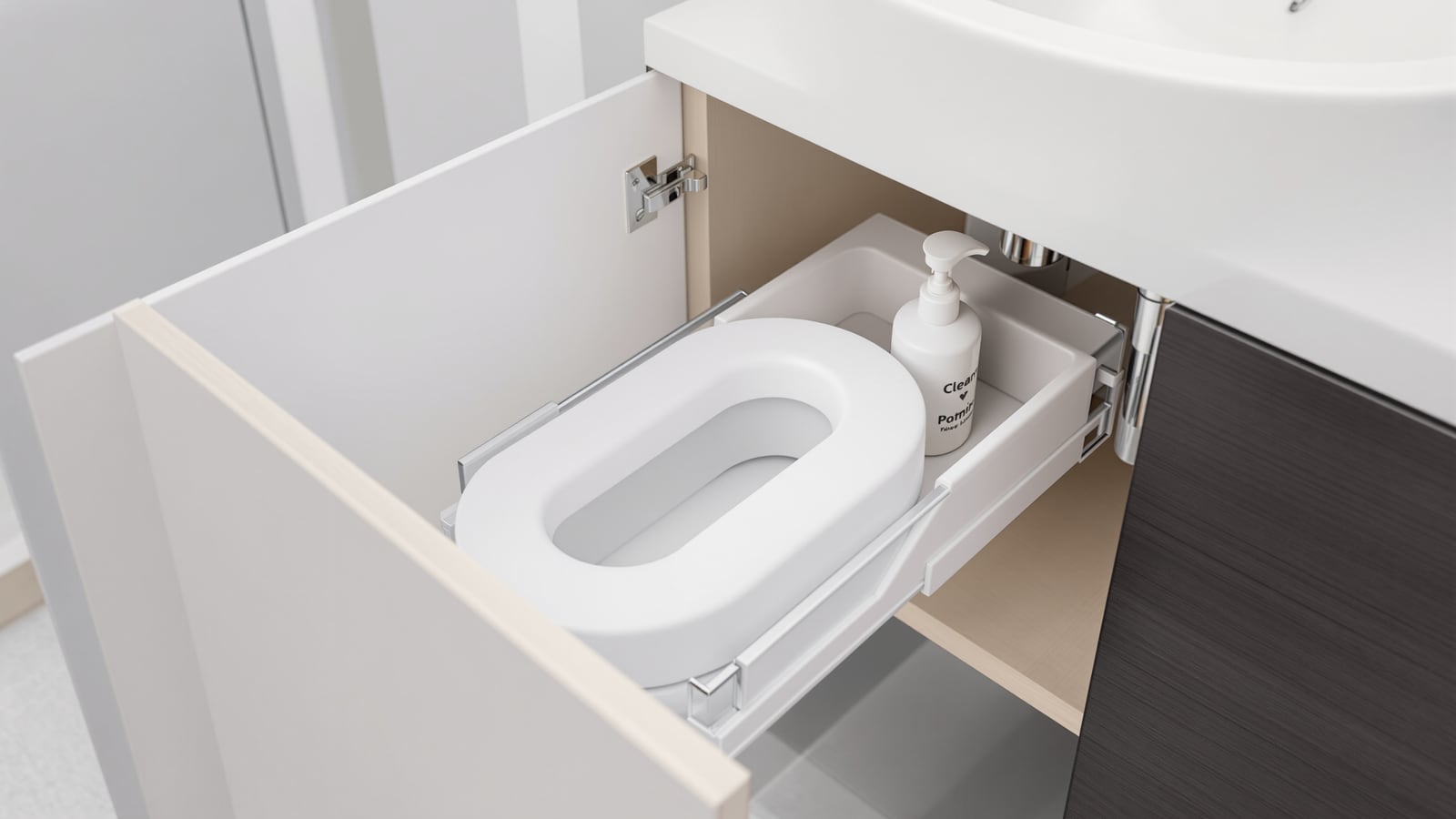
A pull-out drawer or organiser is not a third cabinet type but an upgrade to the first: instead of a fixed shelf you fight to reach past the pipe, a drawer or basket slides the contents out to you. This is where under-sink storage stops being a graveyard and starts earning its space.
Working around the trap
This is the heart of the problem, so it deserves a proper look. A basin drains through a trap that holds a water seal to block sewer gas — mandatory under NBC 2016 and IS 2556 sanitary practice. In a cabinet basin the trap is almost always one of two types:
- Bottle trap — a vertical chrome or plastic cylinder, roughly 250–300 mm tall, projecting straight down from the basin. Compact in plan but tall, so it eats a vertical strip down the middle of the cabinet.
- P-trap — a horizontal U that turns into the back wall. Shorter vertically but projects further back, so it steals the rear of the cabinet.
You cannot move the trap without moving the plumbing, so the storage has to yield to it. Three tactics work:
- U-shaped organiser — a two-tier caddy or shelf with a rectangular notch cut out of the back-centre so it straddles the bottle trap. The pipe passes through the U; the storage wraps around it on three sides. This is the single most effective under-sink product for an Indian bathroom and costs very little.
- Pull-out around the trap — a drawer built shorter than the cabinet depth, or a basket on side-mounted runners, so it clears the trap as it slides. You reach everything without groping past the pipe.
- Stacking risers / tension rods — a raised tray or a rod hung across the cabinet to make a second level above the trap, using the height the bottle trap otherwise wastes.
The diagram below shows how a U-shaped organiser and a pull-out clear the two trap types.
Keeping cleaning supplies dry
The under-sink cabinet is where every Indian home stashes toilet cleaner, phenyl, a spray bottle, scrubs and spare soap. It is also, by definition, the wettest cabinet in the house — the trap and the flexible connectors run through it, and a slow drip or a loosened compression nut can wet the floor of the box for weeks before anyone notices. Cardboard cartons sag, metal cans rust into orange rings, and the smell of damp mixes with bleach.
The fix is to assume it will get wet and design accordingly:
- Raise everything off the cabinet floor. A plastic tray, a wire riser or a slatted false floor keeps bottles out of any pooled water and lets you spot a leak instantly.
- Use a bin-rail or door-mounted caddy so spray bottles hang by their trigger on the inside of the door — off the floor entirely and out of the trap's way.
- Line the base with a wipe-clean tray (a cut-to-size PVC or acrylic sheet) that you can lift out and dry.
- Keep chemicals apart from electricals. A hair dryer, trimmer or electric toothbrush charger under the sink must sit high and dry, ideally in a separate door caddy — never on the same shelf as an open bleach bottle. Any socket in this zone should follow IS 732 wet-area practice with an RCD/RCBO.
Do a leak check the day the plumber leaves and again after the first monsoon: run the tap hard, fill and drain the basin, and feel every joint and the cabinet floor with a dry tissue. Catching a weeping trap early is the difference between a wipe and a rebuilt cabinet. The bathroom leak prevention guide covers the joints to watch.
Moisture-proof materials
Whatever you store, the carcass itself has to survive the environment. This is where cheap under-sink cabinets fail — ordinary MDF or commercial ply swells, delaminates and blows its edge-banding within a year or two of Indian bathroom humidity. Choose the carcass for water resistance first and looks second.
| Material | Water resistance | Notes for under-sink use | Relative cost |
|---|---|---|---|
| BWR / marine ply (IS 710) | High | Boiling-water-resistant glue; seal all cut edges and the trap cut-out | ₹₹₹ |
| WPC board | Very high | Wood-plastic composite; near-zero swell, ideal for the wet base | ₹₹₹ |
| PVC / foam board | Very high | Light, fully waterproof; less screw-holding strength for heavy loads | ₹₹ |
| Stainless steel 304 | Very high | Frame or full carcass; rust-proof, premium, great for open shelves | ₹₹₹₹ |
| Commercial MDF / MR ply | Low–medium | Avoid at the basin; swells at cut edges — false economy | ₹ |
Practical rules that matter more than the board you pick:
- Seal every cut edge, especially the notch cut for the trap and the runner holes — that raw edge is where water wicks in.
- Prefer a wall-hung carcass so the base never sits in mop water; see the wall-hung logic in the wall-hung basin guide.
- Use soft-close, corrosion-resistant runners and hinges (stainless or good-quality coated). Cheap hinges rust and seize in humid air.
- Ventilate the cabinet — a few discreet holes or a gap at the back stop trapped damp air from breeding mildew.
Small-bathroom tricks
In a compact Indian bathroom the under-sink zone often has to do the work of a whole storage wall. A few moves punch above their weight:
- Go wall-hung and let the floor show — the visible floor reads as more space and stays moppable.
- Choose a pull-out over doors where the cabinet is deep; you use the back 200 mm that a door-only cabinet wastes.
- Fit a U-organiser plus a door caddy together — the cheapest possible upgrade, often under ₹2,000, that doubles usable capacity around the trap.
- Use the cabinet door's inner face for flat items: a magnetic strip, a slim rack, or hooks for the health-faucet cleaning brush.
- Where a pedestal basin blocks a cabinet entirely, a narrow open shelf below the bowl plus a wall niche beside it recovers most of the lost storage. The small bathroom layout guide has more on niches and door-swing tricks.
The decision tree below sums up how to choose.
What it costs
Under-sink storage spans a wide range because "storage" can mean a ₹500 plastic caddy or a ₹30,000 fabricated drawer unit. As a rough India guide (materials and basic fit, metros, 2026):
- U-shaped organiser / caddy: ₹600–₹2,500
- Door-mounted spray-bottle rail: ₹400–₹1,500
- Open stainless / WPC shelf below basin: ₹1,500–₹6,000 fitted
- Wall-hung WPC or marine-ply vanity cabinet (600–750 mm): ₹9,000–₹28,000
- Pull-out drawer / basket add-on with runners: ₹3,000–₹12,000 per drawer
The cheapest, highest-return move for almost any existing bathroom is a U-organiser plus a door caddy — under ₹4,000 and it roughly doubles what the space holds without touching the plumbing. Spend the big money only when you are already building or replacing the vanity, and put it into a wall-hung carcass and good runners, not decorative fronts. For the full cabinet specification, sizes and finishes, continue to the bathroom vanity guide for India.
References
- National Building Code of India (NBC) 2016, Part 9 (Plumbing Services) — trap seals, sanitary appliance connection and clearances.
- IS 2556 — Vitreous china sanitary appliances (wash basins), dimensions and traps.
- IS 710 — Marine plywood specification (BWR grade), for wet-area cabinet carcasses.
- IS 732 — Code of practice for electrical wiring installations, wet-area socket and RCD/RCBO requirements.
- CPHEEO Manual on Water Supply and Sanitation, Ministry of Housing and Urban Affairs — trap and drainage design guidance.
- Bureau of Indian Standards (BIS) — current amendments to the standards cited above.
Export this guide
Related Guides — Deep-dive reading
How to Choose a Wash Basin in India: Mount Type, Size, Tap Holes & Budget (2026 Buyer's Guide)
A buyer's decision guide to picking the right wash basin — matching the mount type to your vanity and space, sizing it to the room, getting the tap-hole config right for your faucet, judging material and durability, checking what's in the box, good/better/best rupee tiers, the IS 2556 vitreous-china mark, and how to spot seconds, hairline cracks and warranty traps.
BathroomsBathroom Vanity India: Floor-Standing vs Wall-Hung Units, Materials & Cost
The complete India-first guide to bathroom vanity units — floor-standing versus wall-hung (floating), the carcass materials that actually survive Indian bathroom humidity, counter tops and basin fixing, sizes, heights and honest ₹ costs.
BathroomsHow to Choose a Toilet in India: A Buyer's Guide to WCs, Traps, Flush & Budget (2026)
The make-or-break trap and rough-in check, floor-mounted vs wall-hung, one-piece vs two-piece, flush type and water use, seat and rimless upgrades, good/better/best rupee tiers, what's actually in the box, and how to spot a fake before you pay.
BathroomsRelated Tools — Try Free
Door Material Comparison Tool
Compare 2–4 door materials on cost, durability, maintenance, security and moisture resistance.
Comparison ToolMonsoon-Readiness Checklist
Pre-rain home audit across 9 categories — terrace, drains, waterproofing, electrical, HVAC, pest, vehicles, documents.
Seasonal AuditBefore & After Studio
Generate AI before-and-after renders to preview how your redesign could look.
DesignAI