
Heated Towel Rail India: Electric Towel Warmers, Running Cost, Wiring & When It's Worth It
An honest guide to heated towel rails for Indian bathrooms — electric versus hot-water types, warm dry towels plus the genuine humid-climate bonus of helping dry a damp room and fight mould, where it makes sense, wattage and running cost, IP and RCD wiring, sizes, mounting and real rupee budgets.
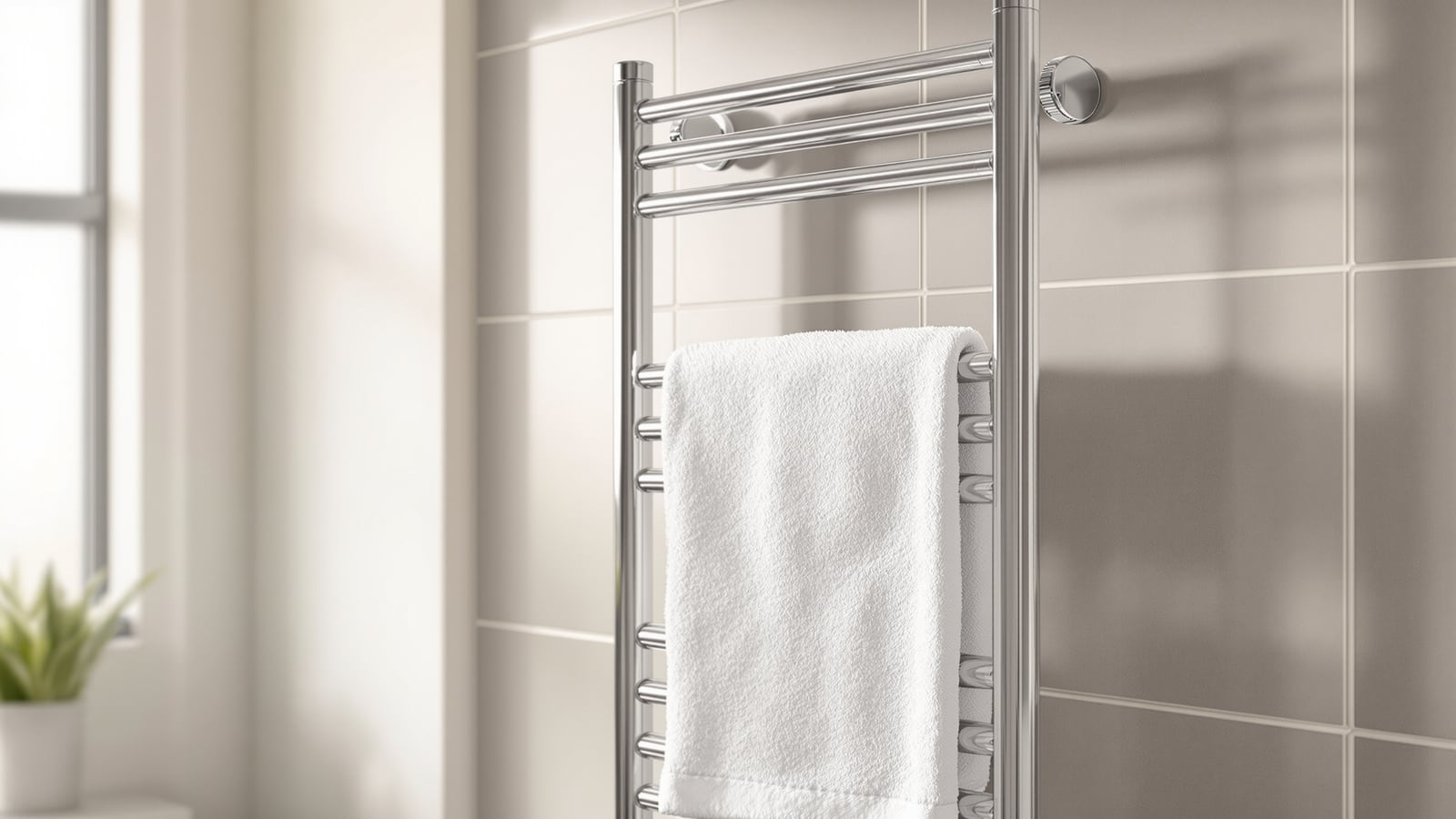
A heated towel rail is one of those small luxuries you do not know you wanted until you have wrapped yourself in a warm, bone-dry towel after a shower. It is a wall-mounted rack of heated bars — usually a ladder shape — that gently warms whatever you drape over it. In cold countries it is close to standard kit. In India it is a niche-but-nice upgrade, and this guide is honest about exactly where it earns its place.
Here is the part that makes it more than a hill-station indulgence: in India's humid coastal and monsoon climate, the real prize is not warm towels at all — it is dry ones. A damp towel that never fully dries is how bathrooms grow that musty smell and how mildew takes hold. A low-wattage heated rail left on keeps towels crisp, sheds moisture into the air where your exhaust fan can carry it away, and takes the persistent dampness off the room. That is a genuine, year-round benefit even in Chennai or Kochi, where a floor-heating system would be pointless.
This is a component guide in the Studio Matrx bathroom hub. Because a towel rail is a mains appliance in the wettest room in the house, wire it as covered in the bathroom electrical guide for India. For how it fits a high-end scheme see the luxury bathroom design guide, and pair it with sensible bathroom linen storage and a real condensation and mould prevention strategy — the rail is one weapon against damp, not the whole plan.
A heated towel rail is a comfort item in cold India and a quiet anti-damp tool everywhere else. Buy it for warm towels in the hills; buy it for dry towels and a fresher room on the coast. Wire it properly or do not fit it at all.
Electric versus hot-water: which type for an Indian home
There are two families, and for almost every Indian bathroom the answer is electric.
- Electric towel rails — a sealed rail filled with a little fluid (or a dry element) heated by a small electric cartridge, run off a switched, protected point on the wall. Self-contained, easy to retrofit into any bathroom, works whether or not you have hot running water, and can be left on independently of your geyser. This is what the vast majority of Indian homes should and do choose.
- Hydronic (hot-water) towel rails — plumbed into a central hot-water or heating circuit so warm water flows through the rail. Common in cold countries with whole-house heating, but Indian homes almost never have a central heating loop to tap, so these are rare here and only appear in large hill-station villas built around a boiler. Ignore them unless you already have that infrastructure.
There is also a hybrid — a hot-water rail with an electric backup element — but again, it presupposes a central circuit most Indian homes lack. For everyone else, electric is simpler, cheaper, and infinitely more flexible.
| Feature | Electric rail | Hot-water (hydronic) rail |
|---|---|---|
| Works without central heating | Yes | No — needs a boiler/loop |
| Retrofit into any bathroom | Easy | Hard — needs plumbing |
| Runs independent of geyser | Yes | No |
| Typical Indian use | The default | Rare, big hill villas only |
| Install complexity | Electrician + point | Plumber + heating engineer |
| Control | Own switch/timer/thermostat | Tied to the heating system |
What it actually does for you — and the honest damp bonus
Sell it to yourself for the right reason and you will not be disappointed.
- Warm, dry towels. The core comfort. In a cold-winter home this is genuinely lovely; in a warm one it is a nice-to-have.
- A drier towel = a fresher bathroom. This is the underrated one. In humid India, towels hung on an ordinary ring stay damp for hours and breed that musty smell; on a warm rail they dry in a fraction of the time.
- Helps dry the whole room. A rail left on adds a gentle, steady warmth that lifts surface moisture off tiles and grout, giving your exhaust fan drier air to remove. It is a supporting player against mould and mildew, not a dehumidifier — it works only alongside good ventilation.
- Airing and quick-drying small laundry. Handwashed items, gym towels and children's clothes dry overnight.
Be honest about the limits. A towel rail is a low-wattage device; it will not heat the room like a space heater, and on its own it cannot cure a bathroom that has no window and no working exhaust fan. Fix the ventilation first — a warm rail plus a good condensation-prevention plan is the combination that actually keeps a coastal bathroom fresh.
Wattage, running cost and the honest bill
This is where people relax, because a towel rail is a small load. A typical electric rail draws 60 to 150 watts — less than a ceiling fan, a fraction of a geyser or a hair dryer. Even left on for hours it barely moves the meter.
| Item | Figure | What it means |
|---|---|---|
| Typical rating (compact rail) | 60-100 W | Small bathroom rail |
| Typical rating (tall/large rail) | 100-150 W | More bars, bigger towels |
| Run 4-6 hrs/day on a timer | ~0.4-0.8 kWh | Around a ceiling fan's daily draw |
| Cost per month (timed use) | ₹90-200 | At ₹7-9 per unit |
| Cost if left on 24x7 | ₹250-500+/month | Wasteful — use a timer instead |
| Annual running cost (sensible use) | ₹700-1,800 | Small and predictable |
Two levers keep the bill trivial. First, a timer or thermostat so it warms before your morning and evening showers and idles the rest of the day. Second, right-sizing: do not buy a 300 W monster for a small bathroom when a 100 W rail dries towels perfectly. The running cost is small enough that, unlike underfloor heating, it is easy to justify in most homes — the real discipline is wiring and control, not electricity.
IP rating, RCD and wiring — the non-negotiable part
A heated towel rail is a mains-powered metal object on a wet wall. Treat its wiring as safety-critical, exactly as you would a geyser or a bathroom light. Read the bathroom electrical guide for the full picture; these are the rules that matter here.
- Earth-leakage protection is mandatory. The rail's circuit must be protected by a 30 mA RCCB / RCD per IS 732. A heated metal rail in a wet room without earth-leakage protection is simply unsafe — this is not optional.
- Choose an IP-rated appliance and a proper connection. Use a rail marked for bathroom use (at least IPX4 splash resistance) and connect it through a fused connection unit or a flex-outlet plate, not a loose 3-pin socket sitting on the wall. No switched socket belongs inside the shower splash zone.
- Keep it out of the direct spray zone. Mount the rail on a dry wall away from the shower's direct spray, so it dries towels without being blasted with water. It should be reachable from the shower or bath but not inside the drench zone.
- Earth everything and use the manufacturer's fittings. Every metal part must be earthed; use the supplied wall brackets and glands so the seal and earth path are intact.
- Let a licensed electrician do it, ideally on a dedicated or lighting sub-circuit with headroom. It is a small load, but the wet-room context makes correct wiring the whole point.
Sizes, styles and mounting
Rails are sold by their footprint and bar count. Match the size to the wall and to how many towels the household actually uses.
| Size class | Typical W x H (mm) | Bars | Suits | Wattage |
|---|---|---|---|---|
| Compact | 400-500 x 700-800 | 6-8 | Powder room, small bath | 60-90 W |
| Standard | 500-600 x 800-1000 | 8-12 | Most family bathrooms | 100-130 W |
| Tall / large | 500-600 x 1200-1500 | 14-20 | Master, multiple towels | 130-200 W |
- Ladder (rung) rails are the common shape — horizontal bars on two uprights, easy to drape towels over. Flat-panel and designer curved rails cost more and heat less towel surface.
- Finishes: chrome and brushed/satin stainless are the mainstays. Chrome looks crisp but shows hard-water spots — a real issue in much of India, so wipe it down or prefer brushed stainless in hard-water areas. Matte black and white powder-coat suit modern schemes.
- Mounting height: set the bottom bar around 1000-1100 mm off the floor so a full-length bath towel hangs clear. Fix into solid masonry or proper anchors — a wet towel adds real weight and a loose bracket in tile is a nuisance to redo.
- Position near the shower or bath exit so you can reach a warm towel as you step out, but on a dry wall as above.
Cost: the honest rupee picture
Prices vary by brand, size and finish, but this is a realistic 2026 range for a single Indian bathroom. The rail and the wiring are the fixed costs; the finish and smart controls are where you spend up.
| Item | Budget | Typical | Premium |
|---|---|---|---|
| Electric towel rail (unit) | ₹4,000 | ₹9,000 | ₹25,000+ |
| Timer / thermostat control | ₹800 | ₹2,000 | ₹6,000 (smart) |
| Fused point + RCCB provision | ₹1,500 | ₹3,000 | ₹5,000 |
| Electrician + mounting labour | ₹1,000 | ₹2,000 | ₹3,500 |
| Total, one bathroom | ~₹7,000 | ~₹16,000 | ~₹40,000+ |
So a heated towel rail is broadly a ₹7,000-40,000 addition, done once, plus roughly ₹100-200 a month to run on a timer in the season you use it. In a cold hill-station home it is a daily comfort; in a humid coastal flat it is a modest, sensible weapon against damp towels and musty air. Either way it is far cheaper to fit and run than underfloor heating, and unlike a floor system it can be retrofitted to a finished bathroom with only a wiring point — no demolition required.
Right-size it, run it on a timer, wire it through a 30 mA RCCB, and mount it just outside the spray zone. Do those four things and a heated towel rail is one of the highest-satisfaction, lowest-drama upgrades in an Indian bathroom.
References
- National Building Code of India (NBC) 2016, Part 8 (Building Services) — electrical installations and safety in wet areas.
- IS 732 — Code of practice for electrical wiring installations; earth-leakage (RCCB) protection and circuit requirements for bathroom appliances.
- IS 3043 — Code of practice for earthing, relevant to the earthing of the rail and its circuit.
- IS/IEC 60529 — degrees of protection provided by enclosures (the IP rating system) for selecting a splash-rated appliance.
- Bureau of Indian Standards (BIS) — appliance-safety marking and current IP-rating references for imported towel warmers and thermostats.
Export this guide
Related Guides — Deep-dive reading
Heated Bathroom Floor India: Underfloor Heating Under Tiles, Cost & When It's Worth It
An honest guide to electric underfloor heating for Indian bathrooms — how the heating mat under tiles works, where it actually makes sense (hill stations and cold north winters), thermostats, running cost and load, how it interacts with waterproofing, and real rupee budgets.
BathroomsBathroom Condensation and Mould India: Stop Damp, Black Mould & Musty Smell for Good
Why warm, wet shower air keeps fogging your tiles, ceiling and walls with black mould — and the full Indian playbook to stop it: exhaust run-on, anti-fungal paint, wet-dry separation, wiping down, a dehumidifier, and safely cleaning the mould you already have.
BathroomsBathroom Electrical India: Loads, IP Zones, RCD Protection & the Complete Wiring Plan
The complete guide to bathroom electrical planning for Indian homes — the loads and points (geyser on a dedicated 16 A circuit, exhaust, mirror and lights, shaver socket, smart WC), the IP zones 0/1/2 that fix where fittings can sit near water, mandatory 30 mA RCD/RCBO earth-leakage protection, earthing, keeping switches outside the wet zone, cable sizing and getting conduits right before plastering — all per IS 732 and NBC 2016.
BathroomsRelated Tools — Try Free
Electrical Safety & Load Audit
Home electrical audit — 10 categories, 65+ checkpoints across earthing, RCCB, MCB, wiring, switchboards, appliance circuits, DG/inverter backup.
Safety AuditCross-Ventilation Analyzer
Estimate airflow and air changes per hour (ACH) from room size, window areas, layout, and local wind — with NBC 2016 Part 8 compliance check.
Ventilation CalculatorHeated Towel Rail Calculator
Size an electric heated towel rail (wattage and bars) and work out its running cost per month and year at your tariff.
Bathroom Calculator