
Bathroom Vanity India: Floor-Standing vs Wall-Hung Units, Materials & Cost
The complete India-first guide to bathroom vanity units — floor-standing versus wall-hung (floating), the carcass materials that actually survive Indian bathroom humidity, counter tops and basin fixing, sizes, heights and honest ₹ costs.
The vanity is the one piece of furniture in an Indian bathroom that has to behave like furniture and survive like plumbing. It carries the basin, hides the trap and the shut-off valves, gives you the only real storage in the room, and does all of it standing in a space that is wetted, splashed, mopped and — for four months of the year — saturated with monsoon humidity. A vanity that would last decades in a bedroom can swell, delaminate and stink within a single season in a bathroom if the wrong board goes into the carcass. Choosing one well is mostly about choosing what it is made of, and only then about how it looks.
This is a storage-and-components guide in the Studio Matrx bathroom hub. Read it alongside the bathroom design guide for India for the whole-room picture; the under-counter basin guide and countertop basin guide for the two ways a basin fixes to a vanity top; the mirror cabinet guide for the storage that goes above it; the under-sink storage guide for organising the awkward space around the trap; and the bathroom stone cladding guide for the granite and quartz surfaces the top is cut from.
A bathroom vanity is a cabinet that lives in a wet room. The finish sells it, but the carcass material decides whether it lasts five years or twenty-five. Buy the board first, the looks second.
Floor-standing vs wall-hung (floating): the first decision
Every vanity is one of two things — it stands on the floor, or it hangs off the wall. This choice drives cost, cleaning, storage and how the room feels.
- A floor-standing vanity rests on a plinth or legs on the bathroom floor. It is cheaper to make and fit, holds more (full-height cupboard down to the floor), and needs no special wall strength. Its weakness is Indian: the base sits in the exact zone where mopping water, health-faucet spray and floor washing collect, so the plinth and lower carcass are constantly wetted and are the first thing to rot.
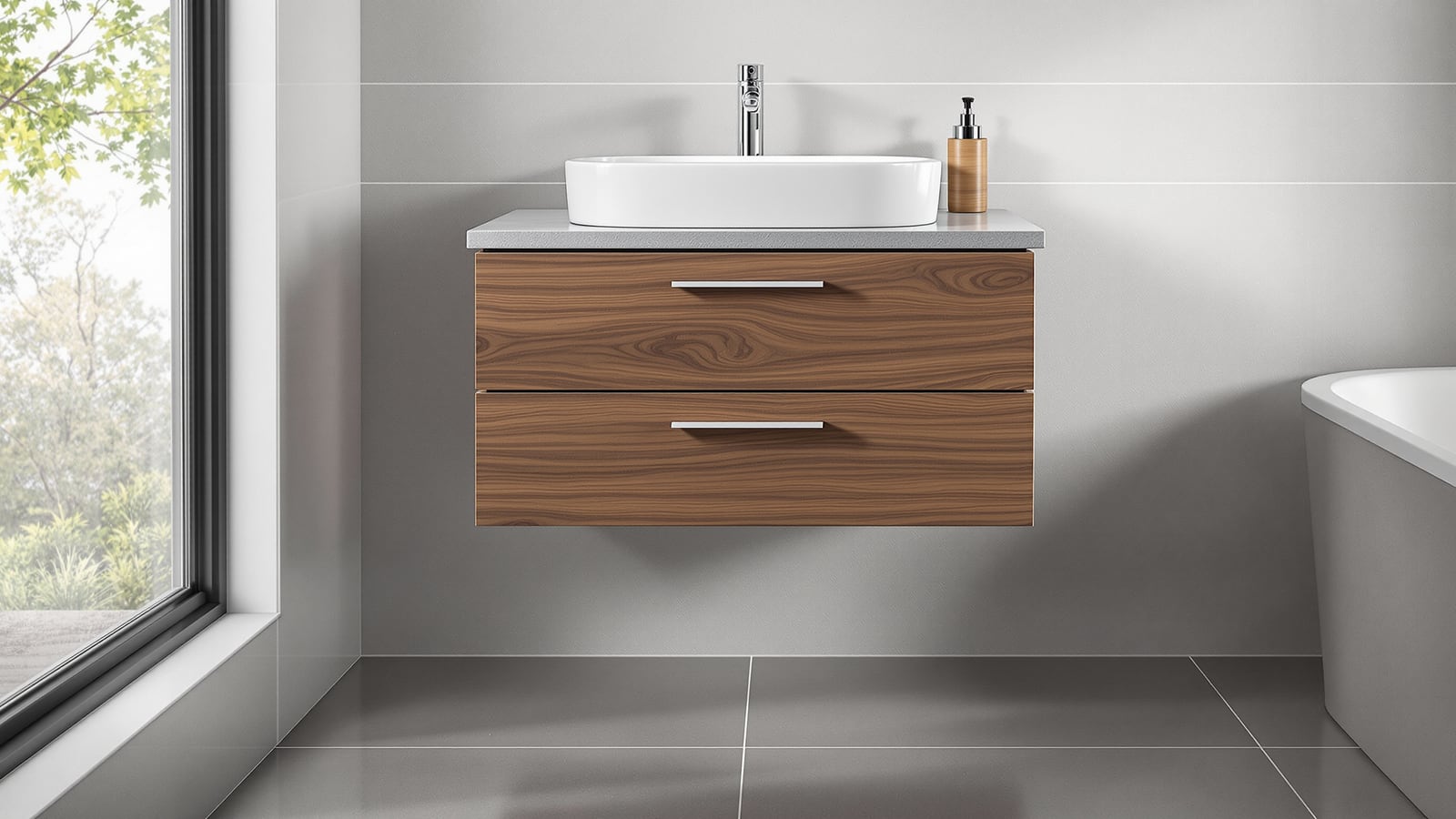
- A wall-hung (floating) vanity is cantilevered off the wall on a concealed metal frame or heavy brackets, with a clear gap beneath it. The floor wipes clean in one pass under the unit, nothing sits in standing water, the room reads larger and lighter, and there is nowhere for damp and grime to hide. It costs more, needs a solid wall (or a hidden steel frame in a drywall), and holds a little less because of the gap.
For most Indian bathrooms — where the floor is washed and the health faucet sprays — a wall-hung vanity is the more durable choice, precisely because it keeps the cabinet up out of the wet zone. Reserve floor-standing units for dry powder rooms, for heavy stone counters that want ground support, or where wall strength is genuinely doubtful.
The carcass: materials that survive Indian humidity
This is the section that decides everything. The carcass is the box of the vanity — the sides, back, base and shelves that do the structural work behind the shutters. In a bathroom it lives in warm, wet air, so ordinary furniture board is the wrong answer.
- Plain MDF and commercial ply fail. Standard MDF drinks water at any cut edge, swells like a sponge and never recovers; ordinary "commercial" (MR-grade) plywood is only moisture-resistant, not waterproof, and delaminates in a wet bathroom. Neither belongs in a vanity carcass, however cheap. This is the single most common reason Indian vanities die young.
- BWR / BWP marine-grade plywood (IS 710 / IS 303) is the trusted workhorse — phenolic-bonded boiling-water-resistant ply that shrugs off humidity and holds screws and hinges properly. Seal the cut edges and it lasts decades. It is the default recommendation for a quality vanity carcass.
- HDHMR (High-Density High Moisture Resistance board) is a dense, uniform engineered board that machines cleanly for routed and membrane finishes and resists moisture far better than MDF; good for shutters and modern flat fronts.
- WPC / PVC board (wood-plastic composite / foam PVC) is effectively waterproof — it will not rot, swell or host termites even if standing in water — which makes it excellent for the plinth and the lower carcass exactly where a floor-standing unit gets wet. It holds screws less firmly than ply and can sag on long unsupported spans, so it is often paired with ply where strength matters.
- Stainless steel (SS 304) carcasses and legs are the indestructible option — genuinely waterproof and hygienic, common in premium and commercial vanities, dearer and more industrial in look.
- Solid surface (acrylic-mineral composite) can form the whole basin-and-vanity as one seamless, non-porous moulded piece with no joints to leak — the most hygienic and the most expensive.
| Carcass material | Moisture behaviour | Screw / hinge hold | Relative cost | Verdict for a bathroom vanity |
|---|---|---|---|---|
| Plain MDF | Swells, ruined | Poor once wet | Cheapest | Avoid — fails fast |
| Commercial MR ply | Delaminates over time | Fair | Low | Avoid for wet zones |
| BWR / BWP marine ply | Very good, seal edges | Excellent | Medium | Best all-round carcass |
| HDHMR | Good | Good | Medium | Good for shutters / flat fronts |
| WPC / PVC board | Waterproof | Moderate | Medium | Best for plinth & lower carcass |
| Stainless steel 304 | Waterproof | Excellent | High | Indestructible, industrial look |
| Solid surface | Waterproof, seamless | N/A (moulded) | Highest | Premium seamless basin-vanity |
Counter tops and how the basin sits in them
The top is a separate specification from the carcass, and the two are chosen together with the basin.
- Granite is India's default vanity top — dense, cheap per square foot, hard-water tolerant and available everywhere. A honed or leathered finish hides scale better than a high polish.
- Engineered quartz gives a uniform, near-non-porous, stain-resistant top with no sealing needed; dearer than granite but almost maintenance-free.
- Solid surface (acrylic composite) allows a seamless top with an integrated moulded basin and no visible joint at all — the easiest surface to keep hygienic.
- Marble is beautiful but etches with acidic cleaners and hard water, and needs periodic sealing — specify it knowing the upkeep.
How the basin meets the top matters as much as the stone:
- An integrated (moulded) basin is formed in one piece with a solid-surface top — no seam, nothing to leak, wipes clean in a stroke.
- An under-counter (undermount) basin is bonded beneath a granite or quartz top for a seamless wipe-down deck — the low-maintenance favourite; see the under-counter basin guide.
- A countertop (vessel) basin sits on top of the deck like a bowl on a table — a statement look that is easier to swap but harder to wipe around; see the countertop basin guide.
Sizes, heights and ergonomics
There is no single "right" size, but there are Indian norms worth designing to.
| Dimension | Typical range | Notes |
|---|---|---|
| Vanity width (single basin) | 450–900 mm | 600 mm is the common apartment size |
| Vanity width (twin basin) | 1200–1800 mm | Master baths; two people at once |
| Depth (front to wall) | 450–550 mm | 500 mm suits most basins |
| Counter height (floor to top) | 800–850 mm | Higher than a kitchen counter; comfortable standing |
| Basin rim height (with vessel bowl) | keep ~ 850–900 mm total | A tall countertop bowl raises effective height |
| Clear gap under wall-hung unit | 200–350 mm | Enough to mop under and to read as floating |
| Toe recess (floor-standing) | 60–100 mm deep | Stops you stubbing toes at the plinth |
Set the counter height to the users, not the catalogue: 800–850 mm suits most adults, but a vessel basin adds its own bowl height on top, so a tall countertop bowl on an 820 mm counter can end up uncomfortably high. Check the total rim height, not just the counter.
Storage: drawers vs shutters, and the trap problem
The storage a vanity gives you is real estate you do not have elsewhere in a small Indian bathroom, so plan it deliberately.
- Shutters (hinged doors) are cheaper and open onto a single tall cavity — but the plumbing trap and shut-off valves sit right in the middle of that cavity, so the usable space is awkward and the back is dead. Best for storing tall bottles and buckets.
- Drawers cost more but are dramatically more usable — everything is visible and reachable, nothing is lost at the back, and a U-shaped drawer can be cut to wrap around the bottle trap so you keep the drawer and clear the plumbing. Pair with the under-sink storage guide for organising that trap zone.
- Soft-close hardware (hinges and drawer runners with hydraulic dampers) is worth specifying throughout — it stops slamming, protects the carcass joints from shock, and is now standard even at mid-market. Insist on rust-resistant hardware (SS or good-quality coated steel); cheap MS hinges rust orange in a bathroom within a year.
Moisture-proofing the carcass, legs and edges
Even the right board fails if it is built and fitted carelessly. These details are what turn a good material into a lasting vanity.
- Seal every cut edge. Boards are waterproof on the face but drink water at raw cut edges and drill holes. Edge-band with PVC lipping and seal internal cuts, hinge borings and the basin cut-out — unsealed edges are where rot starts.
- Keep the base off the wet floor. Prefer a wall-hung unit; if floor-standing, use WPC or stainless legs / plinth, or a raised WPC plinth, so no water-absorbing board touches the floor.
- Ventilate the cabinet. A sealed box under a basin traps humidity — add a couple of vents or a louvred shutter so it dries between uses.
- Bed the tap and waste on silicone. Deck-tap holes and the basin cut-out are ingress points; bed fittings on neutral-cure sanitary silicone so splash cannot run down the thread into the carcass.
- Use rust-proof hardware and a moisture-proof back. The back panel is often the thinnest, cheapest board — specify it in the same waterproof material as the sides, and use SS fixings.
Ninety per cent of dead vanities died of water in the board, not wear in the finish. Waterproof carcass, sealed edges, cabinet off the wet floor, rust-proof hardware, ventilated box — do those five and the vanity outlives the bathroom.
What it costs in India
Budget the vanity as an assembly — carcass, top, basin, tap and hardware — not as one shelf price. A "cheap" vanity is almost always a cheap carcass, and that is exactly the wrong place to save.
| Item | Indicative ₹ range |
|---|---|
| Ready-made laminate vanity (MR board, entry level) | ₹6,000–15,000 |
| Custom BWR marine-ply vanity carcass (600 mm) | ₹12,000–28,000 |
| WPC / PVC-board vanity unit | ₹15,000–35,000 |
| Stainless steel vanity unit | ₹25,000–60,000+ |
| Granite vanity top (supplied + polished) | ₹250–700 / sq ft |
| Engineered quartz top | ₹450–1,200 / sq ft |
| Solid-surface top with integrated basin | ₹1,000–2,500 / sq ft |
| Under-counter ceramic basin | ₹2,500–8,000 |
| Soft-close hinges + drawer runners (per unit) | ₹1,500–6,000 |
| Deck-mounted single-lever basin mixer | ₹3,000–15,000+ |
The gap between a ₹6,000 MR-board unit and a ₹20,000 marine-ply one is not markup — it is the difference between a carcass that swells in its second monsoon and one that is still square in its second decade. On a fixture you cannot easily replace without ripping out the plumbing, that is the right place to spend.
Living with it: keeping a vanity alive
- Wipe the deck dry after use; standing hard-water droplets leave chalky scale that dulls granite and can haze quartz.
- Never leave the shutters shut on a wet cabinet — open them to let a damp box breathe, and clear anything that has pooled inside.
- Re-tool the silicone at the basin rim and tap base every 2–3 years, or sooner if it lifts or grows a black line — that line is mould in a failing seal.
- Check the plinth and back panel twice a year for swelling, staining or a musty smell — the earliest sign of water in the board, caught before it wrecks the carcass.
- Tighten the wall brackets on a floating vanity periodically; a cantilevered unit carries basin, top and water in a lever arm, and loose fixings sag over time.
References
- NBC 2016 (National Building Code of India) — Part 9 Plumbing Services; sanitary appliance provision, fixture setting-out and water-supply requirements.
- IS 710 (Marine-grade / BWP plywood) and IS 303 (Plywood for general purposes, incl. BWR grade) — bonding and moisture-resistance grades for vanity carcass boards.
- IS 2556 (Vitreous sanitary appliances / wash basins) — specification for the ceramic basins fitted into vanities.
- IS 4020 / IS 1659 (Blockboard & laminated boards) and BIS ecomark for boards — panel-product quality references.
- CPHEEO Manual on Water Supply and Sanitation / CPWD Specifications — sanitary appliance fixing and vanity fabrication schedules.
- BIS product certification — confirm plywood, boards, sanitaryware and faucets carry the relevant IS marking.
Export this guide
Related Guides — Deep-dive reading
Composite Bathroom Materials India: WPC, HDHMR, Engineered Stone, Resin & FRP Guide
The India-first guide to engineered composite materials for bathrooms — WPC and HDHMR boards for waterproof vanities, engineered stone and terrazzo for basins and counters, resin and mineral composites, FRP and SMC panels — why they beat natural wood and plywood in humidity, where each fits and what they cost.
BathroomsHow to Choose Bathroom Furniture in India: The Buyer's Guide to Vanities, Mirror Cabinets & Storage
A buyer's decision guide to bathroom furniture in India — the one check that matters most (moisture-proof material), wall-hung versus floor, soft-close hardware, counter tops, ready-made versus custom, good/better/best ₹ tiers, warranty, and how to spot MDF sold as ply.
BathroomsHow to Choose a Wash Basin in India: Mount Type, Size, Tap Holes & Budget (2026 Buyer's Guide)
A buyer's decision guide to picking the right wash basin — matching the mount type to your vanity and space, sizing it to the room, getting the tap-hole config right for your faucet, judging material and durability, checking what's in the box, good/better/best rupee tiers, the IS 2556 vitreous-china mark, and how to spot seconds, hairline cracks and warranty traps.
BathroomsRelated Tools — Try Free
Material Comparison Sheet
India's interior material cheatsheet — plywood, finishes, hardware, countertops, paints, waterproofing.
Reference GuideFull-Room BOQ — Living, Bedroom, Kitchen, Bath
Room-wise BOQ across living, bedrooms, kitchen, utility, and bathrooms with line-item pricing.
Full-Room BOQMaterial Compare — Side by Side
Compare materials side-by-side: granite vs quartz vs marble, laminate vs acrylic vs PU, and more.
Comparison