
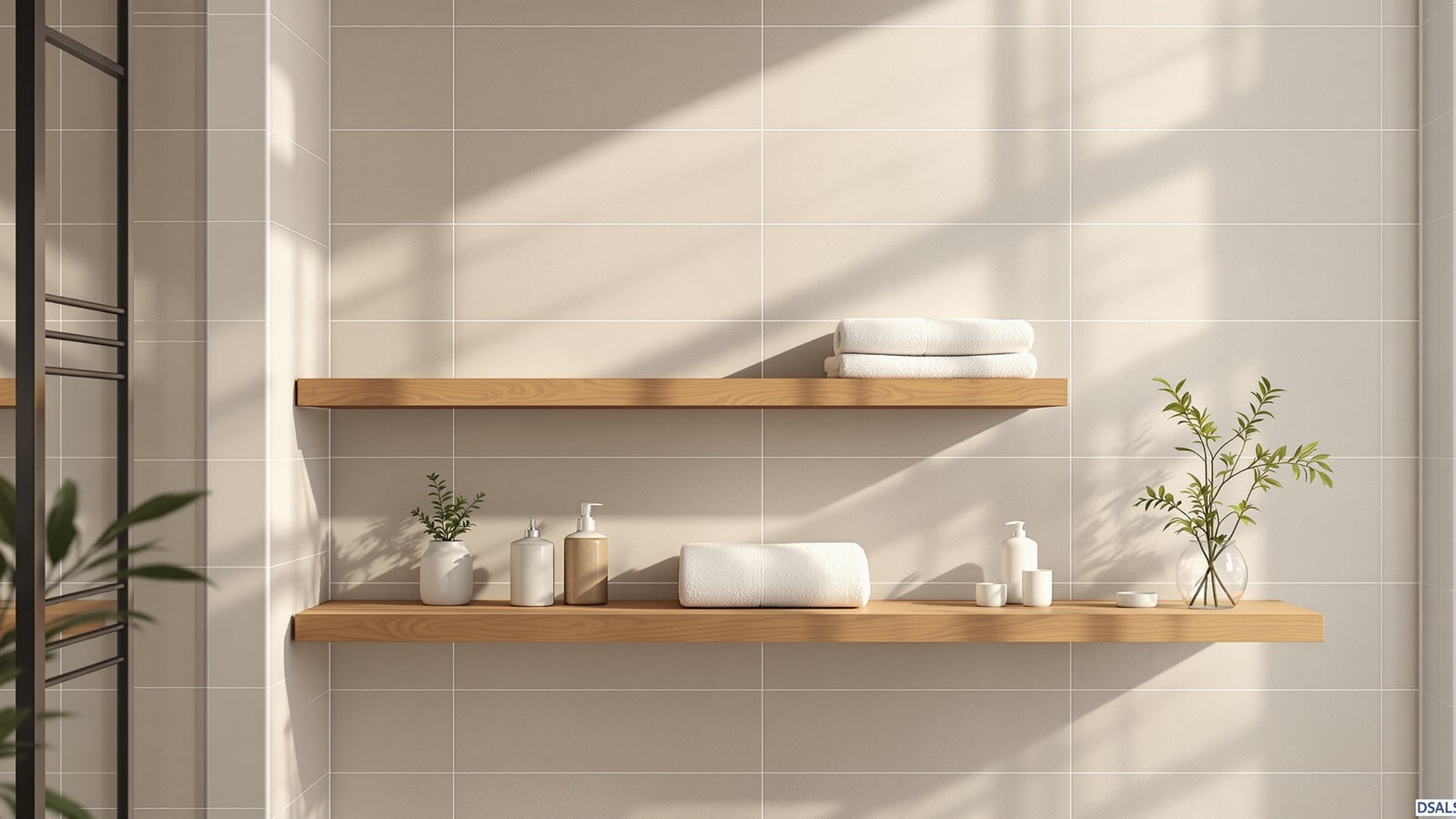
Bathroom Open Shelves India: Floating, Ladder, Niche & Corner Shelving That Survives Damp
A practical guide to open shelving in Indian bathrooms — floating, ladder, recessed-niche and corner shelves — which damp-proof materials actually last (teak, stainless, glass, WPC — never raw MDF), how to style them without clutter, where open shelves beat closed cabinets, how to fix them into tiled walls, and honest ₹ costs.
Storage is where most Indian bathrooms quietly fail. A single mirror cabinet fills up, bottles migrate to the cistern lid and the window sill, and a room that was designed to feel clean ends up looking crowded. Open shelving is the cheapest, most flexible fix — a floating shelf, a recessed niche, a ladder in the corner — but it only works if you get two things right: a material that shrugs off constant damp, and the discipline to style it rather than pile it.
That second point is the whole game. A closed cabinet hides whatever you throw in it; an open shelf is honest, and honesty is unforgiving. Done well, open shelves make a small bathroom feel airy and boutique. Done badly, they turn it into a shelf of half-used bottles. This guide covers the four shelf types that suit Indian bathrooms, the materials that actually survive monsoon humidity and hard-water splash, where open shelving genuinely beats a closed cabinet, and — the part every WhatsApp carpenter gets wrong — how to fix a shelf into a tiled wall without cracking the tile or pulling out of the plaster.
This is a components guide in the Studio Matrx bathroom hub. Read it up to the bathroom vanity guide for India for the main storage workhorse, and alongside bathroom linen storage and decorative bathroom wall finishes. For the room around it, see small bathroom layout and bathroom design.
Open shelving is not a way to store more. It is a way to store less, on show. If an item is not either used daily or genuinely good-looking, it belongs behind a door — put closed storage under the vanity and reserve the open shelf for the eight things that earn their place.
The four shelf types
Almost every open shelf in an Indian bathroom is one of four forms. They are not interchangeable — each suits a different wall, budget and job.
- Floating shelves — a plank fixed to the wall with concealed brackets, appearing to hover. The most versatile and the most common. Great over a WC, beside a mirror or above a vanity. Depth 120–200 mm; go shallower in a narrow room so you do not catch shoulders.
- Recessed niche shelves — a pocket built into the wall cavity, tiled inside, sitting flush with the wall face. The gold standard for a shower zone because nothing projects into the wet area to knock or drip. Needs to be planned before tiling and, in a wet wall, waterproofed inside like the rest of the shower.
- Corner shelves — glass or stainless triangles that use the dead corner a rectangular shelf wastes. Ideal in a tight shower for shampoo and soap. Cheap, fast, and forgiving of an out-of-square wall.
- Ladder shelves — a free-standing A-frame or leaning ladder rack, usually teak or bamboo, that needs no wall fixing at all. Perfect for rented flats where you cannot drill, or a dry corner for rolled towels. Keep it out of the direct splash line.
Materials that survive damp — and the one that never does
An Indian bathroom is a punishing place: 80–90% humidity through the monsoon, daily splash from the health-faucet and shower, and hard water that leaves mineral crust on everything. A shelf material has to take all of that for years. Here is how the honest options rank, and the one you must refuse.
| Material | Damp behaviour | Look & feel | ₹ per running ft (fitted) | Best use |
|---|---|---|---|---|
| Teak / marine-grade hardwood | Excellent — natural oils resist rot; the classic wet-area timber | Warm, premium, ages well | ₹900–2,200 | Floating shelves, ladder racks |
| Stainless steel (SS 304) | Excellent — will not rust if grade 304+; wipe crust off | Clean, utilitarian, slim | ₹450–1,200 | Corner shelves, shower caddies |
| Toughened glass (8–10 mm) | Excellent — inert; shows water spots on hard water | Light, disappears visually | ₹350–900 | Corner and floating shelves |
| WPC (wood-plastic composite) | Very good — waterproof core, no swelling | Timber-look, paintable | ₹300–700 | Floating shelves, budget builds |
| Solid surface / quartz offcut | Excellent — non-porous, wipes clean | Matches vanity top | ₹800–1,800 | Niche linings, chunky floating |
| Marble / granite slab | Good — seal it; marble etches with acidic cleaners | Heavy, luxurious | ₹700–1,600 | Niche shelves, feature floating |
| Raw MDF / particle board | Fails — swells, delaminates and crumbles within a season | — | avoid | Never in a bathroom |
The single rule that saves the most grief: never use raw MDF, HDF or particle board on an open shelf. It looks fine on day one, wicks up moisture through the cut edge within weeks, and by the next monsoon the corners have swollen and blistered. If you love the seamless painted look, use WPC or a properly edge-banded BWR/BWP marine plyboard with a laminate or PU finish — not bare board. Even then, a fully sealed edge is non-negotiable.
For the shower zone specifically, a recessed niche tiled to match the wall is the most durable of all because there is no separate shelf material to fail — it is just tile over a waterproofed pocket, part of the same wall tile and waterproofing system as the rest of the enclosure.
Where open shelves beat closed cabinets
Open shelving is not automatically better — it is a trade. You gain lightness, cost and easy reach; you lose concealment and gain a dusting job. It wins clearly in a few situations.
- Small bathrooms. A closed cabinet has visual bulk — a solid box on the wall. An open shelf reads as a thin line and lets the wall breathe behind it, so a cramped room feels larger. In a bathroom under about 30 sq ft, open shelving almost always feels better than a bulky cabinet.
- Airy, boutique looks. Displayed towels, a plant, a few good bottles — this is the hotel-bathroom effect, and it only works on open shelves.
- Daily-use items. Things you reach for every morning are faster on an open shelf than behind a door.
- Budget and speed. A floating shelf is a fraction of the cost and lead time of a fitted cabinet.
Closed storage still wins for the ugly-but-necessary — cleaning bottles, spare rolls, medicine, backstock. The right answer in most homes is both: closed storage under the vanity and in a linen cupboard for the bulk and the clutter, open shelves for the eight things on show. Split by honesty: pretty and daily goes open, ugly and occasional goes closed.
| Open shelving | Closed cabinet | |
|---|---|---|
| Feels | Airy, light, larger | Solid, contained |
| Cost | Low | Higher |
| Hides clutter | No | Yes |
| Upkeep | Dust & style weekly | Wipe rarely |
| Best for | Small, boutique, daily items | Backstock, medicine, mess |
Styling without clutter
The difference between "boutique" and "bottle graveyard" is a few rules. Decant shampoo and soap into matching dispensers so the shower niche reads calm. Follow the designer's rough count: no more than one or two functional items plus one decorative object per shelf run. Leave real negative space — a half-empty shelf looks intentional; a full one looks like storage. Roll towels rather than stack them. And keep colours to two or three; a rainbow of branded packaging is what makes an open shelf look messy, not the shelf itself.
Fixing shelves into a tiled wall
This is where most installs go wrong. A tiled bathroom wall is a sandwich — glazed tile, adhesive bed, plaster, then brick or block — and each layer behaves differently under a drill. Get it wrong and you crack the tile or the fixing pulls straight out of soft plaster.
The method that works, every time:
- Drill the tile, not the grout line. Drilling the grout is easier but a bracket screwed into grout has almost no hold. Aim for the centre of the tile field.
- Start on the ceramic with a spear-point or diamond tile bit, hammer action OFF. A percussion hammer drill will spider-crack glazed tile. Go slow with light pressure; a strip of masking tape stops the bit skating.
- Switch to hammer/masonry mode only after you are through the tile and plaster. The anchor must seat in the brick or concrete behind — a plug that only grips soft plaster will pull out under a loaded shelf.
- Use the right anchor. Nylon wall plugs for solid brick; a proper cavity/toggle fixing if you are into a hollow block or a light drywall pocket, where a standard plug is useless.
- Seal every hole. Squeeze a little silicone into the drilled hole before you insert the plug — you have just breached the waterproof tile face, and in a wet-zone wall an unsealed hole is a leak path. Finish with a silicone bead where the bracket meets the tile.
For anything above head height or carrying weight (a stone niche shelf, a loaded run), fix into masonry and check the shelf is rated for the load — glass corner shelves are typically good for 5–8 kg, teak floating shelves 15–20 kg with two hidden brackets into brick.
Quick cost picture
Ballpark fitted costs, materials plus basic labour, for a typical mid-range Indian city:
| Job | Typical ₹ |
|---|---|
| Glass corner shelf, single | ₹350–900 each |
| SS 304 shelf / caddy, single | ₹450–1,200 each |
| Teak floating shelf, 600 mm | ₹1,200–2,500 |
| WPC floating shelf, 600 mm | ₹500–1,200 |
| Recessed tiled niche (in a new tiling job) | ₹1,500–4,000 |
| Free-standing teak ladder rack | ₹2,500–7,000 |
A recessed niche is close to free if planned before the wall is tiled and expensive to retrofit afterwards, so decide during bathroom planning, not on site. Overall, open shelving is one of the highest-impact, lowest-cost storage moves available — as long as the material is damp-proof and the fixing bites masonry.
References
- NBC 2016 (National Building Code of India), Part 9 — plumbing and sanitation services; bathroom fit-out context.
- IS 15622 — Pressed ceramic tiles: specification for the tiles you drill through and line niches with.
- IS 2556 — Vitreous sanitary appliances (sanitaryware) specification.
- IS 710 / IS 303 — Marine plywood (BWP) and plywood grades: the standards that separate a damp-safe board from raw MDF.
- IS 1141 — Seasoning of timber: relevant to teak and hardwood shelf stock.
- CPWD Specifications — workmanship references for wall fixings and bathroom finishing.
Export this guide
Related Guides — Deep-dive reading
Shower Niche India: Building a Recessed Wall Shelf That Holds Shampoo Without Ever Leaking
A shower niche is a shelf you carve into the wall instead of screwing onto it. Done right it is invisible and dry for decades; done wrong it is the single most common source of seepage into the room behind. Here is how to size it, which wall you may cut, and how to waterproof, slope and tile the recess so it never leaks.
BathroomsBathroom Vanity India: Floor-Standing vs Wall-Hung Units, Materials & Cost
The complete India-first guide to bathroom vanity units — floor-standing versus wall-hung (floating), the carcass materials that actually survive Indian bathroom humidity, counter tops and basin fixing, sizes, heights and honest ₹ costs.
BathroomsHow to Choose a Wash Basin in India: Mount Type, Size, Tap Holes & Budget (2026 Buyer's Guide)
A buyer's decision guide to picking the right wash basin — matching the mount type to your vanity and space, sizing it to the room, getting the tap-hole config right for your faucet, judging material and durability, checking what's in the box, good/better/best rupee tiers, the IS 2556 vitreous-china mark, and how to spot seconds, hairline cracks and warranty traps.
BathroomsRelated Tools — Try Free
Cross-Ventilation Analyzer
Estimate airflow and air changes per hour (ACH) from room size, window areas, layout, and local wind — with NBC 2016 Part 8 compliance check.
Ventilation CalculatorDoor Material Comparison Tool
Compare 2–4 door materials on cost, durability, maintenance, security and moisture resistance.
Comparison ToolWindow Cleaning Cost Calculator
Estimate professional window cleaning cost per visit and per year by access and frequency.
Window Calculator