
Bathroom Electrical Safety: IP Ratings, Zones & Wiring in India
The room where water and electricity are closest — how to make a bathroom's electrics safe: the zone concept, IP-rated fittings that resist water, an RCCB as non-negotiable, safe positions for the geyser, exhaust and lights, and why the bathroom has the strictest rules in the home.
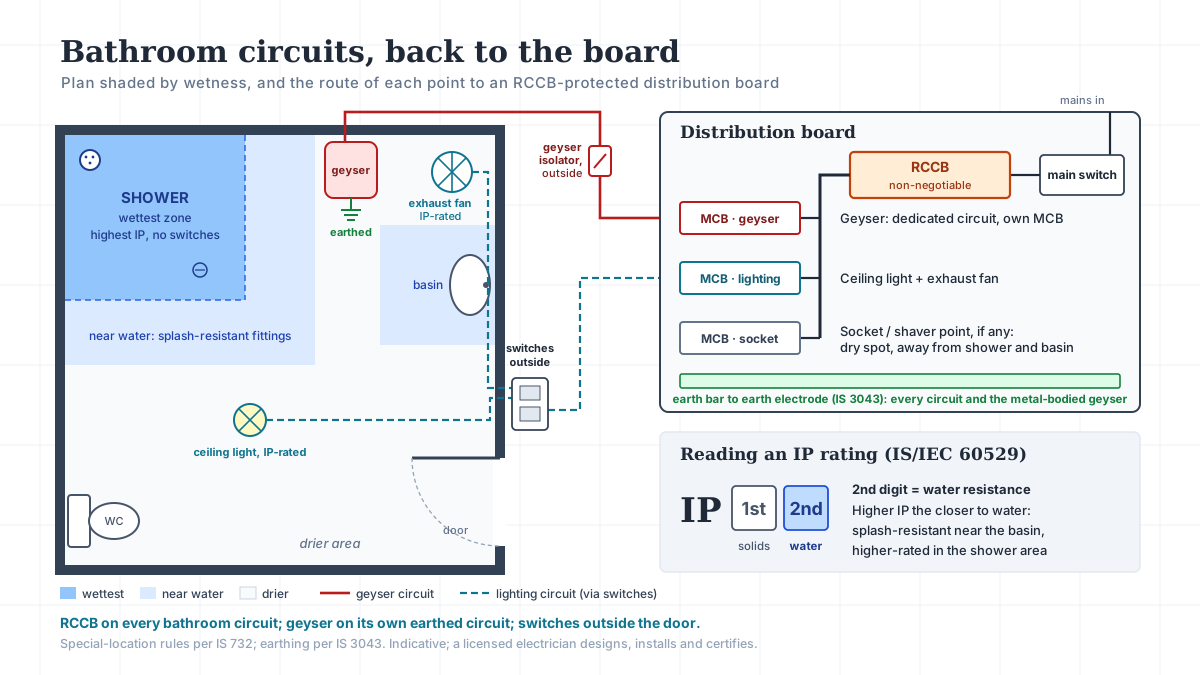
Nowhere in a home are water and electricity closer than in the bathroom — and nowhere are the electrical rules stricter. Water is a conductor, wet skin lowers the body's resistance, and a fault that would be survivable elsewhere can be lethal here. That's why bathroom electrics are governed by the ideas of zones, water-resistant (IP-rated) fittings and mandatory RCCB protection. This guide explains how to make an Indian bathroom's electrics genuinely safe — what belongs where, and what must never go near water.
It is the bathroom guide of the room-by-room set in the Electrical Knowledge Hub, and applies the safety guide to the highest-risk room.
The safety line. Bathroom electrical work is the least forgiving in the home. This guide helps you specify safe positions, IP-rated fittings and protection; all wiring must be installed by a licensed electrician to IS 732's special-location requirements. Never DIY anything electrical in a bathroom.
Why the bathroom has the strictest rules
- Water everywhere — showers, taps, wet floors and steam.
- Wet skin and bare feet — a person's body resistance drops sharply when wet, so a given fault current is far more dangerous.
- Confined, hard surfaces — little room to get clear of a fault.
Because of this, the bathroom is treated as a special location: fittings must resist water, live parts must be kept away from wet zones, and an RCCB is essential.
The zone concept
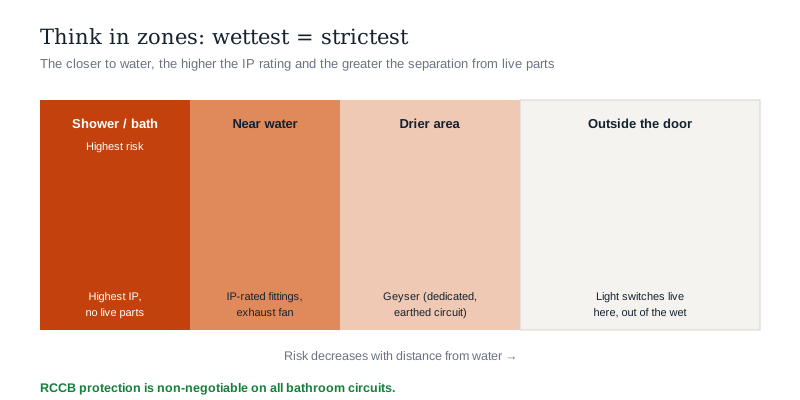
Bathroom safety is built on zones — the idea that risk is highest right at the water and reduces with distance. The wettest areas (inside and immediately around the shower or bath) demand the most water-resistant fittings and the greatest separation from live parts; drier areas further away are less restrictive. The practical takeaway for a homeowner:
- Keep switches and sockets out of the wet zones. In most Indian bathrooms, light switches sit outside the bathroom (by the door), and sockets are kept well away from the shower and basin.
- Position fittings by how wet the spot is — the closer to water, the higher the protection needed.
- Your electrician applies the detailed zone requirements of IS 732; you specify sensible, dry, accessible positions.
IP ratings: fittings that resist water
The IP rating (Ingress Protection, to IS/IEC 60529) tells you how well a fitting resists solids and water — the second digit is the water resistance. In a bathroom:
- Use IP-rated fittings appropriate to the position — higher IP (more water-resistant) closer to water, e.g. a splash-resistant fitting near the basin and a higher-rated one in the shower area.
- Lights, exhaust fans and any fitting in a wet zone must be suitably IP-rated and marked.
- Don't use ordinary indoor fittings in wet areas — they aren't built to keep water out.
Matching the fitting's IP rating to its position is the core of bathroom fitting selection.
The geyser (water heater) — do it right
The geyser is the bathroom's big load and needs care:
- A dedicated circuit with a correctly rated MCB and cable, and RCCB protection.
- An isolating switch (often a high-rating pull-cord or a switch outside the wet zone) to switch the geyser off safely.
- Proper earthing — a metal-bodied heater near water absolutely depends on earthing.
- Positioned and installed per the maker's instructions by a licensed electrician.
The RCCB is non-negotiable
If there is one rule for a bathroom, it's this: the bathroom circuits must be RCCB-protected. An RCCB detects the small earth-leakage current of a developing fault — exactly the kind that becomes a fatal shock in a wet room — and disconnects in milliseconds. In the wettest, most dangerous room in the home, it is the difference between a fault and a fatality.
A bathroom electrical checklist
- Switches outside the bathroom or well clear of wet zones.
- Sockets kept away from the shower and basin (many Indian bathrooms have none, or only a shaver-type point in a dry spot).
- IP-rated lights and exhaust fan matched to their position.
- The geyser on a dedicated, RCCB-protected, earthed circuit with a safe isolating switch.
- RCCB protection and solid earthing on all bathroom circuits.
- Everything installed by a licensed electrician to IS 732's special-location rules.
The one-line answer
The bathroom is the home's most dangerous room for electricity, so its rules are the strictest: think in zones (risk highest at the water, easing with distance), keep switches and sockets out of the wet areas (switches typically outside the door), use IP-rated fittings matched to each position (to IS/IEC 60529) for lights and the exhaust fan, put the geyser on a dedicated, earthed, RCCB-protected circuit with a safe isolating switch, and treat RCCB protection as non-negotiable on all bathroom circuits. Specify the safe positions; leave every bit of the wiring to a licensed electrician working to IS 732's special-location requirements.
Where to go next
- The dangers this guards against: Home Electrical Safety Guide.
- The life-saving device: RCCB & RCBO Guide.
- The other rooms: Kitchen Electrical · Bedroom Electrical.
- The earthing that protects you: Home Earthing Guide.
References
- IS/IEC 60529 : 2001, Degrees of Protection Provided by Enclosures (IP Code), Bureau of Indian Standards.
- IS 732 : 2019, Code of Practice for Electrical Wiring Installations (special locations — bath and shower areas), BIS.
- IS 3043 : 2018, Code of Practice for Earthing, BIS.
- IS 12640 (Parts 1 & 2), Residual Current Operated Circuit Breakers (RCCBs), BIS: https://www.bis.gov.in/
Bathroom electrical requirements are safety-critical and detailed; all wiring must be installed by a licensed electrician to IS 732's special-location rules. Verify any standard's status via the BIS catalogue before relying on it.
Export this guide
Related Guides — Deep-dive reading
Bathroom Electrical Safety India: 30 mA RCD/RCBO, IP Ratings & Waterproof Switches
Wet skin plus mains voltage is the deadliest combination in an Indian home. This is a practical safety guide — why the 30 mA RCD/RCBO that trips in milliseconds is non-negotiable, the IP44/IP54/IP65 rating your fittings need by zone, waterproof switches and sockets (or better, switches outside the door), proper earthing and bonding, avoiding the classic geyser-shock scenario, how to test the RCD, and what to fix in an old bathroom — all per IS 732 and IS 3043.
BathroomsBathroom Electrical India: Loads, IP Zones, RCD Protection & the Complete Wiring Plan
The complete guide to bathroom electrical planning for Indian homes — the loads and points (geyser on a dedicated 16 A circuit, exhaust, mirror and lights, shaver socket, smart WC), the IP zones 0/1/2 that fix where fittings can sit near water, mandatory 30 mA RCD/RCBO earth-leakage protection, earthing, keeping switches outside the wet zone, cable sizing and getting conduits right before plastering — all per IS 732 and NBC 2016.
BathroomsBathroom Electrical Schedule (India): A Point-by-Point Wiring Table with Heights, Loads, Circuits & IP Zones
A working electrical points schedule an Indian architect, MEP consultant or site engineer hands to the electrician — every point with its height from FFL, load, circuit, IP zone and 30 mA RCD protection, so the bathroom is wired correctly, safely and to code.
BathroomsRelated Tools — Try Free
Electrical Safety & Load Audit
Home electrical audit — 10 categories, 65+ checkpoints across earthing, RCCB, MCB, wiring, switchboards, appliance circuits, DG/inverter backup.
Safety AuditEarth Conductor Size Calculator
Find the minimum protective (earth) conductor size for a circuit from its phase conductor size, using the standard IS 732 / IEC 60364 rule.
ElectricalFull-Room BOQ — Living, Bedroom, Kitchen, Bath
Room-wise BOQ across living, bedrooms, kitchen, utility, and bathrooms with line-item pricing.
Full-Room BOQ