
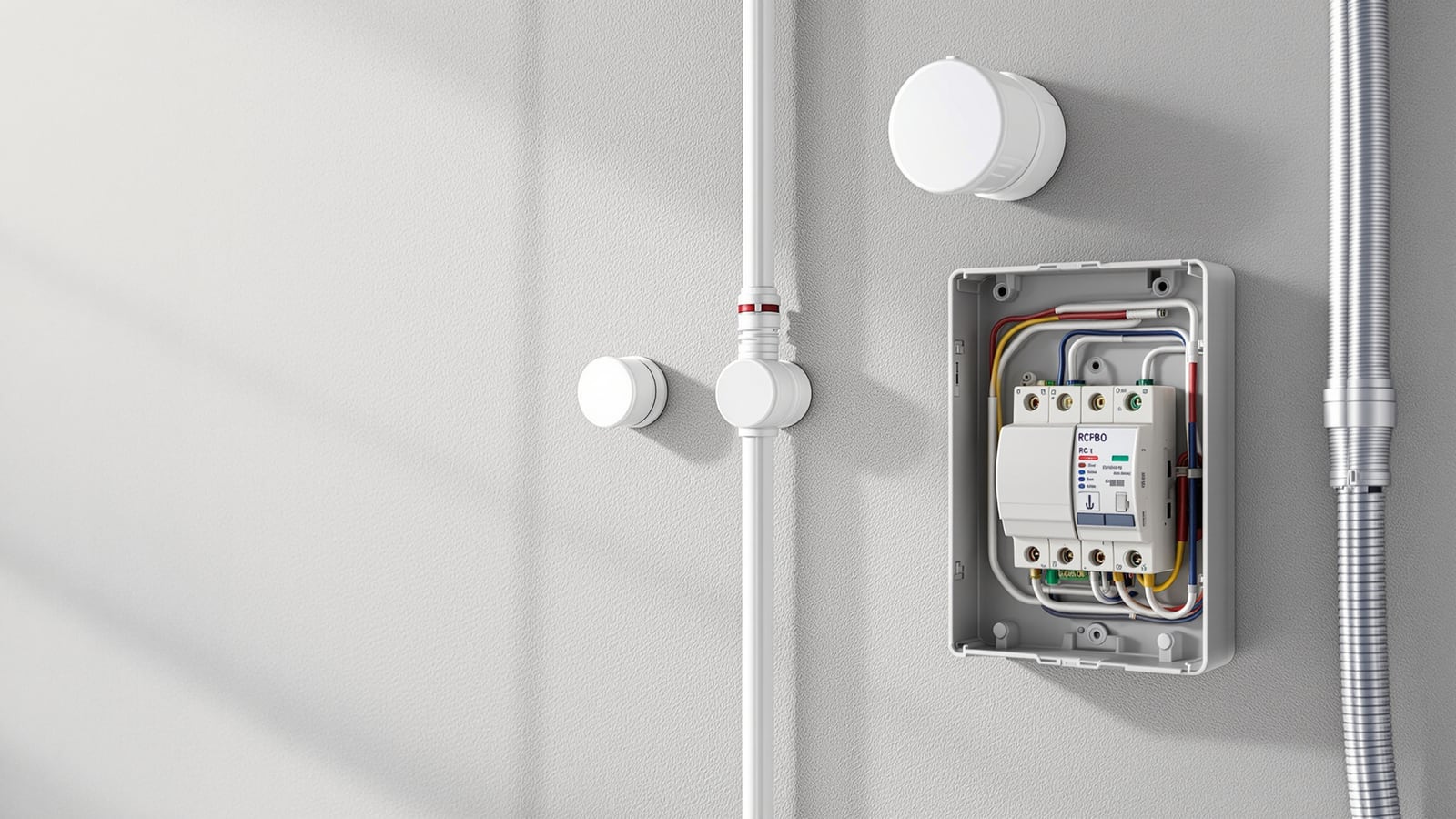
Bathroom Electrical India: Loads, IP Zones, RCD Protection & the Complete Wiring Plan
The complete guide to bathroom electrical planning for Indian homes — the loads and points (geyser on a dedicated 16 A circuit, exhaust, mirror and lights, shaver socket, smart WC), the IP zones 0/1/2 that fix where fittings can sit near water, mandatory 30 mA RCD/RCBO earth-leakage protection, earthing, keeping switches outside the wet zone, cable sizing and getting conduits right before plastering — all per IS 732 and NBC 2016.
The bathroom is the most electrically dangerous room in an Indian home, and the one where wiring is most often treated as an afterthought. Water conducts, bare feet on a wet floor make a perfect path to earth, and the loads here — a geyser pulling 3–4 kW, an exhaust fan, mirror lights, a smart WC — are exactly the ones people bolt on later with no plan. Get the electrical layout right before the plaster goes on, and the room is safe for decades. Get it wrong and you are chasing walls, running surface conduit, or worse, living with a shock hazard you cannot see.
This is the electrical pillar of the Studio Matrx bathroom hub. It covers the whole picture — the loads and points you need, the IP zones that decide where a fitting is even allowed to sit, the 30 mA earth-leakage protection that is non-negotiable life safety, earthing, cable sizing and the conduit-before-plaster sequence. For the room fundamentals keep the complete bathroom design guide open, and if this is a new build, plan it alongside the bathroom planning guide for new homes so the electrician and the plumber are on the same drawing.
The single most important sentence in this guide: every circuit serving a bathroom must be protected by a 30 mA RCD or RCBO. That device is what turns a lethal shock into a nuisance trip.
Start with the loads: what actually draws power here
Before you place a single point, list the appliances. Indian bathrooms have grown from "one light and one geyser" to a small load centre, and the geyser dominates everything.
| Point | Typical load | Circuit | Cable (copper) |
|---|---|---|---|
| Storage geyser (15–25 L) | 2000–3000 W | Dedicated 16 A, its own MCB + RCBO | 2.5 sq mm (up to 3 kW) / 4 sq mm |
| Instant geyser (3–4.5 kW) | 3000–4500 W | Dedicated 20 A | 4 sq mm |
| Exhaust fan | 30–60 W | Light circuit or its own switch | 1.5 sq mm |
| Mirror / vanity lights | 20–60 W | Lighting circuit | 1.5 sq mm |
| Ceiling downlights | 6–12 W each | Lighting circuit | 1.5 sq mm |
| Shaver socket / 6 A socket | 100–1500 W | Socket circuit | 2.5 sq mm |
| Smart WC / bidet seat | 500–1400 W | 6 A/16 A socket behind WC | 2.5 sq mm |
| Heated towel rail | 80–150 W | Fused spur or switched point | 1.5–2.5 sq mm |
Two rules fall straight out of this table. First, the geyser gets its own dedicated circuit back to the distribution board — never share it with lights or sockets, because a 3 kW element on a shared line will nuisance-trip and overheat undersized cable. Size the geyser cable and its own guide, the geyser water heater guide, covers the appliance side. Second, anything with a heating element (geyser, towel rail, smart WC dryer) needs cable rated for its actual current, not the nearest spare wire the electrician had on the van.
The IP zones: where a fitting is allowed to sit
You cannot place electrical points in a bathroom by eye. NBC 2016 and IS 732 divide the room into zones by distance from water, and each zone sets a minimum IP (Ingress Protection) rating and dictates what is permitted at all. This is the concept that separates a professional layout from a dangerous one.
- Zone 0 — inside the bath tub or shower tray itself. Only fittings rated IP67 and running at extra-low voltage (12 V SELV) are allowed. In practice: nothing here except a purpose-made submersible fitting.
- Zone 1 — directly above the shower or tub, up to 2.25 m from the floor. Minimum IP65. Sealed shower downlights and rated exhaust points only. No switches, no sockets, ever.
- Zone 2 — the 0.6 m band extending outward and upward from Zone 1, plus the area around the basin. Minimum IP44. Mirror lights and general ceiling lights live here.
- Outside zones — the dry area beyond Zone 2. Standard fittings are allowed, but a switch or socket must still sit here, not in a wet zone.
The waterproof bathroom lights guide goes deep on which IP-rated fitting belongs in each zone. The takeaway for the electrical plan: place the geyser, the exhaust and any wet-area light to their zone's IP minimum, and push every switch and socket into the dry outer zone.
The life-safety layer: 30 mA RCD/RCBO protection
This is where most Indian home wiring fails, and it is the one thing you must not compromise. A normal MCB protects the cable from overload — it does nothing to protect you from a shock. What saves a life is a residual current device: an RCD or, better, an RCBO (which combines residual-current and overcurrent protection in one module).
A residual current device continuously compares the current flowing out on the live with the current returning on the neutral. If even 30 milliamps leaks away — through a cracked geyser element, a damp fitting, or through a person's body to earth — it disconnects the circuit in well under 300 milliseconds, before the current can stop a heart. IS 732 and NBC 2016 require 30 mA additional protection for socket circuits and bathroom circuits.
- Every circuit serving the bathroom — geyser, lights, sockets, exhaust, smart WC — must sit downstream of a 30 mA RCD or RCBO. 100 mA and 300 mA devices protect equipment and property, not people; they do not satisfy the bathroom requirement.
- Prefer individual RCBOs per circuit over one shared RCD for the whole board. One RCBO per circuit means a fault on the geyser does not black out your lights, and you can find the faulty circuit instantly.
- Test it. Press the "T" button on the RCD/RCBO every few months — it should trip. A device that does not trip on test is protecting nothing.
An MCB protects the wire. An RCD protects the person. A bathroom needs both, and the RCD must be 30 mA.
Earthing: the return path that makes protection work
Protection only works if there is a solid earth. Every metal appliance body — geyser tank, metal light housing, towel rail — must be connected to the earth conductor so that a live fault flows to earth and trips the breaker instead of sitting on the metal waiting for a hand. In many older Indian homes the earth is a corroded pipe or simply not connected; that is why people "feel a tingle" off a geyser body. The fix is a proper earth conductor run with every circuit back to the board's earth bar, plus supplementary bonding of exposed metalwork in the bathroom. Do not rely on a plumbing pipe as an earth — modern CPVC and PEX pipes do not conduct.
Switches, sockets and the golden placement rules
- Keep all switches and sockets outside the wet zones. The classic Indian arrangement — geyser switch just outside the bathroom door, or on the dry wall away from the shower — is correct and required. A switch inside Zone 1 or 2 is a code violation and a hazard.
- Use a double-pole (DP) 20 A switch with a neon for the geyser so it isolates both live and neutral. Never a single-pole 6 A switch.
- The exhaust fan should be interlocked or switched so it runs during and a little after a shower — humidity is what corrodes fittings and grows mould.
- For the smart WC / bidet seat, plan a concealed 16 A socket behind the pan, in the dry zone but reachable — retrofitting one later means chasing a finished tiled wall.
- A shaver socket (isolated-transformer type) is the only socket traditionally permitted closer in, but keep even that out of direct spray.
Sequence: conduits before plaster, always
Bathroom wiring is concealed conduit work, and the entire plan has to be frozen before the mason plasters. Once tiles are on, every change is a demolition job.
A few sequence points that save real money and grief:
- Coordinate with waterproofing. Conduit and boxes must not puncture the tanked wet area — route them so the waterproofing membrane stays continuous. A screw or chase through the membrane is a leak waiting to happen.
- Photograph every wall after conduits are laid and before plaster, with a tape measure in shot. That record is priceless when you later drill for a mirror or shelf and want to miss the cables.
- Leave the geyser and smart-WC points even if you are not fitting the appliance now. Cable is cheap during construction; chasing a finished wall later is not.
Do and don't
| Do | Don't |
|---|---|
| Give the geyser its own dedicated 16 A/20 A circuit | Run the geyser off the light or socket circuit |
| Protect every bathroom circuit with a 30 mA RCD/RCBO | Rely on an MCB alone — it does not protect people |
| Keep switches and sockets in the dry outer zone | Put a switch or socket in Zone 0, 1 or 2 |
| Match the IP rating to the zone of each fitting | Use a bedroom-grade fitting over the shower |
| Earth every metal body and bond exposed metal | Assume a plumbing pipe provides an earth |
| Size cable to the actual load (see table) | Use one spare wire for whatever needs power |
| Freeze the plan and lay conduit before plaster | Decide points after the tiler has finished |
For the deeper safety-only treatment — RCD selection, shock mechanisms, testing routines and fault-finding — read the companion bathroom electrical safety guide. Between these two guides you have the full electrical picture for an Indian bathroom: what to install, where it is allowed, and what keeps everyone in the house safe.
References
- National Building Code of India (NBC) 2016, Part 8 Section 2 — Electrical and Allied Installations, Bureau of Indian Standards.
- IS 732: Code of Practice for Electrical Wiring Installations — including requirements for bathroom/wet-area circuits and residual current protection.
- IS/IEC 60529 — Degrees of protection provided by enclosures (IP Code).
- IS 3043: Code of Practice for Earthing — earthing and equipotential bonding requirements.
- Central Electricity Authority (Measures relating to Safety and Electric Supply) Regulations — statutory safety requirements for installations in India.
Export this guide
Related Guides — Deep-dive reading
Bathroom Electrical Safety India: 30 mA RCD/RCBO, IP Ratings & Waterproof Switches
Wet skin plus mains voltage is the deadliest combination in an Indian home. This is a practical safety guide — why the 30 mA RCD/RCBO that trips in milliseconds is non-negotiable, the IP44/IP54/IP65 rating your fittings need by zone, waterproof switches and sockets (or better, switches outside the door), proper earthing and bonding, avoiding the classic geyser-shock scenario, how to test the RCD, and what to fix in an old bathroom — all per IS 732 and IS 3043.
BathroomsBathroom Planning for New Homes in India: Get It Right Before You Build
The bathroom decisions you cannot undo once the slab is cast — location and stacking, sunken vs non-sunken slabs, waterproofing, and the plumbing, electrical and ventilation you must coordinate with the civil work, stage by stage.
BathroomsBathroom Electrical Code India: IS 732, IS 3043, CEA 2010 & Zone Rules
The standards reference a designer or electrical contractor actually needs — IS 732 (wiring), IS 3043 (earthing), the CEA Safety Regulations 2010, the IP-rated zone concept aligned with IEC 60364-7-701, mandatory 30 mA earth-leakage protection, and the placement, bonding and isolation rules that make a bathroom compliant.
BathroomsRelated Tools — Try Free
Electrical Safety & Load Audit
Home electrical audit — 10 categories, 65+ checkpoints across earthing, RCCB, MCB, wiring, switchboards, appliance circuits, DG/inverter backup.
Safety AuditRainwater Tank Sizer
How big should your rainwater tank be? Computes annual harvest, recommended tank capacity in litres, water-bill savings, and payback — for 10 Indian cities.
RWH CalculatorFalse Ceiling Cost Estimator
Live ₹/sqft across 8 ceiling types — POP, gypsum, designer, metal, PVC, wooden — with cove and spot lighting for 20 Indian cities.
Cost Calculator