
Choosing the Right MCB Rating for Each Circuit
How the correct MCB is chosen — sized to protect the cable, above the circuit's normal load, with the right trip curve for the appliance. The common ratings for lighting, sockets, geysers, ACs and kitchens, and the golden rule that ties the breaker to the wire.
Every circuit in a home needs an MCB of the right rating — and "right" has a precise meaning that many cheap installations get wrong. The MCB's job is to protect the circuit's cable, so its rating must sit in a specific window: above the circuit's normal running current, and below what the cable can safely carry. Get it right and the breaker protects the wire from ever overheating; get it wrong — usually by fitting one too big — and the protection quietly disappears. This guide explains how the rating is chosen, and the common values for a home.
It builds on the MCB & MCCB guide and pairs with the MCB & RCCB selector and the wire size calculator.
The safety line. This guide explains how MCB ratings are chosen so you understand your installation and can ask the right questions. The actual selection must be done by a licensed electrician, coordinated with the real cable, load and installation conditions to IS 732 and IS/IEC 60898. Do not change breakers yourself.
The golden rule: the breaker protects the cable
The single principle that governs MCB selection:
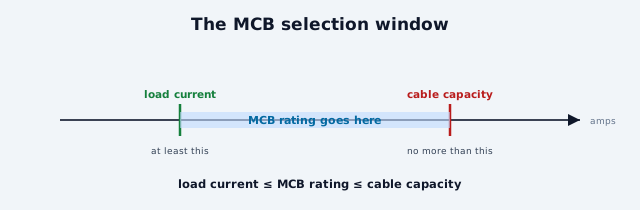
Load current ≤ MCB rating ≤ cable's safe current-carrying capacity.
The MCB rating must be at least the circuit's normal load (or it nuisance-trips), and no more than the cable can safely carry (or the cable can overheat without tripping the breaker). The breaker and the cable are a matched pair — you never choose one without the other. This is exactly why fitting a bigger breaker to stop tripping is dangerous: it breaks the upper half of this rule and removes the cable's protection.
Common ratings for home circuits
These are the typical, indicative values an electrician works from — always confirmed against the actual cable and load:
| Circuit | Typical cable (copper) | Typical MCB | Trip curve |
|---|---|---|---|
| Lighting / fans | 1.0 – 1.5 sq mm | 6 A | B or C |
| General 6 A sockets | 2.5 sq mm | 16 A | C |
| Kitchen / power points | 4 sq mm | 20 A | C |
| Geyser | 4 sq mm | 20 A | C |
| Air-conditioner (1.5 T) | 4 sq mm | 20 A | C |
| Larger AC / heavy point | 6 sq mm | 25 – 32 A | C |
| Main (single-phase home) | per load | 40 – 63 A | C |
Indicative for typical Indian homes. The correct rating depends on the exact cable, its length (voltage drop), the installation method and the appliance — set by a licensed electrician.
Choosing the trip curve
The trip curve (B, C or D) is chosen for how much the load surges at switch-on:
- Type B (trips at ~3–5× rating) — lighting and simple resistive loads with little inrush.
- Type C (trips at ~5–10×) — the common home choice: sockets, ACs, motors, mixed circuits that draw a brief surge at start-up.
- Type D (trips at ~10–20×) — high-inrush industrial loads; rarely needed at home.
Choosing Type C for a motor circuit avoids the nuisance tripping a Type B would suffer on start-up inrush, while still protecting the cable. Match the curve to the load, not by guesswork.
Common mistakes to avoid
- Oversizing the breaker to stop tripping. The cardinal error — it removes the cable's protection. Fix the overload or fault, or upgrade cable and breaker together.
- One big breaker for everything. Defeats the point of separate circuits; a fault then kills the whole home and the cable sizing cannot match one rating.
- Ignoring the trip curve. A Type B on an AC circuit nuisance-trips; a Type D on a lighting circuit is too slow to protect well.
- Forgetting the RCCB. MCB rating is about overload; it does nothing for shock. Pair circuits with a 30 mA RCCB or RCBO.
The one-line answer
The right MCB rating sits in a window — at least the circuit's normal load current, and no more than the cable's safe capacity — because the breaker exists to protect the cable, and the two are always chosen as a matched pair. Use the common values (6 A lighting, 16 A sockets, 20 A geyser/AC, and so on) as a guide, pick Type C for most home circuits, never oversize a breaker to silence tripping, and pair everything with a 30 mA RCCB — with a licensed electrician making the final selection against your actual wiring.
Where to go next
- The breaker basics: MCB & MCCB Guide.
- Shock protection to pair with it: RCCB, RCBO & ELCB Guide.
- Try it: MCB & RCCB Selector.
- Size the cable: Wire Size Calculator.
References
- IS/IEC 60898-1 : 2015, Circuit-Breakers for Overcurrent Protection for Household and Similar Installations (MCBs), Bureau of Indian Standards.
- IS 732 : 2019, Code of Practice for Electrical Wiring Installations, BIS.
- National Electrical Code of India, SP 30 : 2023, BIS: https://www.bis.gov.in/
All ratings and curves are indicative for typical Indian homes and must be set by a licensed electrician coordinated with the actual cable and load. Verify any standard's status via the BIS catalogue before relying on it.
Export this guide
Related Guides — Deep-dive reading
MCB vs MCCB: What They Do & Which Your Home Needs
The two circuit breakers that protect wiring from overload and short circuit — the MCB in every home distribution board and the larger MCCB in bigger installations. What each does, the trip curves and ratings, when you need which, and why a bigger breaker is never the fix for tripping.
Electrical & WiringLighting Safety & IP Ratings: Choose the Right Fixture for the Spot (2026)
The homeowner's safety-literacy guide to lighting — how to read the two-digit IP rating, pick the correctly-rated fixture for bathrooms, gardens and wet zones, and know exactly where selecting a light ends and a licensed electrician's wiring begins.
LightingElectrical Safety for Security Systems in India (2026): Powering It Without Peril
A homeowner's guide to the power side of home and RWA security systems, CCTV, alarms, gates, access control and NVRs, done so it protects you instead of quietly becoming a shock or fire hazard. What makes a supply safe, what to insist on, and why the mains work belongs to a licensed electrician.
SecurityRelated Tools — Try Free
Electrical Safety & Load Audit
Home electrical audit — 10 categories, 65+ checkpoints across earthing, RCCB, MCB, wiring, switchboards, appliance circuits, DG/inverter backup.
Safety AuditMCB & RCCB Selector
Suggests an MCB current rating and trip curve for a home circuit, the minimum matching cable, and the RCCB sensitivity for shock protection.
ElectricalWire Size Calculator
Find the minimum copper or aluminium cable size for a circuit that satisfies both current-carrying capacity and voltage drop over the run length.
Electrical