
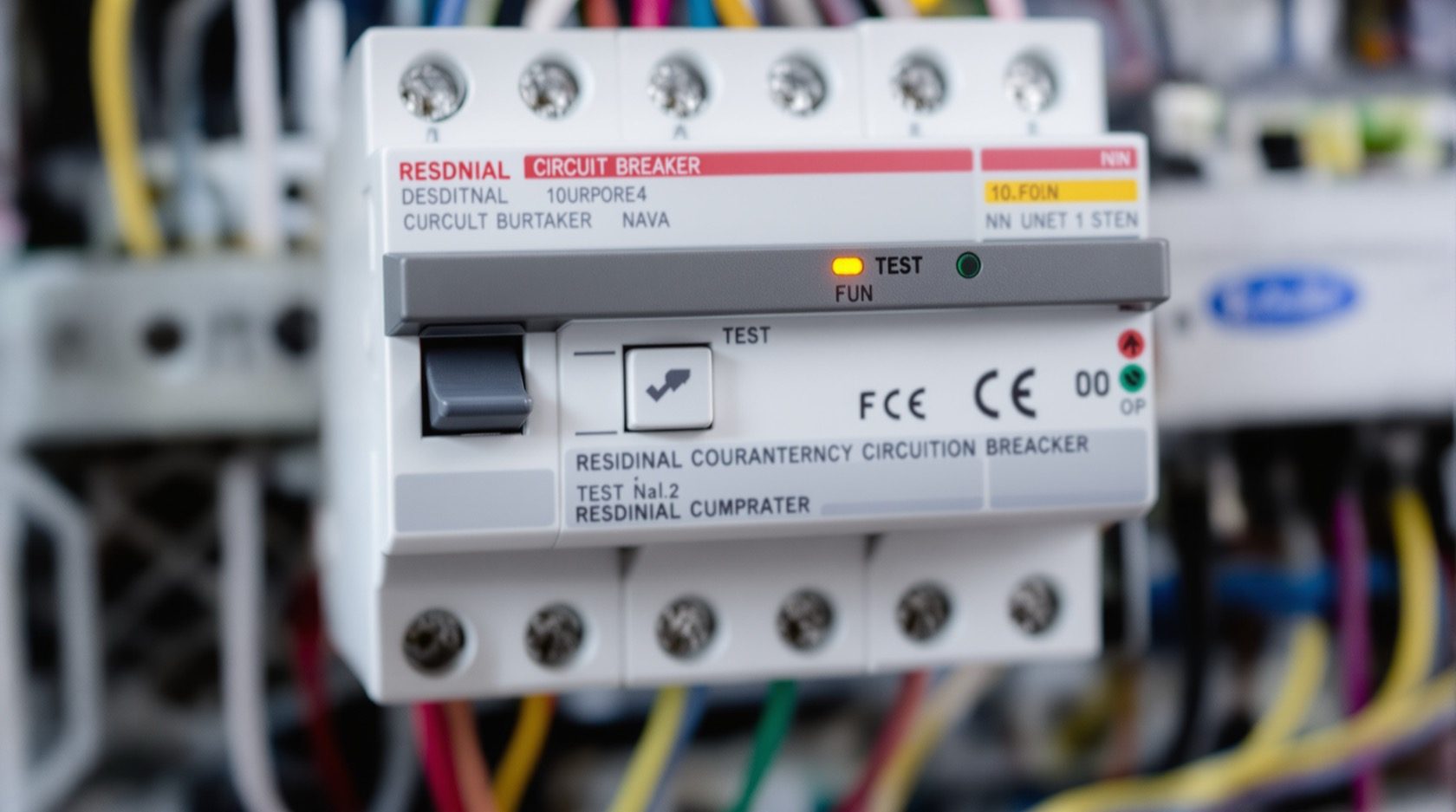
RCCB, RCBO & ELCB: The Devices That Protect You From Shock
The single most important safety device in a home distribution board — the residual current device that detects electricity leaking to earth and cuts power in milliseconds. What RCCB, RCBO and ELCB mean, why 30 mA matters, the difference from an MCB, and why every home must have one.
Of every device in a home's distribution board, one saves lives directly, and many older Indian homes do not have it: the residual current device. It watches for electricity leaking to earth — for example, through a person touching a faulty appliance — and cuts the power in milliseconds, fast enough to prevent a fatal shock. It goes by several names — RCCB, RCBO, ELCB, RCD — which causes real confusion. This guide clears it up, explains why the number 30 mA matters so much, and makes the case that no home should be without one.
It sits under the distribution board guide and complements the MCB & MCCB guide — because these devices do a completely different job from an MCB.
The safety line — the most important in this whole hub. If your home has no RCCB / RCD, it has no protection against fatal electric shock from an earth fault, regardless of how many MCBs it has. Have a licensed electrician confirm whether your board has a working residual current device, and if not, treat adding one as a priority safety upgrade. Never install or test the wiring yourself.
What a residual current device does
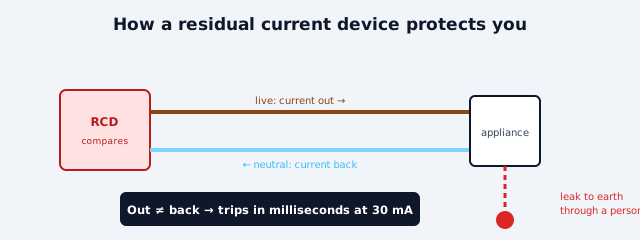
Electricity should flow out on the live and return, in equal amount, on the neutral. A residual current device continuously compares the two. If they no longer match, current must be escaping somewhere it should not — leaking to earth through a fault, a damaged cable, or a person. The device detects that imbalance and trips, cutting the power before the leak can harm anyone.
This is fundamentally different from an MCB:
- An MCB trips on too much current (overload/short circuit) to protect the cable from overheating.
- A residual current device trips on current leaking to earth to protect the person from shock.
A home needs both, because they guard against different dangers. An installation with MCBs but no RCD is protected against fire from overload but not against electrocution.
Decoding the names
| Term | Full name | What it is |
|---|---|---|
| RCD | Residual Current Device | The general term for all of these |
| RCCB | Residual Current Circuit Breaker | Trips on earth leakage only — the common home device |
| RCBO | Residual Current Breaker with Overload | Combines RCCB + MCB in one — leakage and overload protection |
| ELCB | Earth Leakage Circuit Breaker | Older term; modern current-sensing ELCBs are effectively RCCBs |
- An RCCB protects against earth leakage but relies on separate MCBs for overload — the usual arrangement, with one RCCB protecting a group of MCB-protected circuits.
- An RCBO does both jobs for a single circuit — increasingly used to give each important circuit its own combined protection, so one faulty appliance does not trip the whole home.
- ELCB is an older name. The modern, correct device is a current-operated RCCB/RCBO; old voltage-operated ELCBs are obsolete.
In India these devices are made to IS 12640 — Part 1 for RCCBs, Part 2 for RCBOs.
Why 30 mA matters
The sensitivity of an RCD — the leakage current at which it trips — is measured in milliamps (mA). For shock protection of people, the standard is 30 mA:
- 30 mA is low enough to trip before a leakage current through a human body becomes lethal. This is the rating for home socket and general circuits.
- 100 mA / 300 mA devices exist for fire protection and larger installations — they catch bigger leakage but are not sensitive enough to protect a person from shock.
For a home, the life-safety device is a 30 mA RCCB (or RCBO). A 100 mA or 300 mA device protects against fire, not electrocution — do not mistake one for the other. If in doubt, ask your electrician to confirm the sensitivity.
Testing and living with your RCD
An RCD only protects you if it works, so:
- Press the test button (T) every so often — the device should trip instantly. If it does not, it is not protecting you; call an electrician.
- Nuisance tripping usually means a genuine small leak somewhere (an ageing geyser, a damp appliance, moisture) — not a faulty RCD. Have the cause found rather than bypassing the device.
- Never bypass or remove an RCD to stop tripping. It is trying to tell you about a fault that could otherwise electrocute someone.
The one-line answer
An RCCB, RCBO or ELCB is a residual current device — it detects electricity leaking to earth (for instance, through a person) and cuts power in milliseconds to prevent a fatal shock. It does a completely different job from an MCB (which protects the cable from overload), so a home needs both. For life safety, the device must be 30 mA sensitivity (100/300 mA protects against fire, not shock), made to IS 12640. If your home has no RCD, adding one is a priority safety upgrade — arranged and installed by a licensed electrician, tested with its button, and never bypassed.
Where to go next
- Where it lives: Distribution Board Guide.
- The cable protection: MCB & MCCB Guide.
- Upgrading an old board: Electrical Renovation & Rewiring.
- The whole safety net: Residential Electrical Systems.
References
- IS 12640 : Part 1 : 2024, Residual Current Operated Circuit-Breakers without Integral Overcurrent Protection for Household and Similar Uses (RCCBs), Bureau of Indian Standards.
- IS 12640 : Part 2 : 2016, RCBOs (with integral overcurrent protection), BIS.
- IS 732 : 2019, Code of Practice for Electrical Wiring Installations, BIS.
- IS 3043 : 2018, Code of Practice for Earthing, BIS.
- National Electrical Code of India, SP 30 : 2023, BIS: https://www.bis.gov.in/
RCD sensitivities and arrangements are indicative; the device selection and installation must be done by a licensed electrician. If your home lacks a residual current device, treat it as a priority safety issue. Verify any standard's status via the BIS catalogue before relying on it.
Export this guide
Related Guides — Deep-dive reading
MCB vs RCCB vs RCBO vs MCCB: Which Protection Does What
Four devices in your distribution board, four different jobs — an at-a-glance guide to what protects against overload and short circuit, what protects against electric shock, what does both, and where each belongs, so you can read your own board and know it's complete.
Electrical & WiringResidential Electrical Systems: The Complete Guide for Indian Homes
How the electricity in an Indian home actually works — from the utility supply and meter through the distribution board, circuits, wiring, earthing and protection, to lighting, safety, energy efficiency, smart controls, solar and backup — written so a homeowner can understand, plan and judge it, and know exactly where a licensed electrician must take over.
Electrical & WiringBathroom Electrical Safety India: 30 mA RCD/RCBO, IP Ratings & Waterproof Switches
Wet skin plus mains voltage is the deadliest combination in an Indian home. This is a practical safety guide — why the 30 mA RCD/RCBO that trips in milliseconds is non-negotiable, the IP44/IP54/IP65 rating your fittings need by zone, waterproof switches and sockets (or better, switches outside the door), proper earthing and bonding, avoiding the classic geyser-shock scenario, how to test the RCD, and what to fix in an old bathroom — all per IS 732 and IS 3043.
BathroomsRelated Tools — Try Free
Electrical Safety & Load Audit
Home electrical audit — 10 categories, 65+ checkpoints across earthing, RCCB, MCB, wiring, switchboards, appliance circuits, DG/inverter backup.
Safety AuditEarth Conductor Size Calculator
Find the minimum protective (earth) conductor size for a circuit from its phase conductor size, using the standard IS 732 / IEC 60364 rule.
ElectricalElectrical Load Calculator
Estimate a home's connected load and realistic maximum demand from its appliances, whether it needs single or three-phase supply, and a suggested main switch rating.
Electrical