
Basalt Flooring in India: Black Lava Stone Cost, Finishes & Use Guide
Dense, hard, low-porosity volcanic basalt gives the modern matte-black floor — here is how to choose honed, flamed or leather finishes, where it suits indoors and outdoors, and how it compares with granite.
Basalt is the dense black volcanic stone under much of South and West India — the Deccan Trap that paved old Bombay's roads and built temple plinths across Maharashtra and Karnataka. Quarried, cut and finished, that same hard, low-porosity lava stone gives one of the most quietly modern floors you can lay: a deep matte-charcoal surface that looks expensive, wears for decades, and shrugs off the things that ruin marble and limestone. This guide explains the finishes, the realistic ₹/sq ft, where basalt suits an Indian home, and how it stacks up against granite.
What basalt actually is
Basalt is a fine-grained igneous (volcanic) rock — solidified lava. Geologically it is what most of the Deccan plateau is made of, so it has been a working building stone in Pune, Mumbai, Nashik, Kolhapur, Hyderabad and much of Karnataka for centuries (think the black plinths and steps of old wadas and temples). As a floor it is prized for three things: it is hard and dense, it has very low porosity compared with marble, limestone or sandstone, and its colour is a uniform, sober black-grey rather than a busy veined pattern.
That low porosity matters in Indian homes. Marble and limestone are calcareous and react to acids — a splash of lime juice, curd, tamarind or toilet cleaner can etch a dull mark almost instantly. Basalt is silicate-based and far less acid-sensitive, so it tolerates a kitchen or dining floor much more forgivingly. It still benefits from sealing (see below), but it is a genuinely robust stone, not a delicate one.
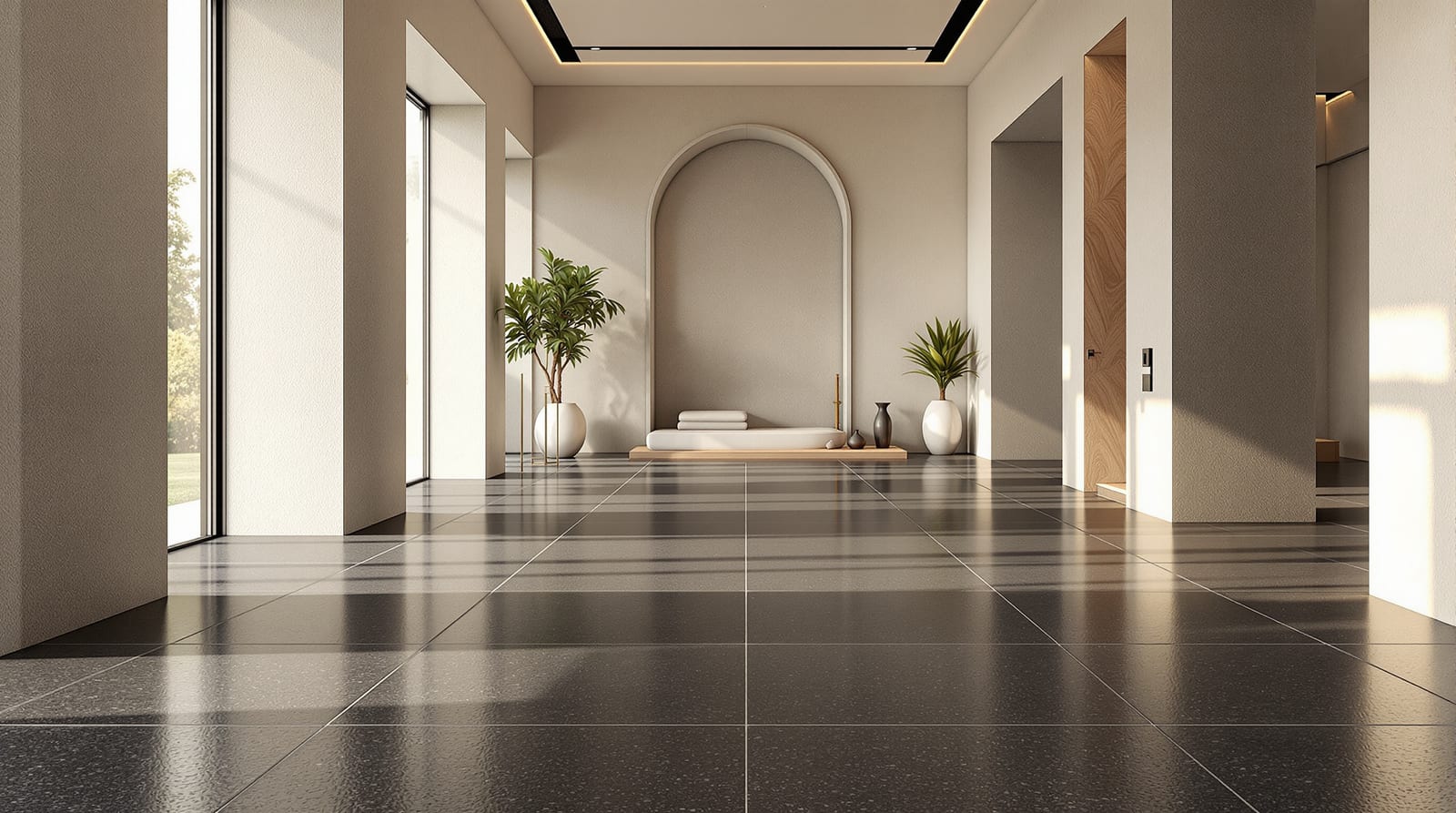
The look is its other draw. The current minimalist and "quiet luxury" interior trend — large-format slabs, almost-invisible grout, monochrome palettes — is built around exactly this kind of dark, matte, low-reflection surface. Honed basalt reads as sophisticated charcoal; designers pair it with timber, brass, off-white walls and indoor greenery.
Finishes: the single biggest decision
The finish changes the colour, the slip resistance and the price more than anything else. Here is how the common basalt finishes behave.
| Finish | How it looks | Slip / texture | Typical ₹/sq ft (material) | Best use |
|---|---|---|---|---|
| Honed (matte) | Smooth, even, deep charcoal-black, no shine | Smooth — slippery when wet | ₹110–250 | Living rooms, bedrooms, dry interiors, modern minimalist floors |
| Polished | Reflective, very dark, almost black | Smooth — slippery | ₹130–250 | Feature interiors (less common; basalt is usually kept matte) |
| Flamed (thermal) | Lighter grey, rough open texture | High grip — anti-skid | ₹100–200 | Outdoors, driveways, pool decks, steps, wet zones |
| Leather / antiqued | Soft satin sheen, subtle texture, hides marks | Mild grip | ₹130–230 | Premium interiors, kitchens, low-glare luxury floors |
| Bush-hammered | Pitted, stippled grey, very rough | Very high grip | ₹100–190 | Ramps, external stairs, heavy-traffic outdoor paving |
A few practical notes. Honed is the default indoor choice and gives that signature matte-black look, but a smooth honed floor is slippery underfoot when wet, so keep it out of bathrooms and uncovered terraces. Flamed (heat-treated so the surface micro-spalls into a rough texture) is the workhorse for anywhere that gets wet — it is naturally anti-skid and the standard pick for outdoor basalt. Leather/antiqued is the smart middle path for a kitchen: a soft low-glare surface that hides smudges and water spots far better than a high polish. Flaming and bush-hammering also lift the colour several shades lighter (toward grey), so always check a finished sample, not a raw offcut.
Cost: what you actually pay
Basalt sits in a mid-to-upper natural-stone band — dearer than Kota or Shahabad, broadly comparable with good granite, far cheaper than imported marble. As an indicative 2026 guide (material only, +18% GST, laying extra):
| Item | Indicative ₹/sq ft |
|---|---|
| Basalt slab/tile, honed (material) | ₹110–250 |
| Basalt, flamed/bush-hammered (material) | ₹100–200 |
| Calibrated basalt tiles (regular sizes) | ₹90–180 |
| Laying & polishing labour | ₹40–90 |
| Sealing (impregnating sealer) | ₹10–25 |
| Installed, typical interior honed floor | ₹180–360 |
Large-format slabs, thicker sections (for outdoors you want 18–25 mm or more), exotic finishes and premium black sources push the upper end. Standard calibrated tiles in regular sizes from a stone yard in Maharashtra, Karnataka or Hyderabad are the most economical route. For your own area, our natural stone slab calculator helps convert slab dimensions and wastage into the number of slabs and the budget; for a whole-floor estimate the flooring cost calculator folds in laying and sealing.
Basalt vs granite — and where each wins
Indians instinctively reach for granite, so the honest comparison matters.
| Factor | Basalt | Granite |
|---|---|---|
| Look | Uniform matte black-grey, calm, modern | Speckled/grainy, often with mineral flecks; many colours |
| Finish trend | Stays matte (honed/leather/flamed) | Usually polished and glossy |
| Hardness & durability | Very hard, very durable | Very hard, very durable |
| Porosity | Very low | Very low |
| Acid sensitivity | Low (silicate) | Low (silicate) |
| Price (material) | ₹80–250 | Often ₹60–200 for common Indian granites |
| Where it wins | The modern matte-black, low-reflection minimalist floor | Budget durability, uniform stocked colours, glossy polish, wide availability |
In short: granite is usually cheaper and more widely stocked, and if you want a polished, multi-colour, mass-available durable floor it is hard to beat. Basalt wins when you specifically want that dense, even, matte-black, no-veining modern look — a designed monochrome surface rather than a busy speckle. Both are silicate stones, so both resist acids far better than marble; the choice is largely aesthetic and budget, not durability. If you are weighing several stones, the granite flooring guide covers the granite side in depth, and the limestone flooring guide covers the softer, more acid-sensitive end of the spectrum.
Basalt also reads close to dark Kadappa (Cuddapah) stone, which is a black limestone, not volcanic — Kadappa is cheaper and softer but acid-sensitive. If a black floor on a tight budget is the goal, the Kadappa stone guide is worth reading alongside this one before you decide.
Where basalt suits an Indian home
Living and dining rooms are basalt's sweet spot — honed slabs, large format, tight grout, paired with timber and light walls. It is cool underfoot in summer, which suits most of the country, though in very cold north-Indian winters a fully stone floor can feel chilly (rugs solve this).
Kitchens work well with a leather or honed finish because basalt's low acid-sensitivity tolerates spills that would etch marble; just seal it and wipe spills reasonably promptly.
Outdoors — driveways, courtyards, pool surrounds, steps and pathways — call for flamed or bush-hammered basalt for grip. Its density and weather resistance make it an excellent external paver, and it pairs beautifully with planting. See the existing outdoor flooring guide for layout and drainage detailing.
Bathrooms and wet areas need the rough flamed/leather finishes, never smooth honed or polished — a wet honed basalt floor is slippery. Pair the finish choice with the principles in our anti-slip flooring for wet areas guide; for retrofit grip on an existing smooth floor, the anti-skid floor treatment guide helps.
Facades and cladding are a growing use: thin honed or flamed basalt panels (often as ventilated cladding) give buildings a sleek dark stone skin that weathers gracefully and ages far better than paint in the monsoon.
For the bigger picture of how basalt fits among all the alternative and specialty floors — seamless, resilient, paving and technical — start from the specialty flooring guide for India, the pillar that maps the whole category.
Care, sealing and longevity
Basalt is low-maintenance but not no-maintenance.
- Seal it. Even though basalt is dense, honed and leather finishes have micro-porosity that can absorb oil and stain over time. Apply a good impregnating (penetrating) sealer after laying, and re-seal honed interior floors roughly every two to three years — our floor resealing guide covers products and method. Flamed outdoor surfaces are more open and may want sealing more often if you want to resist staining.
- Clean with pH-neutral cleaner. Basalt tolerates mild acids far better than marble, but harsh acidic or strongly alkaline cleaners and abrasive scrubbing are still best avoided. Plain water plus a neutral stone cleaner keeps it looking right; see the floor cleaning guide.
- Expect a deepening tone. Sealed basalt often looks slightly richer and darker — many people enhance the colour deliberately with a colour-enhancing sealer.
- It hides dust differently from marble. A matte-black floor shows lint, hair and dry footprints more than a busy patterned floor, so it wants regular dry mopping — a fair trade for the look.
Properly laid on a sound screed and sealed, a basalt floor will comfortably outlast the décor around it, which is part of why it is treated as a long-horizon, "lay it once" stone.
Frequently asked questions
Is basalt flooring slippery?
Smooth honed and polished basalt is slippery when wet, so keep those finishes to dry interiors. For bathrooms, balconies, pool decks and outdoors, specify a flamed, bush-hammered or leather finish — these are textured and naturally anti-skid.
Is basalt better than granite for floors?
Neither is "better" outright. Both are very hard, dense, low-porosity silicate stones, so durability is similar. Granite is usually cheaper, glossier and more widely stocked in many colours; basalt is the choice when you specifically want a uniform, matte-black, modern minimalist floor with no speckle or veining.
How much does basalt flooring cost in India?
Indicatively ₹80–250 per sq ft for the material in 2026 (honed costs more than flamed), plus roughly ₹40–90 for laying and ₹10–25 for sealing, and +18% GST. Installed interior honed floors commonly land around ₹180–360 per sq ft. Prices vary by city, finish, slab size and source.
Does basalt need sealing if it is so dense?
Yes, sealing is still recommended. Basalt resists acids and water far better than marble, but honed and leather surfaces have enough micro-porosity to absorb oils and stains over time. An impregnating sealer after laying, refreshed every two to three years indoors, keeps it stain-resistant.
Can basalt be used outdoors and on terraces in India?
Yes — flamed or bush-hammered basalt is an excellent outdoor paving and cladding stone. It is dense, weather-resistant and grippy, ideal for driveways, courtyards, steps, pool surrounds and facades. Use thicker sections (18–25 mm or more) for traffic-bearing outdoor floors and detail the drainage and joints properly.
Export this guide
Related Guides — Deep-dive reading
Limestone Flooring India: Honed Matte Stone, Colours, Cost and Care
The soft sedimentary stone family — beige, grey, blue and cream limestone with an elegant honed matte look, cool underfoot — plus its porosity, sealing needs, ₹/sq ft cost and where it suits Indian homes.
Flooring & SurfacesShahabad Stone Flooring India: Grey-Blue Karnataka Limestone, Finishes, Cost and Care
The dense grey-blue limestone from Shahabad in Gulbarga, Karnataka — the budget workhorse floor of Maharashtra and Karnataka homes, verandahs, stairs and temples — its natural matte anti-skid look, polished black-ish finishes, ₹/sq ft cost, sizes, sealing and where it suits.
Flooring & SurfacesSlate Flooring in India: Riven Stone, Colours, Cost & Sealing Guide
Indian slate is a layered, naturally anti-skid metamorphic stone for rustic interiors, courtyards, bathrooms and feature walls — here is how to choose, finish, seal and budget it.
Flooring & SurfacesRelated Tools — Try Free
Flooring Cost Calculator
Estimate the all-in cost of a floor — material, laying, wastage, skirting and GST — by area and material.
Flooring CalculatorFull-Room BOQ — Living, Bedroom, Kitchen, Bath
Room-wise BOQ across living, bedrooms, kitchen, utility, and bathrooms with line-item pricing.
Full-Room BOQHome Building & Interior Cost Calculator — 20 Cities
Construction + interior costs for 20 Indian cities across kitchen, wardrobes, flooring, painting, ceiling.
Cost Calculator