
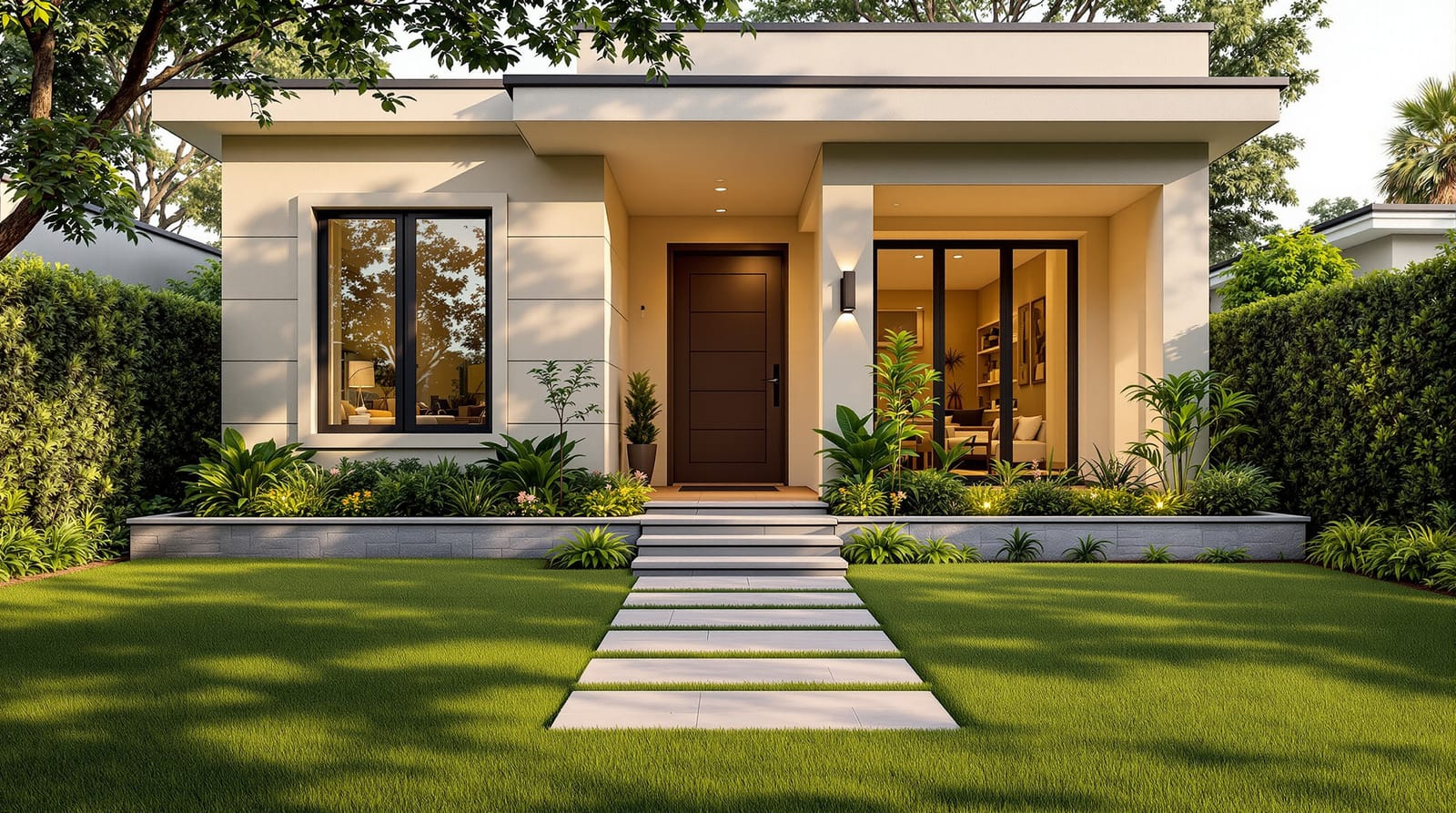
Front Yard Design Ideas — The Garden the Street Sees
Kerb appeal, the arrival sequence, driveway integration, threshold planting and screening the house from the street — without a fortress wall
Your front yard is the one part of your home the whole street reads every single day — it has to welcome a guest, hint at privacy, and look effortless from the kerb while asking almost nothing of you in return.
The front garden of an Indian home does a job no other zone does. The backyard is yours alone; the courtyard belongs to the family; but the front yard is public-facing — it is the handshake your house extends to the road, the postman, the neighbour, and the guest stepping out of an auto at your gate. Get it right and the house feels cared-for and confident before anyone reaches the bell. Get it wrong — a dominating concrete driveway, a fortress wall, a tired patch of grass — and even a beautiful house reads as closed or neglected. This guide is the dedicated playbook for the garden the street sees: arrival, kerb appeal, and the quiet discipline of a low-maintenance public face.
The front yard's twin job
A front yard has to hold two ideas in tension at once. It must be welcoming — open, legible, inviting you to walk in — and it must offer a measure of privacy and security, because it faces the street. The mistake most homes make is to solve only one: either a blank 7-foot compound wall (secure, hostile) or an open lawn with no boundary at all (friendly, exposed).
The resolution is layering. Think of the front yard as three jobs stacked from the road inward:
1. Welcome — the gate and approach read as an open invitation; the front door is the clear focal point.
2. First impression — what the street sees (kerb appeal) is composed and tidy, and stays that way with little effort.
3. Soft defence — partial screening and planting give the house and its windows breathing room from passers-by without walling it off.
Where a Villa Landscape Design treats the front garden as just one of eight zones to balance, and Outdoor Circulation Design covers how people move through a whole site, this guide stays squarely on the front-of-house: the part visitors judge in the first ten seconds.
Reading the zones of a front yard
Even a modest 30x40 or 40x60 plot front setback (typically 3–4.5 m by byelaw) packs several distinct zones into a small strip. Naming them helps you design each on purpose rather than letting the driveway swallow everything.
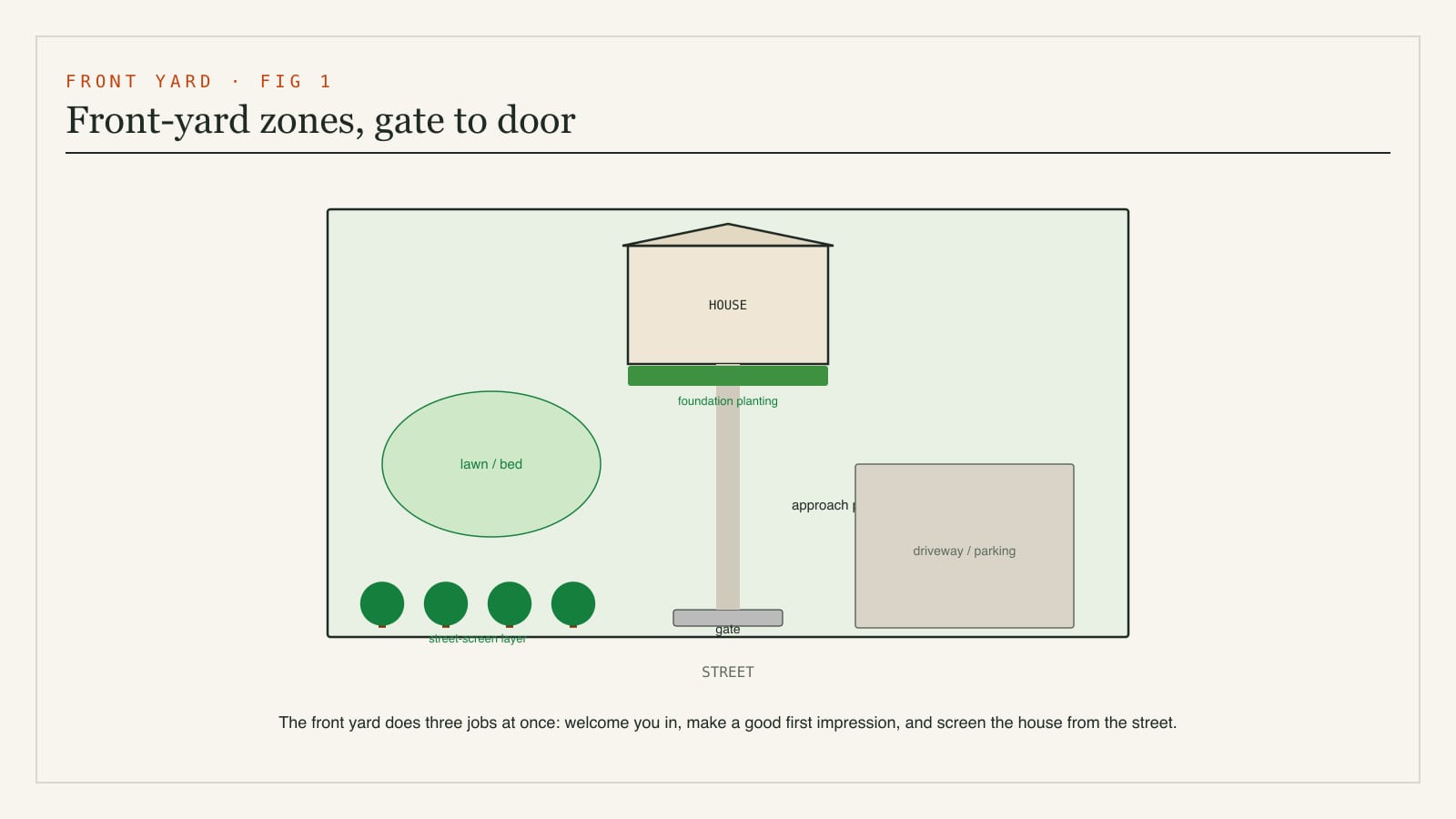
| Zone | What it does | Typical depth/area (front setback) |
|---|---|---|
| Gate and threshold | Marks entry; sets the tone | 1–1.5 m at the boundary |
| Approach path | Carries a person from gate to door | 0.9–1.2 m wide |
| Driveway and parking | Car movement and standing | 2.5–3 m per car width |
| Foundation planting | Softens the house base | 0.5–1 m strip along the plinth |
| Lawn or low bed | The green "rest" for the eye | Whatever is left |
| Street-screening layer | Filters views in/out | 0.3–0.9 m along the boundary |
The art is fitting these into the front setback without any one dominating. The single biggest culprit is the car.
The arrival sequence: gate to door
Good front yards feel like a short, pleasant journey rather than a parking lot you happen to cross. Design the sequence consciously.
The gate
The gate is the first object touched. A solid steel sheet gate reads as defensive; a gate with some openwork (grille, slats, or a planted gate pillar) signals welcome while still controlling access. Frame it — a pair of pillars, a flowering creeper like Madhumalti (Rangoon creeper) or Bougainvillea trained over an arch, or simply two clipped shrubs in pots — so the eye knows exactly where to enter.
The approach path
A separate pedestrian path is the most underrated upgrade an Indian front yard can have. Far too many homes force the guest to walk up the oily, sloping car driveway. Give people their own 0.9–1.2 m route from gate to door — a line of kota stone, terracotta tiles, or stepping pads set in grass — and the whole arrival changes character. Curve it gently if there is room; a path that reveals the door rather than aiming a straight gun-barrel at it feels far more gracious.
The threshold
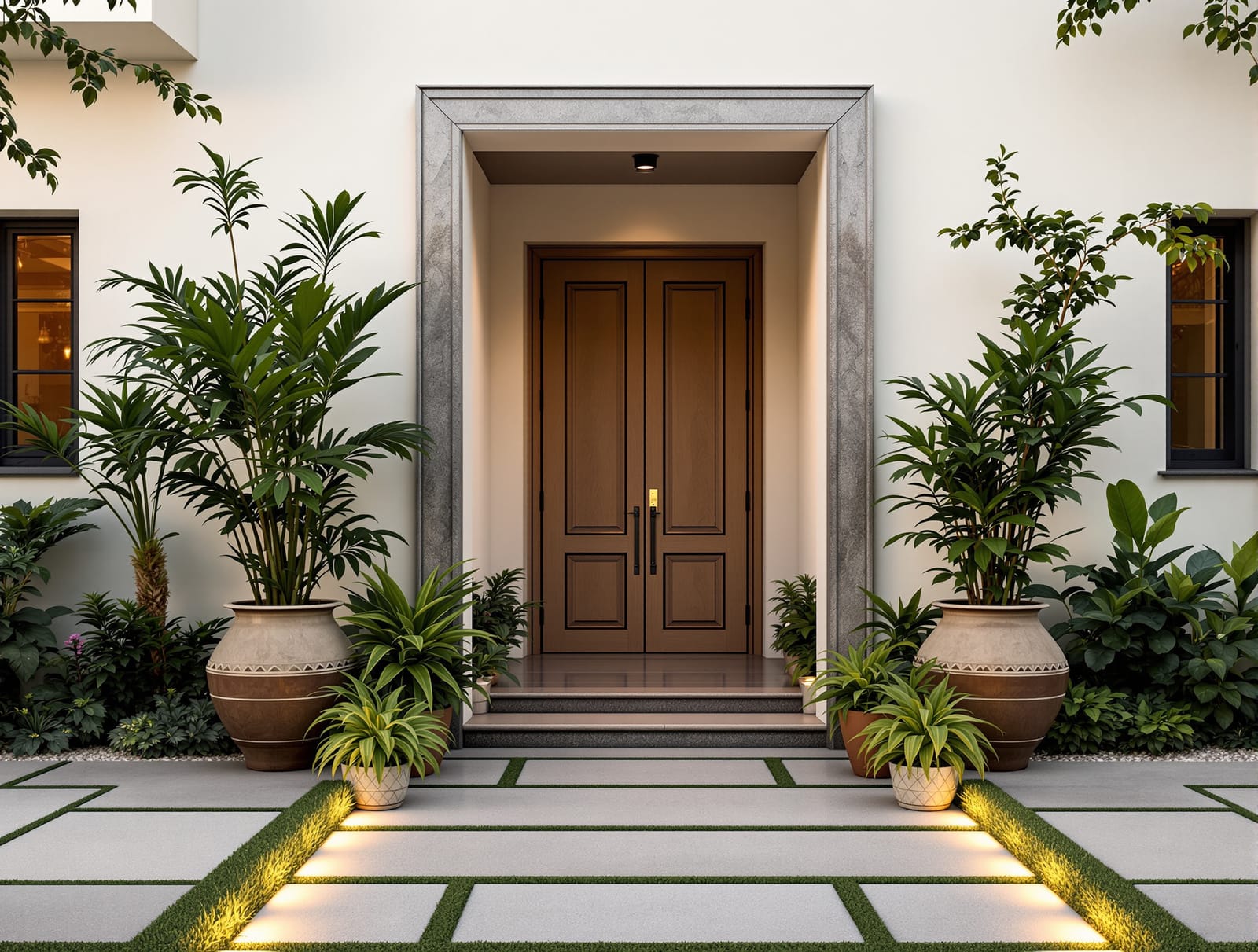
The threshold — the last two metres before the door — is where kerb appeal is won or lost. This is the spot for your best pots, a pair of symmetrical plants flanking the door, a doormat-scale change in paving, and the warm path light that says "you have arrived."
Taming the driveway and parking
In most Indian homes the car is parked in the front setback, and concrete tends to colonise the entire yard. Discipline the car so it does not dominate:
- Use wheel strips, not a slab. Two paved runners (the "ribbon driveway") with grass, gravel, or a grass-paver grid between them cuts visible hardscape by half and lets rain soak in.
- Permeable paving (grass pavers, perforated concrete grids, or open-jointed stone) keeps the front yard green-looking and helps groundwater — important in cities where the front setback is the only unbuilt ground left.
- Share surfaces. Let the pedestrian path and the parking apron meet at a single threshold rather than building two separate hard zones.
- Screen the parked car with a low planted bed or a row of shrubs between the standing area and the road, so the street sees garden, not bumper.
| Driveway approach | Visible hardscape | Rough cost (per sq m) | Rain infiltration |
|---|---|---|---|
| Full concrete slab | 100% | ₹600–900 | Poor |
| Stamped/stone over slab | 100% | ₹1,200–2,500 | Poor |
| Ribbon (wheel strips + grass) | ~50% | ₹700–1,100 | Good |
| Grass pavers (full) | ~30% visible | ₹900–1,600 | Excellent |
Costs are indicative for 2026 metro rates and vary widely with material and labour.
Foundation planting and the planted threshold
Foundation planting is the band of greenery along the base of the house. It does the quiet work of grounding the building so it does not look like a box dropped on bare earth, and it hides the plinth, downpipes, and electrical boxes.
Keep it simple and layered: a low evergreen line (Mussaenda, dwarf Ixora, Duranta "golden" clipped low), a mid shrub or two for seasonal flower (Hibiscus, Tecoma), and one or two taller accents only where they will not block a window or a view from inside. Avoid planting anything that grows large and woody right against the wall — roots and damp are a real problem in Indian monsoon conditions. For species selection by region and microclimate, the companion guide Best Trees for Indian Homes is worth a read before you buy anything tall.
A small front lawn vs low-water beds
The instinct is a lawn — a green carpet says "garden" to most Indian families. Be honest about the cost. A lawn in a hot-dry or warm-humid climate is the thirstiest, most labour-hungry thing you can plant: weekly mowing, daily summer watering, periodic weeding and topdressing.
A small, well-shaped lawn as a deliberate green rest for the eye is lovely. A large lawn covering the whole front yard is a maintenance trap that fights the low-maintenance principle below. The smarter modern front yard is mostly low-water beds and groundcovers with a modest lawn panel — or none at all:
- Groundcovers instead of grass: Wedelia, Mexican grass (Ophiopogon), Portulaca, or carpeting Lantana for sun.
- Massed shrubs that flower without fuss: Bougainvillea, Tecoma, Plumbago, Crossandra (Aboli/Kanakambaram).
- Gravel and mulch to cut watering and weeding between plants.
This is also where you decide the planting palette by your climate zone; the principles in Climate-Responsive Landscape Design apply directly to the exposed, west-sun-baked front strip.
Screening the house without building a fortress
This is the hardest balance in the front yard, and it deserves its own thinking. You want the street to not stare straight into your living-room window or your front door, but you do not want a grim, prison-like wall that also kills ventilation and daylight and signals fear rather than calm.
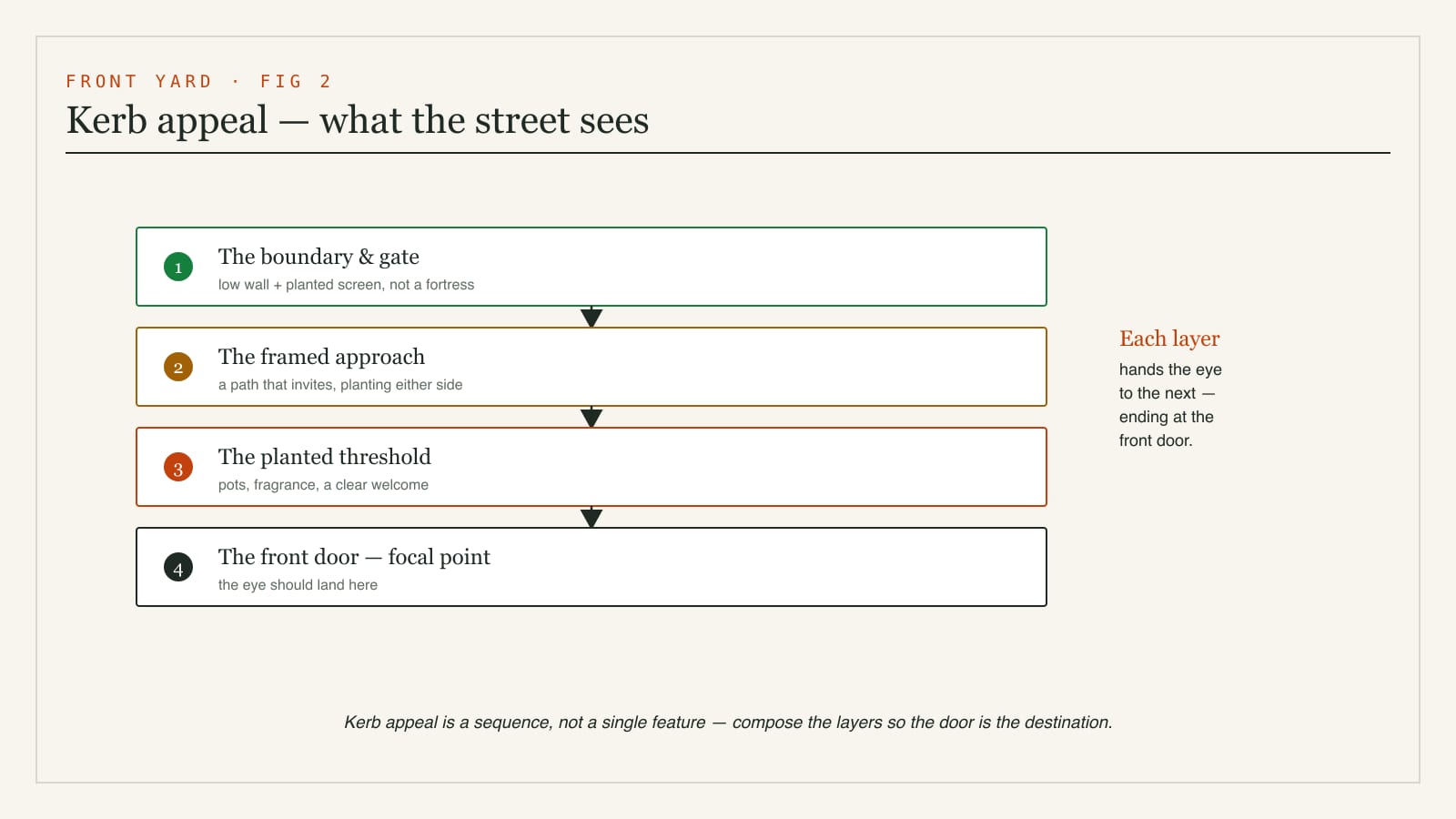
The kerb-appeal layers above are exactly the tools for soft screening. Instead of one tall wall, use:
- A low boundary wall (1–1.2 m) topped with a light grille or planted hedge, so there is enclosure at ground level but air and light above.
- A green screen set just inside the boundary — a hedge of Clerodendrum, Murraya (Kamini/curry-leaf cousin), or bamboo in a planter — that filters sightlines without a slab of concrete.
- Strategic, not solid, planting. You only need to block the specific sightline into a window, not wrap the whole plot. A single well-placed small tree or a tall planter often does more than a continuous wall.
For the deeper toolkit — sightline mapping, layered hedges, and the apartment-balcony version of this problem — see the sibling guide Landscape Privacy Design, which treats screening as its own discipline. This guide keeps it to the front-of-house dose: enough privacy that the house feels settled, never so much that it feels shut.
Front-yard lighting
Lighting is what makes the front yard work after dark — and it is a safety and welcome feature, not a luxury. Keep it warm (2700–3000 K) and low; harsh white floodlights blast the neighbours and flatten everything.
| Light | Where | Purpose |
|---|---|---|
| Gate/pillar lights | At the entry | Find the gate; mark the address |
| Path lights (bollard/inground) | Along the approach | Safe footing; guide to door |
| Threshold/wall light | Beside the door | Welcome; faces and keys |
| Uplight | One feature tree/wall | Drama; depth at night |
| Security light (PIR) | Driveway/dark corners | Deter; only on motion |
Aim light down and across, shield the source from the eye, and put the security floodlight on a motion sensor so it is a deterrent, not permanent glare.
The low-maintenance public face principle
Here is the governing rule of the whole front yard: it must look good with the least possible care, because it is the part you have the least time to fuss over and the most people see. The backyard can be your hobby; the front yard must be self-sufficient. That means:
- Hardy, drought-tolerant, slow-growing plants over fussy showpieces.
- Mulched beds over bare soil (less weeding, less watering).
- Evergreen structure (so it is never bare) with a few seasonal flowering accents.
- Restraint — three or four plant types repeated reads as designed; fifteen reads as chaos and is harder to keep.
A front yard you can keep looking good in twenty minutes a week is worth more than a spectacular one that looks neglected by March.
Security: the thorny-versus-visibility balance
Front-yard security in India is real, but it should be designed, not panicked. Two principles matter:
- Visibility, not opacity, is your friend. A house that can be seen from the street is harder to burgle unobserved than one hidden behind a tall solid wall. Keep the lower 1 m of the boundary open or low so neighbours and passers-by are natural eyes on the property. This is why the fortress wall is often counter-productive.
- Use plants as a defensive layer under vulnerable windows: thorny or dense species like Bougainvillea, Karonda (Carissa), Duranta, or a rose hedge make a far less inviting climb than a bare wall — without the hostile look.
Pair this with the motion-sensor light above and a sightline to the gate, and you get security that does not cost you welcome.
Vastu notes — honestly
Vastu places real weight on the entrance and the front of the home, and many Indian families will want it honoured. Treated honestly — as cultural preference and good arrival design rather than guaranteed outcome — the common front-yard guidance is mostly benign and often coincides with sound design:
- A clean, well-lit, unobstructed main entrance in the north, east, or north-east is favoured. This is also just good kerb appeal: a clear, bright front door.
- Keep the north-east light and open (no heavy structure, tall trees, or clutter there). A lighter, lower-planted NE corner is genuinely pleasant.
- Avoid a large tree directly in front of the main door — Vastu discourages it; practically, a big tree right on the threshold blocks light and drops leaves on your welcome.
- The front is considered auspicious for water features and lighter elements — again, harmless and often lovely.
Follow what brings your household peace of mind, but do not let a Vastu rule force a worse arrival (for instance, a door no one can find). Where Vastu and good design agree — light, openness, a clear path — they reinforce each other.
Bringing it together
A front yard that works is not expensive or complicated. It is layered and intentional: a welcoming framed gate, a separate planted path that leads the eye to the door, a car kept in its place behind a screen of green, foundation planting that grounds the house, a modest lawn or low-water beds, a soft screening layer for privacy, warm low lighting, and a planting palette chosen to look after itself. Once the front of the house is sorted, turn to the private side — the sibling guide Backyard Design Ideas takes the same care to the garden only your family sees.
References & further reading
- National Building Code of India 2016, Part 10 (Landscape Development, Signs and Outdoor Display Structures) — Bureau of Indian Standards. Setbacks, site development, and planting guidance.
- Indian Society of Landscape Architects (ISOLA) — professional resources and Indian landscape practice references.
- ICAR–Indian Institute of Horticultural Research (IIHR), Bengaluru — region-appropriate ornamental and hedge species for Indian conditions.
- Royal Horticultural Society (RHS) — front-garden planting, hedging, and low-maintenance bed principles (adapt species to Indian climate).
- CPWD Horticulture Manual / Harmonised Guidelines for Accessibility (2021) — path widths, gradients, and accessible approach design.
- "Trees of Delhi" / "Flowering Trees" (Pradip Krishen; M. S. Randhawa) — authoritative references for selecting Indian trees and flowering species near homes.
Export this guide
Related Guides — Deep-dive reading
The Best Trees for Indian Homes
A research-grade guide to choosing and placing trees around an Indian home — the real cooling and clean-air numbers, the right species for shade, flowers, fragrance and fruit, and the placement science that keeps roots out of your walls and drains.
LandscapeVilla Landscape Design — Indian Villa Gardens, Hardscape & Vastu Landscape (2026)
8 landscape zones · Climate-zone tree palette · Vastu landscape · NBC 2016 Part 10 · 1.5 acre worked example
Design StylesOrientation, Light & Views: Designing With Your Space, Not Against It
How reading your plot's sun, breeze and views — and placing each room on the right face — gives an Indian home that is cooler, brighter and quietly right, instead of one that fights its site forever.
Design PrinciplesRelated Tools — Try Free
Cross-Ventilation Analyzer
Estimate airflow and air changes per hour (ACH) from room size, window areas, layout, and local wind — with NBC 2016 Part 8 compliance check.
Ventilation CalculatorWindow Grill Design Selector
Pick a window grille style and material by priority — security, looks, budget, view — and estimate cost.
Window ToolGarden Planning Toolkit
Get a tailored garden plan — planting layers, Indian species, features and a checklist — from your climate, space, sun and goals.
Planner