
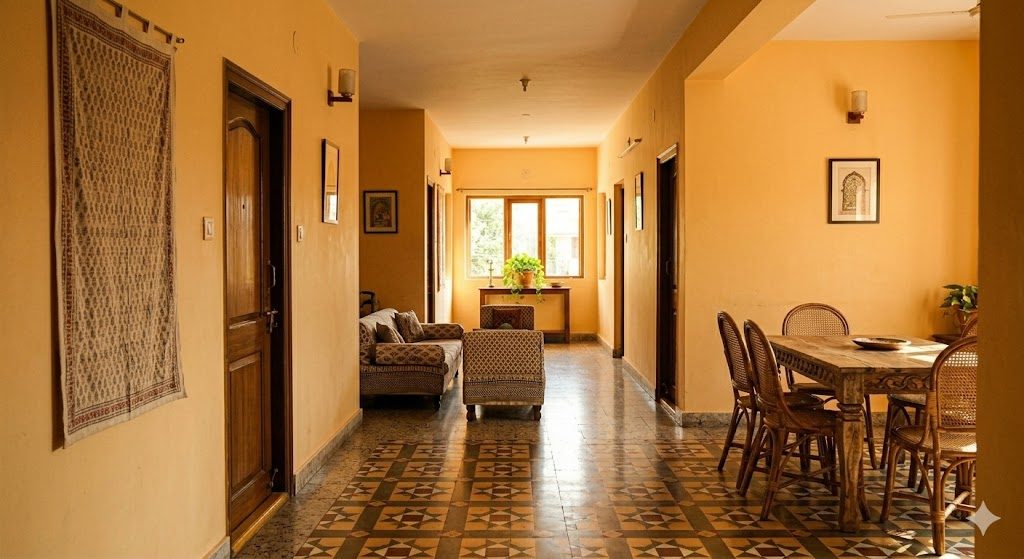
Understanding Spatial Flow in Home Design
How you move through a home — and why good flow is invisible while bad flow nags every day
It is 7:40 on a weekday morning and three people are trying to leave one apartment. Someone is reversing out of the bathroom with a toothbrush still in their mouth. Someone else is carrying a tiffin from the kitchen and has to wait, because the only path to the front door runs straight through the spot where the first person is now hunting for keys. A third person, half-dressed, is pinned in a bedroom doorway. Nobody has done anything wrong. The home itself is creating the traffic jam.
This guide is about that invisible thing — the way a home choreographs movement. Not how big the rooms are, not how they are zoned for privacy, but how a person actually travels through connected spaces over the course of a day: the paths they trace, the corners they cut, the spots where two journeys collide. Architects call it circulation or spatial flow. Most homeowners only notice it when it is bad.
Good flow is invisible — you simply move through the home without thinking, and the layout disappears. Bad flow nags at you every single day, in small frictions you have stopped consciously registering but that quietly cost you time, temper and ease. This guide teaches you to see it, test it on a plan, and fix it before a wall is ever built.
What "spatial flow" actually means
A home is not a collection of rooms. It is a set of rooms plus the movement between them — and that movement is half the experience of living there. Spatial flow is two things at once: the literal path of travel (where your feet go to get from A to B) and the experience of moving through a connected sequence of spaces (what you see, what opens up, what feels cramped or generous as you go).
The distinction matters because rooms get all the attention and circulation gets almost none. Buyers measure bedrooms in square feet and count bathrooms. Almost nobody asks how many steps it takes to carry a hot pan from cooktop to dining table, or whether a guest can reach the sofa without walking past your unmade bed. Yet those movement questions decide whether a home feels effortless or exhausting, far more reliably than another fifty square feet of carpet area.
Three sibling guides on this site handle the neighbouring territory: space-planning principles covers room sizes and clearances; space zoning in Indian homes covers grouping spaces by privacy; and the guide on planning mistakes that make homes feel smaller covers perceived volume. This one owns a different axis entirely — movement, circulation and the sequence of moving through. The choreography, not the rooms.
The home as a stage for daily journeys
The honest way to evaluate flow is to stop looking at the plan as a picture and start watching it as a film — a film of one family across one ordinary day. Every household runs a small number of repeated journeys, and the layout either helps those journeys or fights them.
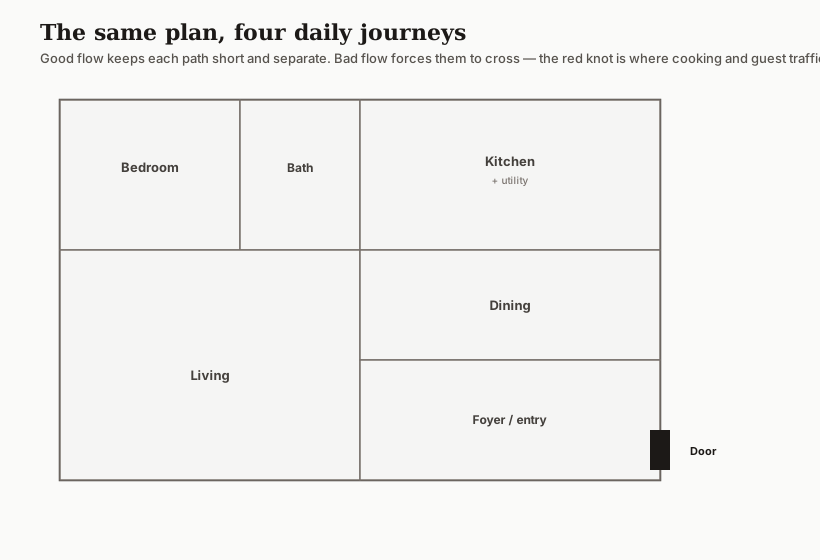
Consider the recurring movement patterns of a typical Indian home:
| Daily journey | What good flow looks like | What bad flow does |
|---|---|---|
| Morning rush (bedroom to bath to kitchen to door) | Each leg short; the bath sits near bedrooms; the exit does not pass through the kitchen work zone | Single shared bathroom at the far end; the only route to the door cuts across the cooking triangle at peak chaos |
| Cooking to dining | Cooktop to dining table in under 4–5 m, no door to nudge open with full hands | Kitchen and dining on opposite sides of the living room; hot dishes carried 8–10 m past seated guests |
| Guest arrival | Door to sofa entirely within the public zone; private corridor never crossed | Guests see straight into bedrooms or must walk past them; the only loo is inside the private wing |
| Service flow (help, deliveries, dustbin, gas cylinder) | A short, somewhat separate route into the kitchen/utility that bypasses the living room | The cook and the courier track through the formal living room every time |
| Kids and elders | Children's room within sightline of the living; elders near a ground-floor toilet, no steps in the daily path | Elders climb stairs to the only bathroom; a toddler's path to a parent runs across an open kitchen |
Notice that none of these journeys is exotic. They happen ten or twenty times a day, every day, for decades. A plan that adds three metres and a door-leaf to each of them is quietly taxing its occupants thousands of times a year. This is why flow, not finish, is what separates a home you relax in from one you are subtly always managing.
Circulation as choreography
Once you watch the journeys, a few governing principles emerge. The first is that people move along desire lines — the path they actually want to take, which is almost always the shortest reasonable one between where they are and where they want to be. You can see desire lines everywhere humans walk: the worn diagonal track across a lawn that ignores the paved L-shaped path. Inside a home it is the same instinct. If the designed route is longer than the obvious one, people will cut the corner, brush past furniture, and squeeze through gaps — and the layout will feel like it is resisting them.
Good circulation respects desire lines: it puts the path where people already want to walk, and keeps that path short and clear. The corollary is the second principle — avoid cross-traffic. Two streams of movement that cross each other create friction, collisions and a low background stress. The classic Indian-home offenders are guests cutting through a private bedroom corridor to reach the only spare toilet, and the cook's hot-pan run from kitchen to dining slicing straight across the route guests use to reach the sofa. Each crossing is a small negotiation: who yields, who waits, who says sorry. Multiply by a day.
Circulation is not leftover space between rooms. It is the most-used "room" in the house — and the one nobody designs on purpose.
The third principle is circulation efficiency. Corridor and passage space is unfurnishable; every square metre of it is area you paid for and cannot live in. But the answer is not zero corridor — it is minimal corridor, with paths that double as transition rather than dead-ending. A short hall that distributes to three bedrooms earns its area. A long spine that exists only to reach one back room is dead space. Where you can, prefer a loop over a dead-end: a route you can pass through and out of feels light and lets two people move without confrontation, whereas a pocket you must back out of forces single file and the small awkwardness of giving way.
Arrival: the sequence that makes a home feel like a home
Flow is not only efficiency; it is also experience. The most charged stretch of movement in any home is the first thirty seconds — the arrival sequence, from the moment you cross the threshold to the moment the home reveals itself.
The architect Christopher Alexander, in A Pattern Language, described this as a deliberate rhythm of compression and release. You pass through something low, narrow or shaded — a porch with a 2100 mm ceiling, a modest foyer — and then the space opens: the ceiling jumps to 2700–3000 mm, light floods in, and the living area feels generous precisely because you were just squeezed. The contrast does the work. A living room you enter directly off the street feels ordinary; the same room entered after a moment of compression feels like an arrival. Alexander's related pattern, the entrance transition, argues that a home needs a clear in-between place that is neither outside nor fully inside, so that you change gear as you cross it.
Two more ideas complete the sequence. Threshold is the marked moment of entry — a change in floor level, material or light that tells your body "you are now inside." In Indian homes this is ancient: the raised otla or veranda, the carved doorframe, the rangoli at the step. Reveal is what the space shows you as you complete the entry — ideally a framed view: a window onto a courtyard, a green wall, a glimpse of the garden, placed so that as you walk in, your eye is pulled forward toward light. Movement follows the eye. Pull the gaze toward something worth seeing and the whole entry feels purposeful rather than abrupt. This is procession — the choreographed unfolding of space as you move — and it is the single biggest reason some modest homes feel gracious while large ones feel like lobbies.
Adjacency logic: deciding what sits next to what
If circulation is the verb, adjacency is the grammar that makes good circulation possible in the first place. Most flow problems are really adjacency problems in disguise — the cooking-to-dining marathon exists because somebody put the kitchen far from the dining table. Solve adjacency first and many circulation problems never arise.
Architects do this before drawing any walls, using a bubble diagram (also called an adjacency diagram): each space is a loose circle, and lines connect the circles that need to be near each other, with a different line for pairs that must be kept apart. You solve the relationships as pure topology — who needs whom — and only then push the bubbles into the actual shape of the plot. It is the cheapest, fastest design tool there is, and you can do it on the back of an envelope.

The recurring adjacency rules for an Indian home:
| Space | Should be near | Should be away from |
|---|---|---|
| Kitchen | Dining, utility/wash, service entry, fridge-side store | Bedrooms (smell, heat, clatter), formal living seating |
| Dining | Kitchen, living (visually open is fine) | The main movement spine between door and bedrooms |
| Living | Entry/foyer, dining, balcony | Bedroom doors opening directly into it |
| Master bedroom | Attached bath, other bedrooms (cluster) | Kitchen, front door, noisy living/TV wall |
| Common toilet | Living/public zone (reachable without entering the private wing) | Buried so deep that guests must cross bedrooms to reach it |
| Puja / prayer space | Quiet, often NE per Vastu; visible but not on a thoroughfare | Adjacent to or facing toilets; in a high-traffic crossing |
| Utility / wash | Kitchen, service entry, drying balcony | The formal arrival sequence |
| Elders' room | Ground-floor toilet, family living | Stairs, the noisiest evening zones |
Two adjacencies deserve special emphasis in the Indian context. First, the kitchen-to-utility-to-service-entry chain: groceries, the gas cylinder, the wet waste and domestic help all want a route that reaches the kitchen without parading through the living room. Second, the public-private separation — the bedroom cluster should sit behind the public zone so that the act of receiving a guest never exposes private space. Get those two right and the home's circulation almost designs itself.
Open or compartmentalised? Choosing the flow you want
Indian homes are caught between two ideals. The open-plan, where kitchen-dining-living merge into one continuous space, sells the dream of airy togetherness. The compartmentalised plan, with the kitchen sealed behind a door, protects against the one thing open plans struggle with here: Indian cooking. Tempering mustard seeds, deep-frying, the daily tadka — these throw oil aerosol and pungent smoke that an open kitchen broadcasts into the sofa fabric and the curtains. ASHRAE-style exhaust guidance suggests a working Indian kitchen wants on the order of 15 or more air changes per hour at the cooktop; an open plan makes that exhaust job far harder and leaks whatever it misses across the whole floor.
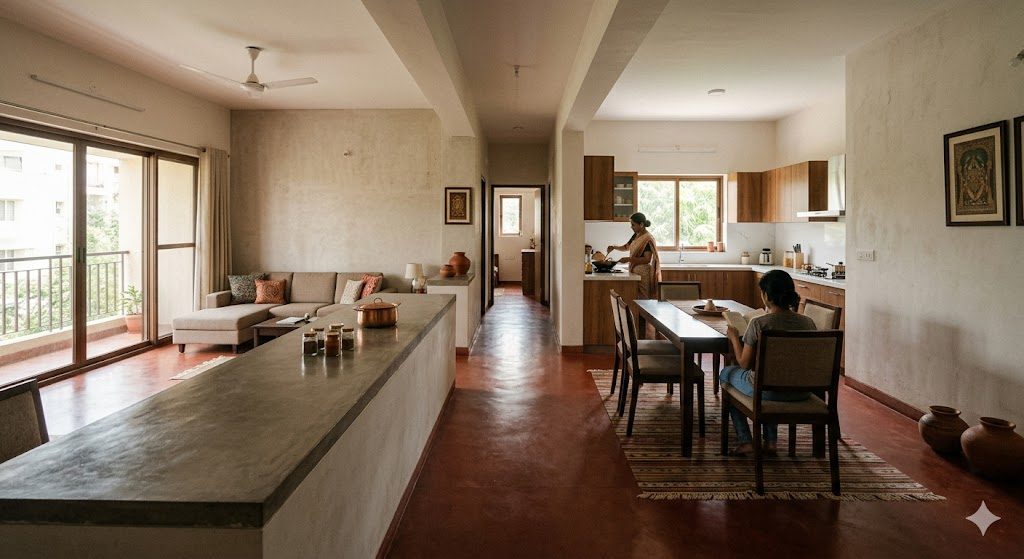
So the choice is not fashion, it is flow priority:
| Choose open flow when | Choose compartmentalised flow when |
|---|---|
| You want sightlines and conversation across cooking, eating and lounging | Heavy daily frying/tempering is the norm and smell control matters |
| The household is small and cooking is light or vented hard | You want to hide kitchen mess when guests arrive |
| You crave the sense of larger volume from merged spaces | You value acoustic privacy — one person cooking, another on a call |
| A strong chimney/exhaust (1000+ m³/h) is in the budget | Budget or layout cannot support strong mechanical exhaust |
The pragmatic Indian answer is often a hybrid: a visually open dining-living, but a kitchen that can be closed off with a sliding or pocket door — open for flow on quiet days, sealed for the heavy cooking. You keep the generous circulation when you want it and the smell barrier when you need it.
Flow and the senses: light, view and the pull forward
Movement is not only mechanical; it is drawn. People walk toward light and toward the promise of a view, often without realising it. Juhani Pallasmaa and other writers on the experience of architecture describe how the body reads space through all the senses, not just the eyes — but vision and light lead the feet. This gives the designer a quiet tool: place light and a worthwhile view at the end of a path, and the circulation begins to feel inevitable rather than imposed.
Practically, this means a passage should terminate in a window, not a blank wall. A corridor that dead-ends in plaster feels like a mistake; the same corridor ending in a sunlit sill feels like it was leading somewhere. It means the framed view at the end of the arrival sequence is not decoration but navigation. And it means sightlines matter: what you can see from where you stand shapes where you choose to go and how large the home feels. A home where you glimpse a far window from the entry reads as deeper and more connected than one chopped into visual dead-ends — a theme the planning-mistakes guide develops, and which our architectural psychology guide ties to the deep human preference for prospect: seeing out, seeing ahead, seeing where the path goes.
How to test flow on a plan — before you build
You do not need software to evaluate flow. You need to walk the plan in your head, as each member of the household, across a full day. This single discipline catches most circulation failures while they are still erasable pencil lines.
Take any plan and run this flow-test checklist:
- Trace the morning rush. Put a finger on a bedroom and walk it to the bathroom, then to the kitchen, then to the front door. Is each leg short? Does it cross the cooking zone at the busiest moment? Could two people do it at once without colliding?
- Trace the cooking-to-dining run. Measure cooktop to dining table. Under about 5 m and with no door to open with full hands? If not, the cook pays for it three times a day.
- Trace a guest's arrival. From the door to the sofa, does the route stay in the public zone? Can a guest reach a toilet without entering the bedroom corridor? Do they see into any bedroom?
- Trace the service flow. Can groceries, a cylinder, the wet-waste bin and domestic help reach the kitchen without crossing the formal living room?
- Trace the elders and the kids. Is there a toilet on their level, on their daily path, without steps? Can a parent in the kitchen keep a small child in sightline?
- Hunt for cross-traffic. Mark every spot where two of those paths cross. Each crossing is a friction point; redesign to uncross them.
- Check for dead corridor. Is any passage there only to reach a single room? Can it be shortened, widened into use, or turned into a loop?
- Check the path ends. Does each main path terminate in light or a view, or in a blank wall?
- Count the door-leaves on hot paths. Every door you must open with full hands on a frequent route is a tax. Minimise or use sliding/pocket doors.
Corridor dimensions matter when you do this — a passage below about 900 mm clear width forces single file and turns every meeting into a stand-off; our corridor-width guide covers the exact thresholds, and the space-planning principles guide gives the room-by-room clearances that keep these paths walkable.
Common flow failures and their fixes
A handful of mistakes account for most of the bad flow in Indian homes, and each has a clean fix:
- The kitchen-dining divorce. Fix: relocate the dining adjacent to the kitchen, or open a serving hatch; never put the living room between them.
- The guest-through-bedrooms toilet. Fix: provide a common toilet reachable from the public zone; cluster bedrooms behind it.
- The single far bathroom. Fix: split into two, or position the shared bath central to the bedroom cluster so morning legs stay short.
- The corridor to nowhere. Fix: absorb a single-purpose corridor into the room it serves, or convert it into a loop.
- The bedroom door into the living room. Fix: introduce a short buffer or rotate the door so private space is never on display during a gathering.
- The blank-wall path end. Fix: end passages on a window, a niche, or a framed view to give movement a destination.
- The full-house service march. Fix: give help and deliveries a service route to the kitchen/utility that bypasses the formal living.
None of these costs more to fix on paper than to ignore — and all of them cost dearly to fix after the walls are up.
What this means for your home
1. Stop evaluating rooms in isolation; evaluate journeys. List your household's five daily journeys and judge any plan by how short and clean each one is.
2. Draw the bubble diagram first. Before fixing room sizes, decide adjacency: what must be near, what must be apart. Kitchen near dining and utility; bedrooms clustered; public separated from private.
3. Hunt and eliminate cross-traffic. Trace every path and uncross the ones that collide — especially cooking-to-dining versus guest-to-sofa, and service versus living.
4. Shorten the cooking-to-dining run to under about 5 m with no door to open with full hands. Your future self will thank you thrice daily.
5. Give guests a toilet they can reach without entering the private wing, and keep bedroom doors off direct view from the gathering zone.
6. Design the arrival. Compress at the threshold, release into the living space, and end the line of sight on light or a framed view.
7. Choose your kitchen flow deliberately — open for connection, closable for heavy Indian cooking, or a hybrid sliding door for both.
8. Walk the plan in your head as every family member, across a whole day, and fix what nags now, on paper, while it is free.
Want to see these journeys before a single wall is built? With DesignAI you can lay out your home, trace the daily movement paths, and test adjacency and arrival in minutes — turning the invisible choreography of flow into something you can actually see and refine. Pair it with our layout planner to block out zones and our furniture layout designer to confirm the paths stay clear once the sofa and dining table land.
References
1. Christopher Alexander, Sara Ishikawa & Murray Silverstein, A Pattern Language: Towns, Buildings, Construction — patterns on Entrance Transition, Intimacy Gradient, Circulation Realms and Zen View (Oxford University Press, 1977).
2. Juhani Pallasmaa, The Eyes of the Skin: Architecture and the Senses — on movement, multisensory experience and procession through space (Wiley, 2012).
3. Francis D. K. Ching, Architecture: Form, Space and Order — chapters on circulation, approach, path-space relationships and configuration of paths (Wiley).
4. Ernst Neufert, Architects' Data — anthropometric clearances, corridor and passage widths, and adjacency planning standards.
5. National Building Code of India 2016 (Bureau of Indian Standards), Part 3 (Development Control) and Part 4 — minimum room dimensions, passage widths and means-of-access provisions.
6. ASHRAE Standard 62.1, Ventilation for Acceptable Indoor Air Quality — kitchen exhaust and air-change guidance relevant to open versus closed cooking layouts.
7. Edward T. Hall, The Hidden Dimension — proxemics and how spatial distance shapes movement and comfort between people (Anchor Books, 1966).
Keep exploring the Design Education series: why corridor width matters, space-planning principles, space zoning in Indian homes, and the planning mistakes that make homes feel smaller.
Export this guide
Related Guides — Deep-dive reading
Sequential Progressions: Why the Order of Spaces Matters
A home is experienced as a journey in time, not a plan seen all at once — and arranging that journey, with compression, release and thresholds from public street to private inner room, is what makes a house feel right.
Design PrinciplesWhy Corridor Width Matters
The most overlooked dimension in your home — how passage width decides comfort, flow and wasted space
Design EducationSpace-Efficient Homes — A 2026 Working Reference for Compact Indian Apartments
Five spatial multipliers · Floor plan tricks · Dual-purpose furniture
Room PlanningRelated Tools — Try Free
Bubble Diagram Planner
Drag rooms as scaled bubbles and link the spaces that belong together — the architect's first sketch.
Design ToolAcoustic Privacy (STC) Visualizer
Indian healthcare acoustic visualizer — compare wall assemblies and noise sources, see received SPL after STC attenuation, and check FGI 2018 / IS 1950 / NABH speech-privacy compliance with live dual-canvas waveform.
Acoustic ToolApartment Furniture Size Chart
Standard furniture dimensions for Indian apartments — sofas, beds, tables, dining, storage.
Reference Chart