
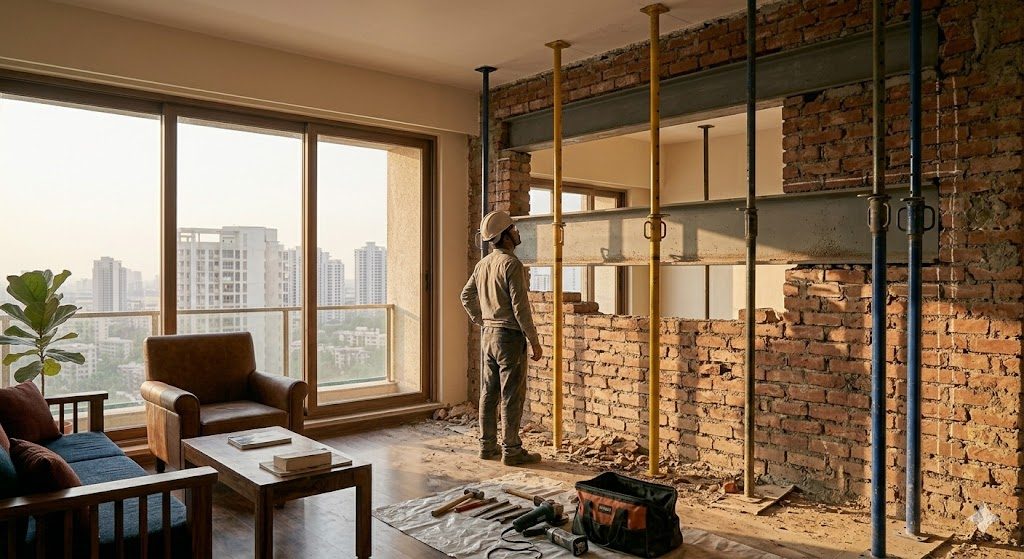
Understanding Structural Walls Before Renovation
Which walls hold your home up — and the costly, dangerous mistake of removing the wrong one
You have stood in your own home and imagined it open. Knock out the wall between the kitchen and the living room, and suddenly there is light, sightlines, a place for the family to gather. The contractor nods, says it is "just a partition," and quotes a number. By the weekend a man with an angle grinder has turned your idea into a cloud of red brick dust.
Sometimes that wall really was just a partition, and nothing happens. And sometimes it was the wall holding up your bedroom floor — or your upstairs neighbour's — and three weeks later a diagonal crack walks across the ceiling, a door stops closing, and a structural consultant is standing in your living room shaking his head at a bill that dwarfs the renovation. This guide is about telling those two walls apart, before the grinder starts.
Not all walls are equal. Some merely divide space; others quietly carry the weight of everything above them down to the ground. Removing the second kind without engineering it first is one of the few renovation mistakes that can injure people — and it is almost always avoidable.
Why this is the one renovation question you cannot wing
Most renovation mistakes are about money and taste. You overpay for a kitchen, you regret a paint colour, you discover the false ceiling eats 200 mm of height you wanted back. Annoying, fixable, survivable. (We cover the financial side of these in our home renovation cost guide and the things nobody warns you about in hidden costs of renovation.)
Structural walls are a different category. A wall that carries load is not decoration and it is not negotiable with a hammer. When it is removed without a replacement load path, the weight it was carrying does not vanish — it has to go somewhere, and it goes into things that were never designed to take it. The slab above sags. Walls beside it overload. Cracks open along lines of stress. In the rare but real worst case, a floor collapses.
The cruelty of it is that the failure is often delayed. The wall comes down, the room looks wonderful, everyone is paid, and the contractor moves on. The structure redistributes load slowly — concrete creeps, masonry settles — and the symptoms surface weeks or months later, by which time the cause is buried under plaster and the responsible party is unreachable. By the time a load-bearing failure is visible, the cheap moment to prevent it is long gone.
So this is not a topic where you trust a confident voice on site. It is a topic where you understand the structure of your own home well enough to ask the right question, and then insist on the one right answer: a structural engineer who has looked, read the drawings, and signed.
Two ways a home stands up
Almost every home in India is built one of two ways, and which one yours is decides everything that follows.
In a load-bearing building, the walls are the structure. Bricks or stone, stacked thick, carry the weight of the roof and every floor above straight down through themselves into a continuous footing in the ground. There are no columns to speak of; the walls do that job. This is how most homes were built before reinforced concrete became standard, and how a great many low-rise houses, older bungalows, village homes, and pre-1980s buildings are still standing. In these homes a surprising number of internal walls are working — the external walls almost always, and usually one or more interior "spine" walls that the floor slabs span onto.
In an RCC framed building, a skeleton of reinforced cement concrete does the carrying: vertical columns and horizontal beams form a rigid frame, with floor slabs spanning between the beams. The walls are infill — brick or block panels that fill the gaps in the frame to make rooms, keep out weather, and give you privacy, but carry nothing but their own weight. This is how nearly every apartment built in the last few decades is constructed, and most new individual houses too. The frame is doing the structural work; the walls are tenants.
The practical consequence is large. In a framed building, many internal walls genuinely can be removed, because the frame will stand without them — though, as we will see, "many" is not "all" and the permission to do so is a separate matter. In a load-bearing building you must assume nothing, because the wall you want gone may be the only thing holding up the room over your head.
| Load-bearing (masonry) | RCC framed | |
|---|---|---|
| What carries the weight | The walls themselves | Columns + beams + slabs |
| Typical era / building | Older, pre-1980s, low-rise, many bungalows & village homes | Most apartments and new houses |
| External wall thickness | 230–450 mm (9–18 in), often stone or 1.5-brick | Often 150–230 mm, but thickness alone proves nothing |
| Internal walls | Some are structural "spine" walls | Mostly non-structural infill |
| Columns visible? | Rarely / none | Yes — corners and grid points, often hidden in walls |
| Beams overhead? | Lintels over openings only | Beams (or drops) running along grid lines |
| Foundation | Continuous strip footing under walls | Isolated / raft footings under columns |
| Removing an internal wall | High risk — assume structural | Lower risk for true infill — but verify first |
| Governing codes | IS 1905 (masonry), NBC 2016 | IS 456 (RCC), NBC 2016 |
A caution that trips up many homeowners: a building can be mixed. Old homes get RCC additions; framed buildings sometimes have a load-bearing core. And in a framed building, the columns themselves are frequently hidden inside what looks like an ordinary wall — so "it's a framed building, walls don't matter" is exactly the kind of half-truth that gets a column chiselled into. Knowing your building type narrows the question. It does not answer it.
How to tell which wall is which
You can gather strong clues yourself. You cannot reach a verdict yourself. Hold both of those thoughts at once.

Thickness. Thick walls are suspicious. A 230 mm (9-inch) wall, or anything thicker, is far more likely to be doing structural work than a 115 mm (4.5-inch) or 75 mm partition. Measure at a doorway or a switch box where the wall is cut. But beware: in framed buildings, infill walls are sometimes 230 mm too (for sound or external weather), and a column hidden in a wall reads as "extra thick." Thickness raises suspicion; it does not settle it.
Position. External walls are almost always structural — they carry the roof and resist wind, and in masonry homes they carry everything. Internal walls running across the short direction of a room, that the floor joists or slab appear to span onto, are prime suspects. A wall that runs down the spine of the house, floor after floor, is doing a job.
A beam overhead. Look up. If a beam — or a "drop," a band of ceiling that hangs lower — runs directly along the top of the wall, that wall is very likely transferring load into or out of that beam. In framed buildings the beams trace the structural grid; a wall sitting under a beam is part of how load reaches the columns.
Stacking. Structural walls line up vertically. If the wall sits directly above a wall on the floor below and directly below a wall on the floor above — same line, every storey — it is part of a load path. A partition, by contrast, can sit anywhere because it carries nothing; you will often find a partition on one floor with open room beneath it.
Age and material. A pre-1980s low-rise home in brick or stone is probably load-bearing throughout. A modern apartment with visible columns is framed. Stone, full brick, and lime mortar lean old and structural; lightweight AAC blocks, gypsum board, and hollow partitions lean non-structural — though, again, AAC is now used as infill in framed buildings precisely because it is light, so material is a hint, not a proof.
The original drawings. This is the single most useful document you can find. The original architectural and structural (RCC) drawings show the column grid, the beam layout, the slab spans, and any shear walls — in black and white. Society offices, the builder, the original architect, or the municipal approval file may hold them. An engineer reading those drawings can tell you in minutes what a week of tapping cannot.
The tap test. Knock along the wall. A solid, dull thud suggests masonry or concrete; a hollow echo suggests a lightweight or hollow partition. This is the weakest clue on the list — a solid-sounding wall can still be non-structural infill, and a plastered partition can sound surprisingly solid — so treat it as a tiebreaker, never a verdict.
Here is the same logic as a working checklist:
| Clue | Points toward LOAD-BEARING | Points toward partition | Strength |
|---|---|---|---|
| Thickness | 230 mm+ (9 in or more) | 75–115 mm | Moderate |
| Wall is external | Yes | — | Strong |
| Beam / drop directly above | Yes | No beam above | Strong |
| Stacks floor-to-floor on same line | Yes | Sits over open space below | Strong |
| On the structural (RCC) drawing | Marked as wall / shear wall | Not on structural plan | Decisive (with engineer) |
| Building age / type | Pre-1980s masonry, low-rise | Modern framed flat, infill | Moderate |
| Material | Stone, full brick | AAC block, gypsum, hollow | Weak–moderate |
| Tap sound | Solid, dull | Hollow echo | Weak |
| Carries a water tank / staircase / heavy load above | Yes | No | Strong |
No single clue proves a wall is safe to remove. The clues exist to tell you when to STOP and call a structural engineer — not to give you permission to start.
And that is the rule beneath all the clues: confirm with a licensed structural engineer, every time, before anything is cut. A site engineer is not the same as a structural consultant; the person who designs the load path is the one who must sign off on removing part of it. The clues above tell you how worried to be. Only the engineer tells you what is true.
What a load-bearing wall actually does, and what goes wrong
A load-bearing wall is, in engineering terms, a vertical support in compression. The slab above rests on it; that slab's weight, plus everything on the slab — furniture, people, the floors above — flows down through the wall as a steady push toward the ground. The wall is happy doing this; masonry is strong in compression, which is exactly why it was used this way for centuries.
Take the wall away and the slab it was supporting loses one of its supports. A slab designed to span, say, 3 m onto that wall now has to span 6 m to the next support — a span it was never reinforced for. The consequences arrive in a fairly predictable order:
Deflection. The slab or beam sags under the load it can no longer shed. You may see a ceiling that dips slightly in the middle, doors and windows in the room above that suddenly bind or won't latch, and floor tiles that lift or "drum."
Cracking. Stress concentrates where it has nowhere good to go. Diagonal cracks appear above former wall ends and at the corners of openings; horizontal cracks open where a now-unsupported wall above starts to part. Cracks that grow, that you can slide a coin into, or that run diagonally are the ones that matter.
Overload of neighbours. The load did not disappear; it transferred. Adjacent walls and columns now carry more than they were sized for, which can crack them, sometimes in a different room than the one you renovated.
Collapse. Rare, but the reason this guide exists. A floor slab losing its support, especially in an older masonry building with no redundant frame to catch the load, can come down — taking the room below with it. People have died this way in Indian cities, usually in unauthorised structural alterations to old buildings. This is the outcome the whole exercise is meant to make impossible.
The pattern is what makes it dangerous: the wall comes out, the room looks great, and the failure is delayed while the structure slowly redistributes. The absence of an immediate problem is not evidence of safety. It is just the gap before the bill.
The walls you must never touch in a highrise
Apartment dwellers face one extra category, and it is non-negotiable. Tall buildings have to resist not just gravity but lateral forces — wind, and in much of India, earthquakes. They do this with shear walls and core walls: thick reinforced-concrete walls, often around staircases, lift shafts, and service cores, that act like a stiff spine bracing the whole tower against sideways movement.
A shear wall looks, from inside your flat, like any other wall. It is usually 150–300 mm of solid RCC (not brick), often without a separate beam over it because the wall is the beam, and it tends to run continuously up the full height of the building in the same position on every floor. Cut an opening in it, chase a deep groove for plumbing, or — worst of all — remove it, and you are not weakening one flat; you are weakening the building's resistance to the next earthquake or storm, for everyone in it.
The rule is simple and absolute: shear walls and core walls are never to be touched, opened, or chased into — by anyone, for any reason, without the original structural designer's written approval. In practice the answer is almost always no. If a wall in your flat is solid RCC rather than brick, treat it as a shear wall until an engineer proves otherwise, and leave it entirely alone.
What you can do — making a safe opening
The good news: you usually do not have to choose between an unsafe demolition and keeping the wall. You can often make an opening in a load-bearing wall — a wide doorway, a pass-through, even a near-full removal — by giving the load a new path before you take the old one away. This is routine structural work. It is also precisely where corners get cut, so the sequence matters as much as the design.

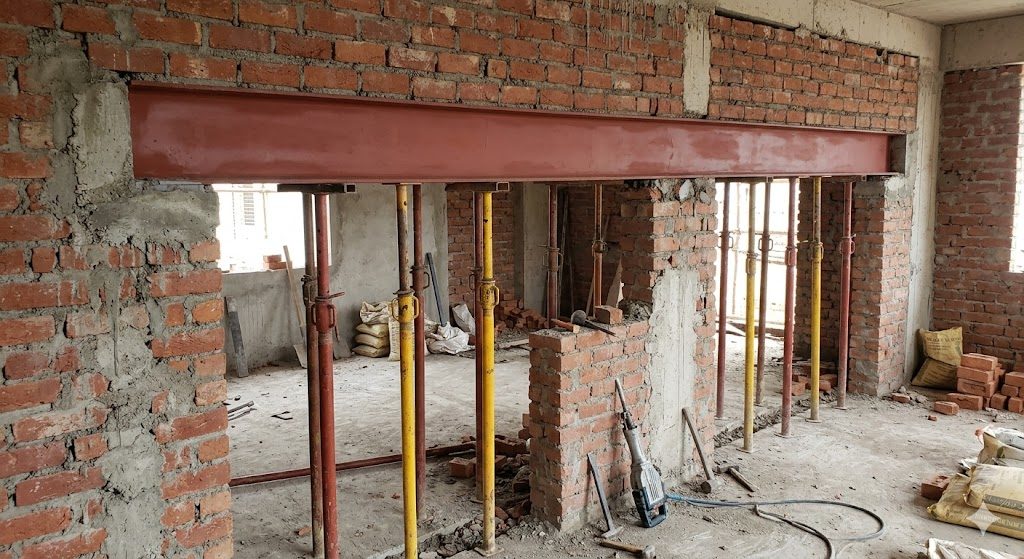
The principle is: a new beam (a lintel) takes over the wall's job before the wall is removed. The engineer designs a beam — RCC cast in place, or a steel section (an ISMB joist or a pair of channels) — sized for the load it must now carry and the span it must cross. Critically, the beam must bear onto solid wall at each end, typically 150–230 mm of bearing per IS 1905, so that it has something to rest on. Then the work proceeds in this order, never any other:
1. Prop and needle. Adjustable steel props are placed on solid floor below to take the slab's weight, often with short "needle beams" threaded through the wall above the cut line to pick up the load directly. The load is now held by the props, not the wall.
2. Insert the beam. The slot for the new lintel is cut — one side at a time in a wide opening — and the RCC or steel beam is placed with full bearing onto the remaining wall stubs at both ends.
3. Transfer the load. The gap between the new beam and the slab above is packed tight with non-shrink grout or dry-pack mortar so the load actually transfers onto the beam, not just hovers above it. The beam now carries what the wall used to.
4. Cut and strike. Only now is the masonry below the beam removed to form the opening — and only after the beam has taken the load are the temporary props struck (removed). Props come out last, not first.
The fatal version of this job is the reverse: knock the wall out, then "put a beam later." During that gap the slab above has nothing holding it, and that is exactly when ceilings sag and cracks tear across the flat above. Support first, cut last is the whole discipline in three words.
Partition walls, by contrast, are the easy case. A true non-structural infill or partition — gypsum, AAC block, hollow brick carrying only itself — can usually be removed cleanly, no beam, no props. Plan around the boring realities: electrical wiring and switchboards inside the wall, concealed plumbing, and the fact that even a "non-structural" wall might be stiffening a long span or hiding a column. Confirm it is genuinely a partition first; the cost of being wrong is too lopsided to guess.
| You CAN (with the right process) | NEVER do this |
|---|---|
| Make an opening in a load-bearing wall with an engineer-designed lintel/beam | Remove a load-bearing wall and "add a beam afterwards" |
| Remove a confirmed non-structural partition | Demolish any wall before an engineer has identified it |
| Prop and needle the slab before cutting | Cut the wall first and prop later — or not at all |
| Use full end-bearing (150–230 mm) for the new beam | Rest a beam on a sliver of brick or skip the bearing |
| Get a structural engineer's certificate before work | Touch a shear wall, core wall, or column — ever |
| Get society NOC and follow bye-laws (apartments) | Chase deep grooves into RCC structural walls for pipes |
| Pack/grout the beam tight so load transfers | Trust "it's just a partition" without verification |
The apartment rules nobody mentions in the brochure
If you own a flat, the structure is shared, and so the right to alter it is not yours alone. Beyond the engineering, there is a layer of permissions that is mandatory, not optional, and ignoring it can get work stopped, fines levied, or your flat flagged when you try to sell.
- Society / association NOC. Most cooperative housing societies and apartment associations require a written No-Objection Certificate before any structural alteration. Many will not issue one without a structural engineer's report confirming the change is safe.
- Structural engineer's certificate. A licensed structural engineer's assessment — confirming the wall's status and certifying that the proposed change (or its denial) is structurally sound — is the document everything else hangs on. Keep it; it is also your protection if a dispute arises later.
- Municipal bye-laws and NBC 2016. Structural alterations to a building are governed by local development bye-laws and the National Building Code (NBC 2016, Part 6, on structural design). Significant changes may need municipal approval, not just the society's.
- Common and structural elements are off-limits. Columns, beams, slabs, shear walls, the building's external envelope, and anything classed as a common element belong to the building, not to your flat. You cannot alter them, and the society is within its rights to refuse.
- RERA and your sale. Unauthorised structural changes can surface during resale due diligence and complicate the transaction. Under RERA, builders are also liable for structural defects for five years from handover — meddling with the structure yourself can void that protection for the affected work.
The order of operations for an apartment is therefore: engineer's assessment first, society NOC and any municipal approval next, then — and only then — the work, executed exactly to the engineer's drawing. A contractor who offers to skip these to save you "paperwork" is offering to put you on the wrong side of both your neighbours and the law.
What doing it right costs — and the red flags when it isn't
Doing it safely is not expensive relative to the stakes. A structural engineer's inspection and a basic report typically runs in the low thousands to a few tens of thousands of rupees depending on city and scope; designing and supervising an opening with a steel or RCC beam adds the cost of the beam, props, the grinder/cutting work, making good, and the engineer's supervision. Against the cost of a collapsed slab, an unsellable flat, or someone hurt, it is the cheapest insurance in the whole renovation. We break down where renovation money actually goes — and where it leaks — in our renovation cost and hidden costs guides; structural certification belongs in that budget from day one, not as a surprise.
The danger signs that a contractor is doing this wrong are usually visible before the first brick falls. Watch for these, and treat any one of them as a reason to stop:
- "It's just a partition, trust me" — said about a thick wall, with no engineer involved and no drawing consulted.
- A plan to remove the wall first and add a beam later. This is the single most dangerous red flag.
- No structural engineer on the job at all — only a contractor, mason, or "site engineer" who has never produced a structural drawing.
- No props or needling set up before cutting begins.
- A proposed beam with little or no end bearing, resting on a sliver of brick.
- Willingness to chase deep grooves into, or cut openings in, solid RCC walls (possible shear walls) for plumbing or wiring.
- Pressure to skip the society NOC, the engineer's certificate, or municipal approval to "save time."
- Cracks, sagging, or doors jamming during the work — and an assurance to just plaster over them.
These overlap heavily with the broader warning signs we catalogue in renovation red flags; on structural work specifically, any one of them is enough to halt the job.
When to absolutely stop: if a wall is being cut without an engineer's sign-off; if anyone proposes touching a column, beam, slab, or solid RCC wall; if cracks or sagging appear during work; or if the people on site cannot show you a structural drawing and a method statement. Stopping costs you a delay. Not stopping can cost far more.
Apply it, in order
1. Identify your building type. Framed (columns and beams, usually a modern flat) or load-bearing (thick masonry, usually older or low-rise)? This frames every later decision — and pairs with understanding how rooms connect, covered in our guide to spatial flow.
2. Find the original drawings. Architectural and especially structural (RCC) plans — from the society, builder, architect, or municipal file. They are the fastest path to a true answer.
3. Run the clue checklist on the specific wall — thickness, external/internal, beam above, stacking, age, material, tap. Use it to decide how worried to be, not to grant yourself permission.
4. Call a licensed structural engineer before anything is cut. Get the wall's status confirmed in writing. This is the step you never skip, never substitute, never rush.
5. If you want an opening, have it designed. Beam type and size, bearing length, props and needling layout, and the cutting sequence — all on the engineer's drawing, supervised by the engineer.
6. Clear the permissions (apartments). Society NOC, structural certificate, and any municipal approval under local bye-laws and NBC 2016 — before work starts.
7. Enforce support-first, cut-last on site. Props and beam in place and loaded before any structural masonry is removed; props struck only after the load has transferred.
8. Leave shear walls, core walls, columns, beams, and slabs entirely alone — and stop the job at the first sign of a crack, a sag, or a contractor who can't show you a drawing.
Good renovation opens up a home without ever putting it at risk — and the calm, well-lit, well-connected spaces you are reaching for are easier to plan when the bones are understood first. If you are reworking layout, sketch the new flow with our layout planner and price the work honestly with the cost calculator before a single wall is touched.
The deeper point is the one that runs through all of this cluster: a home is a system you should understand, not a surface you merely decorate. The same instinct that makes a space feel calm and protective — explored in architectural psychology and comfortable spaces — starts with respecting the structure that makes the space possible at all.
Want to reshape your home's layout without guessing what is structural? DesignAI helps you visualise new layouts and openings on your actual plan, so you can take a clear, considered proposal — not a vague idea — to the structural engineer who must sign it off.
References
1. Bureau of Indian Standards. IS 456:2000 — Plain and Reinforced Concrete: Code of Practice. (Design of RCC beams, lintels, slabs, and columns.)
2. Bureau of Indian Standards. IS 1905:1987 — Code of Practice for Structural Use of Unreinforced Masonry. (Load-bearing walls, bearing lengths, masonry strength.)
3. Bureau of Indian Standards. IS 1893 (Part 1) — Criteria for Earthquake Resistant Design of Structures. (Lateral systems, shear walls.)
4. Bureau of Indian Standards / Ministry of Housing & Urban Affairs. National Building Code of India 2016 (NBC 2016), Part 6 — Structural Design. (Governing framework for structural alterations.)
5. Real Estate (Regulation and Development) Act, 2016 (RERA) — provisions on structural defect liability (five years from handover).
6. Francis D. K. Ching. Building Construction Illustrated. Wiley. (Load paths, framed vs bearing-wall systems, beam and lintel detailing.)
7. Ernst Neufert. Architects' Data. Wiley-Blackwell. (Standard wall thicknesses, openings, and structural dimensioning.)
Part of the Studio Matrx Design Education series. Continue with architectural psychology and comfortable spaces, why corridor width matters, and understanding spatial flow in home design.
Export this guide
Related Guides — Deep-dive reading
Construction Quality Control for Homeowners
How to make sure your house is actually built well, stage by stage, without an engineering degree — concrete, steel, cover and curing, the cardinal site sins to refuse, and the simple checks anyone can do.
Structural SafetySecurity for People Living Alone in India (2026): Calm, Practical Habits When There Is No Second Person to Notice
Living alone is an ordinary and growing part of Indian life - the student in a new city, the working single, the elder whose children are abroad, the person after a separation. It does not call for fear. It calls for a few deliberate habits, because there is no second person in the home to notice trouble, raise the alarm, or catch an accident. This is calm self-reliance, layer by layer.
SecurityDo You Need an Architect, an Interior Designer — or AI?
The first real decision of any Indian home project: who you actually need, when AI is enough, and when a licensed professional is non-negotiable
Planning Your ProjectRelated Tools — Try Free
Electrical Safety & Load Audit
Home electrical audit — 10 categories, 65+ checkpoints across earthing, RCCB, MCB, wiring, switchboards, appliance circuits, DG/inverter backup.
Safety AuditFalse Ceiling Cost Estimator
Live ₹/sqft across 8 ceiling types — POP, gypsum, designer, metal, PVC, wooden — with cove and spot lighting for 20 Indian cities.
Cost CalculatorAcoustic Privacy (STC) Visualizer
Indian healthcare acoustic visualizer — compare wall assemblies and noise sources, see received SPL after STC attenuation, and check FGI 2018 / IS 1950 / NABH speech-privacy compliance with live dual-canvas waveform.
Acoustic Tool