
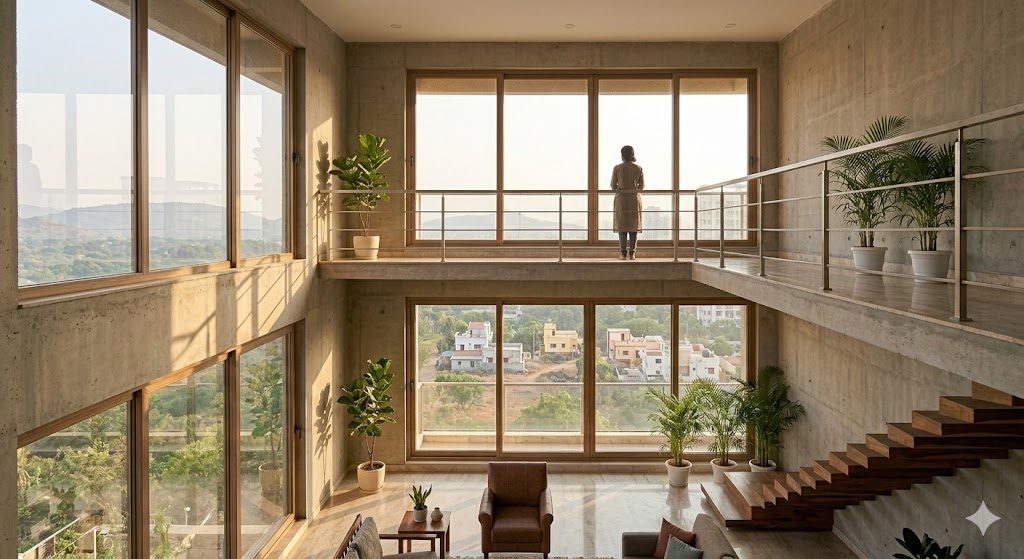
The Science of Ceiling Heights
How the height above your head shapes mood, focus, air and cost — and the right height for each room
Walk into an old colonial bungalow, a temple mandapam, or a heritage hotel lobby and something happens before you have noticed a single piece of furniture: you stand a little taller, you breathe a little deeper, your voice drops. Walk into a modern under-the-staircase study or a compartment of a sleeper train and the opposite happens — you fold inward, you focus, you feel held. You have not changed. The height above your head has.
This guide is about that height — the single dimension of a room that almost nobody specifies on purpose and almost everybody feels. We will look at the psychology (why a high ceiling makes you think differently from a low one), the physics (why your grandmother's 12-foot rooms stayed cooler than your 9-foot flat), the rules (what the National Building Code actually demands and why builders give you the bare minimum), and the practical question that brings most people here: what is the right ceiling height for each room, and how do you make a short ceiling feel taller.
Ceiling height is not a leftover number that falls out of construction — it is a design instrument that tunes mood, focus, air, light, sound and cost all at once. Choose it on purpose, room by room, and a home that is otherwise ordinary starts to feel right.
Why height matters more than people think
We argue endlessly about square footage. A 2BHK versus a 3BHK, 900 versus 1,200 square feet — the floor plate is the number on the brochure, the number we pay for, the number we compare. The third dimension, the volume over our heads, barely gets a mention. Yet of the three measurements of a room, height is the one we read most viscerally and control least.
Part of the reason is that floor area is abstract until you furnish it, while height is felt the instant you enter. Your body knows the difference between a 2.4-metre ceiling and a 3.3-metre one without a tape measure, the way it knows a low doorway it has to duck under. We evolved reading the volume of a shelter for two opposite signals at once — shelter (can I hide here, is my back covered) and prospect (can I see, can I move, am I free). Height speaks directly to both, which is why it reaches us below the level of conscious thought.
The other reason height is neglected is economic, and we will come to it: in a multi-storey building, every extra centimetre of ceiling is multiplied by the number of floors and traded against how many floors you are allowed to build at all. Builders have a powerful incentive to compress. So most of us live under ceilings chosen by a spreadsheet, not by a designer — which is exactly why understanding the dimension is worth your time.
The psychology: the cathedral effect
The clearest piece of evidence that height changes the mind is a set of experiments by Joan Meyers-Levy and Rui Zhu, published in 2007 under the lovely title "The Influence of Ceiling Height: The Effect of Priming on the Type of Processing That People Use." They put participants in identical rooms that differed only in ceiling height — roughly 3 metres versus 2.4 metres — and gave them mental tasks. The result has since been nicknamed the cathedral effect.
Under a high ceiling, people thought more abstractly and freely. They were better at tasks that needed relational, big-picture, creative connections, and they reported a stronger sense of freedom. Under a low ceiling, people thought more concretely. They were better at detail-oriented, item-by-item tasks, and they felt a stronger sense of confinement — which, crucially, is not always bad. The researchers traced the mechanism to priming: a high ceiling primes the concept of freedom, a low ceiling primes the concept of confinement, and that primed concept spills over into how we process whatever is in front of us.

The practical reading is not "high ceilings are better." It is height should follow function. A space for expansive, social, aspirational activity — a living room, a hotel lobby, a place of worship, a studio for imaginative work — benefits from generous height. A space for focus, intimacy and rest — a study, a reading nook, a bedroom, a den — often works better a little lower, because the enclosure helps the mind narrow. The architect Christopher Alexander made the same observation decades earlier without the lab coat: in "A Pattern Language" he describes "Ceiling Height Variety" as a way of varying intimacy across a home, low ceilings for intimate rooms, high for the most public.
| Activity / room intent | Ceiling that helps | Cognitive effect it primes |
|---|---|---|
| Creative, social, aspirational (living, lobby, studio) | High | Abstract, big-picture, free, expansive |
| Focused, detailed work (study, home office) | Lower | Concrete, item-by-item, attentive |
| Rest and intimacy (bedroom, reading nook) | Lower | Cosy, enclosed, safe, restful |
| Civic awe, worship, drama (double-height, atrium) | Very high | Uplift, transcendence, occasion |
| Routine, utilitarian (toilet, store, utility) | Minimum allowed | Neutral; height is wasted here |
A high ceiling does not make a room better; it makes a room think differently. The skill is matching the height to what the room is for.
Proportion: when a room feels boxy, lofty or cavernous
Height never acts alone — it acts in ratio to the floor. The feeling of a room comes largely from the relationship between its height and its width, not from the height in isolation. A 3-metre ceiling feels grand over a small study and merely normal over a large hall.
A rough and useful rule of thumb, drawn from classical proportion and confirmed by how rooms actually feel, is the height-to-width ratio:
| Height : width ratio | How the room reads | Typical case |
|---|---|---|
| Below 1 : 5 (very low for the width) | Flat, pressing, "boxy", the ceiling feels like a lid | A wide living room squeezed to 2.4 m |
| Around 1 : 3 to 1 : 4 | Comfortable, human-scaled, calm | A 3.3 m living room about 4 m wide |
| Around 1 : 2 | Lofty, generous, a little formal | A tall study or a compact double-height |
| 1 : 1 or taller (height equals or exceeds width) | Cavernous, vertical, can feel like a well or a chimney | A narrow stair-shaft or a poorly judged atrium |
The lesson is that you cannot judge a ceiling height as a single number. A 9-foot ceiling that feels fine over a 9-foot-wide bedroom can feel oppressively flat over a 16-foot-wide living-dining run, because the eye reads the proportion, not the metre. This is why making one large open space feel right is harder than it looks, and why it is worth thinking about volume at the layout stage rather than after the walls are up — our guide on space-planning principles and the layout planner both start from the plan, but the height is the silent third dimension riding on top of every decision you make there.
The physics: air, heat, light and sound
Beyond mood, ceiling height changes the actual physics of the room — and in India, where the dominant comfort problem is heat, this matters as much as the psychology.
Air volume and ventilation. A taller room simply holds more air per square metre of floor. That larger volume buffers temperature, smell and carbon dioxide — it takes longer to get stuffy. More importantly, height powers the stack effect: because warm air is less dense, it rises and pools at the top of the room. Give it a high outlet — a clerestory window, a jaali near the ceiling, a ventilator over the door, a vent in a double-height void — and that hot air escapes while cooler air is drawn in low. The taller the room, the stronger the temperature difference between top and bottom, and the more powerfully this passive chimney works without a single fan.

This is the entire logic of the traditional Indian tall room. The old havelis, the Kerala nalukettu, the Chettinad mansions and the colonial bungalows all ran ceilings of 3.5 to 4.5 metres (12 to 15 feet) for one overriding reason: heat collects above head height and the people below stay cooler. Pair that with cross-ventilation and you have a home that is comfortable for much of the year without mechanical cooling — the same family of strategies covered in our guides on passive cooling for Indian homes and how ventilation changes home quality.
Thermal comfort and HVAC load — the trade-off. There is a catch, and it cuts the other way. If you air-condition a tall room, you are now cooling a much larger volume of air. A double-height living room can have nearly twice the air to chill of a normal one, and the coldest air sinks while the hottest hovers at the ceiling, so the thermostat works harder. IS 3792 and the broader thermal-comfort thinking behind the NBC assume the occupied zone is the lower 1.8 metres or so; everything above that is, for an air-conditioner, expensive dead volume. So the same height that is a gift in a naturally ventilated room becomes a penalty in a sealed, conditioned one. Tall and naturally cooled, or modest and efficiently conditioned — the worst of both worlds is a tall room you then seal and air-condition.
Lighting. Higher ceilings mean light fittings are farther from the work surface, and light falls off with the square of distance. A ceiling fixture that gives crisp light at 2.7 metres can feel dim and flat at 4 metres. Tall rooms therefore need a layered lighting plan — taller windows to push daylight deeper, plus wall-washers, pendants dropped on long stems, and floor and table lamps to bring light back down to where people actually are. This is also why a tall room with only a central ceiling light often feels gloomy despite all its volume.
Acoustics. More volume means longer reverberation — sound takes longer to die away. A tall, hard-surfaced room rings; conversation blurs and television gets shouty. This is the cathedral's literal acoustic signature, wonderful for an organ and tiring for a family dinner. Tall rooms need soft furnishing, rugs, curtains, upholstery and sometimes acoustic panels to tame the echo that a low, carpeted room never produces.
| Implication | Tall ceiling (3.3 m and above) | Low ceiling (2.4 to 2.7 m) |
|---|---|---|
| Air volume and freshness | More air, buffers heat and stuffiness | Stuffy sooner, needs active ventilation |
| Passive cooling (stack effect) | Strong if a high outlet exists — keeps you cooler | Weak; relies on fans and cross-breeze |
| Air-conditioning load and cost | Higher — more volume to cool, cold air sinks | Lower — efficient, occupied zone is the room |
| Daylight reach | Tall windows push light deep | Limited unless windows are wide |
| Artificial lighting | Needs layered, lowered fixtures | Single source often enough |
| Acoustics | Longer reverberation, echo-prone | Naturally quieter, intimate |
| Sense and mood | Grand, free, formal | Cosy, focused, restful |
The India context: from 14 feet to 8.5 feet
India's ceilings have been shrinking for a century, and the reasons are entirely about money and floor-count, not comfort.
The traditional tall room. Pre-air-conditioning, height was free cooling. Climate-responsive vernacular homes across the country — explored in our guide on vernacular architecture and modern homes — used ceilings of 3.5 to 4.5 metres, deep verandahs, jaalis and high ventilators precisely so the stack effect and shade did the cooling. People lived under these heights for centuries and it was normal.
The modern apartment squeeze. Today's flats typically have a slab-to-slab height of about 3.0 to 3.2 metres, which leaves a finished floor-to-ceiling height of roughly 2.85 to 3.0 metres (about 9.5 to 10 feet). Then the false ceiling arrives — for cove lighting, air-conditioning ducts, recessed lights and a flat modern look — and steals another 200 to 450 mm, dropping the lived height to about 2.55 to 2.75 metres (8.4 to 9 feet). The grand 12-foot room of your grandmother's house has become an 8.5-foot box in two generations.
What the NBC actually requires. The National Building Code of India 2016 sets minimum floor-to-ceiling heights for habitable rooms — living rooms, bedrooms, kitchens — at 2.75 metres (about 9 feet), measured to the lowest point of the finished ceiling, including any false ceiling. Non-habitable spaces are allowed less: bathrooms, water-closets and stores may go down to about 2.1 to 2.2 metres, and the underside of a beam or a mezzanine soffit has its own lower limits. Crucially, this is a floor, not a target — and a false ceiling that drops your living room below 2.75 metres is not merely cosy, it is non-compliant.
| Room | NBC 2016 minimum | Comfortable typical | Feels generous | The feeling at the right height |
|---|---|---|---|---|
| Living / dining | 2.75 m (9.0 ft) | 3.0–3.3 m (9.8–10.8 ft) | 3.6 m+ (12 ft+) | Open, sociable, a touch of occasion |
| Double-height living / atrium | 2.75 m (lower zone) | 4.8–5.5 m (16–18 ft) | 6 m+ (20 ft+) | Grandeur, drama, light, vertical pull |
| Master bedroom | 2.75 m (9.0 ft) | 2.85–3.0 m (9.3–9.8 ft) | 3.2 m (10.5 ft) | Cosy yet not pressing, restful |
| Study / home office | 2.75 m (9.0 ft) | 2.7–2.9 m (8.9–9.5 ft)* | — | Enclosed, focused, attentive |
| Kitchen | 2.75 m (9.0 ft) | 2.85–3.0 m | — | Practical; height helps vent heat and smell |
| Bathroom / WC | ~2.1–2.2 m | 2.4 m (7.9 ft) | — | Snug, easy to ventilate and warm |
| Store / utility | ~2.1–2.2 m | 2.2–2.4 m | — | Neutral; height here is wasted |
\*A study can read as lower because of furniture and intent even when the slab height meets the 2.75 m minimum; the feeling of focus comes from enclosure, not from breaking the code.
Why builders go to the minimum. In a multi-storey building, the height you can build is governed by Floor Area Ratio (FAR / FSI) and by an overall building-height limit. Within a fixed building height, every extra 150 mm of ceiling per floor either reduces the number of floors the developer can stack or eats into the height budget for the floors above. More floors mean more saleable flats from the same plot, so the developer's incentive is to compress each floor to the legal minimum and add another storey. The economics of FAR — explained in our FAR / FSI calculator — are the real author of your ceiling height, which is why a custom home on your own plot is often the only place you get to choose generosity.
The false-ceiling trade-off
False ceilings are nearly universal in Indian flats, and they are not villains — they hide ducts and wiring, carry cove and recessed lighting, level out an uneven slab, and give a clean modern plane. But they cost height, and that cost is invisible until you live with it.
The rules are simple. A flush false ceiling for lighting and a slim air-conditioning run might drop only 200 to 250 mm. A full peripheral cove with a central ceiling-cassette air-conditioner can take 400 to 450 mm. On a 9.5-foot slab that is the difference between a room that feels normal and one that feels squat. So the discipline is to spend the height only where it buys something:
- Drop the ceiling only where services demand it. Run the duct over the corridor, the bathroom lobby or the wardrobe, not across the whole living room. A partial drop with the main field left high keeps the volume where you sit.
- Avoid false ceilings entirely in already-low rooms. If your slab is 2.9 metres, a full false ceiling can push you under the NBC minimum and make the room feel like a lid. Surface conduits and a slim track light are often the better call.
- Use the drop as a design move, not just a cover. A deliberate lower band over the dining table or the bed can give intimacy on purpose, while the rest stays open — height variety inside one room.
Double-height spaces: grandeur and its price
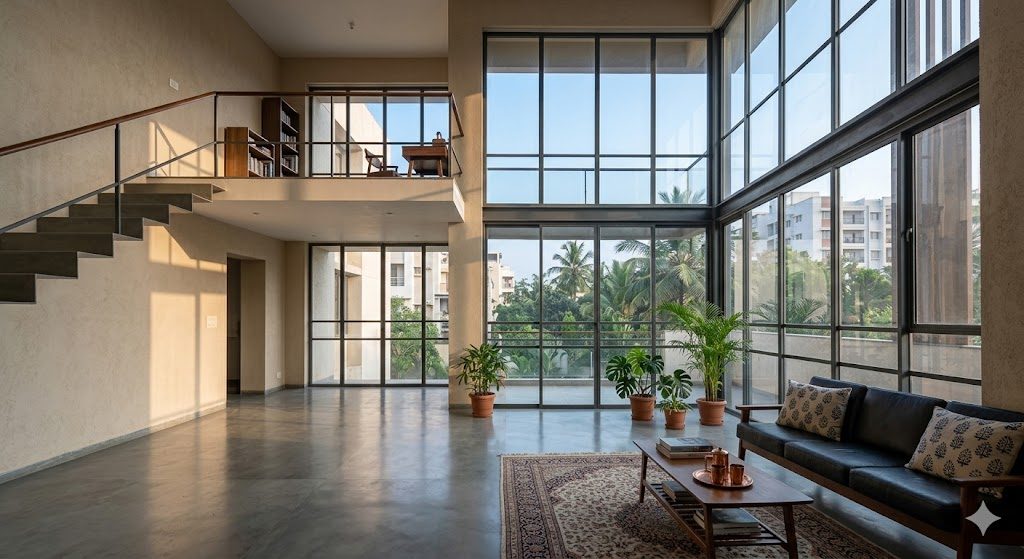
The double-height living room is the aspirational move of the modern Indian home, and for good reason — it floods the space with light, gives drama and a sense of arrival, and lets the cathedral effect work at full strength. But it is the clearest example of height as a trade-off, and worth entering with open eyes.
The gains are real: vertical daylight from clerestory and tall windows, a powerful stack effect for passive cooling, visual connection between floors, and a genuine sense of occasion. The costs are equally real. You sacrifice the floor area of the room above the void — square footage you have paid to build but cannot use. Air-conditioning is harder and dearer, because the conditioned air has to fill a tall volume and the cold sinks away from where you live. Acoustics need active management or the room rings. Heating in cold-climate hill homes is inefficient for the same reason cooling is. And maintenance — changing a bulb, cleaning a high window — needs scaffolding or a long ladder. The double-height space is wonderful when you commit to its full system: tall windows, layered lighting, soft acoustic surfaces, ceiling fans to push warm air down in winter, and a cooling strategy that leans on the stack effect rather than fighting it.
How a low-ceiling apartment can feel taller
Most readers cannot raise their slab. The good news is that the feeling of height is partly an illusion you can engineer, because the eye judges proportion and the path your gaze travels, not the absolute metre. None of these add a centimetre; all of them add the sense of one.
- Draw the eye up with vertical lines. Floor-to-ceiling curtains hung close to the ceiling (not at the window top), tall slim shelving, vertical panelling or fluting, and full-height doors all stretch the room upward.
- Hang curtains high and wide. This is the single highest-impact trick: mount the rod just under the ceiling and let the fabric fall to the floor. The window — and the room — instantly reads taller.
- Keep furniture low. Low-slung sofas, platform beds and low sideboards increase the apparent gap between the furniture top and the ceiling, exaggerating the height you do have.
- Light the ceiling, not just the room. Wall-washers, uplighters and cove lighting that graze the ceiling make it glow and recede; a flat, evenly lit dark ceiling presses down. Avoid bulky low pendants in the centre of a low room.
- Use colour to lift the lid. A ceiling painted slightly lighter than the walls — or the walls and ceiling in one continuous pale tone — blurs the edge and the boundary seems to float upward. A dark ceiling does the opposite, which is occasionally what you want in a cosy den.
- Mind the proportion, not just the height. Because the room reads height-to-width, keeping a wide room from feeling flat can mean breaking the floor into more intimate zones so no single span is too wide for its height.
These moves overlap heavily with the broader question of why rooms feel cramped or generous, covered in our guide on architectural psychology and comfortable spaces — the conceptual anchor for everything in this Design Education cluster — and on the circulation side in why corridor width matters.
What this means for your home
1. Measure what you actually have. Stand a tape from finished floor to the lowest point of the ceiling, including any false ceiling. Compare it to the NBC minimum of 2.75 metres for habitable rooms; use the room measurement tool to log every room. If a false ceiling has put a bedroom or living room below 2.75 metres, that is a flag.
2. Assign height by function before you assign finishes. Decide which rooms want generosity (living, any double-height) and which want intimacy (bedrooms, study, den). Let that drive where you spend volume and where you happily keep it low.
3. Protect the living room's height. Resist a full false ceiling here if your slab is already modest. Run services over corridors and wardrobes, and keep the main field high.
4. If you build tall, plan its whole system. Tall rooms need tall windows, layered and lowered lighting, soft acoustic surfaces, and a cooling plan that uses the stack effect — a high vent or clerestory to let hot air escape — rather than sealing and over-cooling.
5. If you build for air-conditioning, do not over-build height. A modest, well-sealed ceiling is cheaper and more comfortable to cool. Save the drama for the one room that earns it.
6. Engineer apparent height where you cannot add real height. Curtains to the ceiling, low furniture, vertical lines, a lit and lightened ceiling. These cost little and change the room immediately.
7. Treat the false-ceiling decision as a height decision. Every cove and cassette is a trade of centimetres for looks and services. Spend those centimetres only where they buy something real.
If you are at the stage of choosing layouts and volumes and want to see options before committing, DesignAI can visualise your rooms at different ceiling heights and lighting schemes, so you can feel the difference between a 2.7-metre and a 3.3-metre living room before a single slab is poured.
References
1. Meyers-Levy, J. & Zhu, R. (2007). "The Influence of Ceiling Height: The Effect of Priming on the Type of Processing That People Use." Journal of Consumer Research, 34(2), 174–186. (The cathedral-effect experiments.)
2. Bureau of Indian Standards. National Building Code of India 2016 (NBC 2016), Part 3 (Development Control and General Building Requirements) — minimum room heights and habitable-space requirements.
3. Bureau of Indian Standards. IS 3792: Guide for Heat Insulation of Non-Industrial Buildings; and broader IS thermal-comfort guidance on the occupied zone.
4. Alexander, C., Ishikawa, S. & Silverstein, M. (1977). A Pattern Language — pattern 190, "Ceiling Height Variety," on matching ceiling height to room intimacy.
5. Ching, F. D. K. Architecture: Form, Space, and Order — on proportion, scale and the human reading of volume.
6. Neufert, E. Architects' Data — standard room heights, anthropometric and dimensional norms.
7. ASHRAE Standard 55 — Thermal Environmental Conditions for Human Occupancy, on the occupied zone and stratification in tall spaces.
Part of the Studio Matrx Design Education series. Continue with how ventilation changes home quality, passive cooling strategies for Indian homes, why corridor width matters, and space-planning principles for Indian homes.
Export this guide
Related Guides — Deep-dive reading
The Architectural Psychology of Comfortable Spaces
Why some rooms feel right and others never do — the science of space and the human mind
Design EducationWhy Scale Matters: Keeping Rooms Comfortable for Humans
How sizing furniture, art and lighting to the human body — not the showroom — keeps small Indian flats from feeling crushed and large halls from feeling empty.
Design PrinciplesFloor-to-Ceiling Curtains: The Height Illusion Done Right (India 2026)
Why hanging high and dropping to the floor makes a room look taller and more expensive, where to mount, how to measure the drop, and the fabric, hardware and costs that make long curtains work in Indian homes.
Window TreatmentsRelated Tools — Try Free
Cross-Ventilation Analyzer
Estimate airflow and air changes per hour (ACH) from room size, window areas, layout, and local wind — with NBC 2016 Part 8 compliance check.
Ventilation CalculatorWindow Quantity Calculator
Estimate how many windows your home needs for NBC daylight and ventilation norms.
Window ToolFuture Home Comfort Score
Score your home 0 to 100 on daylight, ventilation, thermal and acoustic comfort and find the weak link.
Window Tool