
Apartment Landscape Planning
Greenery across the whole apartment — your balcony, podium gardens, entry courtyards, amenity zones and façade greening, and what you versus the RWA can green
An apartment's greenery is not one balcony — it is a stack of layers, some yours to plant freely and some that belong to the whole society, and living well with plants in a flat means understanding which is which and how they fit together. Most balcony guides stop at your railing. This one zooms out to the whole building: the podium garden you share with eighty families, the arrival courtyard, the amenity zones, the terrace, the façade greening, and the strip of planting along the compound wall — and where you, as a single flat-owner, actually have a say.
If you want the deep detail on planting your own balcony, read Balcony Design Ideas for Indian Apartments; for the shared terrace, Rooftop Garden Design. This guide is the connective tissue between them — the apartment-scale picture.
The seven layers of apartment landscape
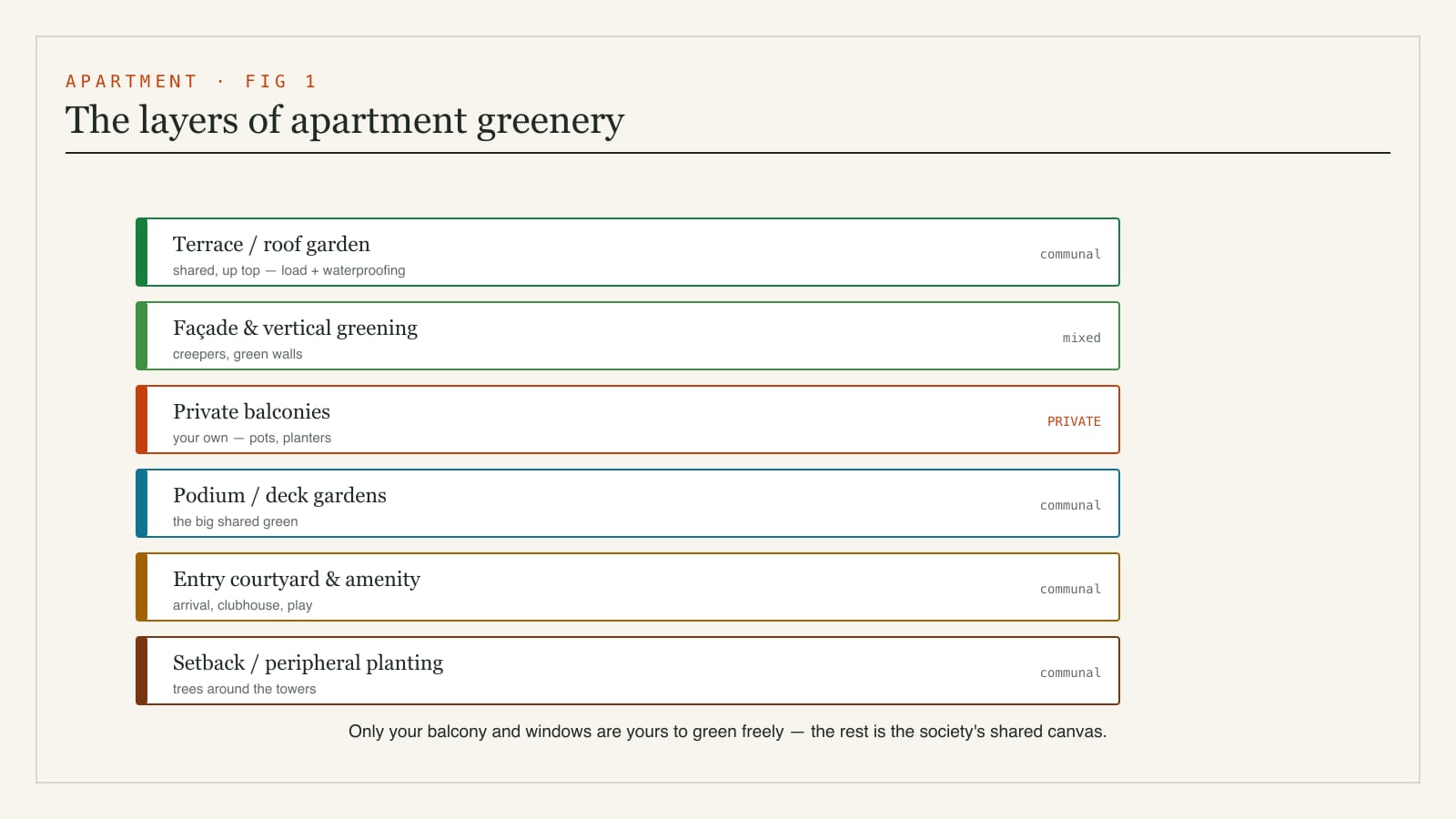
A modern Indian apartment complex carries greenery at several distinct elevations and ownership levels. Confusing them is the single biggest reason residents feel powerless about their building's greenery — they assume the lobby planters are "someone else's problem" and that their balcony is "all they get." Both halves of that belief are usually wrong.
| Layer | Typical location | Who controls it | What it can do |
|---|---|---|---|
| Private balcony / utility balcony | Your flat | You (within byelaws) | Herbs, screening, shade, a green view |
| Window ledges / grilles | Your flat façade | You (usually) | Trailing greens, security-grille planters |
| Entry courtyard / arrival | Ground, near gate | Society / developer | First impression, shade at drop-off |
| Podium garden / deck | Over the basement/parking slab | Society / RWA | The shared "ground" — lawns, trees, play |
| Amenity zones | Clubhouse, pool, play, loops | Society / RWA | Where families actually spend evenings |
| Terrace / roof | Topmost slab | Society (common) | Community garden, urban farm, solar+green |
| Setback / peripheral planting | Between building and compound wall | Society / developer | Privacy, dust and noise buffer, canopy |
The honest takeaway: roughly one layer is fully yours, and six are shared. Your influence over those six is real but indirect — it runs through the Resident Welfare Association (RWA) or the managing committee, not through your own chequebook.
What a single flat-owner can do — and what they cannot
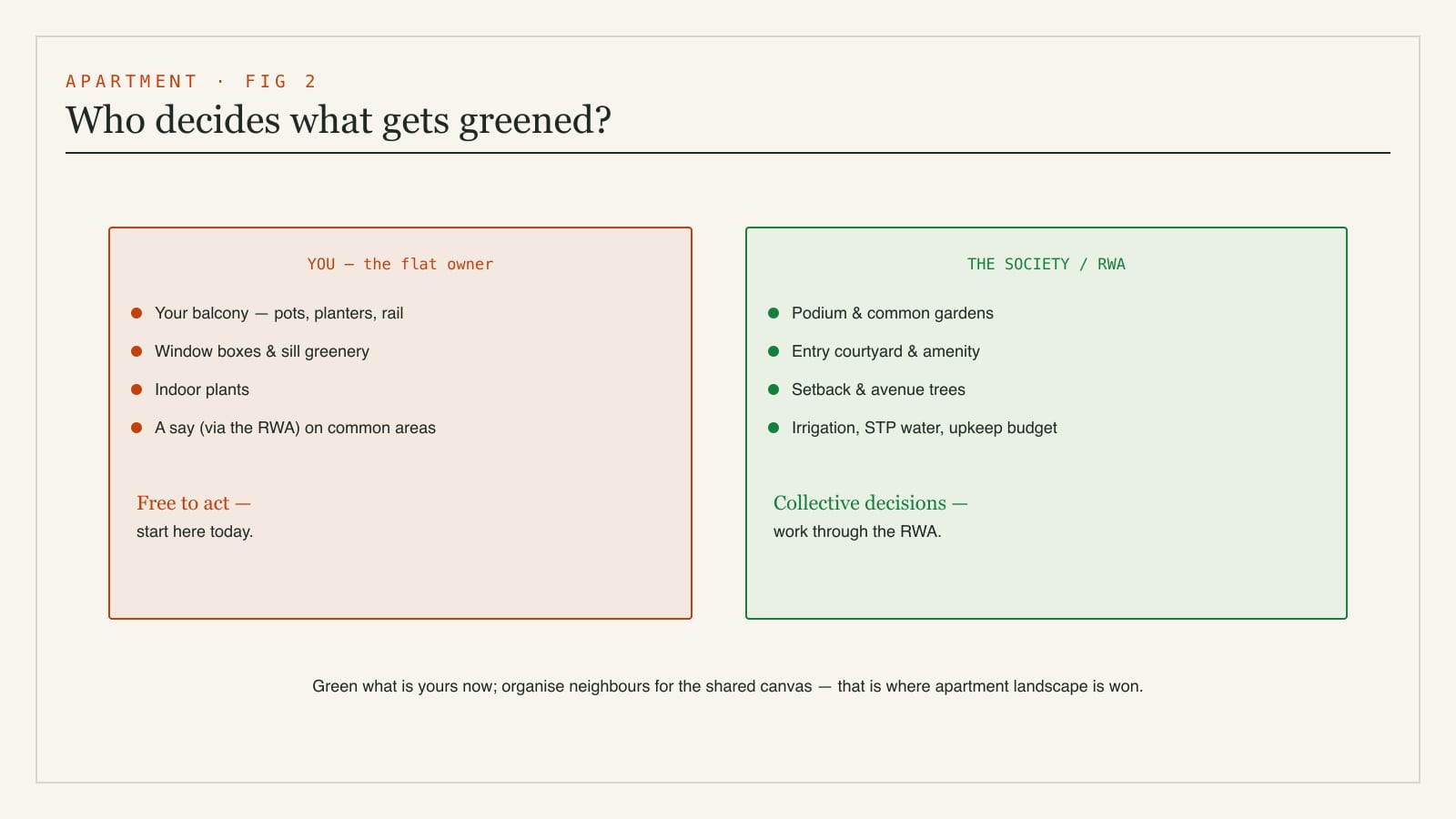
The dividing line is ownership of the surface the plant sits on. Anything within your flat's demised area — your balcony floor, your window grille, your utility ledge — is yours to green, subject to byelaws. Anything on common property — the podium, the terrace, the corridor, the setback soil — is a collective decision.
Clearly within your rights (most societies):
- Container plants on your own balcony and utility balcony.
- A grille planter or trellis fixed to your own railing or window — provided nothing projects beyond the building line or drips onto the flat below.
- Indoor plants, obviously.
Grey zone — get written permission first:
- Drilling into the external façade for a heavy trellis or vertical-garden frame (this is common-area structure even if it is "your" wall).
- Anything visible from outside that alters the building's elevation — many builder-managed and gated societies enforce a uniform look.
- A balcony so heavily planted that drainage or load becomes a question.
Not yours to decide alone:
- Planting trees in the podium or setback, changing the lawn, adding a vegetable patch on common ground, or modifying the terrace. These need RWA approval because they touch shared waterproofing, shared maintenance budgets, and shared liability.
A useful mental rule: if your plant fails and water or soil reaches a neighbour or a common slab, it is no longer a private matter. Drip trays under every pot and never overwatering onto a balcony that drains toward the flat below are not just courtesies — they are what keeps your right to garden uncontested. The same logic that governs a private plot's edges — see Landscape Privacy Design — applies in miniature at your railing.
The podium garden: the shared "ground"
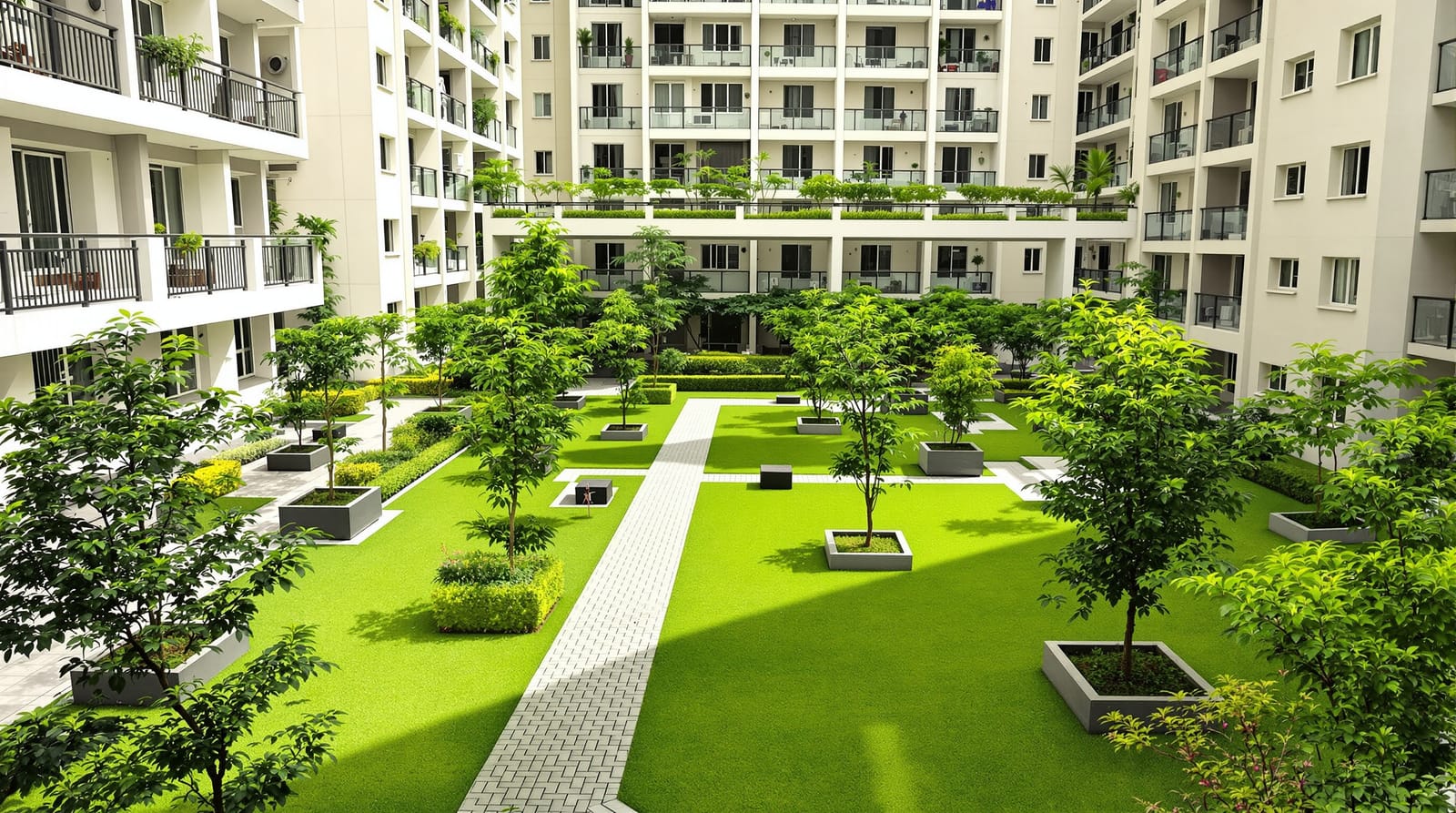
In most mid- and high-rise developments the visible green "ground" is not earth at all — it is a podium deck sitting on top of one or two levels of basement parking. This changes everything about what can grow there, and it is the layer residents most often misunderstand.
A podium is a structural slab with a finite load allowance and a waterproofing membrane that must never be punctured. You cannot simply "plant a tree" in it. Everything grows in raised planters or built-up soil beds, and weight is the governing constraint — saturated soil weighs roughly 1,600–2,000 kg per cubic metre, so a 600 mm deep planter loads the slab at well over a tonne per square metre once watered.
| Podium planting type | Soil depth needed | Realistic on a podium? |
|---|---|---|
| Lawn / groundcover | 150–300 mm | Yes, in dedicated beds |
| Shrubs (hibiscus, ixora, tecoma) | 450–600 mm | Yes, in planters |
| Small ornamental trees (frangipani, kadamba) | 900–1,200 mm | Only where the slab is designed for it |
| Large shade trees (rain tree, peepal) | 1,500 mm+ | Rarely — usually only over column lines |
The practical answers for podiums are lightweight: shallow lawns, shrub massing, palms and small ornamentals in engineered planters, and generous use of lightweight media (perlite, cocopeat, expanded clay) in place of heavy black soil. The same load-and-waterproofing physics governs every elevated planting; the deep treatment lives in Rooftop Garden Design and applies equally to a podium. If your RWA is planning podium greening, the membrane warranty and the structural consultant's load sheet must be checked before a single planter is filled — a leak into the parking below is the most expensive mistake in this whole field.
The arrival landscape and amenity zones
The entry courtyard is the building's handshake. A shaded drop-off with a flowering tree (where soil depth allows) or large planters of areca palm and song-of-india, a green threshold rather than a bare ramp — this is what residents and visitors read first, and it costs surprisingly little relative to its impact. The principles of how people move through a planted entrance are the same at apartment scale as on a plot; Outdoor Circulation Design is worth a read for the RWA's landscape sub-committee.
The amenity zones — clubhouse surrounds, the pool deck, the children's play area, the senior-citizens' corner, and the walking loop — are where the landscape earns its keep, because this is where families spend evenings. Good apartment landscape thinks in zones, exactly as a family plot does in Landscape Zoning for Family Activities:
- Pool deck: non-staining, non-littering species only — avoid bougainvillea and anything that drops fruit or heavy leaf into the water. Palms and clipped hedges work.
- Play area: soft groundcover or engineered safety surfacing, shade trees on the periphery, and strictly no thorny (bougainvillea, cactus) or toxic (oleander, datura) plants within a child's reach.
- Walking loop: a continuous canopy of shade trees is the single biggest comfort upgrade a society can make — it is the difference between a 6 pm walk being pleasant or abandoned through the summer.
- Senior corner: level paths, seating in shade, fragrant low-maintenance plants (jasmine, parijat).
Façade and vertical greening
Vertical greening — green walls, façade-integrated planters, balcony-edge trailers repeated across a tower — is the most visible apartment-scale move and the most maintenance-hungry. Living green walls need dedicated drip irrigation, a feeding regime, and a maintenance contract; abandoned ones look worse than bare concrete within a year. For most Indian societies the realistic, durable version is modular planters at each balcony edge planted with hardy trailers (money plant, wedelia, syngonium) rather than a single monumental green wall. This is a society-level decision because it alters the elevation and usually taps common water and façade-access (gondola or scaffold) budgets for upkeep.
Water and irrigation for the common landscape
Common landscape lives or dies on its irrigation, and water is a recurring society cost. The single most important decision an RWA can make is to irrigate the common landscape from treated water, not the municipal potable supply. Most apartment complexes above a threshold size are required by state pollution-control norms to run a Sewage Treatment Plant (STP); STP-treated water is intended precisely for flushing and landscape irrigation, and using it cuts both the water bill and the freshwater draw dramatically.
Practical irrigation discipline for apartment common areas:
- Drip and sub-surface lines for beds and planters, not hose-pipe flooding — it cuts consumption by half or more and keeps paths dry.
- Zoned timers so lawns, shrubs and planters get only what each needs.
- Rainwater harvesting feeding the landscape and recharge pits — mandatory in most metros and genuinely useful for the monsoon-to-summer carry.
- Drought-tolerant species on the periphery so that water failures do not kill the whole planting. Choosing species to climate, not against it, is the theme of Climate-Responsive Landscape Design.
Working with the RWA: how shared greening actually happens
Because six of the seven layers are common property, change happens through the association, and that is a feature, not a bug — it spreads the cost and the upkeep across every flat. The realistic path:
1. Raise it as an agenda item at the general body or managing-committee meeting, with a rough costing and a maintenance plan — not just "we should have more plants."
2. Form a landscape sub-committee of interested residents; horticulture-minded retirees are gold here.
3. Budget for maintenance, not just planting. The commonest failure is a beautiful one-time plantation drive with no gardener, no irrigation upkeep, and a dead garden by the next summer. Maintenance — a gardener's wages, water, replacements, pruning — is the real recurring line item.
4. Use an Annual Maintenance Contract (AMC) with a landscape firm for anything ambitious (green walls, large podium gardens) rather than relying on a single mali.
Indicative costs to set expectations (they vary widely by city and scale):
| Item | Indicative range |
|---|---|
| Landscape AMC (mid-size society, per month) | ₹15,000 – ₹60,000 |
| In-house gardener (mali), per month | ₹12,000 – ₹22,000 |
| Podium planter installation (per sq m, supply + soil + plants) | ₹2,000 – ₹6,000 |
| Avenue/shade tree (semi-mature, planted) | ₹1,500 – ₹8,000 each |
| Modular green-wall system (per sq m, installed) | ₹4,500 – ₹12,000 |
A developer at handover and an RWA after it carry the same duty of care that a homeowner carries on a plot; the design logic in Residential Site Planning scales directly to a gated community.
Choosing a flat for its greenery
If you are still flat-hunting, greenery is something you can read off the building before you sign — and it is far easier to buy into a green building than to green a bare one against eighty neighbours' indifference.
- Which way does your balcony face? A west-facing balcony bakes; an east or north one is a far easier place to keep plants alive. Harsh west sun is the single biggest balcony-planting constraint in most Indian cities.
- Is the "garden" real soil or a podium? Ask. It changes what can ever grow there and how it must be maintained.
- Are there mature trees on site, or only saplings in renders? Renders are aspirational; canopy takes years.
- What does the maintenance bill say about landscape? A line item for an AMC or a gardener signals a society that actually maintains its green areas.
- Is the walking loop shaded? Walk it at 5 pm. That tells you more than any brochure.
A flat in a genuinely green complex gives you, for your monthly maintenance, a share of trees and lawns you could never fit on a balcony — which is precisely why the apartment-scale view matters more than the railing-scale one. For the freedoms a private plot allows by contrast, see Villa Landscape Design; for getting the green decisions right before a building even exists, Landscape Planning Before Building Design.
A note for RWAs and developers
Developers: a landscape that is designed for the slab it sits on, irrigated from the STP, and handed over with a maintenance plan is a sales asset that survives the first summer. Specify load-rated planters, protect the waterproofing membrane, and avoid littering species near pools and toxic or thorny species near play areas. RWAs: budget for upkeep before you plant, meter your landscape water, and keep a simple register of what is planted where and who waters it. The greenery your residents fell in love with in the brochure is now, legally and practically, yours to keep alive.
References & further reading
- National Building Code of India 2016, Part 10 (Landscape Development, Signs and Outdoor Display Structures) — Bureau of Indian Standards. The baseline for landscape planning, planting and soil-depth norms in Indian developments.
- ISOLA — Indian Society of Landscape Architects. Professional guidance and member directory for engaging qualified landscape architects on common-area and podium projects.
- ICAR–IIHR (Indian Institute of Horticultural Research, Bengaluru). Authoritative Indian guidance on species selection, container culture and irrigation for ornamental and edible plants.
- Central Pollution Control Board (CPCB) / State Pollution Control Board norms on Sewage Treatment Plants and treated-water reuse. The regulatory basis for irrigating apartment landscapes from STP-treated water.
- CPWD Horticulture / Harmonised Guidelines and Space Standards for Barrier-Free Built Environment (2021). For accessible, level circulation through landscaped common areas and amenity zones.
- The Royal Horticultural Society (RHS) — guidance on container growing, green walls and roof/podium planting. Useful technical reference adaptable to Indian species and climate.
Export this guide
Related Guides — Deep-dive reading
Green & Living Facades in India — Vertical Gardens and Living Walls as a Building Skin
The honest guide to planted facades: the crucial difference between a green facade (climbers on cables and trellis) and a living wall (plants growing in modular or hydroponic panels), how each is built and watered, the real benefits and the Indian caveats — water, maintenance, cost and what kills them.
Building FacadesTreated Water for Landscape Irrigation: Distribution, Storage, Quality & Salinity
How to irrigate large lawns, planted podiums and campus landscapes with STP-treated water — the distribution network, storage sizing, the quality numbers that keep plants alive, and how to manage salt build-up in the soil over the years.
Sewage Treatment PlantsSTP for Gated Communities: Community-Scale Sewage Treatment Explained
How large gated communities of villas and apartments treat their own sewage — centralised versus cluster STPs, phased capacity, reusing treated water in common areas, and sharing the cost and governance fairly among residents.
Sewage Treatment PlantsRelated Tools — Try Free
Monsoon-Readiness Checklist
Pre-rain home audit across 9 categories — terrace, drains, waterproofing, electrical, HVAC, pest, vehicles, documents.
Seasonal AuditRainwater Tank Sizer
How big should your rainwater tank be? Computes annual harvest, recommended tank capacity in litres, water-bill savings, and payback — for 10 Indian cities.
RWH CalculatorSociety Handover & NOC Checklist
Builder-to-RWA handover audit — 9 categories, 65+ checkpoints across legal docs, drawings, utilities, STP/WTP, fire safety, finances, warranties.
RWA Handover