
HMDA / GHMC Setbacks in Hyderabad — A 2026 Architect's Working Reference
Setbacks under Telangana Building Rules 2012 + GO Ms 168 — front, side, and rear margins by abutting road width and height, the most aggressive high-rise coupling in India, the cantonment carve-out, and the TS-bPASS self-certification framework.
Governing framework: Telangana Building Rules 2012 + GO Ms No. 168
Working reference tables
Print or screenshot these for the studio wall. Cross-check against the current authority notification before any specific filing.
Residential setback matrix (Telangana Building Rules 2012)
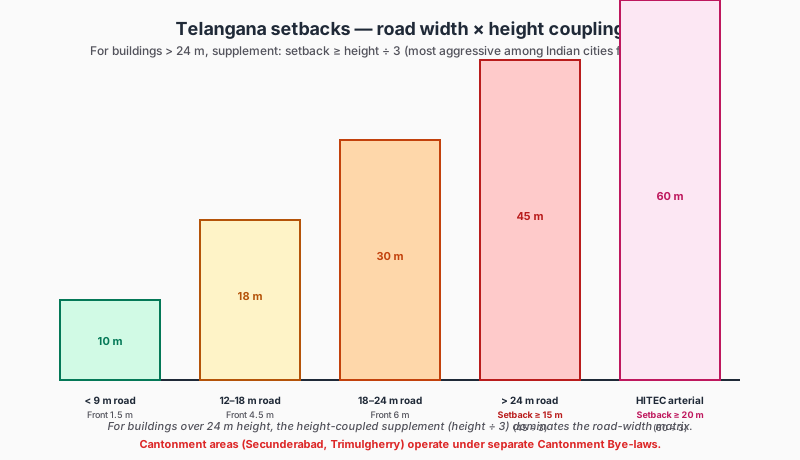
Setbacks scale with both abutting road width and building height. For tall buildings, the height-coupled supplement (height ÷ 3) often dominates the matrix.
| Plot Frontage Road | Building Height | Front | Side (each) | Rear |
|---|---|---|---|---|
| < 9 m | Up to 10 m | 1.5 m | 1.0 m | 1.5 m |
| 9–12 m | Up to 15 m | 3.0 m | 2.0 m | 3.0 m |
| 12–18 m | Up to 18 m | 4.5 m | 3.0 m | 4.5 m |
| 18–24 m | Up to 24 m | 6.0 m | 4.0 m | 6.0 m |
| > 24 m | > 24 m | 9.0 m+ (height-coupled) | 6.0 m+ | 9.0 m+ |
Indicative Telangana Building Rules 2012 values, as amended by GO Ms 168. HUDA-specific layouts may impose layout-level setbacks. Cantonment areas are separate.
Height coupling supplement (height ÷ 3) — for tall buildings
Telangana's coupling formula is the most aggressive in India for buildings over 24 m height. Setback supplement = (height ÷ 3) on every façade with a prescribed setback.
| Building Height | Coupling supplement | Effective minimum |
|---|---|---|
| ≤ 24 m | Matrix floor only | Per matrix row |
| ≤ 30 m | 10.0 m | max(matrix, 10.0 m) |
| ≤ 45 m | 15.0 m | max(matrix, 15.0 m) |
| ≤ 60 m | 20.0 m | max(matrix, 20.0 m) |
| > 60 m | Per HMDA high-rise approval | Negotiated |
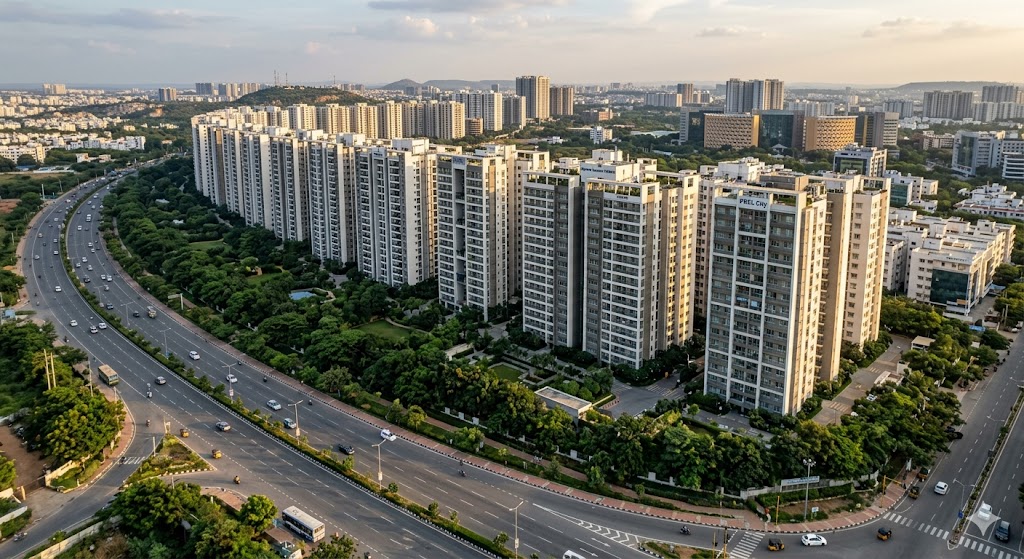
For HITEC City and Gachibowli high-rise residential — the coupling supplement is binding far more often than the road-width matrix.
Cantonment vs civil-area regulatory boundary
Two cantonment areas operate under the Cantonment Act 2006, with separate Cantonment Bye-laws — different from Telangana Building Rules.
| Area | Authority | Setback framework |
|---|---|---|
| GHMC civil area | GHMC + HMDA | Telangana Building Rules 2012 + GO Ms 168 |
| Secunderabad Cantonment | Secunderabad Cantonment Board | Cantonment Bye-laws (stricter) |
| Trimulgherry Cantonment | Trimulgherry Cantonment Board | Cantonment Bye-laws |
| HUDA-legacy layouts (Banjara Hills, Jubilee Hills) | GHMC, with HUDA layout overrides | Layout-specific (often more generous) |
Plots near the cantonment-civil boundary require careful jurisdiction verification before concept design. Cantonment Bye-laws typically run stricter setbacks and lower FSI.
TS-bPASS sanction tracks — three tiers, all self-certified
Telangana State Building Permission Approval and Self-certification System. Setback compliance is self-certified by the registered architect at each tier.
| Track | Plot size | Approval timeline |
|---|---|---|
| Instant approval | ≤ 75 sqm | 24 hours |
| Expedited approval | 75–500 sqm | Approx. 15 days |
| Standard approval | > 500 sqm | 30+ days |
| Random audit | All tracks | Periodic post-sanction |
Self-certification errors carry professional consequences — including registration suspension on audit findings. Even instant-approval projects face plinth verification.
The working reference, in full
Hyderabad's residential setbacks are governed by the Telangana Building Rules 2012, as substantially amended by GO Ms No. 168 dated 2012. The HMDA (Hyderabad Metropolitan Development Authority) is the regional planning authority; GHMC (Greater Hyderabad Municipal Corporation) sanctions individual building plans within GHMC limits. HUDA (Hyderabad Urban Development Authority — predecessor) layouts and outer-zone plots are sanctioned by HMDA. Two Cantonment areas — Secunderabad and Trimulgherry — operate under the Cantonment Act 2006 with separate Cantonment Bye-laws administered by the respective Cantonment Boards.
Telangana's road-width × height matrix
Telangana Building Rules 2012 setbacks scale with both abutting road width and building height, similar to Chennai's TNCDBR 2019 framework but with a different matrix and an even more aggressive height-coupling supplement for high-rise. The matrix shows the road-width-driven baseline; for buildings over 24 m, the height-coupled supplement setback ≥ (building height ÷ 3) often dominates the road-width baseline. Hyderabad's high-rise residential typology — which has expanded substantially in Gachibowli, Madhapur, Kondapur, and Manikonda — operates primarily under the height-coupled supplement.
HUDA-layout legacy and its setback implications
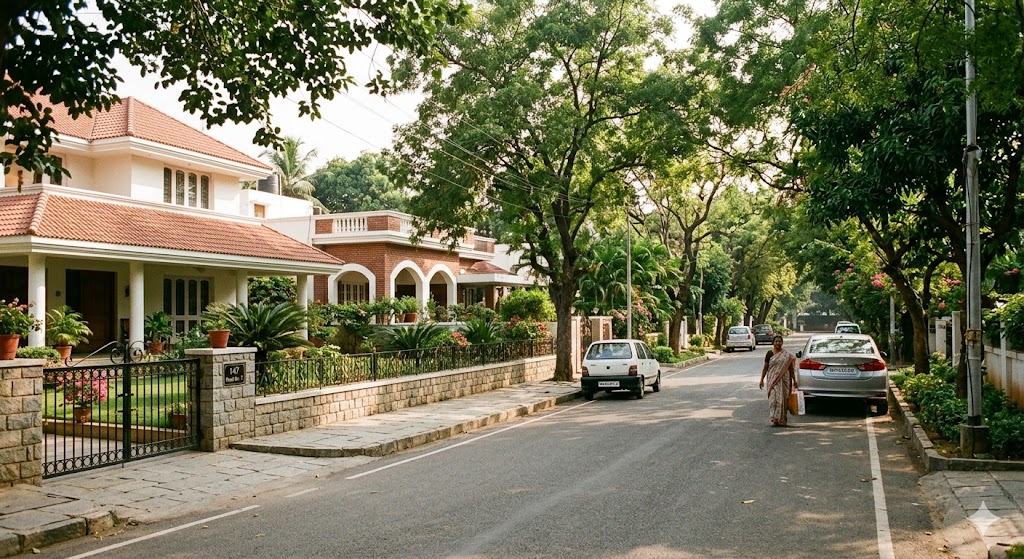
Many older Hyderabad residential plots sit within HUDA-approved layouts (Banjara Hills, Jubilee Hills, Begumpet, Secunderabad cantonment-adjacent zones). HUDA layouts often have layout-specific setback prescriptions — typically more generous than the bye-laws default — that apply to plots within the original allotment. The architect must inspect both the bye-laws table and the HUDA layout sanction plan; for plots in newer HMDA-sanctioned layouts (Gachibowli, Kokapet, Tellapur), the bye-laws default typically applies. Layouts in the Outer Ring Road extension zones (Shamshabad, Adibatla) often have HMDA-specific setback variations.
Cantonment areas — a separate regulatory regime
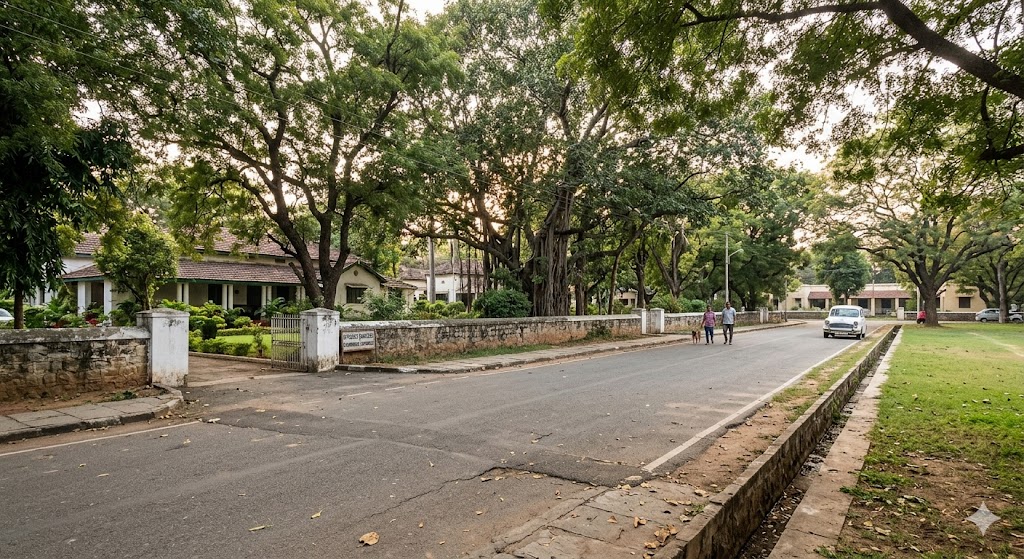
Hyderabad has two large Cantonment areas — Secunderabad Cantonment and Trimulgherry Cantonment — which operate under the Cantonment Act, 2006, with separate Cantonment Building Bye-laws administered by the Cantonment Boards. Cantonment plots are not subject to Telangana Building Rules 2012; setback, FSI, and approval procedures are different. Plots in the cantonment-civil-area boundary zones require careful jurisdiction verification — the wrong framework applied to a cantonment plot is uncorrectable and the project will fail at sanction. Cantonment Boards report to the Ministry of Defence, Government of India, and operate independently of GHMC and HMDA.
Heritage and lake-buffer overlays
Hyderabad has several notified heritage precincts (Charminar precinct, Golconda Fort precinct, Paigah Tombs area) and a network of lakes (Hussain Sagar, Osman Sagar, Himayat Sagar) with prescribed buffer zones. Within heritage precincts, the Department of Heritage Telangana imposes setback and height controls overriding the bye-laws. Lake-buffer plots face mandatory non-construction zones and graduated supplemental setbacks — particularly around Hussain Sagar where redevelopment is heavily restricted. The Hyderabad-specific overlay map is available on the HMDA portal; the architect's pre-design overlay check is mandatory for plots near notified water bodies or heritage zones.
TS-bPASS — the online sanction system and self-certification
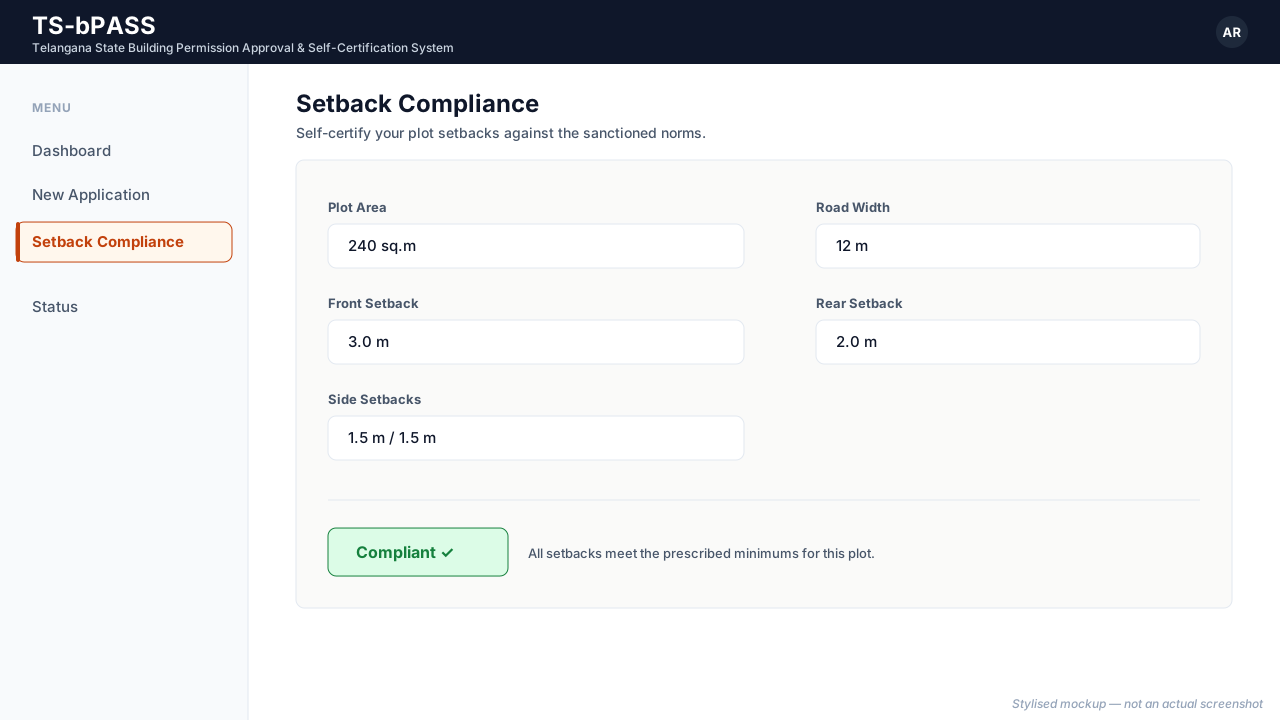
Telangana operates TS-bPASS (Telangana State — Building Permission Approval and Self-Certification System) — a unified online sanction platform launched under GO Ms No. 168 amendments. Under TS-bPASS, plots up to 75 sqm are eligible for instant approval (24 hours) on architect self-certification; plots 75–500 sqm get expedited approval; larger plots follow standard sanction. The self-certification model places the burden of setback verification on the registered architect — incorrect declarations risk professional consequences and sanction revocation on subsequent inspection. Random audits have triggered architect-registration suspensions in Telangana for self-certified setback violations.
Common pitfalls
- Applying Telangana Building Rules to cantonment plots — cantonment areas have a separate regime under the Cantonment Act.
- Forgetting the height-coupling supplement on high-rise buildings — the road-width matrix is a floor only.
- Treating HUDA-legacy layout setbacks as bye-laws default — the layout sanction plan often supersedes.
- Missing the lake-buffer overlay on plots near Hussain Sagar, Osman Sagar, or Himayat Sagar — buffer rules supersede the matrix within the notified zone.
- Submitting TS-bPASS instant-approval declarations without verifying every clause — random audits suspend architect registrations.
- Mis-locating the cantonment-civil boundary — plots near the boundary require jurisdiction verification.
Frequently asked questions
›Do Hyderabad setbacks differ between HMDA and GHMC plots?
›What is TS-bPASS and how does it affect setback declarations?
›Are cantonment plots in Secunderabad subject to Telangana Building Rules?
›What setback applies for high-rise residential in Gachibowli or Kondapur?
›Are HUDA-legacy layout setbacks different from Telangana Building Rules default?
›Does Hyderabad have lake-buffer rules like Bengaluru?
Sources & references
Telangana Building Rules 2012
Government of Telangana, Building Rules 2012 — setback matrix, FSI provisions, sanction framework
GO Ms No. 168 — Telangana Building Rules amendments
Telangana Government Order Ms 168 (2012) — substantial amendments introducing TS-bPASS framework
Cantonment Act, 2006
Act No. 41 of 2006 — statutory framework for Cantonment Boards and separate Cantonment Bye-laws
Telangana TS-bPASS Portal
Telangana State Building Permission Approval and Self-certification System — three-track sanction framework
HMDA Master Plan and Layout Notifications
Hyderabad Metropolitan Development Authority — HMDA master plan with HUDA-legacy and outer-ring extension provisions
Hussain Sagar / Osman Sagar / Himayat Sagar Buffer Zone Notifications
Telangana water-body buffer zone rules for Hyderabad lakes
National Building Code of India (NBC) 2016
Bureau of Indian Standards, NBC 2016 — Volume 1 Part 3 General Building Requirements
Disclaimer: Regulatory rates and dimensional rules change frequently and may be modified by mid-year notifications. Values reflect the framework as of 2026-05-10; verify against the current authority notification before any specific filing. This page is informational and is not legal or planning advice — engage a registered architect and a qualified planning consultant for project-specific compliance.
Related guides from the library
The companion deep-dives that practising architects keep alongside this reference.
FSI / FAR Computation in India
A State-by-State Working Reference for Indian Architects
24 min read · Open ConstructionBuilding Plan Approval Process in India
State-Wise Guide — BBMP, BMC, CMDA, GHMC, MCD, PMC & 14 More Cities
30 min read · Open ConstructionOC, CC & Plinth Verification in India
The Architect's Submission Workflow for Statutory Completion Milestones
20 min read · Open ConstructionArchitect Fee Structures in India
Slab, Lump-Sum, Hourly, and Hybrid — A Working Reference for Indian Practice
21 min read · Open ConstructionThe Architect's Scope of Services in India
COA Conditions of Engagement Decoded — Stages, Deliverables, Fees, and What's Actually Included
23 min read · OpenCompare across cities
The same Setbacks topic, different regulatory frameworks, different city quirks. Architects practising across metros should bookmark the adjacent reference.
Setbacks in Bengaluru
BBMP Building Bye-laws 2003 + Revised Master Plan 2031 (RMP 2031)
Open MCGM · MaharashtraSetbacks in Mumbai
Development Control and Promotion Regulations 2034 (DCPR 2034)
Open DDA · Delhi (NCT)Setbacks in Delhi
Master Plan for Delhi 2021 (MPD 2021) + Unified Building Bye-laws 2016
Open CMDA · Tamil NaduSetbacks in Chennai
Tamil Nadu Combined Development & Building Rules 2019 (TNCDBR 2019)
Open