
Delhi Setbacks (DDA / MCD) — A 2026 Architect's Working Reference
Setbacks under MPD 2021 and the Unified Building Bye-laws 2016 — plot-category-driven matrix, DDA-layout overrides, the Lutyens' Bungalow Zone heritage controls, and the Joint Inspection Committee gate that decides on-site compliance.
Governing framework: Master Plan for Delhi 2021 (MPD 2021) + Unified Building Bye-laws 2016

Working reference tables
Print or screenshot these for the studio wall. Cross-check against the current authority notification before any specific filing.
Plot category setback matrix (Unified Building Bye-laws 2016)
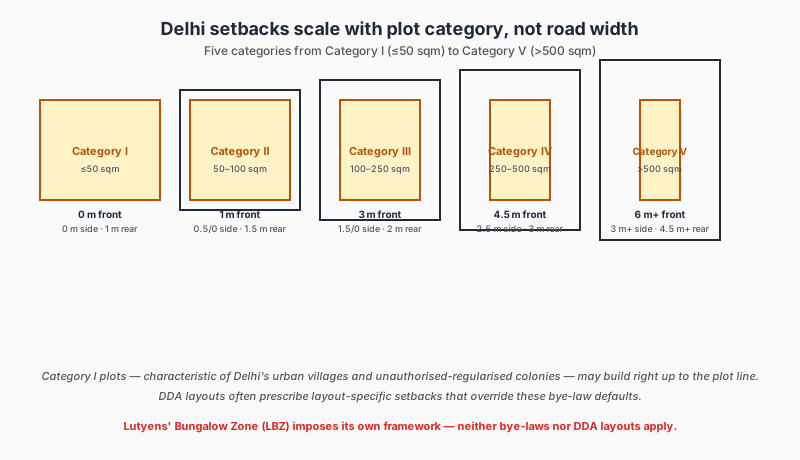
Delhi setbacks are driven by plot category (I to V), which is a function of plot size. Smaller plots get smaller mandatory margins, reflecting Delhi's mixed urban-village and planned-colony typology.
| Category | Plot Size | Front | Side (each) | Rear |
|---|---|---|---|---|
| I | Up to 50 sqm | 0 m (plot line) | 0 m | 1.0 m |
| II | 50–100 sqm | 1.0 m | 0.5 m / 0 m | 1.5 m |
| III | 100–250 sqm | 3.0 m | 1.5 m / 0 m | 2.0 m |
| IV | 250–500 sqm | 4.5 m | 2.5 m | 3.0 m |
| V | Above 500 sqm | 6.0 m+ | 3.0 m+ | 4.5 m+ |
Indicative values from the Unified Building Bye-laws 2016. DDA layouts often prescribe layout-specific setbacks that override these. Always cross-check the layout sanction plan and current MCD circulars at filing.
DDA-layout overrides (sample — Vasant Kunj, Dwarka, Rohini)
Many Delhi residential plots sit within DDA-approved layouts; layout-specific setbacks override the bye-laws default within the layout boundary.
| Layout | Typical residential plot | Layout-specific front setback |
|---|---|---|
| Vasant Kunj (cooperative society plots) | Cat IV–V | Per society allotment plan, often 5–6 m |
| Dwarka Sector 22 (newer DDA layout) | Cat III–IV | 3–4.5 m, matched to bye-laws default |
| Rohini (older DDA cooperative) | Cat III | 3 m, with layout-specific side setback rules |
| Hauz Khas Enclave (DDA bungalow zone) | Cat V | 6 m+ front, lower FAR cap |
The DDA layout sanction plan and the cooperative-society allotment letter are the authoritative documents within the layout. The Unified Bye-laws 2016 fill in the gaps where the layout is silent.
Lutyens' Bungalow Zone — heritage overrides
LBZ plots in central New Delhi follow heritage-zone regulations administered by NDMC, with controls below the bye-laws baseline.
| Parameter | LBZ value | Standard bye-laws (Cat IV–V) |
|---|---|---|
| Ground coverage | ≤ 25% | 40–50% |
| FAR / FAR% | ≈ 100% (FAR 1.0) | 150–200% |
| Height | ≈ 11 m / G+1 | Cat IV–V: up to 17.5 m |
| Façade material | Bagh Lutyens stucco palette | Architect-determined |
| Heritage NOC | Mandatory (HCC) | Not required |
LBZ extent is bounded approximately by Kasturba Gandhi Marg, Sardar Patel Marg, Aurobindo Marg, and Mathura Road. NDMC administers heritage controls.
Joint Inspection Committee — on-site verification gates
MCD's JIC inspects at plinth stage and at completion stage; setback verification is the central check at both gates.
| Stage | JIC role | Outcome of violation |
|---|---|---|
| Plinth (after foundation + plinth slab) | Tape-measure setbacks against OBPAS-sanctioned drawing | Stop-work until rectification or compounding |
| Completion (before OC issuance) | Verify final-built setbacks against sanctioned drawing | OC denial; building cannot be occupied or sold |
| Random audit (post-OC) | Spot-check on complaint-based or risk-flagged sites | Compounding fees or partial demolition |
Delhi's JIC mechanism is broadly similar to BBMP's plinth verification but covers a wider scope of dimensional checks at two stages.
The working reference, in full
Delhi's residential setback framework is unique among major Indian cities because two authorities operate in parallel. The DDA (Delhi Development Authority) controls the master-plan and layout sanction under MPD 2021; MCD (Municipal Corporation of Delhi) sanctions individual building plans under the Unified Building Bye-laws 2016. NDMC (New Delhi Municipal Council) operates separately for the Lutyens' Bungalow Zone (LBZ) under its own heritage-zone regulations. The architect must establish the applicable framework — bye-laws default, DDA layout, or LBZ — before any concept design.
Plot category drives the setback row
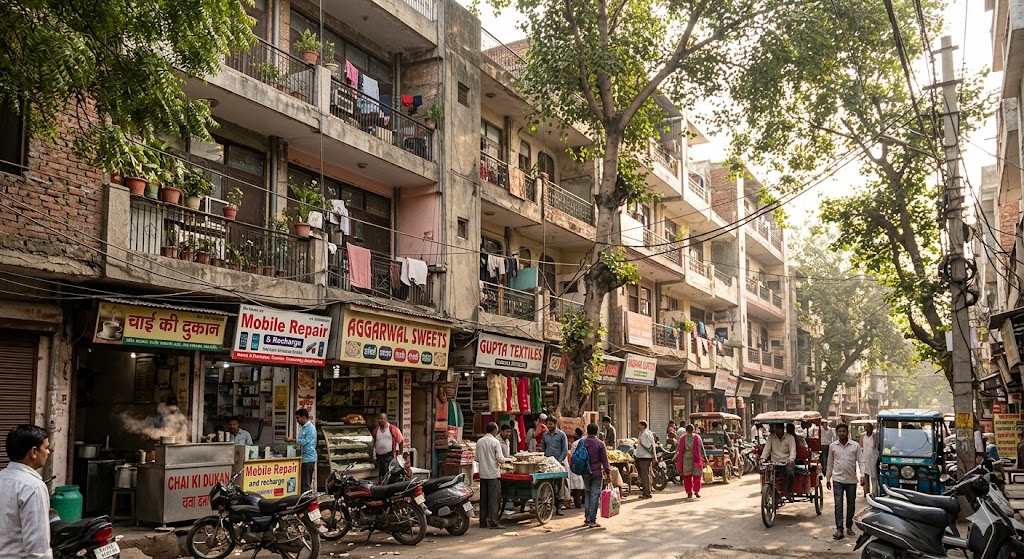
Unlike Bengaluru (plot-area-driven matrices) or Mumbai (road-width-driven), Delhi's setbacks are primarily driven by plot category (I through V), which is a function of plot size. Category I (up to 50 sqm) plots may be built right up to the plot line on the front and one side — characteristic of Delhi's narrow-row developments in urban villages, unauthorised-regularised colonies, and old planned colonies (Karol Bagh, Daryaganj, Lajpat Nagar). Category V (above 500 sqm) plots have setbacks comparable to large-plot bungalow zones in other cities. This category-driven framework reflects Delhi's residential typology: a mix of dense planned colonies, urban villages, regularised colonies, and large-plot bungalow zones.
DDA layouts override the bye-laws within the layout
Many Delhi residential plots sit within DDA-approved layouts — Vasant Kunj, Dwarka, Rohini, Saket, Hauz Khas Enclave, Sarita Vihar, etc. — each with its own layout-specific setback prescriptions that may differ from the Unified Bye-laws baseline. The DDA layout sanction plan, often filed with the original allotment, is the authoritative document for plots within DDA layouts. The cooperative-society allotment letter and the original layout site plan jointly govern. Outside DDA layouts (urban villages, unauthorised-regularised colonies), the Unified Bye-laws are the primary instrument. The architect's pre-design verification: which framework — layout or bye-laws — applies to this plot.
Lutyens' Bungalow Zone — heritage controls override everything
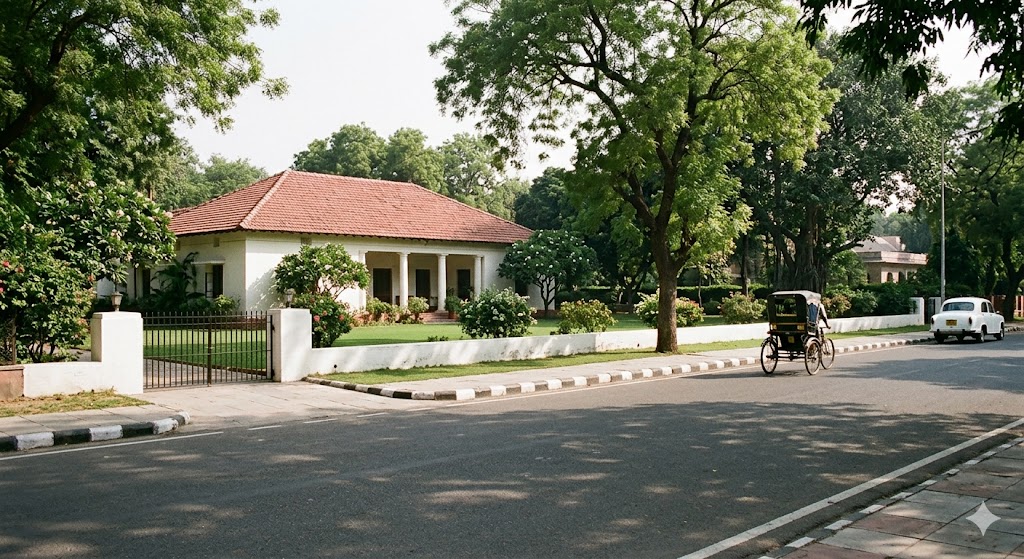
Plots within the Lutyens' Bungalow Zone (LBZ) — the central New Delhi area roughly bounded by Kasturba Gandhi Marg, Sardar Patel Marg, Aurobindo Marg, and Mathura Road — are subject to NDMC's heritage-zone regulations, which override both the bye-laws and any DDA layout provisions. LBZ plots cannot be redeveloped beyond modest extensions to the original bungalow footprint; ground coverage is capped at 25%, FAR at approximately 100%, height at 11 m / G+1, with façade material restricted to the Bagh Lutyens stucco palette. The Heritage Conservation Committee (HCC) NOC is mandatory for any work — new construction, redevelopment, or even substantial façade modification.
Stilt parking, basements, and projection rules
MCD permits stilt parking on plots above 100 sqm under MPD 2021 amendments, with the stilt floor (up to 2.4 m height) excluded from FAR but subject to the setback requirements applicable to the plot category. Basements are permitted within the building envelope with mandated ventilation and safety provisions; basements cannot project beyond the setback line, and basement extensions over the rear setback have been a recurrent rejection cause in MCD sanctions. Cantilever projections (sunshades, balconies, chajjas) over the setback are permitted up to depth limits typically 0.6–0.75 m, with minimum clear height of 2.4 m above ground.
OBPAS sanction and the Joint Inspection Committee
MCD plan sanction follows submission via the Online Building Plan Approval System (OBPAS), inspection by the Joint Inspection Committee (JIC) at plinth and at completion, and issuance of the Occupancy Certificate by MCD. JIC inspections specifically verify setback compliance — the on-site tape-measurement is the binding test, and a paper-compliant plan with on-site setback violation triggers stop-work until rectified. The JIC mechanism is broadly similar to BBMP's plinth verification but covers a wider scope of dimensional checks at two stages. Repeat or wilful violations result in OC denial, which makes the property un-saleable and un-financeable.

Common pitfalls
- Applying the Unified Building Bye-laws baseline within a DDA layout — the layout sanction plan governs.
- Missing the LBZ heritage overlay on plots within the Lutyens' Bungalow Zone — heritage rules override standard setbacks regardless of plot category.
- Treating older MCD by-laws (pre-2016) as authoritative — the Unified Building Bye-laws 2016 are the current framework.
- Forgetting the JIC plinth-stage check — paper sanction does not survive on-site setback violation.
- Mis-categorising the plot — Category boundaries (50, 100, 250, 500 sqm) are exact; a 49 sqm plot is Cat I, a 51 sqm plot is Cat II with materially different setbacks.
- Confusing NDMC area with MCD area — NDMC plots in Connaught Place / Lutyens' Delhi follow NDMC Bye-laws, not MCD's.
Frequently asked questions
›Why can Category I plots have zero setback in Delhi?
›Do DDA layouts override the Unified Building Bye-laws?
›What setback applies in Lutyens' Delhi?
›Can I build right up to the plot line in unauthorised-regularised colonies?
›What happens if JIC plinth inspection finds a setback violation?
›Are NDMC area setbacks different from MCD area setbacks?
Sources & references
Delhi Development Act, 1957
Act No. 61 of 1957 — statutory authority for DDA master-plan and layout-sanction powers
Master Plan for Delhi 2021 (MPD 2021)
Delhi Development Authority, MPD 2021 — Volume I and II; FAR matrix, plot-category framework
Unified Building Bye-laws 2016
MCD, Unified Building Bye-laws 2016 — plot category setback and FAR matrix
NDMC Building Bye-laws and LBZ Heritage Regulations
New Delhi Municipal Council Building Bye-laws — Lutyens' Bungalow Zone heritage-zone controls
OBPAS — Online Building Plan Approval System
MCD OBPAS portal — sanction workflow, JIC inspection scheduling, dimensional auto-validation
Heritage Conservation Committee (Delhi)
Delhi HCC NOC framework for heritage-listed structures and LBZ work
National Building Code of India (NBC) 2016
Bureau of Indian Standards, NBC 2016 — Volume 1 Part 3 General Building Requirements
Disclaimer: Regulatory rates and dimensional rules change frequently and may be modified by mid-year notifications. Values reflect the framework as of 2026-05-10; verify against the current authority notification before any specific filing. This page is informational and is not legal or planning advice — engage a registered architect and a qualified planning consultant for project-specific compliance.
Related guides from the library
The companion deep-dives that practising architects keep alongside this reference.
FSI / FAR Computation in India
A State-by-State Working Reference for Indian Architects
24 min read · Open ConstructionBuilding Plan Approval Process in India
State-Wise Guide — BBMP, BMC, CMDA, GHMC, MCD, PMC & 14 More Cities
30 min read · Open ConstructionOC, CC & Plinth Verification in India
The Architect's Submission Workflow for Statutory Completion Milestones
20 min read · Open ConstructionArchitect Fee Structures in India
Slab, Lump-Sum, Hourly, and Hybrid — A Working Reference for Indian Practice
21 min read · Open ConstructionThe Architect's Scope of Services in India
COA Conditions of Engagement Decoded — Stages, Deliverables, Fees, and What's Actually Included
23 min read · OpenCompare across cities
The same Setbacks topic, different regulatory frameworks, different city quirks. Architects practising across metros should bookmark the adjacent reference.
Setbacks in Bengaluru
BBMP Building Bye-laws 2003 + Revised Master Plan 2031 (RMP 2031)
Open MCGM · MaharashtraSetbacks in Mumbai
Development Control and Promotion Regulations 2034 (DCPR 2034)
Open CMDA · Tamil NaduSetbacks in Chennai
Tamil Nadu Combined Development & Building Rules 2019 (TNCDBR 2019)
Open HMDA · TelanganaSetbacks in Hyderabad
Telangana Building Rules 2012 + GO Ms No. 168
Open