
CMDA Setbacks in Chennai — A 2026 Architect's Working Reference
Setbacks under TNCDBR 2019 — front, side, and rear margins by road width and building height, OSR Open Space Reservation, CRZ overlays on the coastal stretch, and the Madras HC directives that supersede the matrix in eco-sensitive zones.
Governing framework: Tamil Nadu Combined Development & Building Rules 2019 (TNCDBR 2019)
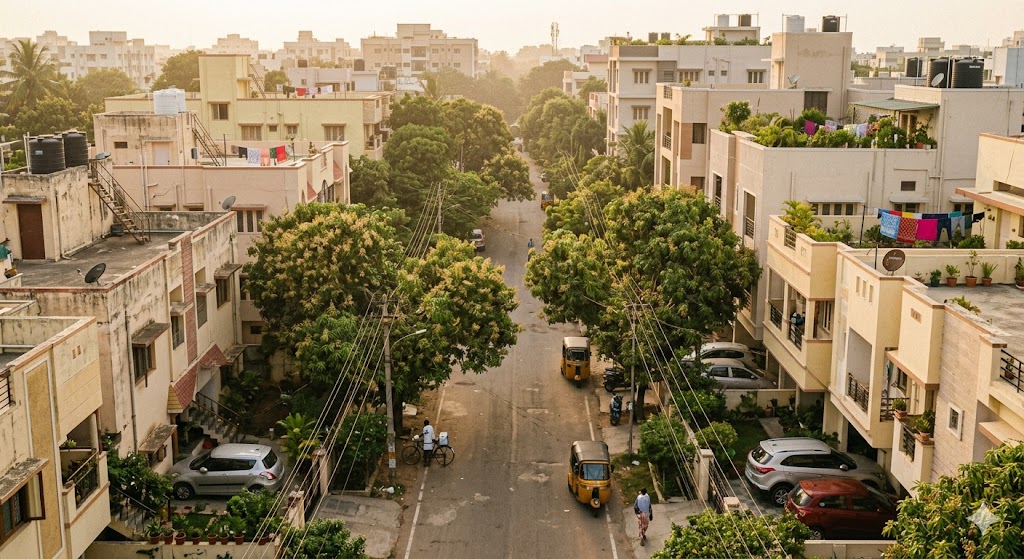
Working reference tables
Print or screenshot these for the studio wall. Cross-check against the current authority notification before any specific filing.
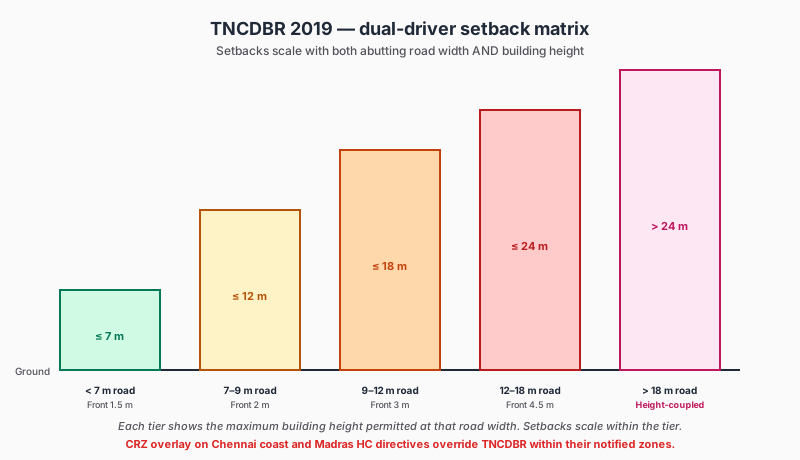
Residential setback matrix (TNCDBR 2019)
Setbacks scale with both abutting road width AND building height. The matrix is a floor; the height-coupled supplement applies for buildings over 18 m.
| Plot Frontage Road | Building Height | Front | Side (each) | Rear |
|---|---|---|---|---|
| < 7 m | Up to 7 m | 1.5 m | 1.0 m | 1.5 m |
| 7–9 m | Up to 12 m | 2.0 m | 1.5 m | 2.0 m |
| 9–12 m | Up to 18 m | 3.0 m | 2.5 m | 3.0 m |
| 12–18 m | Up to 24 m | 4.5 m | 3.5 m | 4.5 m |
| > 18 m | > 24 m | 6.0 m+ (height-coupled) | 5.0 m+ | 6.0 m+ |
Indicative TNCDBR 2019 values. CRZ-affected plots, heritage-listed buildings, and Madras HC directives override these.
OSR — Open Space Reservation requirement
Layouts above threshold sizes must dedicate contiguous open space, in addition to setbacks. The OSR is binding and cannot be re-allocated as buildable area.
| Layout size | OSR percentage | Notes |
|---|---|---|
| ≤ 1,500 sqm | Not required | Standard setbacks only |
| 1,500–5,000 sqm | 10% of plot area | Contiguous; usable open amenity |
| > 5,000 sqm | 15% of plot area | Contiguous; usable open amenity |
| Group Development Schemes | Per scheme notification | Often higher (up to 20%) |
OSR is a TNCDBR distinctive feature not present in equivalent form in Bengaluru, Mumbai, or Delhi bye-laws. CMDA layout sanction binds the OSR location and area.
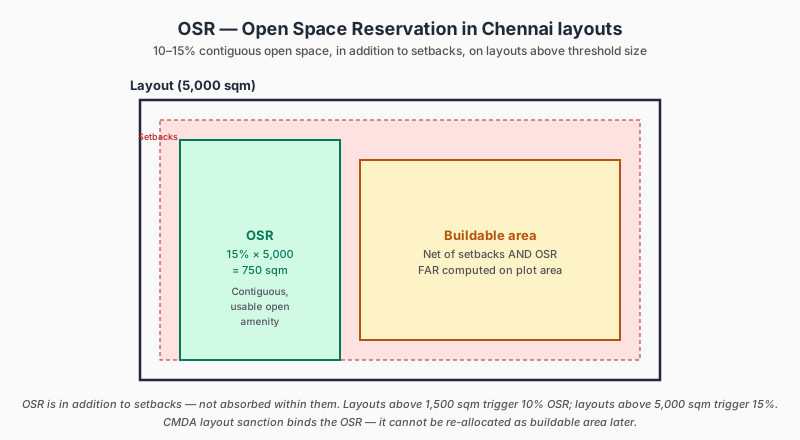
CRZ overrides on Chennai coast
TNSCZMA-notified CRZ zones supersede TNCDBR 2019 within the notified zone width. Coastal-plot setback strategy is constrained by CRZ category.
| CRZ category | Distance from HTL | Construction status |
|---|---|---|
| CRZ-IA | 0–200 m (ecologically sensitive) | No construction |
| CRZ-II (developed urban) | Marina, Adyar, Besant Nagar, Thiruvanmiyur | Redevelopment within existing footprint only |
| CRZ-III (rural / less developed) | Kovalam, ECR fringe villages | 200 m no-development zone; restricted beyond |
| CRZ-IV (water bodies) | Backwaters, estuaries | Per project-specific MoEFCC clearance |
| Beyond CRZ | > 500 m from HTL | TNCDBR 2019 applies normally |
Tamil Nadu State Coastal Zone Management Authority (TNSCZMA) issues CRZ clearances. Verify before concept design.
Cantilever projection allowances (TNCDBR 2019)
Limited projections over the setback are permitted; setback measured to the outermost overhang.
| Projection | Maximum | Notes |
|---|---|---|
| Sunshade / chajja | 0.6 m | Min 2.4 m clear height |
| Balcony (residential) | 0.75 m | Counts against FSI per zone |
| Cornice / decorative | 0.45 m | Architectural only |
| Projection over public road | Not permitted | Common rejection cause |
Compound walls and gates may sit on the plot line. Setback measurement still tracks the projection's outermost edge.
The working reference, in full
Chennai's residential setbacks are governed by the Tamil Nadu Combined Development and Building Rules 2019 (TNCDBR 2019) — a unified framework that consolidated earlier development control regulations across the state. Within Chennai Metropolitan Area, the CMDA (Chennai Metropolitan Development Authority) is the planning and layout-sanction authority, while plan-sanction power for individual buildings rests with the Greater Chennai Corporation (GCC) for plots within GCC limits and with the local town panchayat or municipality elsewhere. The architect must establish which authority sanctions this plot before any concept design.
TNCDBR setbacks scale with road width AND height
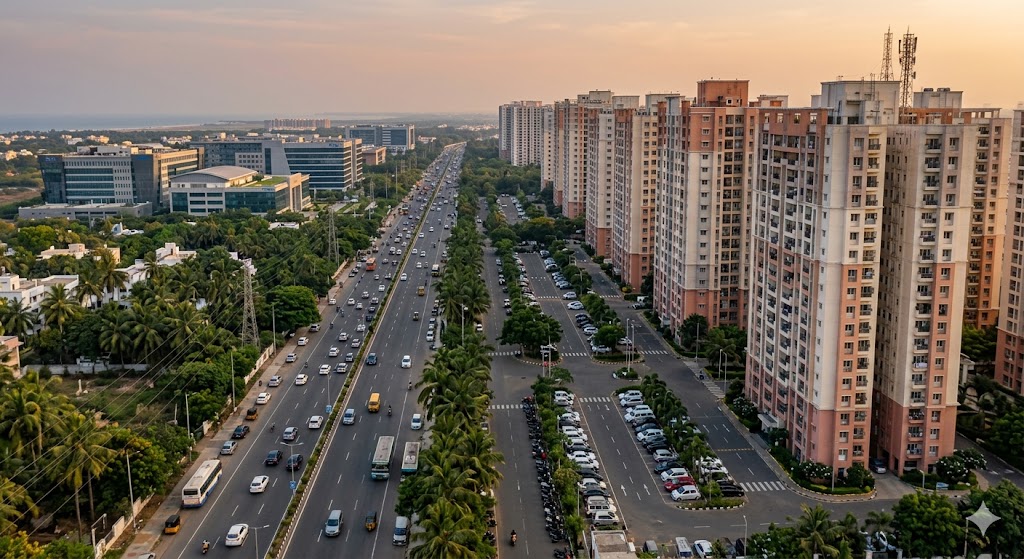
Unlike Bengaluru (plot-area-driven) or Delhi (plot-category-driven), TNCDBR 2019 setbacks scale with both the abutting road width and the building height. This dual scaling reflects Chennai's typology of mixed-use streets where the same road width supports both single-family residential and mid-rise apartment buildings. The matrix shows the road-width-driven baseline; the height-coupling supplement applies for buildings over 18 m. For high-rise residential along OMR (Old Mahabalipuram Road) and the IT corridor extension, the height-coupling almost always dominates the road-width matrix.
OSR — Open Space Reservation, Chennai's distinctive requirement
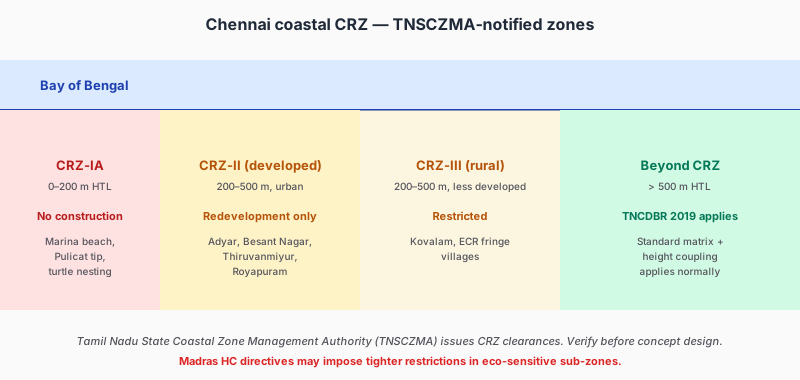
TNCDBR 2019 imposes an Open Space Reservation (OSR) requirement on layouts above a threshold size — typically 10% of plot area for layouts above 1,500 sqm, increased to 15% for layouts above 5,000 sqm. The OSR is in addition to setbacks and must be a contiguous open area, usable for landscape or community amenity. OSR is a TNCDBR distinctive feature; it is not present (or at least not in the same form) in the bye-laws of Bengaluru, Mumbai, or Delhi. The CMDA layout sanction binds the OSR location — once approved, OSR cannot be re-allocated as buildable area. Architects new to Chennai sometimes treat OSR as absorbable into the setback margin, which is a sanction-blocker.
CRZ overlay on Chennai's coastal plots
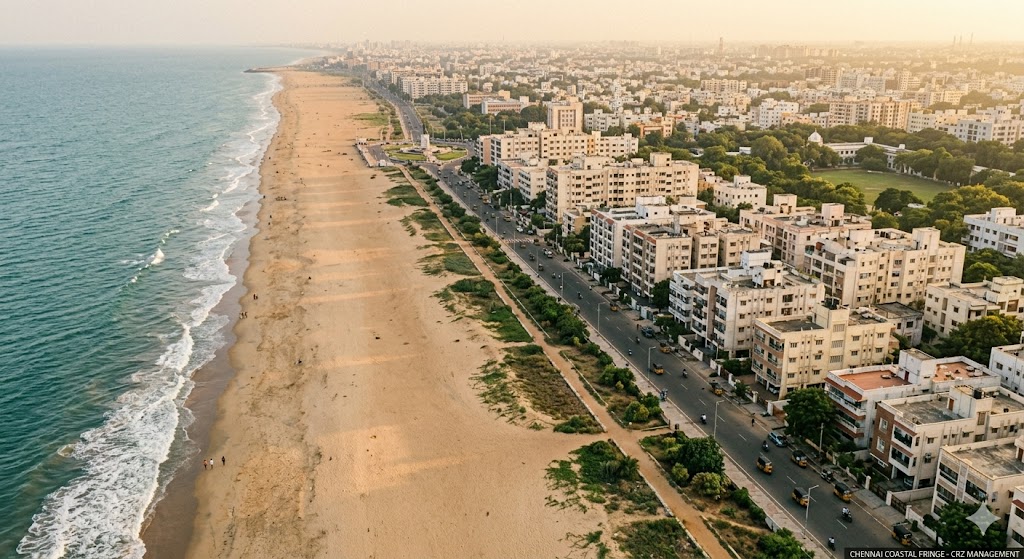
Chennai's coastal stretch — Marina, Besant Nagar, Thiruvanmiyur, Adyar, Royapuram, Tondiarpet — sits within the Coastal Regulation Zone, with CRZ-II permitting redevelopment within existing footprint and CRZ-III restricting new construction. The Tamil Nadu State Coastal Zone Management Authority (TNSCZMA) issues CRZ clearances. Coastal-plot setbacks are governed by the CRZ Notification 2019 and override TNCDBR setbacks within the notified zone width. The architect's CRZ verification — preferably via TNSCZMA — must precede any concept design on a coastal plot. CRZ status is not surfaced on standard property documents.
OSR in practice — what 15% contiguous open space looks like
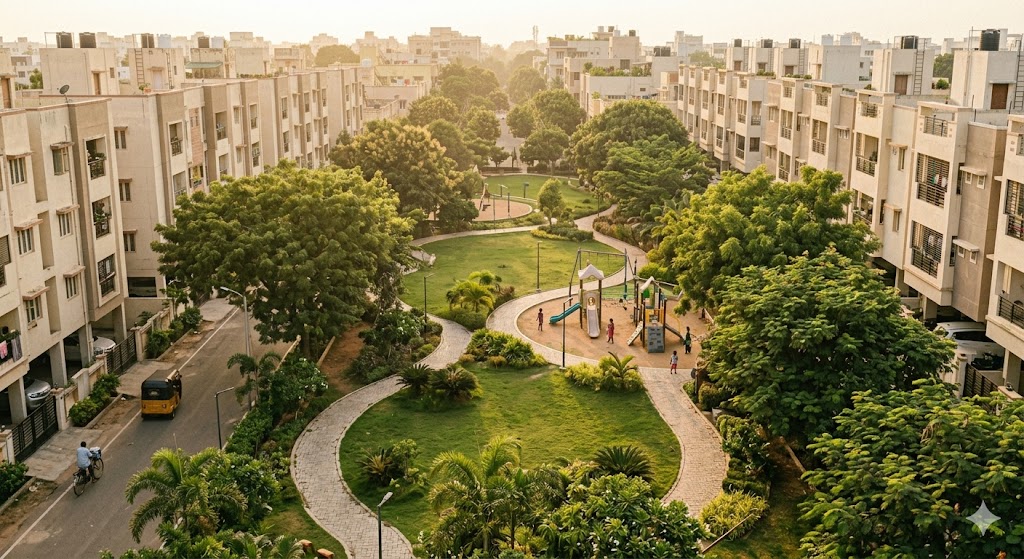
On paper, OSR is a number; on site, it's a 15% block of open ground that the developer cannot build on, the residents cannot encroach on, and the architect must place coherently within the layout. CMDA-sanctioned OSR areas typically take the form of a central landscaped park, a perimeter walking strip with native shade trees, or a play-area-plus-clubhouse zone — the layout sanction plan binds the location and shape. Once approved, the OSR cannot be moved or reduced, and any encroachment by individual plot owners (extended porches, parked vehicles overflowing onto OSR) is enforceable by GCC complaint mechanism.
Madras HC directives — the often-missed override
Chennai's setback regime is unusually shaped by Madras High Court directives in public-interest litigation. Notable directives have constrained construction near the Pallikaranai marsh (eco-sensitive zone), restricted setbacks on plots within 100 m of certain rivers (Adyar, Cooum), and imposed environmental setbacks beyond the standard TNCDBR matrix. The architect's pre-design environmental check should include a search for plot-specific or area-specific HC directives — common-knowledge in long-established Chennai practices but easy to miss for newcomers. Multiple high-profile project demolitions in Chennai have followed undetected HC directives.
OBPAS sanction and the IT-corridor zones
Chennai's plan sanction follows submission via CMDA's OBPAS (Online Building Plan Approval System), with simultaneous filings to GCC for the actual building plan within GCC limits. Plinth verification is conducted by GCC engineers; CMDA verifies layout-level setback compliance. For plots in Chennai's IT-corridor extension areas — Old Mahabalipuram Road, Sholinganallur, Siruseri — CMDA's role as layout sanction authority is more pronounced, and layout-specific setback prescriptions often supersede the TNCDBR baseline. The architect must inspect both the CMDA layout sanction plan and the TNCDBR table.
Common pitfalls
- Forgetting the height-coupling supplement for buildings over 18 m — the road-width matrix is a floor only.
- Missing the OSR requirement on layouts above 1,500 sqm — OSR is in addition to setbacks, not absorbed within them.
- Treating CRZ stretches as standard TNCDBR plots — CRZ supersedes within the notified zone.
- Ignoring Madras HC directives on plot-specific environmental constraints — these have caused multiple high-profile project demolitions in Chennai.
- Treating IT-corridor plots as TNCDBR-default — CMDA layout sanctions often impose stricter or different setbacks.
- Computing OSR within the FSI count — OSR is an open-space requirement, not an FSI deduction.
Frequently asked questions
›What is the minimum setback for a small Chennai plot on a narrow road?
›What is OSR in CMDA approvals?
›Do Chennai's HC directives override the TNCDBR setback matrix?
›Are setbacks in IT-corridor areas different from central Chennai?
›Does CRZ permit redevelopment of coastal Chennai apartments?
›Can OSR area be moved later if the developer needs more buildable area?
Sources & references
Tamil Nadu Town and Country Planning Act, 1971
Act No. 35 of 1972 — statutory authority for TNCDBR 2019 dimensional rules
Tamil Nadu Combined Development and Building Rules 2019 (TNCDBR 2019)
Tamil Nadu Government Order — TNCDBR 2019 Rules 25–35 (setbacks), Rule 27 (OSR)
Coastal Regulation Zone Notification 2019
MoEFCC CRZ Notification 2019 — CRZ category framework as applied along Chennai coast
Tamil Nadu State Coastal Zone Management Authority (TNSCZMA)
TNSCZMA — coastal clearance framework for Chennai metropolitan area
Madras High Court — Public Interest Directives
Various PIL judgments restricting construction near Pallikaranai, Adyar, Cooum, and other eco-sensitive zones
CMDA OBPAS — Online Building Plan Approval System
Chennai Metropolitan Development Authority OBPAS portal — sanction workflow and dimensional auto-validation
National Building Code of India (NBC) 2016
Bureau of Indian Standards, NBC 2016 — Volume 1 Part 3 General Building Requirements
Disclaimer: Regulatory rates and dimensional rules change frequently and may be modified by mid-year notifications. Values reflect the framework as of 2026-05-10; verify against the current authority notification before any specific filing. This page is informational and is not legal or planning advice — engage a registered architect and a qualified planning consultant for project-specific compliance.
Related guides from the library
The companion deep-dives that practising architects keep alongside this reference.
FSI / FAR Computation in India
A State-by-State Working Reference for Indian Architects
24 min read · Open ConstructionBuilding Plan Approval Process in India
State-Wise Guide — BBMP, BMC, CMDA, GHMC, MCD, PMC & 14 More Cities
30 min read · Open SustainabilityPassive Design Strategies for Indian Climate Zones
A Climate-Zone-by-Zone Working Reference for Indian Architects
24 min read · Open ConstructionArchitect Fee Structures in India
Slab, Lump-Sum, Hourly, and Hybrid — A Working Reference for Indian Practice
21 min read · Open ConstructionThe Architect's Scope of Services in India
COA Conditions of Engagement Decoded — Stages, Deliverables, Fees, and What's Actually Included
23 min read · OpenCompare across cities
The same Setbacks topic, different regulatory frameworks, different city quirks. Architects practising across metros should bookmark the adjacent reference.
Setbacks in Bengaluru
BBMP Building Bye-laws 2003 + Revised Master Plan 2031 (RMP 2031)
Open MCGM · MaharashtraSetbacks in Mumbai
Development Control and Promotion Regulations 2034 (DCPR 2034)
Open DDA · Delhi (NCT)Setbacks in Delhi
Master Plan for Delhi 2021 (MPD 2021) + Unified Building Bye-laws 2016
Open HMDA · TelanganaSetbacks in Hyderabad
Telangana Building Rules 2012 + GO Ms No. 168
Open