
MCGM (BMC) Setbacks in Mumbai — A 2026 Architect's Working Reference
Setbacks under DCPR 2034 — the road-width matrix, the aggressive height-coupling formula, the 16 notified heritage precincts that override façade lines, and the CRZ Notification 2019 that supersedes everything along the coastline.
Governing framework: Development Control and Promotion Regulations 2034 (DCPR 2034)
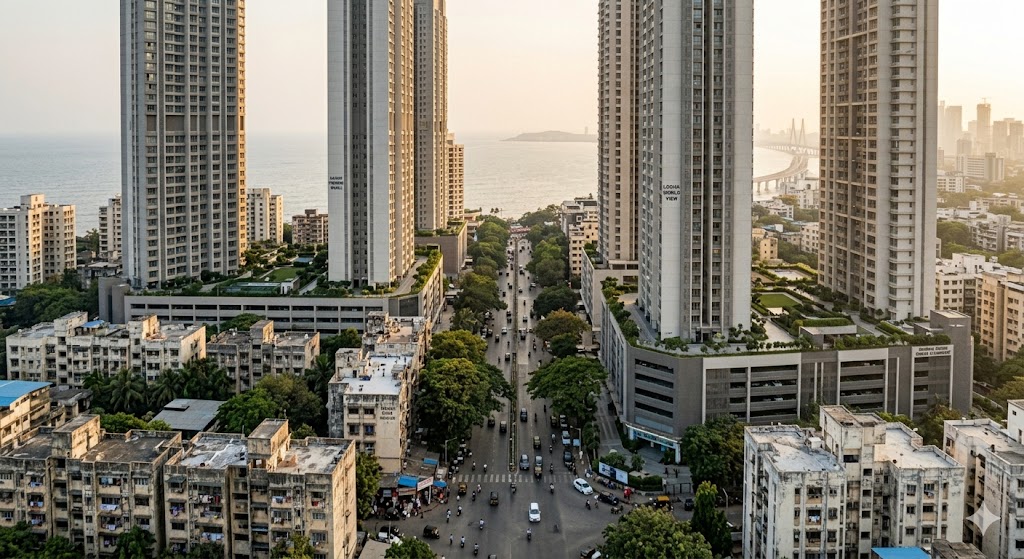
Working reference tables
Print or screenshot these for the studio wall. Cross-check against the current authority notification before any specific filing.
DCPR 2034 setback matrix (residential, indicative)
Mumbai's setbacks scale with the abutting road width — not plot size. The matrix is a floor; the height-coupling supplement (separate table) often dominates for high-rise.
| Plot Frontage Road | Front Setback | Side Setback | Rear Setback |
|---|---|---|---|
| < 9 m | 1.5 m | 1.5 m | 3.0 m |
| 9–12 m | 4.5 m | 3.0 m | 4.5 m |
| 12–18 m | 7.5 m | 4.5 m | 6.0 m |
| > 18 m | 10.5 m | 6.0 m | 7.5 m |
DCPR 2034 baseline. Heritage precincts (Fort, Marine Drive, Khotachiwadi, etc.) override these. CRZ-affected plots follow the CRZ Notification 2019 instead.
Height-coupling supplement (DCPR 2034)
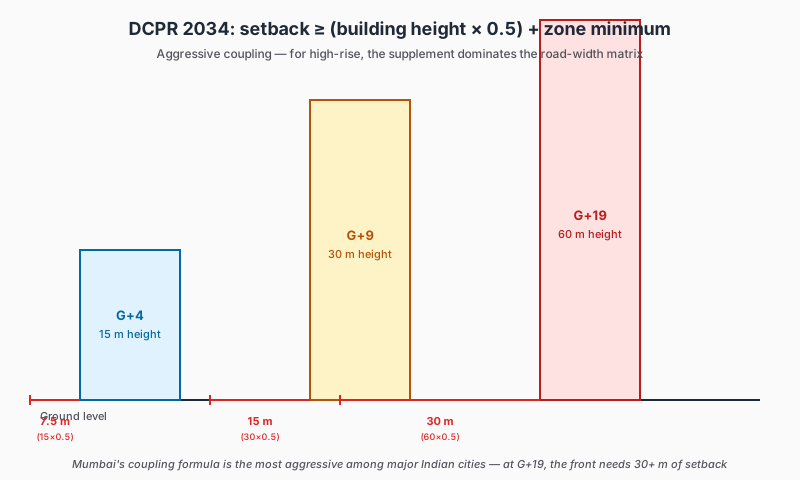
Mumbai's height coupling is the most aggressive in India — half the building height becomes the supplemental setback floor.
| Building Height | Height-coupled supplement (× 0.5) | Effective minimum |
|---|---|---|
| ≤ 15 m (G+4) | 7.5 m | max(matrix, 7.5 m) |
| ≤ 24 m (G+7) | 12.0 m | max(matrix, 12.0 m) |
| ≤ 30 m (G+9) | 15.0 m | max(matrix, 15.0 m) |
| ≤ 45 m (G+14) | 22.5 m | max(matrix, 22.5 m) |
| ≤ 60 m (G+19) | 30.0 m | max(matrix, 30.0 m) |
Height is measured to the highest occupied floor's slab top. The coupling supplement applies on every façade with a prescribed setback. For high-rise, the road-width matrix becomes a floor that the coupling almost always overrides.
Heritage and CRZ overrides — when standard matrix doesn't apply
Three frameworks override DCPR 2034 standard setbacks within their notified zones. Pre-design verification is mandatory.
| Override Framework | Setback Treatment | Authority |
|---|---|---|
| Heritage Precinct (16 notified) | Façade-line continuity; zero front setback typical | Heritage Conservation Committee (HCC) |
| Heritage-listed individual structure | Per heritage grading; modest extension only | HCC + MCGM |
| CRZ-IA (0–200 m, ecologically sensitive) | No construction permitted | MCZMA |
| CRZ-II (developed urban) | Redevelopment within existing footprint; no FSI increase | MCZMA |
| CRZ-III (less-developed coastal) | 200 m no-development zone; restricted beyond | MCZMA |
| SRA Scheme (slum redevelopment) | Reduced setbacks (1.5–2 m) against very high FSI (4.0+) | Slum Rehabilitation Authority |
| Cluster Development Scheme (CDS) | Reduced setbacks against cluster amalgamation | MCGM |
Mumbai is the most-overridden setback regime in India. The standard matrix applies only after CRZ, heritage, SRA, and CDS frameworks have been ruled out for the plot.
Cantilever projection allowances (DCPR 2034)
Limited projections over the setback are permitted; setback is measured to the outermost overhang projection.
| Projection type | Maximum projection | Notes |
|---|---|---|
| Sunshade / chajja | 0.6 m | Min 2.4 m clear height |
| Balcony (residential) | 1.0 m | Counts against Fungible FSI consumption |
| Cornice / decorative band | 0.45 m | Architectural treatment only |
| Refuge platform (high-rise) | Per fire-NOC clause | Excluded from FSI; counts as projection for setback |
| Projection over public road / footpath | Not permitted | Common rejection cause |
Fungible FSI consumption for balconies is computed separately; the setback measurement still tracks the projection's outermost edge.
The working reference, in full
Mumbai is the densest residential market in India and the most regulatory-intricate jurisdiction an architect can practise in. MCGM (the Municipal Corporation of Greater Mumbai, also called BMC) enforces setbacks under DCPR 2034 — the Development Control and Promotion Regulations 2034, which superseded the older DCR 1991. DCPR 2034 setbacks are tied to abutting road width rather than plot size, reflecting Mumbai's lot-and-block grain. But on any given plot, the architect must check four overrides before applying the standard matrix: the heritage precinct framework (16 notified precincts), the CRZ Notification 2019 (extensive coastline coverage), the SRA scheme guidelines (slum-cleared land), and the Cluster Development Scheme. Mumbai's setback regime is the most-overridden of any Indian metro.
The matrix and the height-coupling supplement
DCPR 2034 ties setback to building height through the light-and-air-passage formula: setback ≥ (building height × 0.5) + zone-specific minimum. This is the most aggressive coupling formula in any major Indian city. A 30-metre building (G+9) on a plot otherwise eligible for a 4.5 m front setback must, in practice, leave 19.5 m at the front — the 4.5 m matrix floor plus 15 m height-coupled supplement. For high-rise residential — the dominant typology in modern Mumbai — the coupling alone often dictates the achievable plot footprint, with the road-width matrix becoming a non-binding floor.
Heritage precincts — façade-line continuity overrides the matrix
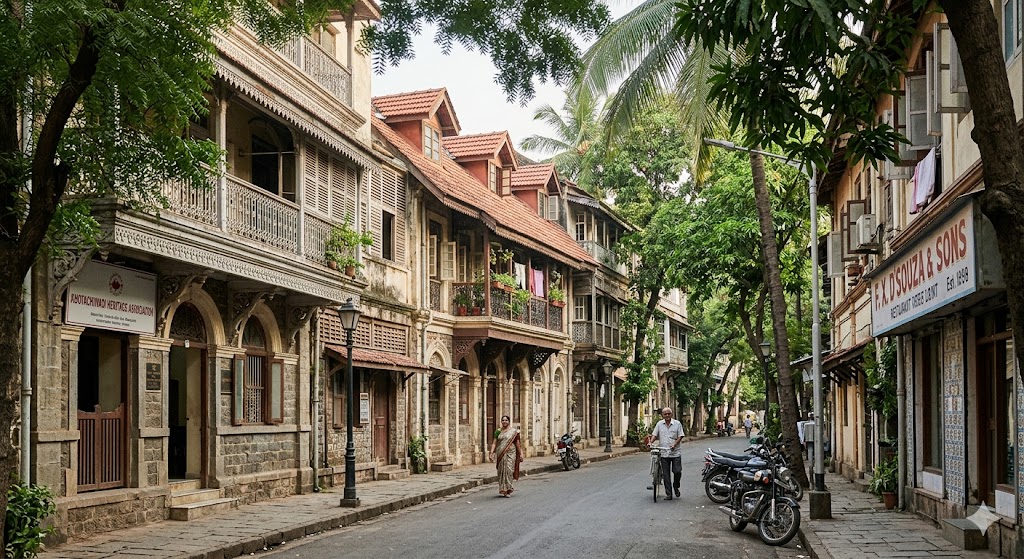
Mumbai has 16 notified heritage precincts (Fort, Marine Drive, Khotachiwadi, Bandra Bandstand, Banganga Tank precinct, Kala Ghoda, Horniman Circle, Oval Maidan, Cooperage, Apollo Bunder, and others) and over 1,200 listed heritage structures. Within a heritage precinct, the standard DCPR 2034 setback matrix is overridden by precinct-specific guidelines — typically requiring façade-line continuity (zero front setback to match the existing street wall), height caps tied to the prevailing skyline, and material restrictions. The Heritage Conservation Committee (HCC) NOC is mandatory for any work — new construction, redevelopment, or façade modification. The architect's pre-design verification must confirm whether the plot sits within a precinct or carries an individual heritage grading; both override the standard matrix.
CRZ overlay — the no-build line along the coastline
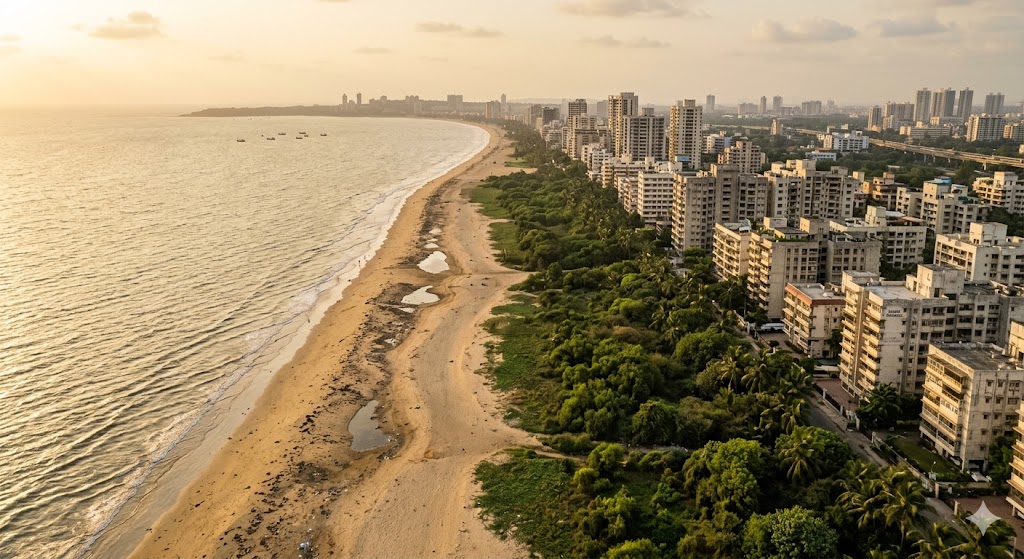
The Coastal Regulation Zone (CRZ) Notification 2019 prescribes a no-development line based on distance from the High Tide Line (HTL). Substantial portions of Mumbai's residential market — South Mumbai's Marine Drive belt, Worli, Bandra West, Juhu, Versova, Madh Island, Gorai, parts of Thane Creek — sit within the CRZ. CRZ-IA (0–200 m, ecologically sensitive) prohibits all construction. CRZ-II (developed urban) permits redevelopment within the existing footprint with no FSI increase. CRZ-III (less developed coastal) restricts new construction beyond limited categories with a 200 m no-development zone. CRZ supersedes DCPR 2034 within the notified zone width; the architect's CRZ verification — preferably via the Maharashtra Coastal Zone Management Authority (MCZMA) — must precede any concept design on a coastal plot.
SRA, MHADA, and Cluster Development — different setback regimes
Three special schemes operate outside the standard DCPR 2034 setback regime. SRA (Slum Rehabilitation Authority) projects routinely run 1.5–2.0 m setbacks against very high FSI (4.0+) — the SRA scheme guidelines, not DCPR 2034, govern. MHADA (Maharashtra Housing and Area Development Authority) layouts have layout-specific setback prescriptions tied to the original allotment plan. Cluster Development Scheme (CDS) plots may consume their setback margins at lower depths than the matrix in exchange for cluster-level open-space contribution. Mis-routing a project — claiming SRA setbacks for a non-SRA plot, or applying DCPR setbacks within an MHADA-redeveloped layout — is one of the costliest planning errors in Mumbai practice.
Architect's compliance certificate and the AGNI/DPMS workflow
Mumbai operates the AGNI / DPMS online sanction workflow — the Auto DCR / Building Plan Auto Approval portal layered with the Development Permission Management System. Architects file the sanction package digitally; the AGNI auto-validation runs DCPR 2034 dimensional checks on the submitted drawing (setbacks, FSI, parking, fire passage). The architect's signed FSI / setback compliance certificate is part of the package — a clause-by-clause declaration that the design conforms to DCPR 2034 (or to the applicable heritage / CRZ / SRA / CDS scheme guideline where overrides apply). Errors in declared road-width, missed height-coupling supplement, or unaccounted heritage / CRZ overlay are the most frequent rejection reasons; the AGNI auto-validation often catches these faster than a manual review would.

Common pitfalls
- Applying DCPR 2034 setbacks within a heritage precinct — precinct guidelines override and façade-continuity often eliminates front setback entirely.
- Missing the CRZ overlay on plots within 500 m of the High Tide Line — CRZ supersedes DCPR within the notified zone; the standard property card does not surface CRZ status.
- Computing height-coupled setback on the wrong height — DCPR 2034 measures to the highest occupied floor's slab top, not to the parapet or rooftop machine room.
- Treating private internal-society roads as if they had a notified width — only gazetted road widths qualify for the matrix row.
- Routing an SRA-eligible project through standard DCPR sanction — SRA scheme provides reduced setbacks against high FSI; the wrong route loses the FSI benefit.
- Applying DCPR 2034 in Thane or Navi Mumbai — Thane DCR and CIDCO Building Bylaws govern those jurisdictions, with different setback matrices.
Frequently asked questions
›Are DCPR 2034 setbacks the same across MCGM, Thane, and Navi Mumbai?
›Does premium FSI affect setback in Mumbai?
›Can a fungible-FSI balcony project over the setback?
›Do heritage precinct setbacks vary between Fort and Bandra Bandstand?
›What is the minimum setback for a small Mumbai plot on a narrow road?
›Does CRZ permit redevelopment of existing coastal buildings?
Sources & references
Maharashtra Regional and Town Planning Act, 1966
MRTP Act, 1966 — statutory authority for DCPR 2034 dimensional rules
Development Control and Promotion Regulations 2034 (DCPR 2034)
MCGM, DCPR 2034 — Regulations 30 (setbacks), 33 (Premium and Fungible FSI), 41 (TDR)
Coastal Regulation Zone Notification 2019
Ministry of Environment, Forest and Climate Change, CRZ Notification 2019 — CRZ-IA / IB / II / III / IV categories and dimensional restrictions
Maharashtra Heritage Conservation Committee Guidelines
MCGM Heritage Conservation Committee — 16 notified heritage precincts and grading framework
Slum Areas (Improvement, Clearance and Redevelopment) Act, 1971
Maharashtra Slum Act 1971 — Slum Rehabilitation Authority scheme guidelines
AGNI / DPMS Online Building Plan Auto Approval Portal
MCGM AGNI portal — Auto DCR rule-based validation and DPMS workflow
National Building Code of India (NBC) 2016
Bureau of Indian Standards, NBC 2016 — Volume 1 Part 3 General Building Requirements
Disclaimer: Regulatory rates and dimensional rules change frequently and may be modified by mid-year notifications. Values reflect the framework as of 2026-05-10; verify against the current authority notification before any specific filing. This page is informational and is not legal or planning advice — engage a registered architect and a qualified planning consultant for project-specific compliance.
Related guides from the library
The companion deep-dives that practising architects keep alongside this reference.
FSI / FAR Computation in India
A State-by-State Working Reference for Indian Architects
24 min read · Open ConstructionBuilding Plan Approval Process in India
State-Wise Guide — BBMP, BMC, CMDA, GHMC, MCD, PMC & 14 More Cities
30 min read · Open ConstructionOC, CC & Plinth Verification in India
The Architect's Submission Workflow for Statutory Completion Milestones
20 min read · Open ConstructionArchitect Fee Structures in India
Slab, Lump-Sum, Hourly, and Hybrid — A Working Reference for Indian Practice
21 min read · OpenCompare across cities
The same Setbacks topic, different regulatory frameworks, different city quirks. Architects practising across metros should bookmark the adjacent reference.
Setbacks in Bengaluru
BBMP Building Bye-laws 2003 + Revised Master Plan 2031 (RMP 2031)
Open DDA · Delhi (NCT)Setbacks in Delhi
Master Plan for Delhi 2021 (MPD 2021) + Unified Building Bye-laws 2016
Open CMDA · Tamil NaduSetbacks in Chennai
Tamil Nadu Combined Development & Building Rules 2019 (TNCDBR 2019)
Open HMDA · TelanganaSetbacks in Hyderabad
Telangana Building Rules 2012 + GO Ms No. 168
OpenBuilding Setbacks Across India
A State-by-State Guide to Development Control Regulations, Plot Setbacks, Ground Coverage, and FAR — for Architects, Planners, and Developers
Read the deep-dive Mumbai compliance mapThe Architect's Compliance Map — Mumbai
MCGM, MMRDA, SRA, MahaRERA, MPCB, CRZ — DCPR 2034, Premium and Fungible FSI, TDR, Heritage Overlays, and the Operational Workflow for Residential Practice in 2026
Read the city map