
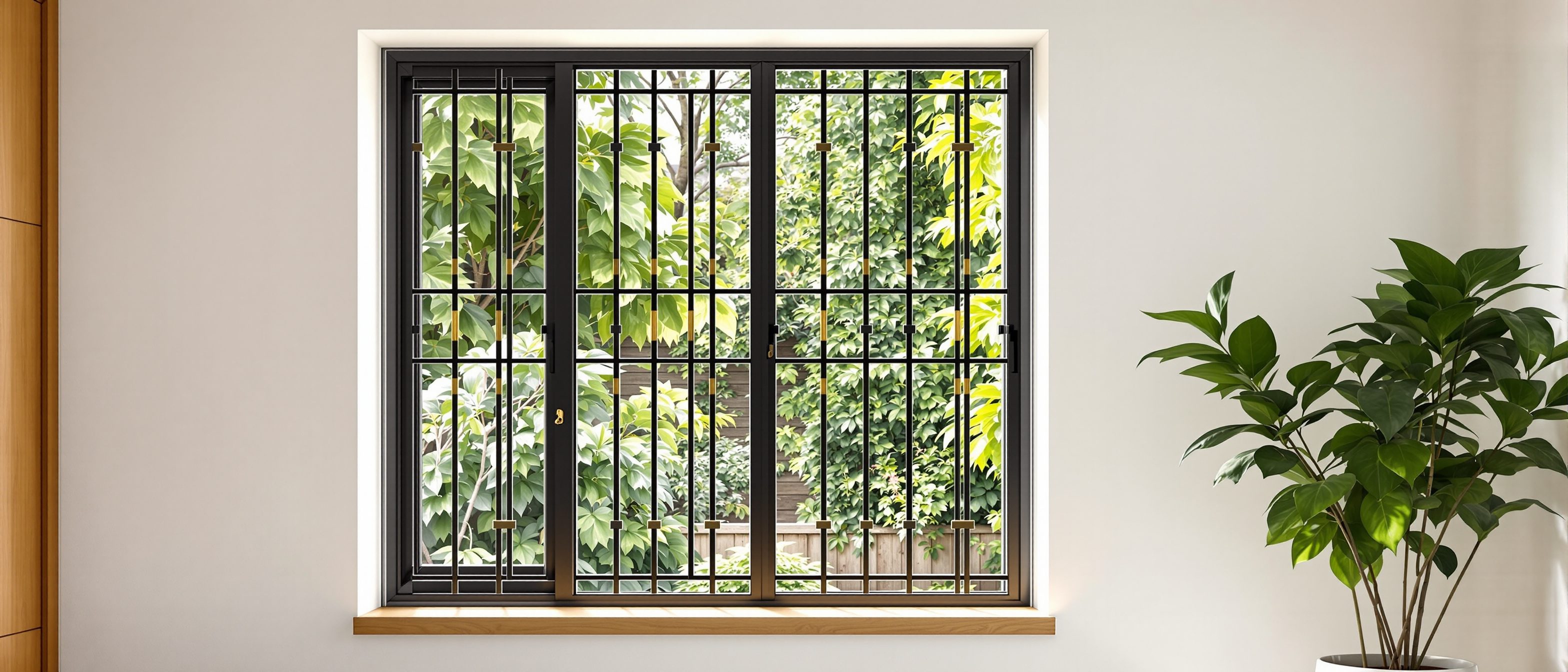
Window Grills Design Guide
Security grilles as design: pattern families, materials and cost, dual-tone finishes, invisible cable grilles and the child-safety numbers that matter
In most Indian homes a window grille is not optional. It is the line of defence against burglary, the safety rail that keeps a toddler from a third-floor sill, and the frame that lets you leave a window open through a humid night. The mistake is treating it as pure hardware. A grille covers the most-looked-at rectangle on your facade, so it is doing aesthetic work whether you design it or not. This guide is about designing it on purpose: pattern families, materials and honest per-square-foot costs, dual-tone finishes, the new "invisible" cable grilles for high-rise views, and the safety numbers that should never be value-engineered away.
A grille is the only piece of security you see from your sofa every single day. Make it worth looking at.
Grille versus jali — get the words right first
These two get muddled constantly, and they are different objects. A grille is a set of metal bars (mild steel, wrought iron or stainless steel) fixed across a window opening for security and child-safety. A jali is a perforated screen — stone, concrete, wood or terracotta — that filters light, air and view as an architectural surface, with security as a happy side-effect at best. A jali pattern can absolutely inspire a grille (see the jali-inspired family below), but a true jali is not a substitute for a load-rated security barrier. If you want the screen as a design element rather than a guard, read our companion guide on jali windows. This guide stays in the security-bar lane.
The five pattern families
Almost every grille on the market is a variation on five families. Pick the family first; it decides the mood far more than the colour does.
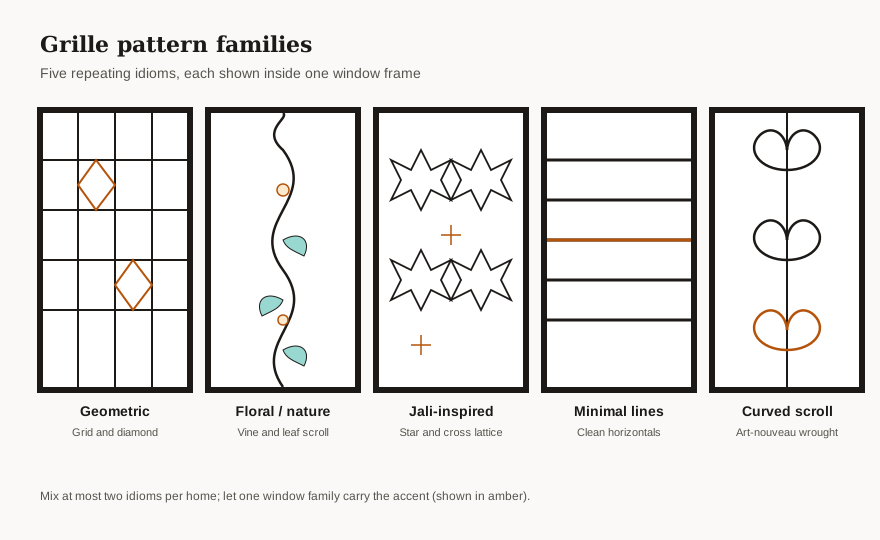
| Pattern family | Look it speaks | Best home style | Notes |
|---|---|---|---|
| Geometric (grid, diamond, hexagon) | Crisp, modern, calm | Contemporary, minimal | Reads quiet; aligns with slim window frames |
| Floral / nature (vines, leaves, peacock) | Ornate, traditional, warm | Heritage, classic bungalow | Hand-forged wrought iron shows best here |
| Jali-inspired (lattice, star-and-cross) | Indo-modern, textured | Contemporary Indian, courtyard homes | Laser-cut sheet gives crisp repeats |
| Minimal horizontal lines | Architectural, understated | Modern, black-frame homes | Fewest bars; pairs with picture windows |
| Curved / art-nouveau scroll | Soft, decorative | Mediterranean, colonial villa | Scrolls hide where bars meet the frame |
Geometric is the safe default for a modern Indian home — a simple square or diamond grid in matte black disappears into a dark frame and lets the view do the talking. Floral and nature-inspired grilles (vines, leaves, a stylised peacock or paisley) are where traditional craft lives; forged wrought iron with hand-bent scrollwork still beats any laser cut for depth. Jali-inspired grilles borrow a lattice or star-and-cross repeat from screen tradition and execute it in steel — the Indo-contemporary sweet spot. Minimal horizontal lines use the fewest bars possible for an architectural, almost-not-there read that suits black-frame and picture-window homes. Curved scrollwork softens everything and belongs on Mediterranean and colonial-villa facades.
Material and cost — the honest matrix
This is the table people actually search for. Rates are indicative, fabricated-and-installed, and vary by city, design density and steel prices.
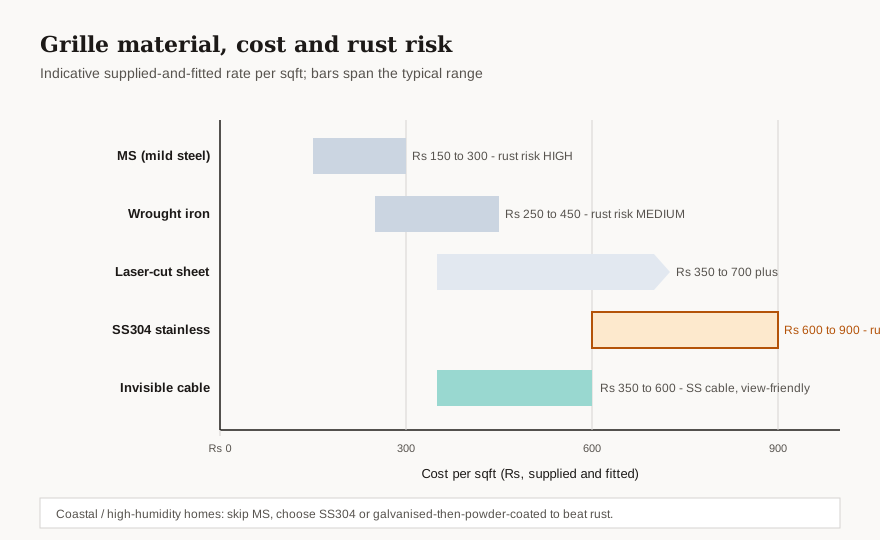
| Material | Indicative cost (per sqft) | Strength | Rust risk | Best for |
|---|---|---|---|---|
| Mild steel (MS) | Rs 150-300 | Good | High if unpainted | Budget, painted designs, most homes |
| Wrought iron | Rs 250-450 | Good, ductile | Moderate | Ornate floral and scroll work |
| Stainless steel SS304 | Rs 600-900 | Excellent | Very low | Coastal, low-maintenance, premium |
| Laser-cut MS / steel sheet | Rs 350-700+ | Pattern-dependent | Needs powder-coat | Crisp jali-inspired panels |
| Invisible SS cable | Rs 250-500 per running ft (system) | High-tensile | Very low | High-rise, view-critical openings |
A few rules of thumb. MS is the workhorse — strong and cheap, but it will rust if the coating fails, so it must be primed and either enamel-painted or powder-coated, never left raw. Wrought iron is softer and more ductile, which is exactly why a craftsman can bend it into vines; it costs a little more and still needs coating. SS304 is the premium, near-maintenance-free choice and the right call within a few kilometres of the sea, where MS grilles can streak with rust in a single monsoon. Laser-cut lets you reproduce intricate jali or floral repeats perfectly across many panels, but the price climbs with pattern density and it still needs powder-coating. General install adds roughly Rs 200 per sqft on top of fabrication for site fixing.
Finishes and the dual-tone trend
Finish is where a cheap grille starts to look designed. Powder-coating is the durable workhorse: an oven-cured polyester coat that resists chipping and fading far better than brush enamel, available in matte black, charcoal, bronze and bespoke RAL colours. For a richer look, dual-tone grilles are the current trend:
- Matte black plus brass — black bar field with brass-finish accent verticals or a brass border. Reads luxe against white walls.
- White plus rose gold — soft, contemporary, popular in apartments and child rooms.
- Charcoal plus champagne / antique gold — quieter than brass, good for muted palettes.
Keep the accent metal to roughly a fifth of the design; dual-tone reads as a deliberate detail, not a clash, when the second tone is the minority.
The invisible grille — views without bars
For high-rise apartments where a conventional grille would wreck the city view, invisible grilles use thin (about 2-3 mm) high-tensile stainless-steel cables strung vertically or in a fine grid through an aluminium track top and bottom. From inside they nearly vanish; from a few metres away they read as a faint screen.
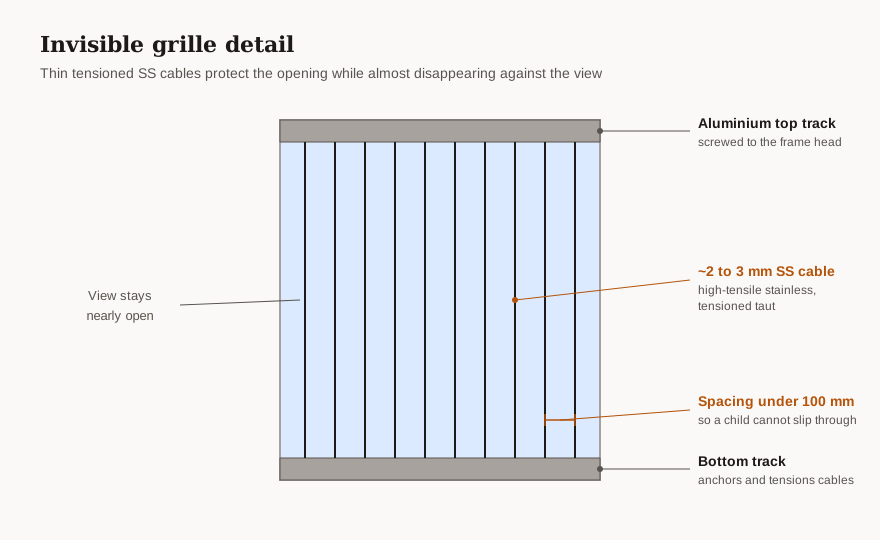
They are popular and effective for fall-prevention and pet safety, and they preserve egress better than welded bars. Two cautions: cable spacing must still meet child-safety limits (see below), and against a determined intruder a cable system is less of a deterrent than welded steel — so reserve them for upper floors where the threat is falls, not break-ins, and keep welded SS or MS grilles on ground and first floors.
Safety — the non-negotiables
A grille that fails its safety job is a decoration, not a guard. Three numbers and one rule matter.
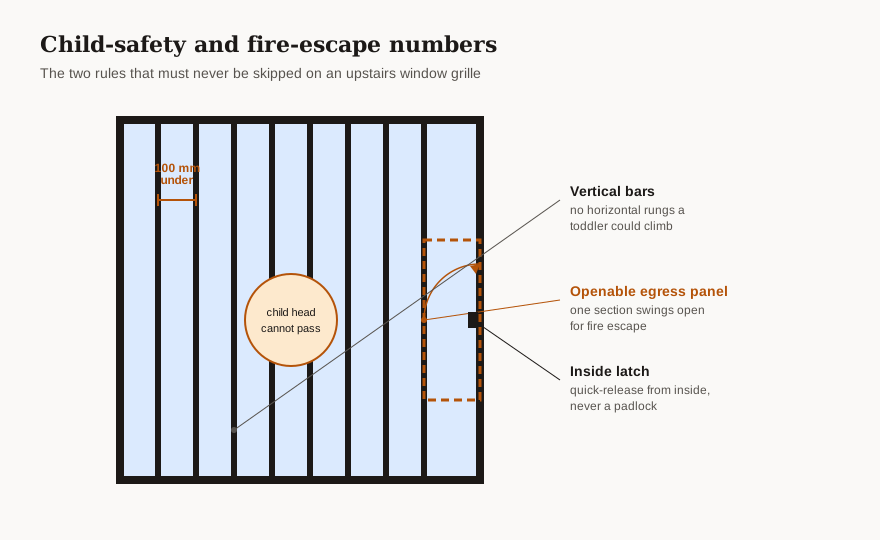
| Requirement | Specification | Why |
|---|---|---|
| Child-safety bar gap | Keep clear spacing under ~100 mm (a child's head must not pass) | Prevents head-entrapment and falls |
| Vertical bars preferred | Use vertical, not horizontal, bars in child areas | Horizontal bars become a climbable ladder |
| Egress / fire escape | At least one openable grille per room (hinged panel with an inside latch, no padlock needed from within) | Lets you exit in a fire; a fully welded grille can trap you |
| Anti-rust | Prime plus powder-coat or enamel; inspect joints yearly | A rusted weld is a failed barrier |
The egress point is the one most homeowners skip and the one fire services repeatedly flag: a welded, padlocked grille across the only window of a bedroom has killed people in Indian apartment fires. Specify at least one hinged, quick-release grille panel per habitable room, openable from inside without a key.
Maintenance by material
- MS and wrought iron: wipe dust monthly; inspect for rust spots and chipped coating twice a year; touch up bare metal immediately. Re-coat every few years, sooner near the coast.
- SS304: wipe with a damp cloth; avoid steel-wool which scratches the passive layer. Minimal upkeep.
- Invisible cable: check cable tension and track fixings annually; clean with mild soapy water.
Match the grille to the home
| Home style | Grille move |
|---|---|
| Modern / minimal | Geometric grid or horizontal lines, matte black, slimmest bars |
| Contemporary Indian | Jali-inspired laser-cut panel; see our contemporary Indian window designs |
| Heritage / bungalow | Hand-forged floral wrought iron, dark bronze |
| High-rise apartment | Invisible cable on upper floors; welded SS lower down |
| Coastal villa | SS304 in curved or geometric pattern, salt-proof |
For the wider styling logic of frames, glazing and proportion that the grille sits inside, start from the modern window design ideas pillar, and use types of home windows to choose the operable window the grille will guard. A grille is the last layer you add — but if you choose its pattern, metal and finish with the same care you gave the window, it stops being a cage and becomes the frame your view deserves.
References
- Bureau of Indian Standards (window and metalwork standards index): https://www.bis.gov.in/
- National Building Code of India overview (BIS): https://www.bis.gov.in/standards/technical-department/national-building-code/
- INTACH (heritage metalwork and craft conservation): https://www.intach.org/
Export this guide
Related Guides — Deep-dive reading
Minimalist Window Designs for Indian Homes
The slimline, near-frameless look — hidden frames, single large panes, no grids, monochrome detail, and how to get it without the heat and cleaning traps.
Windows & GlazingGate Finishes and Rust Prevention in India: Paint, Powder Coat and Galvanising (2026)
A plain, India-grounded guide to keeping a steel gate looking good and not rusting — the protection system in layers (surface prep, primer, topcoat), site enamel and PU paint vs factory powder coating vs hot-dip galvanising compared on durability, cost and best-fit, where gates rust first, coastal and monsoon care, and the maintenance cycle that makes any finish last.
Compound WallsAluminium Window Maintenance
How to clean, lubricate and protect aluminium windows in India — track care, hinge servicing, finish care and the coastal salt rinse
Windows & GlazingRelated Tools — Try Free
Window Grill Design Selector
Pick a window grille style and material by priority — security, looks, budget, view — and estimate cost.
Window ToolWindow Maintenance Cost Calculator
Estimate annual window upkeep by frame material — yearly, per-window and 5-year cost.
Window CalculatorCross-Ventilation Analyzer
Estimate airflow and air changes per hour (ACH) from room size, window areas, layout, and local wind — with NBC 2016 Part 8 compliance check.
Ventilation Calculator